 CYNDRA
You usually find out a competitor changed something important at the worst possible moment. A prospect says another vendor just cut pricing. Your sales team notices a new feature screenshot in a deal thread. Customer success hears that a rival is pushing a migration campaign into your installed base.
The problem usually isn't lack of effort. It's that teams still treat competitor tracking like research instead of operations. They save a few pages, subscribe to a few alerts, maybe review a spreadsheet once a quarter, then wonder why real moves still slip through.
That's why learning how to monitor competitor activity now has less to do with collecting more alerts and more to do with building a system your team uses. The strongest setups are continuous, measurable, and tied to decisions. They tell sales what changed, tell product what to validate, and tell leadership what needs a response this week.
Table of Contents
- Why Most Competitor Monitoring Fails Before It Starts
- Define Your Goals Competitive Set and KPIs
- Signals That Actually Predict Competitor Moves
- Tools and Automations That Keep Monitoring Running
- Turn Alerts Into Action Inside Your Revenue Workflow
- Keep Your System Lean Accurate and Actionable
Why Most Competitor Monitoring Fails Before It Starts
A familiar failure pattern looks like this. Someone on the team says, “We should watch competitors more closely.” A shared document appears. A few people add links to pricing pages, blogs, and social profiles. Alerts start coming in. Nobody decides what matters, who owns review, or what should happen when a signal shows up.
Within a month, the system becomes background noise.
A lot has changed in how teams run competitive intelligence. A 2023 industry report found a 125% increase since 2018 in the share of CI programs that use KPIs, which shows how much competitor monitoring has shifted toward measurable tracking instead of informal observation, according to Crayon's State of Competitive Intelligence research. That same source notes a wide source set for modern monitoring, including news, company websites, earnings calls, regulatory filings, and trade publications. That breadth matters because major competitor moves rarely show up in only one place.
Alerts fail when nobody defines the job
The teams that miss competitor moves are often watching plenty of channels. They're just watching without a decision model.
If pricing changes are mission critical, your monitoring should feed sales talk tracks, renewal strategy, and account risk review. If product launches matter most, your monitoring should support roadmap validation, objection handling, and launch response. If your system can't connect a detected change to a next action, you haven't built monitoring. You've built a feed.
Practical rule: If an alert doesn't have an owner, a response path, and a reason it matters, it shouldn't exist.
Lean teams need a smaller, sharper operating model. That's why I prefer setups that establish a baseline first, then look for meaningful change against that baseline. If you want an example of that mindset in practice, the Sift AI CI program is useful because it treats competitor monitoring as an ongoing workflow rather than a pile of disconnected checks.
Quarterly audits are too slow
A quarterly benchmark still has value. It helps you compare positioning, pricing architecture, packaging, proof points, and product depth across a set of rivals.
But quarterly work won't catch the smaller moves that shape pipeline before leadership notices. A revised pricing page, a cluster of job postings, a new landing page for enterprise buyers, or repeated review-site complaints can all signal a directional shift early. By the time those signals show up in a quarterly deck, sales has already felt the impact.
The good system doesn't feel academic day to day. It feels operational. The team knows what's being watched, what counts as a material change, where updates land, and who has to act.
Define Your Goals Competitive Set and KPIs
Most monitoring programs get bloated before they become useful. Teams start with a practical question, then expand the project until they're tracking half the market and reporting on things nobody can act on.
That's fixable if you choose the decision first.
Start with decisions, not dashboards
Before you pick tools, decide which actions your monitoring should improve. Good examples include:
- Pricing response: You need fast notice when a competitor changes packages, discounts, or plan structure.
- Messaging correction: You want to see when a rival moves upmarket, targets a new segment, or shifts its category language.
- Feature prioritization: You need a cleaner read on launches, release cadence, and product bets.
- Account defense: You want customer success and sales to spot competitor pressure inside active deals or renewals.
Independent guidance on competitor benchmarking recommends treating this as a recurring workflow: define the scope, gather and analyze, then translate findings into action. It also advises keeping the set to three to five competitors, including at least one direct rival, one aspirational leader, and one adjacent competitor, and selecting 10 to 15 metrics across financial, product, marketing, operations, customer, and digital categories, as outlined in Elevated Signal's competitor benchmarking guide.
That structure keeps your monitoring useful. It prevents the common drift where every interesting datapoint gets added, even when it has no clear downstream use.
Choose a tight competitive set
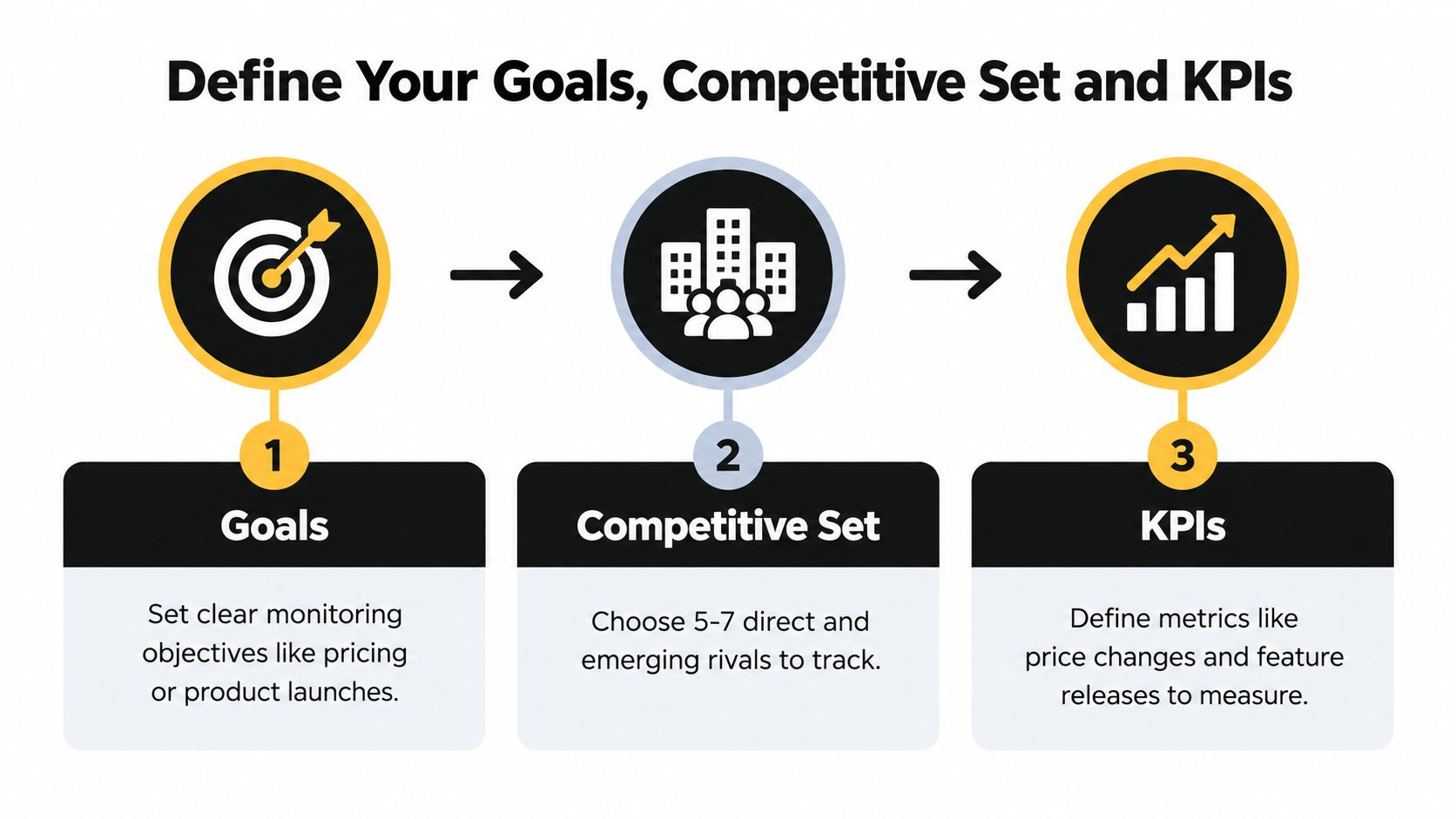
A small set beats a broad set if your goal is action. For most operators, the right mix looks like this:
Direct competitor
The vendor you lose to most often, or the one your buyers compare you against most often.Aspirational competitor
The company that's winning in the segment, geography, or price tier you want to grow into.Adjacent competitor
The player from a nearby category who could reposition into your lane or change buyer expectations.
Sometimes a fourth or fifth belongs on the list. Usually that happens when a new entrant is moving fast or a legacy incumbent still shapes enterprise buying criteria.
A broad list feels safer, but it introduces noise. It's harder to maintain source coverage, harder to compare changes against a baseline, and harder to brief internal teams on what matters.
Pick KPIs your team can act on
Your KPI set should tell you whether a change needs a response. It shouldn't just describe a competitor in more detail.
Useful KPI categories include:
- Product indicators such as new feature pages, revised capabilities, release-note patterns, and integration changes
- Commercial indicators like pricing-page edits, plan packaging changes, promo language, and comparison-page updates
- Go-to-market indicators including homepage messaging, segment-specific landing pages, campaign themes, and ad creative shifts
- Operational indicators such as hiring concentration, leadership hires, expansion pages, partner announcements, and support model changes
For teams building this from scratch, Cyndra's guide to competitive intelligence gathering is a practical reference because it forces the discipline many skip: deciding what intelligence is for before collecting more of it.
Benchmarking works when the question is narrow enough to answer and important enough to change a decision.
If a metric doesn't influence pricing, positioning, roadmap, pipeline strategy, or account defense, cut it.
Signals That Actually Predict Competitor Moves
Too many weak signals and too few predictive ones are watched. They'll monitor every social post but ignore release notes. They'll obsess over homepage copy but never baseline job openings by function. They'll react to chatter without validating whether anything material changed.
The fix is to rank signals by actionability, confidence, and update behavior.
Start with the high-yield pages
Some sources consistently reveal more than others. If I had to build a lean watchlist, I'd begin with pages and records that show operational movement, not just marketing output.
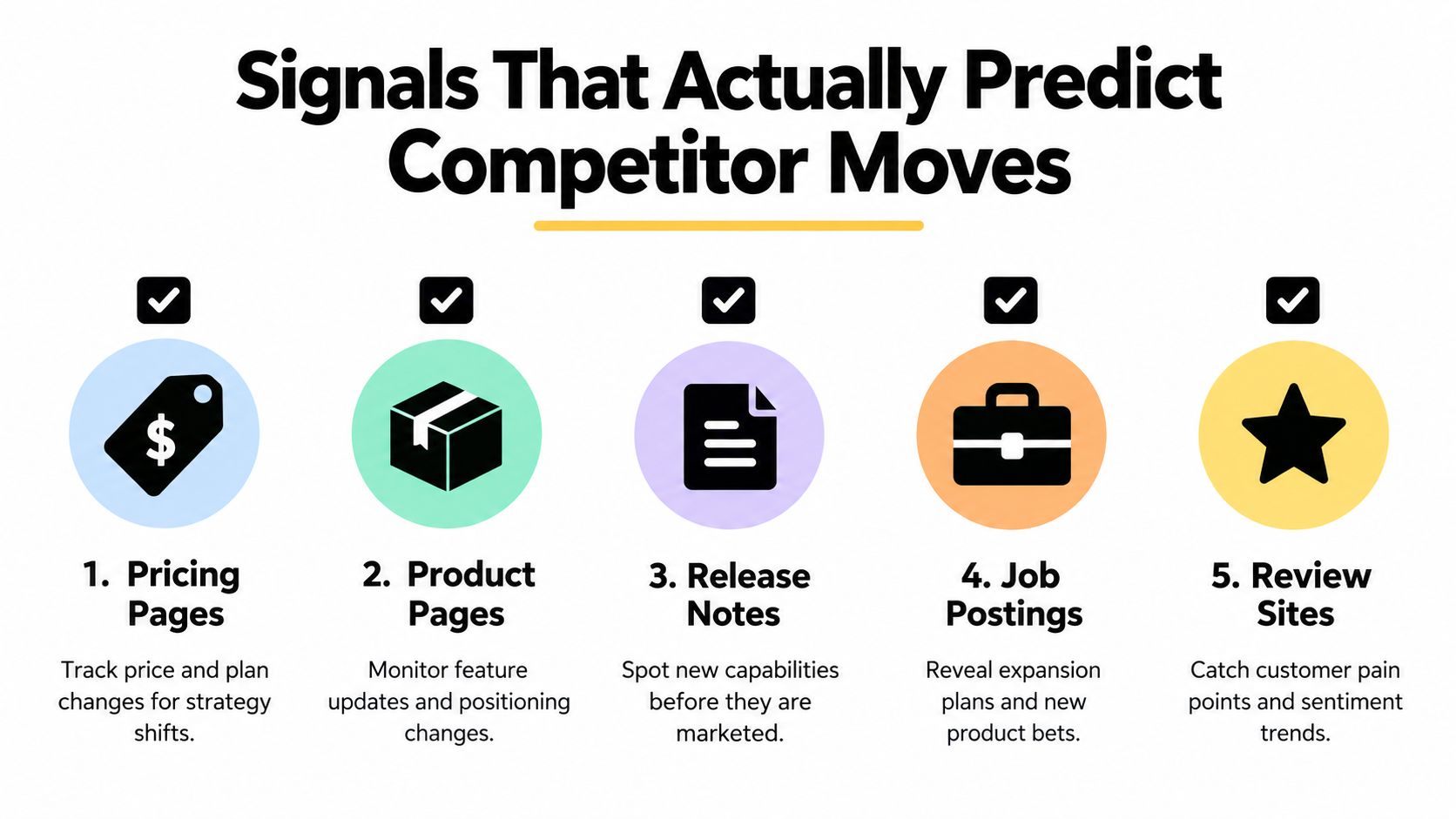
A competitive-intelligence source points to pricing pages as a particularly strong source, noting that 7,700+ users monitor them and 43% detect changes monthly, which makes them one of the most actionable recurring watchlist targets in Visualping's review of competitive intelligence sources.
The pages I'd prioritize first are:
- Pricing pages because changes here often connect directly to deal strategy, margin pressure, packaging, and sales objections.
- Product pages because they show how the company wants buyers to understand capability, use cases, and differentiation.
- Release notes because they often reveal launches before the marketing team amplifies them broadly.
- Job postings because hiring patterns can expose expansion, product bets, enterprise push, or AI investment before launches happen.
- Regulatory filings when relevant, because they tend to surface material changes with less spin.
Weight signals by confidence, not excitement
Not every signal deserves the same response speed.
A useful model is to score each input on three dimensions:
| Signal Type | Confidence | Typical Use |
|---|---|---|
| Pricing-page edit | High | Sales guidance, package review, renewal defense |
| New release note | High | Product validation, updated battlecards |
| Job cluster in one function | Medium | Directional bet, hiring hypothesis |
| New ad angle | Medium | Messaging shift, campaign testing |
| Review-site complaints | Medium to high | Objection handling, competitor weakness tracking |
| Web traffic estimate | Low to medium | Trend context, not decision trigger |
| App-store telemetry or shipping records | Variable | Secondary confirmation, not primary trigger |
This matters even more now because monitoring is broadening beyond classic pricing and product tracking. Recent industry coverage says alternative data such as job postings, app-store telemetry, hiring signals, web traffic estimates, patent filings, and shipping records has become mainstream in competitor models, while tools are moving toward real-time data, AI-assisted analysis, and system integration, as discussed in Segment8's 2026 competitive intelligence overview.
That doesn't mean every alternative signal is useful on its own. Many are proxies. Proxies can help, but they need validation.
Don't escalate because a signal is interesting. Escalate because it changes the probability that a competitor is taking a concrete action.
Validate before you react
The cleanest habit here is simple: no single low-confidence signal should trigger a major response.
Instead, validate through combinations such as:
- Hiring plus messaging shift: Enterprise account executive roles plus new enterprise landing pages
- Release notes plus product page edits: Launch appears in changelog, then gets folded into positioning
- Pricing edit plus ad copy: Page changes, then paid acquisition starts using new offer language
- Review complaints plus support or documentation changes: Repeated friction points followed by reactive updates
If you want a practical workflow for one of the highest-value categories, competitor price intelligence is worth treating separately from general CI. A focused setup like competitor price tracking becomes useful because price changes are concrete, frequent enough to matter, and directly tied to revenue decisions.
Tools and Automations That Keep Monitoring Running
Manual checking breaks first on consistency. Someone gets busy, a review meeting slips, and the whole program turns stale.
That's why the question isn't which single tool to buy. It's how to build a stack that keeps collecting, filtering, and routing signals without constant babysitting.
Match the tool to the job
Different monitoring categories solve different problems. Teams get into trouble when they expect one platform to cover every source well.
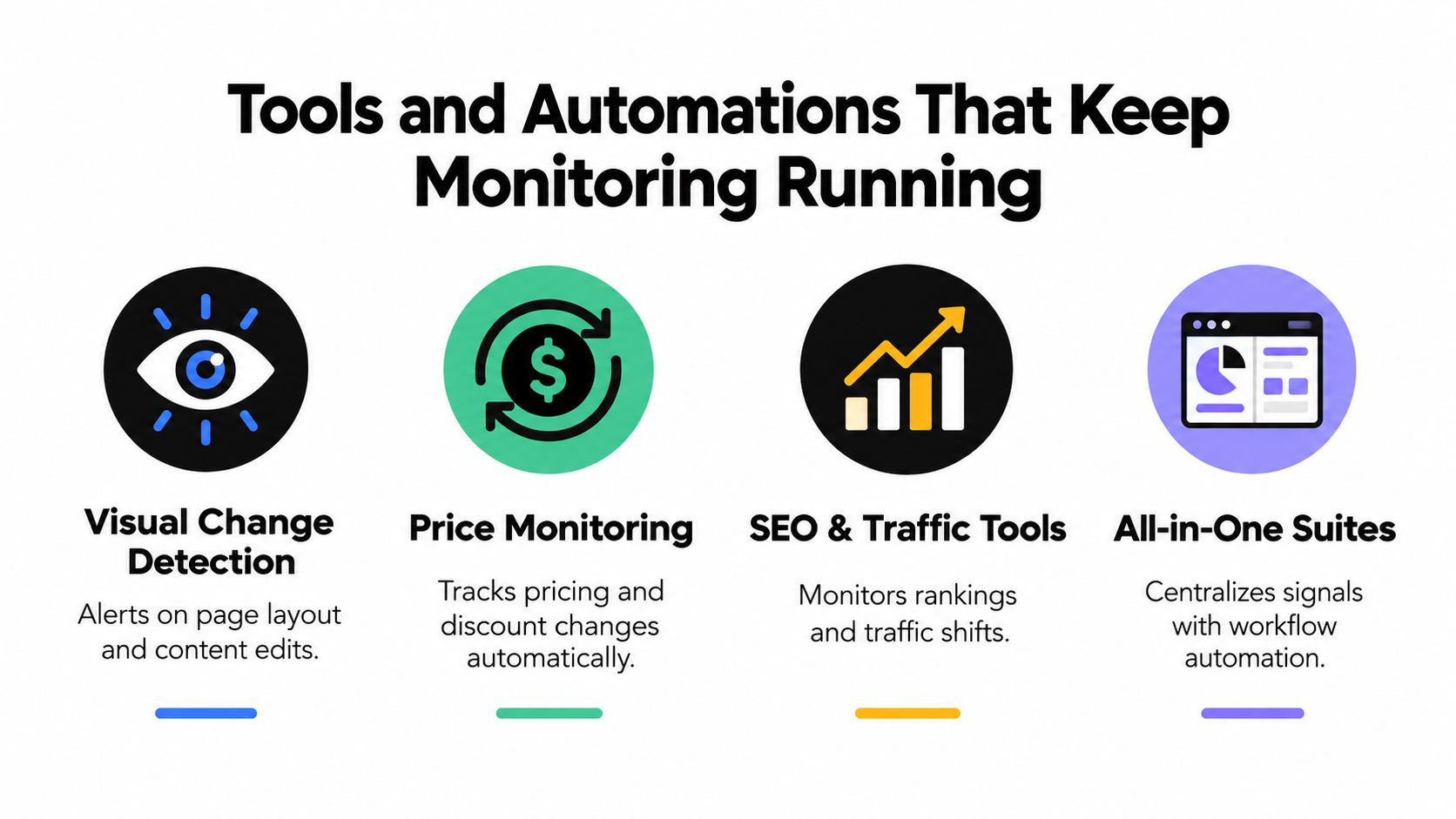
Here's a practical way to think about the stack:
| Tool Category | Best For | Automation Level | Watch Out For |
|---|---|---|---|
| Visual change detection | Pricing pages, product pages, legal pages, key landing pages | High | Too many cosmetic alerts if page regions aren't configured carefully |
| Price monitoring tools | Structured tracking of package, discount, and offer changes | High | Can miss context if used without messaging review |
| SEO and traffic tools | Share-of-voice trends, new pages, keyword movement | Medium | Easy to overinterpret noisy directional estimates |
| All-in-one CI suites | Centralizing sources, summarization, and team distribution | Medium to high | Can encourage broad collection without clear response workflows |
| Custom AI agents | Cross-source monitoring, classification, summarization, routing into internal systems | Variable | Needs good prompts, baselines, and human review rules |
A 2026 industry overview describes modern competitor-analysis tools as systems that continuously monitor rivals across news, company websites, earnings calls, regulatory filings, and trade publications, which matches what operators need from an always-on setup. A separate market report estimates the global competitor-monitoring-tool market at USD 1.2 billion in 2024 and projects USD 3.5 billion by 2033, implying a 12.5% CAGR from 2026 to 2033. A related report on competitor price monitoring estimates USD 2.8 billion in 2025 and projects USD 7.4 billion by 2033, with North America accounting for 38.5% of revenue and software holding 68.3% share, according to Verified Market Reports on competitor monitoring tools. The takeaway isn't just that the category is growing. It's that companies are putting real budget behind systematic monitoring, especially around pricing and positioning.
Build a source mix, not a single feed
The easiest way to miss competitor movement is to rely on one source type.
Use web monitoring for site changes. Layer in filing and publication review where relevant. Track hiring and review sites for context. Watch paid messaging when go-to-market shifts matter. For ad analysis, a practical reference point is Google Ads MCP tools, which shows the kind of structured access and workflow support teams often need when they want campaign changes to feed into broader monitoring instead of living in a separate ad-analysis process.
If you want one system to combine monitoring with internal routing, Cyndra is one option for building AI employees that track competitor websites, pricing pages, press releases, job postings, and related sources, then summarize changes into dashboards or team workflows. That works best when the monitoring logic is already defined. Automation amplifies clarity. It does not replace it.
Filter noise before it hits humans
The best automations don't just collect. They suppress.
Use rules like these:
- Ignore cosmetic edits unless price, plan names, feature lists, proof points, or CTA structure changed
- Group related changes into one event when several pages update around the same theme
- Escalate only repeated signals for medium-confidence sources like hiring bursts or paid messaging changes
- Route by function so product sees product motion, sales sees commercial shifts, and leadership sees market-level implications
That's how you keep the system alive after the novelty wears off.
Turn Alerts Into Action Inside Your Revenue Workflow
Most competitor monitoring fails at the handoff. A useful signal gets detected, summarized in a dashboard, maybe dropped in Slack, then disappears. Sales doesn't use it in active deals. Customer success doesn't use it in renewals. Leadership remembers it a week later, after the timing advantage is gone.
That's the gap worth fixing.
A 2025 industry report says less than a third of competitive intelligence programs engage with sales daily or weekly, and 44% of companies lack competitor visibility inside their CRM, according to Crayon's 2025 State of Competitive Intelligence report. That tells you the problem isn't access to data. It's distribution into frontline systems.
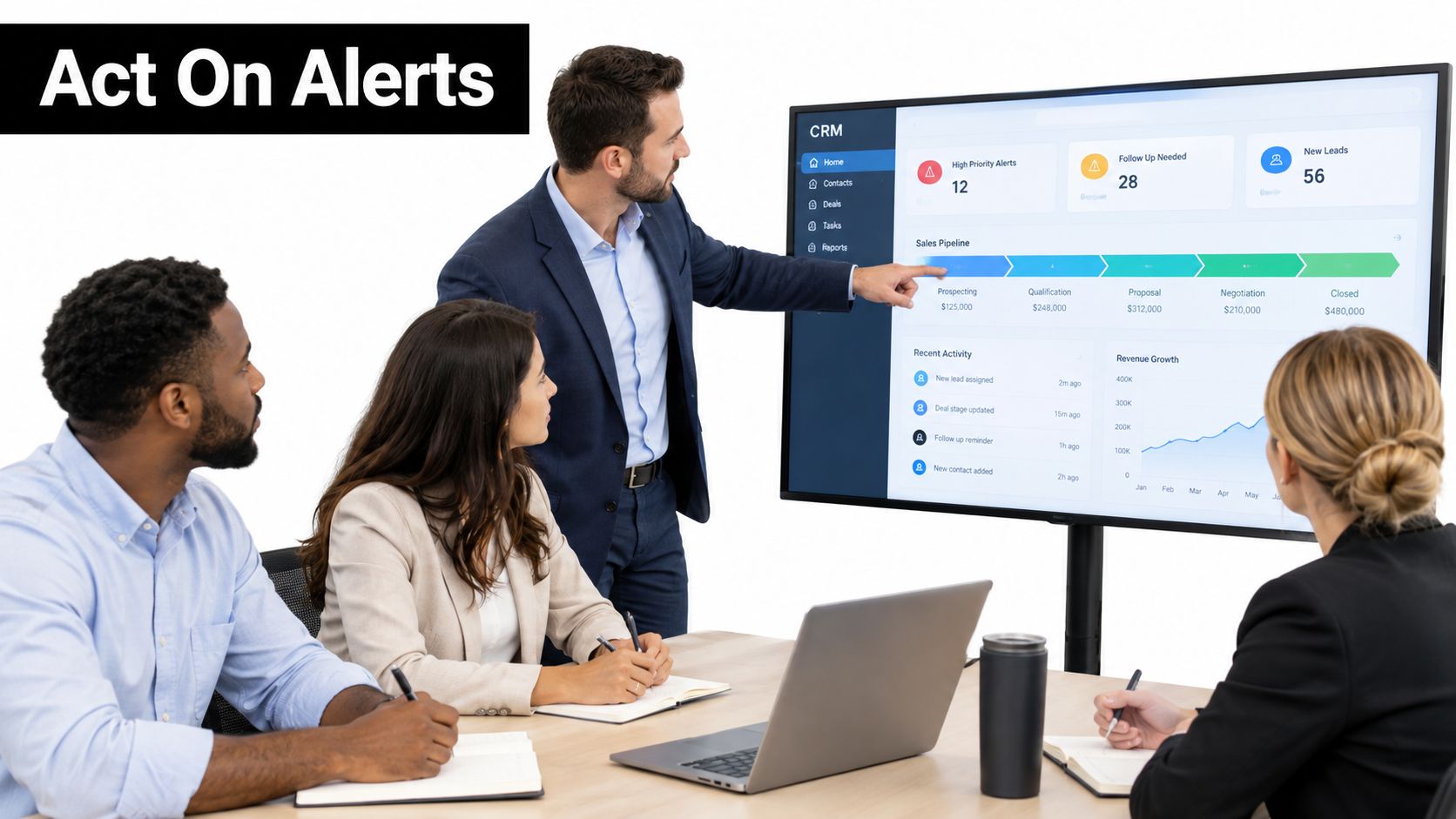
Route competitor signals to accounts and deals
A competitor alert becomes valuable when it lands in the context of a real account.
If a rival changes pricing, that signal should attach to open deals where that competitor is mentioned, to renewal accounts at risk, or to segments where price sensitivity is already known. If a rival launches a feature, product marketing should update the battlecard, but account teams also need a concise note on where the launch matters and where it doesn't.
A workable routing model looks like this:
- CRM record updates: Tag relevant opportunities and accounts when a monitored competitor makes a material move
- Deal-stage triggers: Surface competitor notes when a deal enters evaluation, procurement, or renewal risk
- Battlecard sync: Push validated changes into sales enablement assets, not just analyst notes
- Customer-success flags: Notify retention owners when competitor campaigns target migration or replacement
Create a weekly operating rhythm
This work needs cadence or it drifts.
A simple rhythm is often enough:
Daily collection
Tools and automations watch the source set continuously.Midweek triage
One owner reviews flagged changes, validates high-confidence signals, and assigns relevance.Weekly revenue review
Sales, success, product marketing, and leadership review only material changes. Each item gets a decision: ignore, monitor, update messaging, revise pricing guidance, change account strategy, or escalate.Asset refresh
Battlecards, dashboards, objection docs, and account notes get updated right after the review.
Operator note: More alerts usually create less advantage if nobody maps them to live accounts, deal stages, or retention actions.
That's where dashboard design matters. A clean competitor operations dashboard should merge source changes with internal context from CRM, finance, ad platforms, and commerce systems. If you're building that layer, dashboard automation is the right design problem to solve, because value comes from connecting market motion to operational decisions your team already makes.
Use AI to shorten the path from signal to behavior
AI is useful here, but not in the vague “summarize the market” sense.
It helps most when it does narrow jobs well:
- Classifies a change by type
- Compares it against a baseline
- Scores confidence
- Drafts a short implication by team
- Routes the update into CRM, Slack, or a review queue
- Suggests which battlecard or account plan needs revision
That's how competitor monitoring becomes part of revenue operations instead of a side project run by one person with a spreadsheet and too many tabs.
Keep Your System Lean Accurate and Actionable
A good monitoring system gets lighter over time, not heavier. The team learns which signals predict movement, which pages generate junk alerts, and which metrics never change decisions.
If your system keeps growing, it usually means nobody is pruning it.
Keep the operating rules strict
Review your program like any other operating process:
- Validate source quality: If a source creates frequent false positives or stale data, downgrade it or remove it.
- Tune thresholds: Cosmetic edits shouldn't page humans. Repeated or high-confidence changes should.
- Retire dead metrics: If a KPI hasn't influenced a pricing, product, messaging, or account decision in a meaningful period, cut it.
- Refresh baselines: Product pages, plan structures, and category language drift. Your baseline has to reflect the current state.
- Update battlecards quickly: A stale battlecard is often worse than no battlecard because the team trusts it.
Watch for three failure modes
The first is alert sprawl. Too many notifications train people to ignore all of them.
The second is single-source confidence. If one weak proxy drives a strong reaction, you'll waste cycles chasing noise.
The third is analysis without ownership. Monitoring only matters when someone is responsible for the response.
Keep the system honest by asking one question in every review: what changed because we knew this in time?
That's the standard. Not whether the dashboard looks complete. Not whether the alert volume is high. Whether the intelligence changed behavior while there was still time to benefit from it.
Teams that treat competitor monitoring as market-motion detection tend to make better decisions with less drama. They don't try to track everything. They track what they can validate, route, and use.
Cyndra helps operators turn competitor monitoring into a working system, not another dashboard that nobody opens. If you need AI employees that watch competitors, route signals into your workflows, and help your team act on them inside days instead of months, visit Cyndra.