 CYNDRA
Your finance team probably knows this drill. Sales closes business faster than finance can operationalize it. Orders come in from a CRM, a self-serve portal, EDI, and email. Someone rekeys data into the ERP. Invoices go out late because fulfillment status is sitting in another system. Cash arrives, but remittance data is messy, so AR parks it in unapplied cash until someone figures it out.
That isn't a tooling problem first. It's an operating model problem.
Order-to-cash automation matters because it determines how quickly revenue turns into usable cash. If you're still treating it as a back-office efficiency project, you're missing the issue. O2C defines how your company captures orders, enforces credit policy, issues compliant invoices, receives payment, applies cash, and resolves disputes without finance acting as human middleware.
The mistake I see most often is companies buying automation to cut clerical work, then discovering blockers are stale customer master data, exception-heavy workflows, and disconnected systems. The better approach is to redesign the path from order to cash receipt so the routine work becomes touchless and the messy work becomes controlled.
Table of Contents
- Why Order-to-Cash Automation Matters Now
- The End-to-End O2C Cycle Explained
- KPIs That Prove Automation Is Working
- Core Architecture and System Integrations
- Where O2C Automation Actually Breaks
- A 90-Day Implementation Roadmap
- A Real-World O2C Automation Case Study
- The 2026 O2C Operating Model and Next Steps
Why Order-to-Cash Automation Matters Now
Mid-market teams usually wait too long. They tolerate manual order entry, fragmented billing, and reactive collections because the process still sort of works. Then volume grows, a new region launches, payment methods expand, and the cracks turn into delays in cash, reporting, and customer communication.
That timing matters more now than it did a few years ago. One industry analysis summarized by Workato said order-to-cash was the most automated finance process, representing 57% of finance-function automations, even after being 73% the year before, which suggests automation is spreading broadly while O2C remains a core use case (Workato finance automation statistics). The same summary noted that only 13% of companies believed they had reached high levels of automation in invoice-to-cash workflows, up from 6% two years earlier, while 57% reported medium-to-high automation, up from 50%. In plain English, adoption is real, but most organizations still aren't close to a clean end state.
The pressure isn't only internal
Three forces are changing the urgency.
- Mandatory e-invoicing is spreading: Market research cited by Mordor Intelligence says e-invoicing rules are active in more than 80 jurisdictions, which means invoice structure, clearance, and delivery requirements are becoming a real design constraint, not an afterthought (accounts receivable automation market analysis).
- Payments are speeding up: Real-time rails expose reconciliation weaknesses that slower settlement used to hide.
- Working capital is tighter: Slow AR isn't just annoying. It directly limits hiring, inventory, and operating flexibility.
If you're trying to understand the broader shift beyond AR alone, this overview of banking automation for efficiency is useful context. Finance operations across the stack are moving toward faster, more connected, API-driven workflows. O2C is part of that same redesign.
Practical rule: If cash posting still depends on inbox triage and spreadsheet cleanup, you do not have an O2C process. You have a labor-intensive workaround.
What to optimize for
The goal isn't "more automation." The goal is shorter time from clean order to applied cash.
That requires a decision: will your company keep adding people to absorb transaction growth, or will it standardize the revenue workflow so systems handle the routine path and humans handle the exceptions? The companies that get this right don't just automate tasks. They define how cash is supposed to enter the business, then wire systems around that path.
The End-to-End O2C Cycle Explained
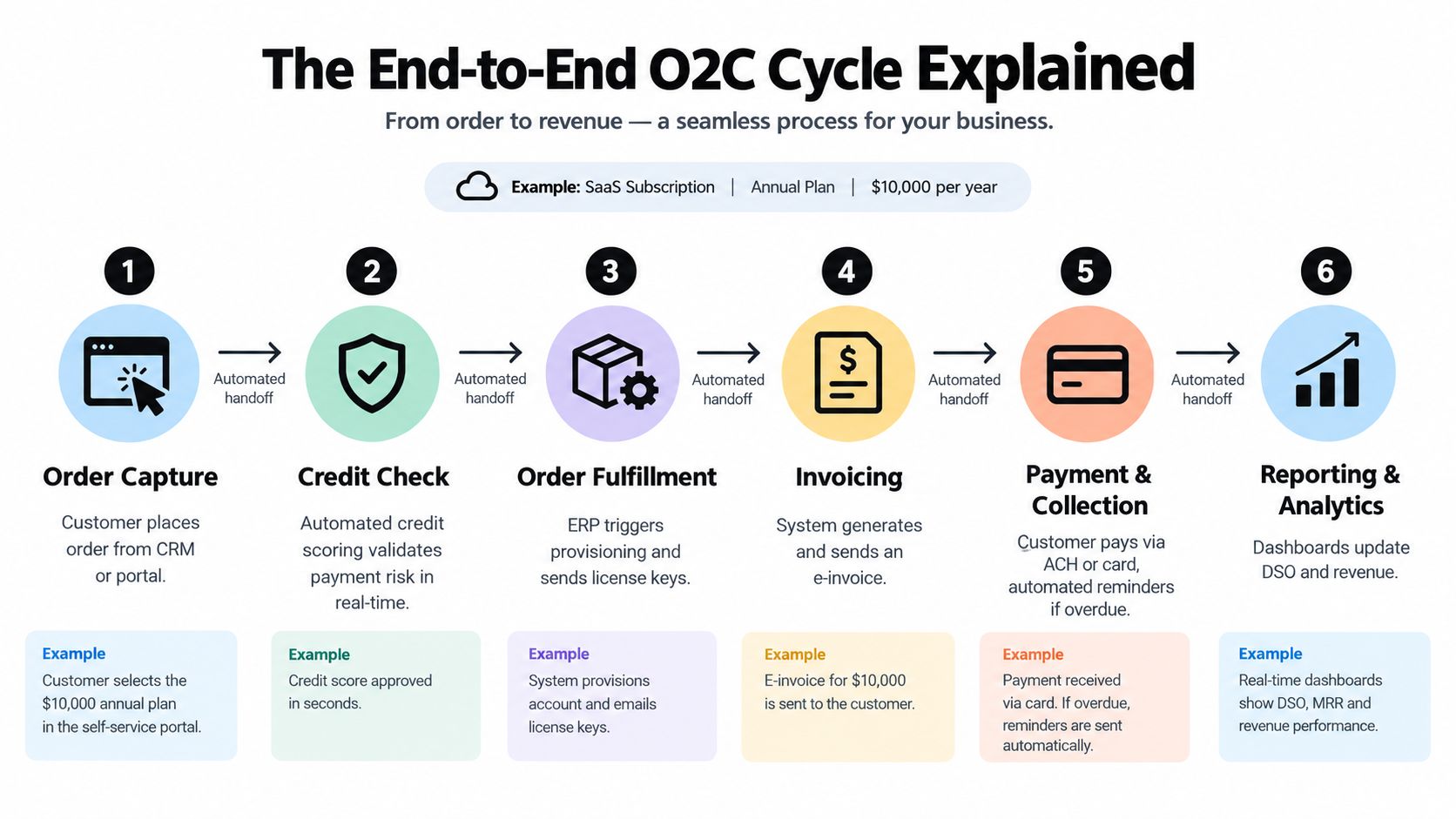
Use one simple example. A customer buys a $10,000 annual SaaS subscription through your sales team or self-serve portal. That sounds straightforward. It usually isn't.
Where the cycle starts
The process begins with order capture. In a typical stack, Salesforce or HubSpot holds customer details, pricing, and commercial terms. A portal might capture payment method and billing contact. If that data reaches the ERP cleanly, everything downstream gets easier. If finance has to fix customer names, entities, tax details, or payment terms after the fact, the clock has already started slipping.
Then comes credit check. For a SaaS business selling annual contracts, this might mean validating terms, internal limits, or risk flags before provisioning. In mature setups, the ERP or adjacent credit workflow checks that automatically.
The middle is where latency multiplies
After approval, order fulfillment happens. In SaaS, that means provisioning licenses, access, or account activation. In product businesses, it's shipment confirmation. The point is the same. A fulfillment event should trigger the billing event.
Next is invoice generation and delivery. Many teams still lose days for no good reason. The invoice should be generated from system data, sent electronically, and logged against the customer record. If your team still builds invoices manually or sends PDFs outside the system, you're creating future disputes.
For operators building stronger AR fundamentals, this guide to accounts receivable for SMBs is a helpful complement because it frames collections and receivables control as operating discipline, not just bookkeeping.
The money part isn't the end
Then the customer pays through ACH, card, bank transfer, or another rail. Payment receipt is not the finish line. Cash application is. The payment has to be matched to the open receivable and posted correctly in the ledger.
Finally, reporting updates the cash position, aging, and collections view. That's the point where leadership should see what happened without waiting for someone in AR to explain three exceptions sitting in email.
Touchless processing is the real target. Not because humans are bad at the work, but because human handoffs create delay, inconsistency, and audit gaps.
Front office versus back office
The clean boundary is this:
- Front office activities: quote, order capture, pricing confirmation, customer acceptance
- Back office activities: invoicing, payment collection, cash application, collections, dispute resolution
That boundary matters because bad front-office data always becomes a back-office problem. If the CRM sends bad billing attributes into NetSuite, SAP S/4HANA, Oracle Fusion, or Microsoft Dynamics 365, AR inherits the mess. Good automation tightens every handoff so the transaction can move without rekeying, chasing, or manual interpretation.
KPIs That Prove Automation Is Working
Tracking too many dashboards and too few useful signals is common. If you want to know whether order-to-cash automation is improving operations, watch the metrics that expose handoff quality, posting speed, and collection outcomes.
APQC's O2C benchmark framework is a good anchor because it treats O2C as an end-to-end control system and focuses on measures like cycle time from invoice transmission to payment receipt, total cost per process FTE, FTEs per $1B revenue, and deduction value per FTE. APQC also calls out consistent enterprise data and centralized remittance capture as prerequisites for higher straight-through processing (APQC order-to-cash performance assessment).
Leading indicators first
Don't wait for DSO alone to tell you something's broken. By the time DSO moves, the process problem has already been in production for a while.
| O2C Automation KPIs and Benchmarks | Formula | Target Benchmark | What Movement Signals |
|---|---|---|---|
| DSO | Accounts receivable divided by average daily credit sales | Lower over time for the same business mix | Collections, invoicing speed, and dispute handling are improving or deteriorating |
| Invoice touchless rate | Invoices processed without human intervention divided by total invoices | Higher over time | Upstream order data and billing rules are getting cleaner |
| Cost per invoice processed | Total invoicing and AR processing cost divided by invoice volume | Lower over time | Manual effort, rework, and exception load are falling |
| Cash application match rate | Payments automatically matched divided by total payments received | AI-assisted matching can reach 85% to 92%, while rules-only systems tend to sit at 45% to 55% according to benchmark data on AR automation (AI cash application automation statistics 2026) | Remittance quality, matching logic, and customer payment behavior are becoming easier to reconcile |
| Order-to-cash cycle time | Time from order acceptance to applied cash | Shorter over time | The whole system is moving faster, not just one task inside it |
What good measurement looks like
I group these into two buckets:
- Leading indicators: touchless invoice rate, cash application match rate
- Lagging indicators: DSO, cost, working capital, total cycle time
That's important during rollout. If touchless rate improves but DSO doesn't, your collections or dispute process is still weak. If DSO improves but match rate stays ugly, AR is probably cleaning things up manually behind the scenes.
A useful finance dashboard should make those relationships obvious. If you need a practical reference for structuring that view, this primer on what a KPI dashboard should include is worth reviewing.
Watch the metrics that move before cash outcomes do. That's where you catch implementation mistakes early.
Core Architecture and System Integrations
A workable O2C stack isn't one platform. It's a chain of systems that each own part of the transaction. The job is to make data move cleanly between them so orders, invoices, payments, and ledger entries stay aligned.
What each system should do
The ERP is the center of gravity. In most growth-stage and enterprise setups, that's SAP S/4HANA, Oracle Fusion, NetSuite, or Microsoft Dynamics 365. It should act as the system of record for sales orders, invoices, receivables, and accounting entries.
CRM sits upstream. Salesforce and HubSpot usually own account details, pipeline context, contacts, and in some cases commercial terms. If CRM and ERP disagree on legal entity, billing address, payment terms, or tax treatment, you're planting future disputes.
| Core O2C Systems and Their Role in the Stack | Primary Role in O2C | Required Integration |
|---|---|---|
| ERP | Order, invoice, AR, revenue, ledger system of record | Bi-directional sync with CRM, billing, payments, and bank data |
| CRM | Customer, opportunity, contacts, commercial context | Validated account and order data into ERP or billing |
| CPQ or billing engine | Pricing logic, recurring billing, usage rating | Contract and billing events into ERP |
| Payment gateway or processor | Card or bank transaction capture | Payment status, fees, settlement events, customer identifiers |
| Bank API or lockbox service | Cash visibility and remittance intake | Bank statement and remittance data into AR workflows |
| Tax engine | Indirect tax calculation and compliance | Invoice-level tax determination and reporting fields |
| Middleware or iPaaS | Workflow orchestration across the stack | Reliable event handling, transformation, retries, monitoring |
Integration depth matters more than tool count
Obsessing over software selection while underinvesting in the wiring is backwards.
You need bi-directional sync, durable event handling, and reconciliation keys that survive across systems. That means invoice IDs, payment references, customer identifiers, and fulfillment events have to remain usable after they move through Stripe, Adyen, Avalara, Vertex, or a bank file feed.
For teams mapping those handoffs, this guide on integrating CRM and ERP is directly relevant because most O2C failures start with weak upstream data synchronization.
Pick the integration pattern that fits complexity
You have three practical options:
- Native APIs: Good when the workflow is simple and the ERP supports reliable connectivity.
- iPaaS platforms: MuleSoft, Workato, and Boomi make sense when you need orchestration across several systems and business-owned workflows.
- Event-driven architecture: Webhooks and queues are the better fit when timing matters and multiple downstream actions depend on the same business event.
One body option worth mentioning is Cyndra, which can build and manage AI-driven workflow agents that sit inside finance and operations environments to route exceptions, reconcile transactions, and keep data moving across the existing stack. That's useful when the problem isn't only connectivity, but also operational follow-through inside the process.
Where O2C Automation Actually Breaks
Vendor demos make O2C look cleaner than real life. The screens are polished, the workflows are linear, and the exceptions politely disappear. Actual implementations fail for more boring reasons.
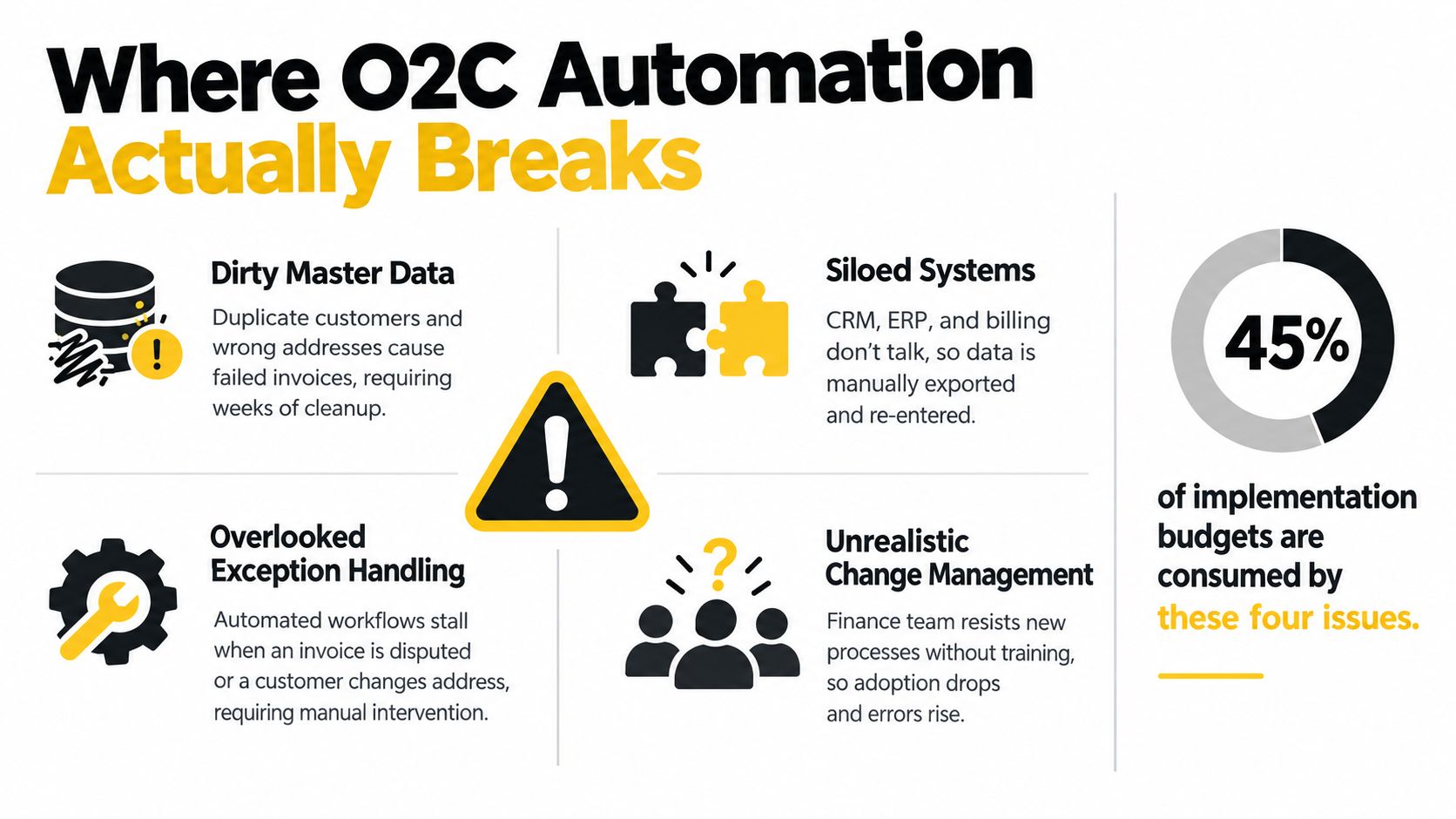
Recent market research summarized in the SSON report says the biggest O2C pain points remain manual processes, data accuracy and integration, payment delays, and dispute and deductions management. The same research noted that revenue leakage from manual tasks and disparate systems was often estimated at $5 million or more annually, and that cash application match rates were basically flat year over year even as other touchless capabilities improved (SSON Future Order to Cash Market Report). That tells you exactly where the hard work is now. Not invoice generation. Exception handling.
Four failure modes that matter
- Dirty master data: Duplicate customers, stale payment terms, wrong tax IDs, and inconsistent legal entities cause the system to automate the wrong thing faster.
- Exception-heavy transactions: Deductions, short pays, pricing disputes, split remittances, and partial shipments don't follow the happy path.
- Disputes outside the system: If your team manages issues in email and spreadsheets, you lose status visibility and auditability.
- Compliance blind spots: Generic invoice automation often ignores structured e-invoicing, clearance requirements, and local timing rules.
The plan notes behind many software rollouts pretend those are edge cases. They're not. They're the work.
The fix is operational, not cosmetic
If dispute resolution isn't embedded in the workflow, collectors will chase balances they don't really control. If customer master ownership is vague, finance will keep cleaning data after sales has already moved on. If remittance still lands in personal inboxes, AI matching won't save you.
A stronger approach starts with transaction controls and exception routing. Teams should think in terms of workflow states, ownership, timestamps, and evidence. If you're redesigning that layer, this piece on transaction reconciliation is relevant because it gets into how matching, break resolution, and control logic should work.
More bots won't fix a bad exception model. They just create faster confusion.
A 90-Day Implementation Roadmap
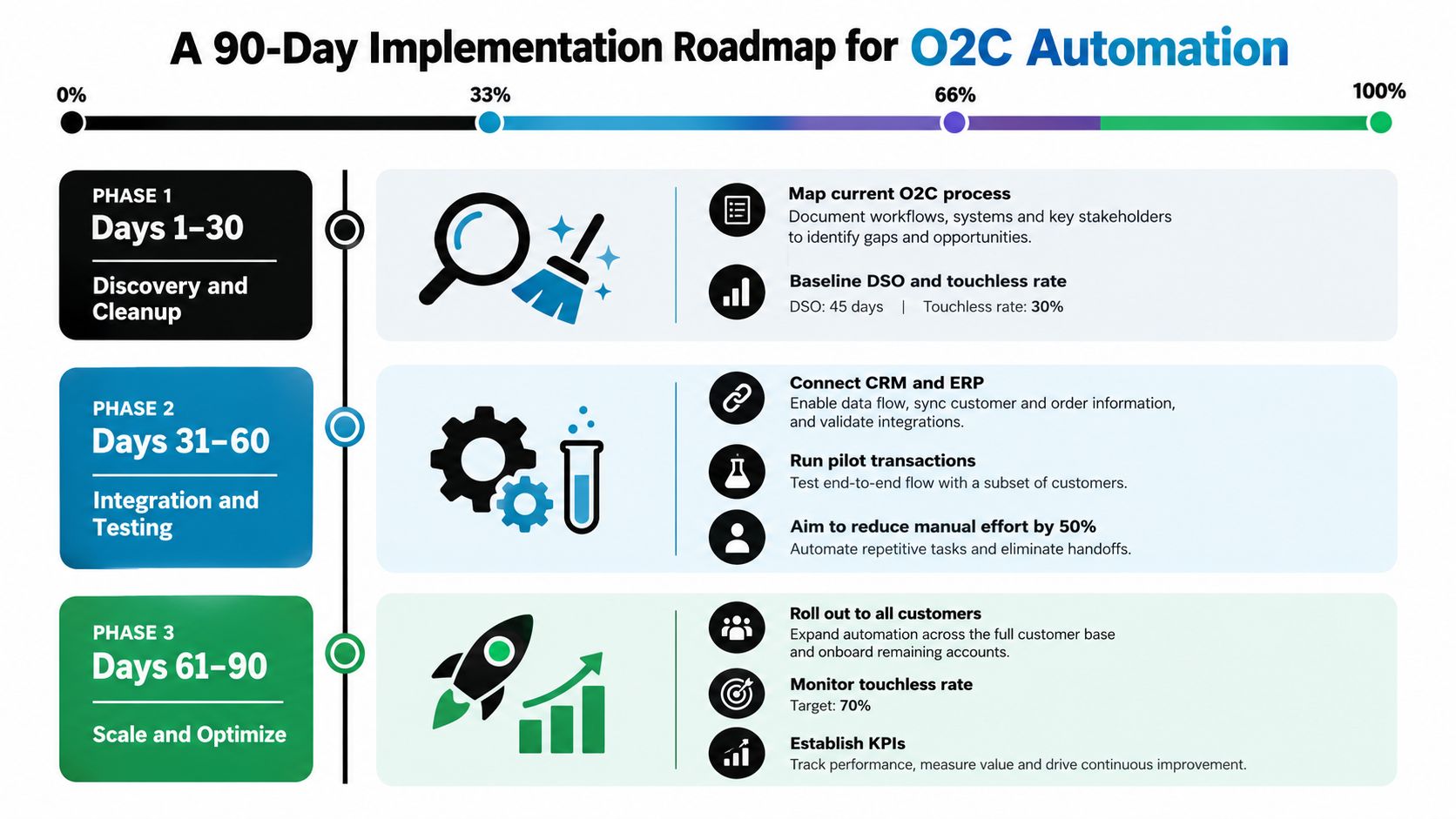
You don't need a year-long transformation program to start. You do need discipline. The fastest successful O2C projects narrow scope, clean data first, and pilot on a segment that can go live.
Days 1 to 30
Start with process mapping. Follow one transaction from order capture to applied cash and document every handoff, approval, delay, and manual correction. Then audit customer master data, payment terms, billing entities, tax fields, remittance channels, and dispute categories.
Pick one segment for wave one. The best candidates are usually domestic recurring transactions with low product complexity and reasonably standard payment behavior.
- Map the current path: Find where rekeying, spreadsheet exports, and inbox routing happen.
- Define your exception taxonomy: Separate disputes, deductions, short pays, unapplied cash, and data defects.
- Baseline the core metrics: Capture your current touchless rate, cycle time, and cash application performance so the pilot has a scoreboard.
Days 31 to 60
This is the integration and configuration phase. Connect CRM, ERP, billing, payment gateway, and bank or lockbox data. Set the rules for order validation, invoice triggering, and remittance ingestion.
Build the dispute and deduction workflow inside the system. Don't leave it for phase two. If the exceptions stay outside the platform, phase one will look better in a demo than it performs in production.
Before expanding scope, it helps to align the team on a visual walkthrough of the rollout logic. This explainer gives a decent baseline:
Days 61 to 90
Run the pilot on a defined slice of invoice volume. Watch exception queues daily. Tune matching logic, invoice delivery rules, and dispute routing based on what breaks first.
Then document the operating playbook:
- Who owns each exception type
- What evidence is required to resolve it
- Which KPI signals a breakdown
- When the issue escalates across finance, sales, or operations
If your first pilot segment is highly customized, cross-border, and full of nonstandard contracts, you're setting the project up to fail.
By the end of the quarter, you should have a go or no-go decision for broader rollout into harder segments like international invoicing, usage billing, or complex customer-specific terms.
A Real-World O2C Automation Case Study
Most published O2C case studies are too polished to be useful. They skip the arguments over customer IDs, ignore cross-functional ownership problems, and pretend disputes just disappear. A better example is a representative mid-market manufacturer with a mixed domestic and EU customer base, multiple invoice channels, and chronic rework in AR.
Before automation, the symptoms were familiar. Sales orders arrived through CRM and EDI. Billing worked off ERP data that wasn't always complete. AR spent too much time finding remittance detail, and disputes sat in inboxes because no one had a structured workflow for them.
What changed operationally
The company didn't start by chasing headcount reduction. It rebuilt three choke points:
- Order integrity at intake: customer records, terms, and tax attributes had to validate before the transaction advanced
- ERP-native billing orchestration: invoice generation triggered from fulfillment and billing events rather than manual batching
- Cash application with exception routing: straight-through items posted automatically while breaks moved into a tracked queue with ownership
It also gave customers a self-service path for invoice access and payment visibility, which reduced pointless back-and-forth with collectors.
Before and after
The before-and-after result wasn't magic. It came from removing repeat manual work and forcing ugly exceptions into a visible process.
| Case Study: Before vs. After O2C Automation | Before Automation | After Automation |
|---|---|---|
| DSO | 41 days | 27 days |
| Touchless invoicing | 38% | 84% |
| Past-due balances actively chased by AR | $4M | Lower after structured collections and dispute workflow |
| AR staffing focus | Clerical chasing and manual follow-up | Redeployed toward credit analysis and collections strategy |
| Dispute resolution time | 11 days | 3 days |
| Working capital impact in year one | Constrained by slow collections | Roughly $3.2M unlocked |
The critical lesson wasn't the software mix. It was the operating model. Pricing mismatches, partial shipments, and cross-border VAT issues didn't go away. The company just stopped pretending they belonged in email. Once those exceptions lived inside the workflow, leadership could finally see what was blocking cash and who needed to fix it.
The 2026 O2C Operating Model and Next Steps
The old O2C model assumed some delay between invoice, payment, and reconciliation. That cushion is disappearing. Faster settlement, structured invoicing mandates, and AI-assisted matching are compressing the time available to correct bad data after the transaction is already in motion.
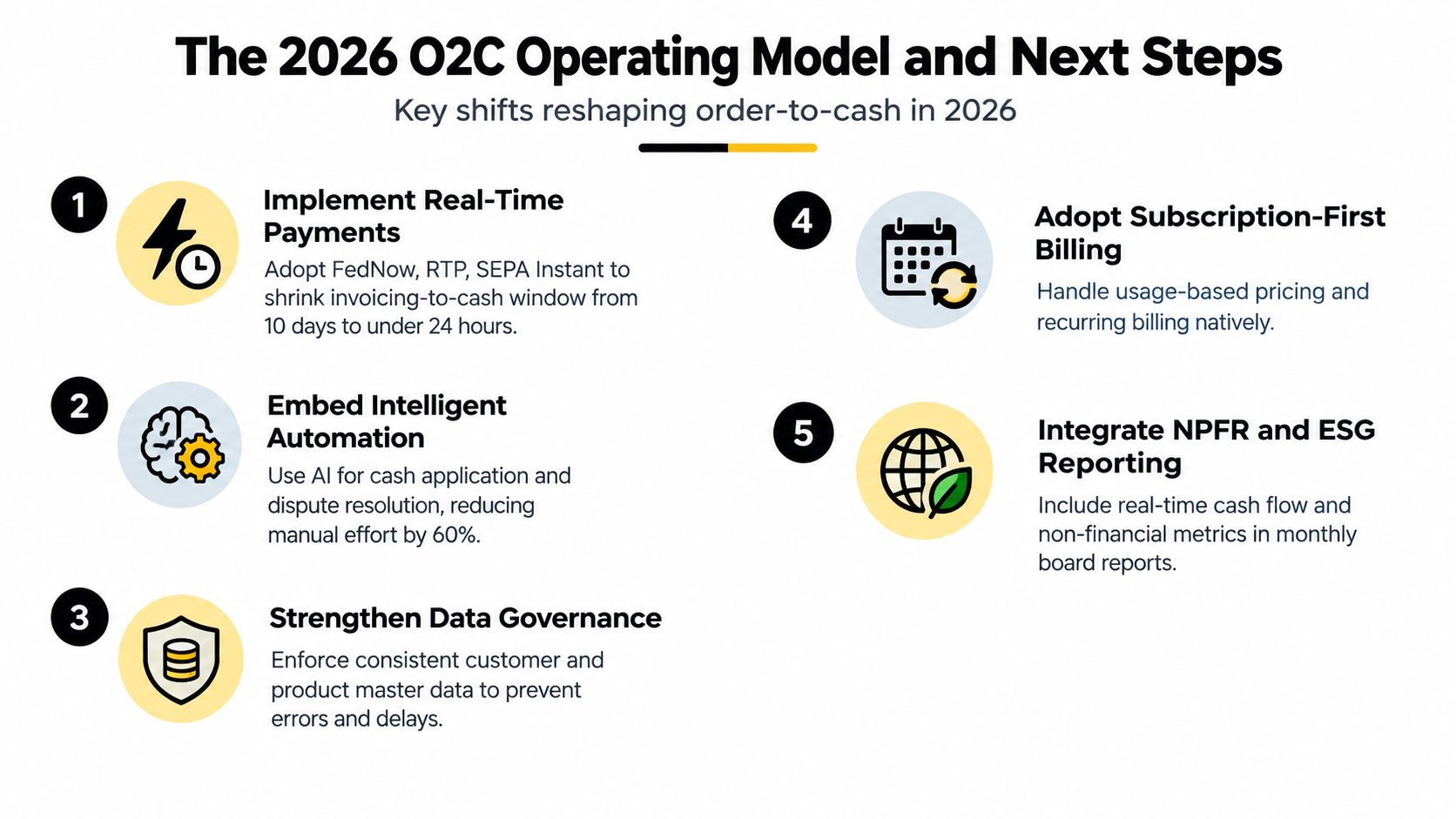
The broader market direction is clear. Independent market estimates placed the global order-to-cash automation market at $5.2 billion in 2025 with a projection to reach $12.8 billion by 2034 at a 12.3% CAGR, while another estimate valued it at $12.3 billion in 2025 and projected $21.7 billion by 2034 at a 6.2% CAGR. In adjacent software, one report valued the global order-to-cash software market at $585 million in 2024 and projected $1.005 billion by 2032 at an 8.1% CAGR. The same market summary said software held 68.5% of the market and cloud deployment represented 62.3% of revenue (order-to-cash automation market outlook). This is not a niche tooling category anymore. It's infrastructure.
What the operating model should look like
The companies that will run O2C well in this environment will do five things consistently:
- Treat master data as a control surface: customer, tax, entity, and payment attributes need explicit ownership.
- Design for structured invoicing: e-invoicing compliance has to sit inside the workflow, not in a side process.
- Push cash application toward same-day visibility: slower posting creates blind spots that real-time settlement will expose immediately.
- Use AI where pattern recognition matters: especially in remittance matching, collections prioritization, and exception routing.
- Manage exceptions as a first-class workflow: not as miscellaneous cleanup.
What to do this quarter
If you're deciding where to act first, keep it blunt:
- Audit customer and billing master data.
- Check e-invoicing readiness for every country where you operate.
- Pilot AI-assisted cash application on one segment with clean volume.
- Review payment terms with major accounts in light of faster settlement expectations.
- Put touchless rate and cash application performance on the finance dashboard.
This is the shift most generic guides miss. The question isn't whether to automate. It's whether your finance operating model is built for cash to move faster, compliance to get stricter, and exceptions to become more visible.
Cyndra helps operators turn messy finance workflows into production-grade automation that works inside the tools they already use. If your team needs AI agents for reconciliation, exception routing, dashboarding, or invoice-driven workflows, visit Cyndra and see how that operating model can be implemented without adding another layer of manual work.