 CYNDRA
The request lands late in the afternoon. The buyer wants a quote before the next meeting, but the rep is still checking a spreadsheet, confirming which options can be bundled, asking finance about a discount, and rebuilding a proposal from an old template. By the time the document is ready, the buyer has gone quiet, and nobody can say whether the delay came from pricing, approvals, or simple rekeying.
That pattern is why sales quote automation deserves treatment as a revenue-operations project, not a document-formatting exercise. The right workflow connects product rules, pricing, approvals, CRM data, and the handoff into contracting or billing. The practical path for teams isn't a big-bang CPQ rollout. It starts with clean rules, controlled templates, and a narrow pilot that proves where automation removes work without weakening commercial judgment.
Table of Contents
- Why Sales Quote Automation Pays Off Now
- Mapping Your Products Pricing and Rules for Automation
- Connecting CRM Finance and Templates Into One Flow
- Testing Rollout and Adoption Without Heavy IT
- Measuring Cycle Time Accuracy and Revenue Impact
- Putting Automation Into Practice and Next Steps
Why Sales Quote Automation Pays Off Now
A quote request can consume an entire selling block. The rep checks product options, confirms the current price, asks for approval on a discount, edits the proposal, and then finds a mismatch in billing terms. The buyer sees one late response. Internally, the delay came from several handoffs and repeated data entry.
That work is large enough to affect capacity. A 2025 Salesforce figure cited in the gathered market coverage says sales organizations spend an average of 10.3 hours per week on quoting and proposal-related tasks, equal to 26% of total selling time (source coverage of AI quote generation statistics). Configuration checks, price calculations, approval follow-up, and document assembly create a stream of interruptions rather than one visible administrative task.
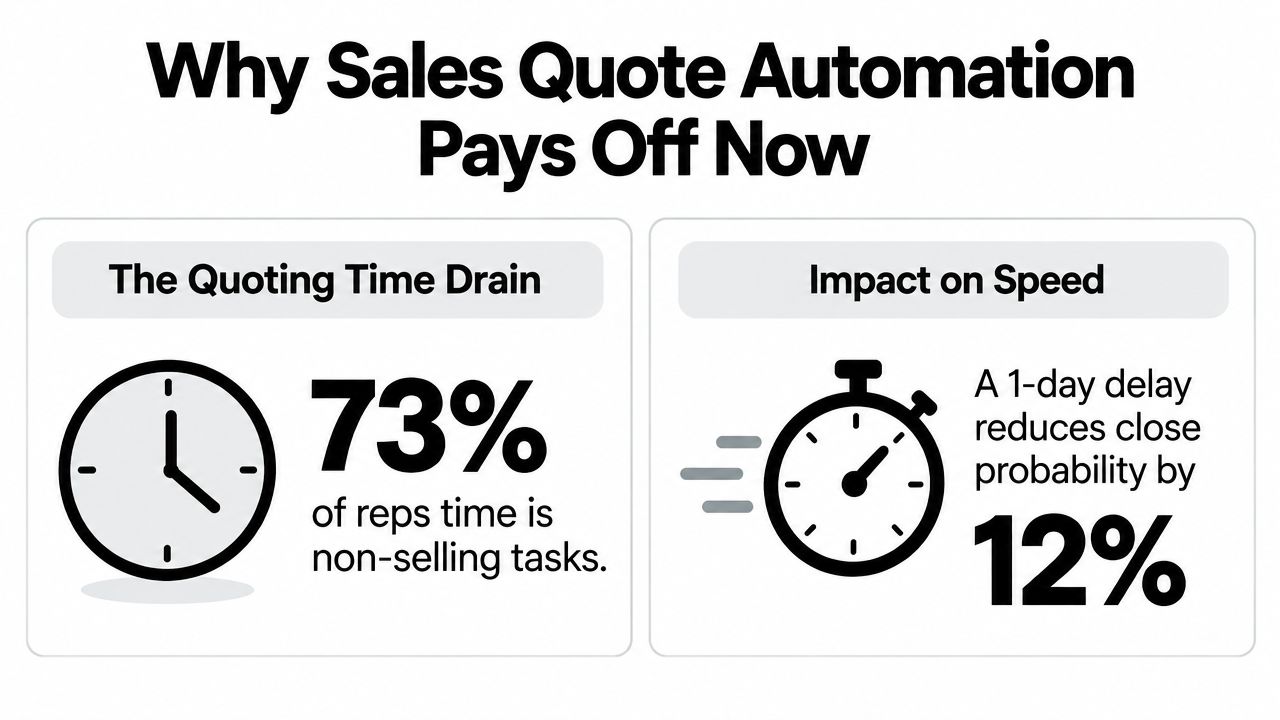
The infographic should not be treated as separate verified evidence here. The usable figure is the 26% of selling time cited above. Recovering that capacity gives reps more room for discovery, negotiation, follow-up, and account planning without creating another manual process.
Templates are not the same as automation
A shared proposal template controls formatting. It does not check accessory compatibility, apply account-specific pricing, route unusual terms to legal, or prevent use of a retired price book. Spreadsheet formulas can calculate a discount, but a person still has to open the correct file and copy the result into the CRM.
Rules-based automation handles the repeatable decisions. It centralizes product eligibility, price logic, discount limits, and approval triggers, then applies them consistently. AI-assisted quote generation can interpret less-structured requests and prepare a draft. It still needs guardrails, because an AI system should not invent a configuration or bypass a commercial control.
The same 2025 coverage says 57% of sales organizations use some CPQ tool, while 31% have AI-assisted quote generation. That gap supports a staged approach. Teams without enterprise CPQ can first document rules, standardize templates, and automate one approval path before asking IT to support a broader implementation.
Practical rule: Automate deterministic decisions first. Use AI for interpretation and preparation, then require explicit approval for exceptions involving pricing, configuration, legal terms, or margin.
When the investment makes sense
Start the business case when reps quote from multiple spreadsheets, deal desk reviews the same exceptions repeatedly, finance corrects prices after signature, or sales operations cannot identify where a quote is stalled. A narrow pilot can cover one product family, market, or approval path. Define test cases before launch, including valid bundles, expired pricing, discount thresholds, missing CRM fields, and rejected approvals. At handoff, confirm that the approved quote, audit trail, and customer terms reach contracting or billing without rekeying.
For wider context on automation across revenue workflows, review these sales automation insights. Teams assessing AI beyond quote generation can also examine AI for sales automation and decide which tasks belong in the first controlled release.
Mapping Your Products Pricing and Rules for Automation
A quoting system can only enforce the logic your team has made explicit. If the catalog is contradictory, automation will produce contradictions faster. Start with an inventory workshop, not a software demo.
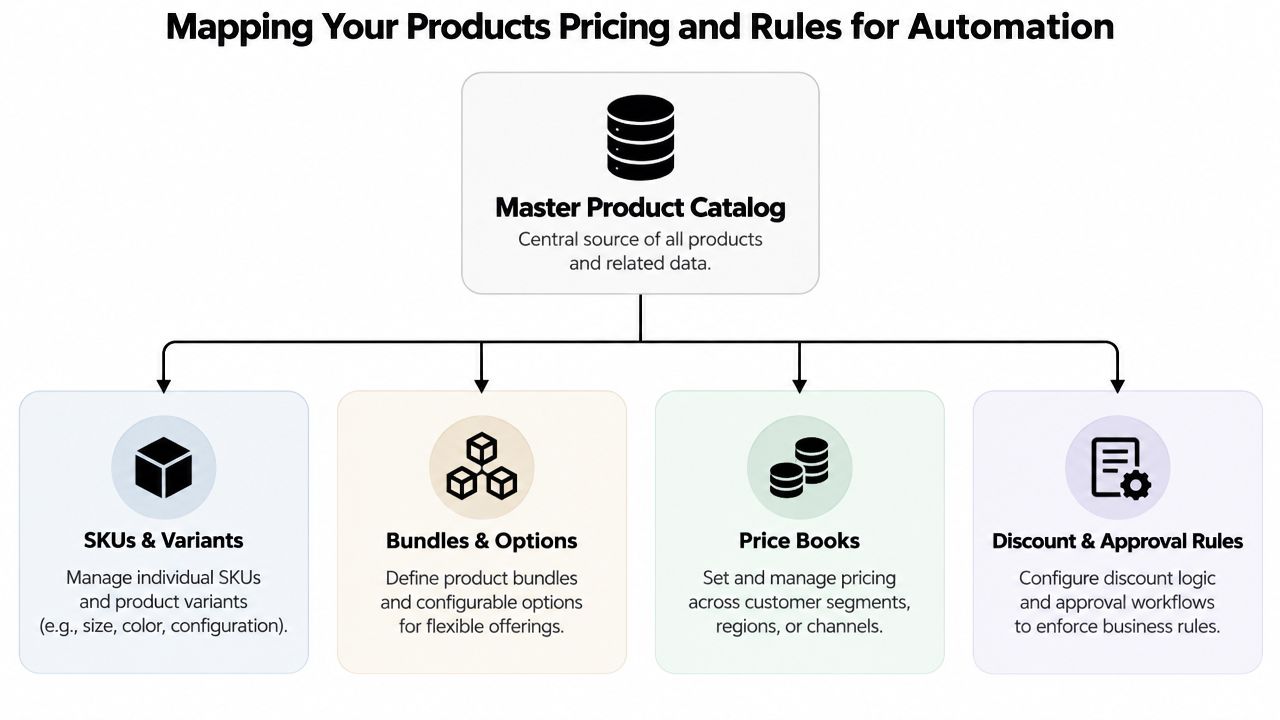
Create a working catalog with a stable identifier for every sellable item. Record the SKU, customer-facing name, internal description, status, unit of measure, compatible options, replacement item, and owner. Separate a product's identity from its marketing language. Reps may call the same package by different names, but the automation layer needs one canonical record.
Build the rulebook before the workflow
Use a simple matrix to expose gaps. Don't try to encode every edge case immediately. Capture the rules that determine whether a quote is valid and the exceptions that must reach a human.
- SKUs and variants: Identify required attributes such as capacity, region, service tier, or term. Mark which fields are mandatory before the item can be quoted.
- Bundles and options: Record what must be included, what can be added, and what can't be combined. If an option requires another component, represent that dependency directly.
- Price books: Define which price applies by customer segment, currency, region, contract, and effective date. Assign an owner who can retire or publish a version.
- Discount rules: Document standard discount boundaries, who can approve an exception, and what information the approver needs to make a decision.
- Commercial terms: Flag payment terms, renewals, implementation conditions, usage commitments, and service-level language that require review.
A clean spreadsheet is acceptable as a staging artifact. It isn't a durable control if multiple people edit copies without version ownership. Use one source file or system, record effective dates, and give every rule a plain-language explanation. The person maintaining a catalog should be able to answer, “Why did this quote route to approval?” without asking the rep who built it.
Use test cases to find hidden knowledge
Ask experienced sellers to provide real examples of a standard quote, a valid bundle, an invalid bundle, a contract-price exception, a regional variation, and a request with missing information. Convert each example into an expected result. This turns tribal knowledge into a testable specification.
A practical rulebook contains three outcomes: allow, block, and route for review. “Allow” means the system can proceed without intervention. “Block” means the configuration or price is invalid. “Route” means the request may be commercially sensible but needs an accountable decision.
The cleanest automation blueprint is not the one with the most rules. It's the one where every rule has an owner, an expected result, and a safe failure path.
Don't postpone currency or tax logic until the end if you sell across jurisdictions. You don't need to build a tax engine during the first pilot, but you do need to identify where the authoritative calculation lives and prevent the quote workflow from presenting an unverified value as final.
Connecting CRM Finance and Templates Into One Flow
A quote should begin with opportunity context and end with a controlled commercial document. The rep shouldn't copy the account name, billing details, products, or terms across several systems just to create a proposal.
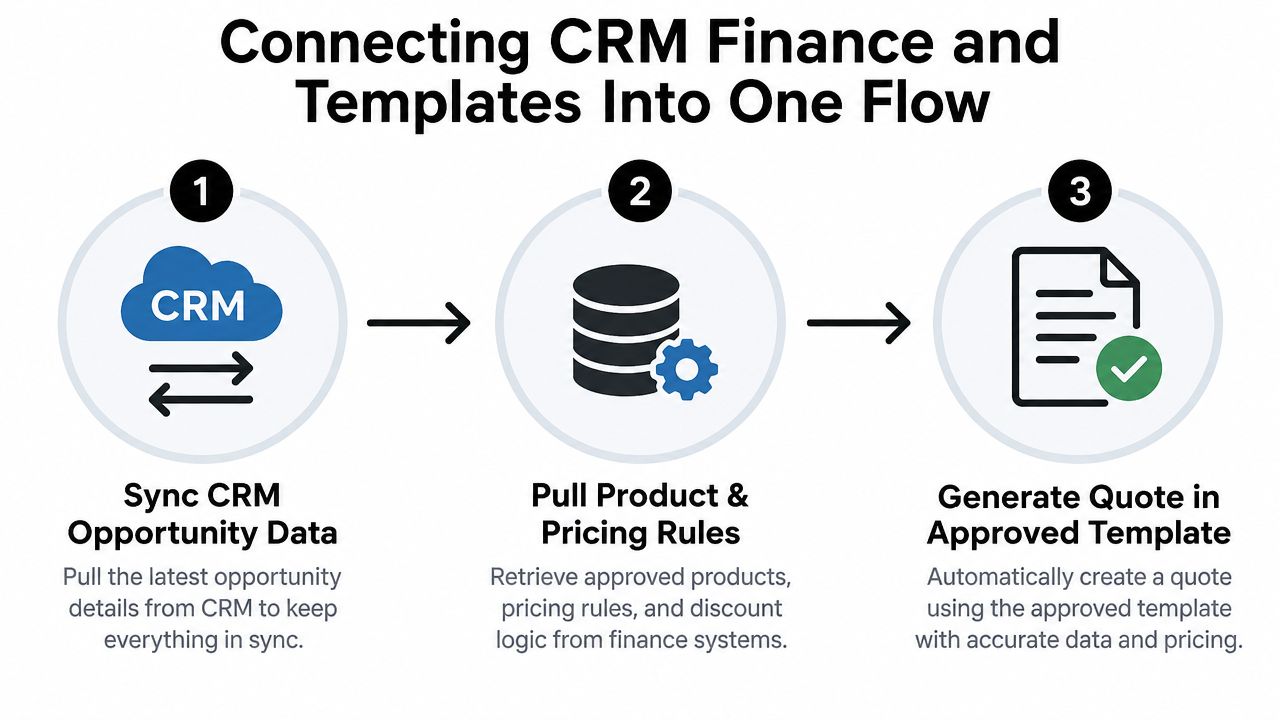
Start by defining the system of record for each field. The CRM usually owns opportunity stage, account relationship, seller, forecast context, and customer contact details. The product catalog owns sellable items and configuration constraints. Finance or an ERP may own contract pricing, customer credit conditions, tax treatment, inventory availability, or billing requirements. The integration design should make those boundaries visible.
Map fields and choose deliberate triggers
Document the direction of every important data movement. Account identity may flow from CRM into the quote. Approved pricing may come from finance into the pricing service. The final quote status should return to the opportunity so sales managers can see whether the document is drafted, under review, sent, signed, or rejected.
Choose triggers based on business events rather than constant synchronization. Useful triggers include creating a quote from a qualified opportunity, changing the customer or currency, adding a nonstandard item, submitting an approval, and accepting a quote. Each trigger needs an owner, a failure notification, and a defined retry or manual recovery process.
For teams connecting lightweight tools, an integration platform can handle practical handoffs. For example, operators assessing CRM and workflow connections can review how to connect Estimatty to Zapier. The important question isn't whether a connector exists. It's whether the connector preserves identifiers, timestamps, approval status, and the final document version.
Make templates dynamic but controlled
A good template separates content the seller can edit from content the business must protect. The cover note and customer-specific explanation may be editable. Prices, totals, payment terms, legal clauses, expiry language, and product descriptions should populate from approved records.
Build template variants only when the buyer or transaction requires them. Too many templates create another catalog problem. Give each template a clear name, owner, effective date, and retirement process. When legal changes a clause, update the controlled source rather than asking every rep to download a new document.
Design approvals around exceptions
Approval routing should answer three questions:
- What changed from the standard offer?
- Who has authority to approve that change?
- What evidence must accompany the decision?
A discount exception might route to sales leadership, while unusual payment terms might involve finance and legal. Where reviews are independent, parallel routing can reduce waiting. Where one decision depends on another, keep the sequence explicit. Never use a generic “manager approval” step that hides what the manager is expected to verify.
The final handoff matters just as much as quote creation. An accepted quote should carry its line items, pricing version, terms, approvals, and customer identifiers into contracting, order entry, or billing. If the team still retypes the accepted quote into the ERP, the automation has only moved the error risk downstream. A practical reference for this architecture is integrating CRM and ERP, particularly when field ownership and handoff controls are unclear.
Testing Rollout and Adoption Without Heavy IT
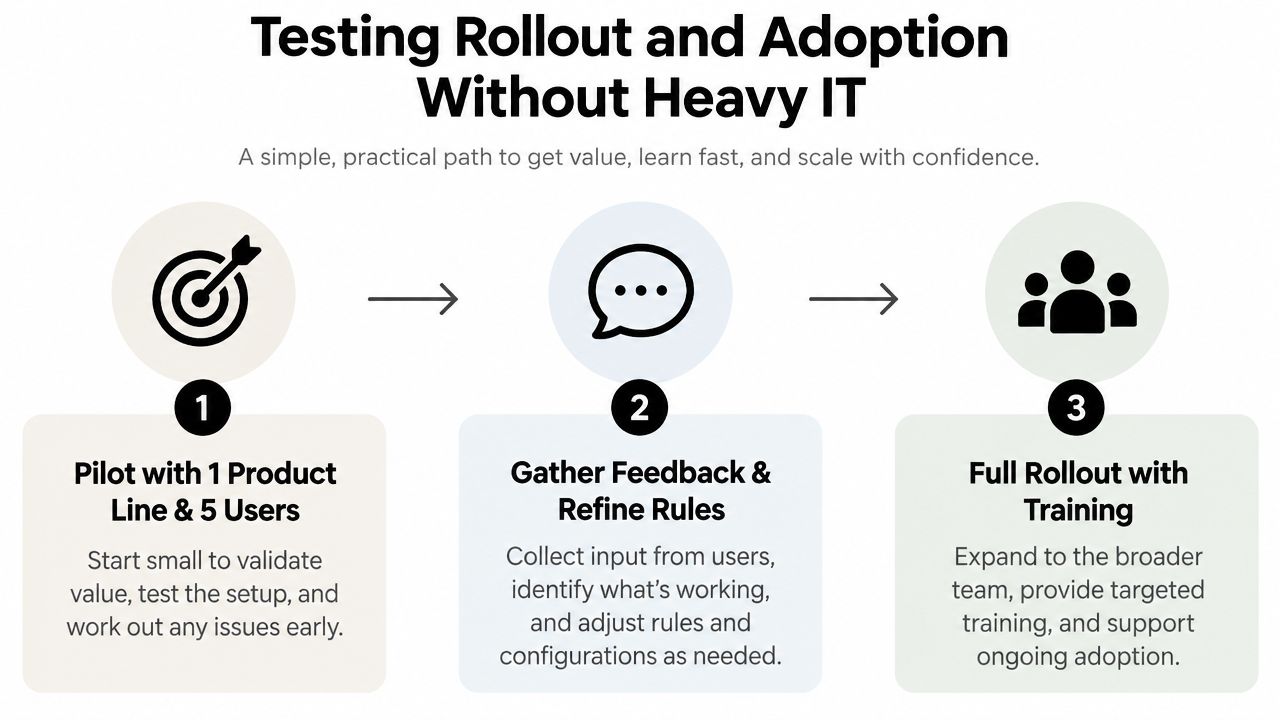
Small and mid-sized teams often don't lack motivation. They lack spare implementation capacity. Market coverage cited in the brief says only 42% to 48% of freight forwarders globally had adopted some form of quotation automation by 2025, with adoption at 65% to 72% among large enterprises and 28% to 35% among SMBs (Cincom's coverage of slow quote turnaround). The practical implication is clear: a staged path matters, especially when the team can't fund a full CPQ program immediately.
Start with a bounded pilot. Select one product line, one market, or one quote type with enough volume to expose friction but limited enough to control. Include a small group of users who represent different behaviors, not only the most technically comfortable reps.
Write the test cases before go-live
The handoff checks are where many implementations fail. Test the normal path, then deliberately test the uncomfortable paths.
- Standard configuration: Confirm that a permitted product and ordinary price create the expected quote without manual correction.
- Invalid combination: Select incompatible options and verify that the system blocks the configuration with an understandable message.
- Discount exception: Enter a discount outside the standard boundary and confirm that the correct approver receives the request.
- Nonstandard term: Add an unusual payment or service condition and check that the document uses the right clause or routes for review.
- Changed customer context: Switch currency, region, account tier, or contract status and verify that the price source changes appropriately.
- Approval rejection: Reject the quote and confirm that the rep sees the reason, the opportunity records the decision, and the rejected version can't be sent accidentally.
- Downstream handoff: Accept a quote and verify that the order, contract, or billing process receives the right identifiers and totals.
Run parallel quotes before replacing the current process. Have the team build the same transaction through the existing method and the automated path, then compare line items, prices, terms, approval outcomes, and document versions. Don't call a test successful because the PDF looks correct. The true test is whether the accepted commercial intent survives every handoff.
Set rollback and governance checkpoints
Define rollback criteria before launch. Examples include an unresolvable pricing mismatch, a missed mandatory approval, a broken downstream identifier, or a document that uses an outdated clause. When a failure occurs, pause the affected path, preserve the audit trail, and return to the controlled manual process while the owner fixes the rule.
Training should be short and transaction-based. Show reps how to start a quote, resolve a blocked configuration, submit an exception, check approval status, and recover from missing data. Give managers a review checklist rather than asking them to inspect every field from scratch.
Adoption improves when the system tells a rep what to do next. A blocked quote with a clear reason is safer than a silent calculation that produces a document nobody trusts.
Collect feedback from sellers, approvers, finance, and the person who receives the accepted order. The last group often finds the most expensive defects because they see whether the quote can be processed.
Measuring Cycle Time Accuracy and Revenue Impact
Quote automation needs an evidence trail. Before changing the workflow, record how long quotes wait, how much hands-on work they require, how often revisions occur, and where approvals stall. Pull these signals from CRM timestamps, quote-version history, approval records, and downstream order data where available. A baseline prevents the team from treating higher activity as improvement.
Measure each quote separately, not only the opportunity. One opportunity can contain several quote versions with different outcomes. Define the clock consistently, such as from quote request received to approved quote sent. Track accepted quote to order creation as a separate interval, because that handoff exposes defects the quoting team may not see.
| Metric | Before Automation | After Automation |
|---|---|---|
| Quote turnaround time | Record elapsed time from request to send | Compare time by quote type and exception status |
| Manual touchpoints | Count rekeying, spreadsheet lookups, document edits, and approval chases | Count remaining interventions and classify their causes |
| Rework and errors | Record price corrections, invalid configurations, and regenerated documents | Monitor defects by rule, product, user, and integration |
| Approval lag | Measure waiting time by approver and exception category | Check routing speed and remaining queues |
| Discount compliance | Review quotes against approved discount boundaries | Check whether exceptions are routed and recorded |
| Commercial outcome | Segment sent, accepted, rejected, and expired quotes | Compare similar cohorts without assigning every change to automation |
The sales-operations data cited earlier gives this work a practical priority. Quoting and proposal work can consume a substantial share of selling time. Your dashboard should show how much of that burden comes from repeatable work and how much still requires commercial judgment.
For operational guidance on measuring cycle time reduction, set a baseline for each quote category rather than copying another company's target. Identify the current bottleneck, define what “done” means, and record the test cases used in the pilot. Include standard quotes, discount exceptions, bundled products, missing data, and approval rerouting. Those cases show whether automation handles the rules your team uses.
Separate speed from quality
A shorter turnaround is not a success if finance rejects the quote, the buyer receives incorrect terms, or order entry rebuilds the transaction. Pair speed with accuracy and handoff measures. Review the accepted quote against the order payload, customer identifiers, prices, terms, and approved document version. Record defects by source so owners can fix the rule, template, data field, or integration instead of blaming the user.
Keep standard and exception quotes in separate cohorts. Standard transactions should become more predictable. Exceptions may still take longer, but the dashboard should show the reason, approval owner, waiting time, and final outcome. This distinction protects controls while giving revenue leaders a clearer view of where automation saves time.
Set handoff checks before the pilot begins. Confirm that required fields survive each transfer, that approval evidence remains attached, and that rejected or expired quotes cannot enter order creation. Review results at a fixed checkpoint, then adjust templates, rules, or routing based on the defect pattern. Speed matters only when the commercial record remains accurate from request through order.
Putting Automation Into Practice and Next Steps
Treat the approved quote as a structured commercial record, not only as a PDF. After signature, pass accepted line items, customer identifiers, prices, terms, approval history, and document version into the next process. Order entry can validate the payload, billing can use the agreed terms, and fulfillment can receive the configuration without asking sales to reconstruct it.
That handoff reveals problems that demonstrations often hide. A stale price book can produce a polished but invalid offer. A copied template can retain obsolete legal language. An approval rule can route to a former employee or let an exception pass because a required field is blank. Assign owners for catalog changes, price publication, approval maintenance, template control, and integration monitoring.
A practical next-month plan:
- Choose one painful quote path. Select a product line or segment with repeatable rules and visible delays.
- Clean the source data. Remove duplicate SKUs, identify obsolete prices, document bundle dependencies, and assign owners.
- Write the approval matrix. Define standard boundaries, exception types, approvers, required evidence, and rejection behavior.
- Build the minimum connected flow. Start with CRM opportunity data, the authoritative product and pricing source, an approved template, and recorded approval status.
- Run parallel tests. Compare standard, invalid, discounted, nonstandard, rejected, and downstream handoff scenarios.
- Train around decisions. Show reps how to resolve blocks and submit exceptions. Show approvers which evidence to check.
- Review the dashboard weekly. Track manual touches, recurring rule failures, stale data, and approval queues before expanding scope.
The category's history supports staged adoption. CPQ grew from earlier configuration and pricing practices. BigMachines was founded in 2000, and the category accelerated after Gartner published its first CPQ technology report in 2010, according to the market history summarized in the gathered sources (CPQ software market overview). Those estimates describe a scaled category, not a required implementation plan for every team.
Start with the rules your team repeats every day. Automate templates and approvals that do not require heavy IT, then expand only after test cases pass and the handoff preserves the commercial record.
Cyndra helps teams turn sales workflows into production-grade AI employees that can work with CRM data, support quote approvals, record decisions, and preserve audit trails. Visit Cyndra to discuss a staged sales quote automation workflow that fits existing tools instead of requiring a full CPQ overhaul on day one.