 CYNDRA
You've got an inbox agent, a CRM workflow, a support bot, and three dashboards that were supposed to save your team time. Instead, someone still checks every output, fixes broken integrations, and explains to the finance lead why yesterday's numbers changed. The demo looked impressive. Production feels like another system to manage.
That's the problem with buying AI automation agency services as if they were a one-time software installation. Launch speed matters, but it's not the purchase decision. The key question is whether the agency can keep an AI-enabled workflow accurate, permissioned, observable, and useful after the launch team leaves.
I've hired agencies that built attractive prototypes and disappeared when an API changed. I've also worked with teams that started slower, documented the workflow, measured the baseline, and treated the agent like an operational employee with an owner, a runbook, and review cycles. The second model scales. The first becomes expensive technical debt.
Table of Contents
- What an AI Automation Agency Actually Does
- The Six Core Services Inside Every AI Automation Engagement
- How a Real Engagement Unfolds From Kickoff to Handoff
- Where AI Automation Services Move the Numbers
- Governance, Permissions, and the Security Conversation
- The Post-Launch Operating Model Most Buyers Forget to Plan
- How to Choose an AI Automation Agency and Stay in Control
What an AI Automation Agency Actually Does
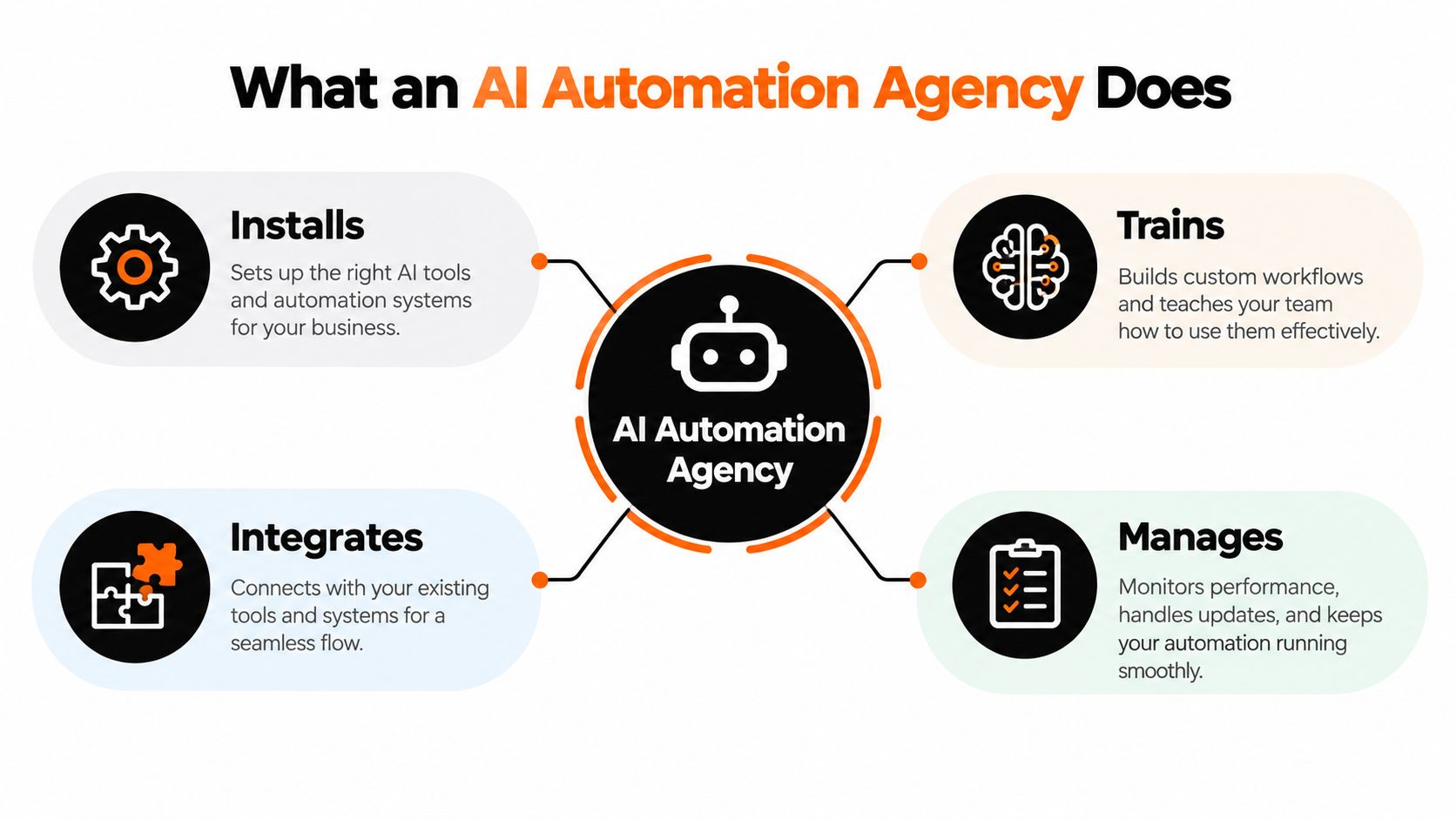
An AI automation agency is a service firm that installs, integrates, trains, and manages software agents inside your existing business systems. It doesn't just sell access to a model. It identifies a repeatable workflow, connects the relevant tools, configures the agent's instructions and boundaries, trains your team to use it, and supports the system after deployment.
That distinction matters because the market now includes several very different providers:
- A SaaS vendor gives you a product with standard configuration options.
- A freelance prompt engineer may improve instructions but often won't own integrations, permissions, monitoring, or adoption.
- A traditional systems integrator can connect enterprise systems but may not understand agent evaluation, model behavior, or human approval design.
- An AI automation agency should combine workflow redesign, agent development, integration, governance, training, and ongoing operations.
The demand is real. Across OECD member countries, the share of businesses with at least 10 employees using AI rose from 5.6% in 2020 to 14% in 2024, according to OECD data on AI adoption by small and medium-sized enterprises. Adoption is uneven by size, with roughly 40% of firms employing 250 or more people using AI compared with 11.9% of firms employing 10 to 49 people, from the same source.
Who should hire one
The strongest fit is a growth-stage company with recurring work across sales, support, finance, marketing, recruiting, or operations. COOs, non-technical CTOs, agency leaders, and founders usually benefit when they can point to a specific bottleneck, such as stale CRM records, slow lead qualification, a support queue that grows overnight, or reporting assembled manually from Shopify, ad platforms, and finance tools.
A weak fit is a company looking for a magical employee replacement without clean processes, accountable owners, or access to reliable data. If nobody can define the workflow, approve exceptions, or judge output quality, an agency can't responsibly automate it.
Buyer test: If you can name the task, the systems involved, the current human decision, and the consequence of an error, you're ready for discovery. If you can only describe a desire to “use AI,” you're not ready to buy.
The Six Core Services Inside Every AI Automation Engagement
A credible proposal should separate the engagement into deliverables. If the agency sells one vague package called “AI transformation,” ask what specifically gets built, connected, tested, and maintained.
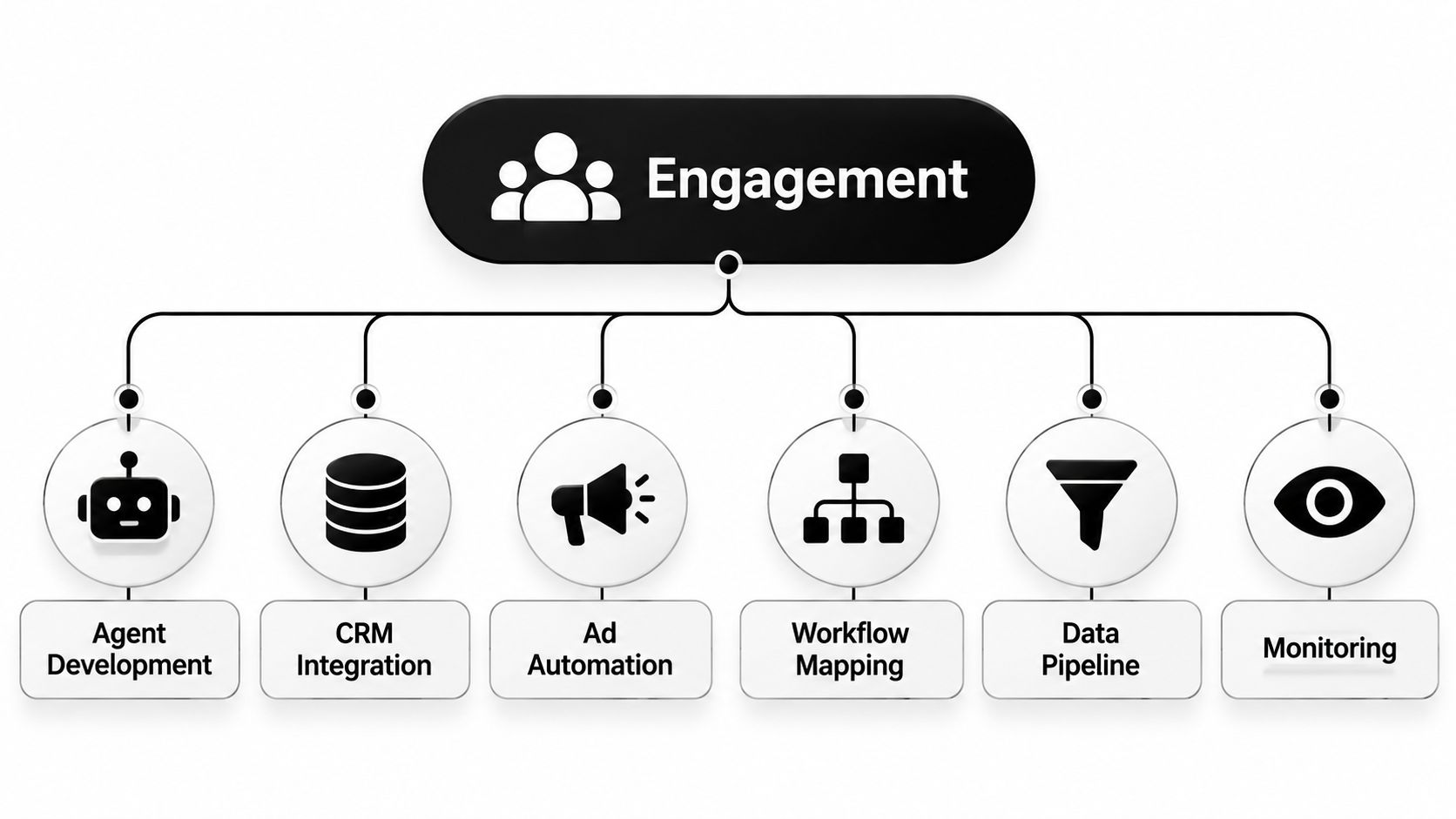
1. Agent development
The agency builds an agent around a real job, not a generic chatbot. A sales agent might research an account, classify fit, draft an email, and place uncertain prospects in a review queue. A support agent might retrieve approved knowledge, suggest a response, update the ticket, and escalate an exception.
2. CRM and system integration
The agent needs context from tools such as Salesforce, HubSpot, Zendesk, Slack, Shopify, Google Workspace, ad platforms, or finance systems. Integration work determines whether the agent can act on current records or merely produce disconnected text that someone has to copy and paste.
3. Workflow mapping
The agency should document the existing process before automating it. That includes triggers, decisions, handoffs, exceptions, approval points, and the definition of a completed task. Automating a bad process only makes bad work move faster.
4. Data pipeline design
Dashboards and agents need dependable inputs. The provider should identify source systems, reconcile conflicting fields, define data freshness, and establish what happens when a required value is missing. A dashboard that looks polished but joins incompatible data is worse than no dashboard because operators trust it.
5. Team training and adoption
Training covers more than showing employees where to click. People need to know what the agent can do, what it can't do, how to review drafts, when to escalate, and how to report a failure. The International Labour Organization's 2025 global index estimates that one in four workers worldwide are in occupations with some exposure to generative AI, which makes task redesign and human collaboration more practical than a simplistic replacement plan.
For recruiting teams, a specialist resource such as dreach AI for recruiters can help frame how AI fits into candidate sourcing, screening, and recruiting workflows.
6. Monitoring and managed services
Post-launch support should include error monitoring, exception handling, regression tests, prompt and permission changes, usage review, and workflow improvements. This is the category many buyers underfund, even though it determines whether the system remains dependable.

Match these six services against the proposal. A vendor that offers only agent development and tool integration is selling a build, not a production operating capability.
How a Real Engagement Unfolds From Kickoff to Handoff
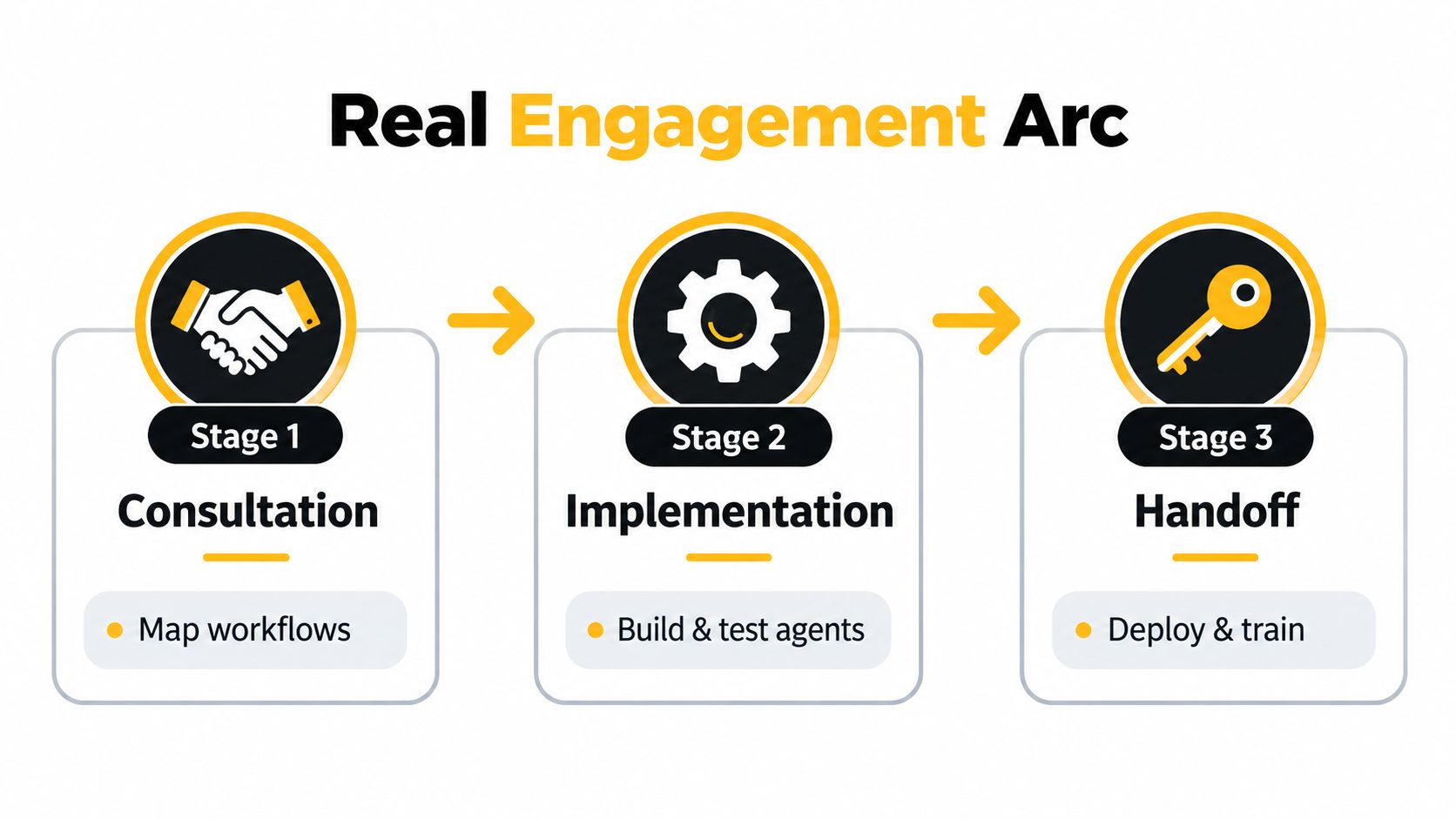
A serious engagement follows a sequence. The agency first understands the work, then builds against evidence, then transfers ownership with enough documentation for your team to operate without guesswork.
Consultation
The opening phase maps workflows, systems, data sources, owners, and failure costs. The agency should interview the people doing the work, inspect representative records, and rank opportunities by volume, repeatability, business value, and risk.
The output should be an auditable workflow specification. It should state the trigger, inputs, permitted actions, expected output, approval checkpoints, failure classes, escalation route, and success measures. If the agency skips this and jumps straight into a demo, it's optimizing for excitement rather than deployment.
Implementation
The agency builds the first workflow against a baseline. For a support process, that may include resolution rate, handle time, escalation rate, quality review, and customer sentiment. For sales, it might include lead-routing accuracy, response time, meeting quality, and human acceptance of drafts.
A meaningful first production agent is a 60-day outcome, not a 60-minute demo. The schedule can compress when the data is clean and the workflow is narrow. It stretches when systems are poorly documented, permissions are unclear, or multiple departments must approve the design.
By week four, you should have a working design, an initial test set, documented edge cases, and a visible list of unresolved decisions. You shouldn't still be debating what the agent is supposed to do.
Transformation and handoff
The final phase changes the operating model. The agency trains users, establishes an owner, delivers a runbook, defines escalation procedures, and records how to update prompts, permissions, connectors, and evaluation tests.
Use a practical AI implementation roadmap to make those artifacts explicit before signing. Your handoff checklist should include credentials ownership, workflow documentation, test results, monitoring access, incident procedures, version history, and training records.
A handoff isn't a presentation. It's the point at which your team can diagnose, approve, pause, and improve the workflow without calling the agency for every decision.
Where AI Automation Services Move the Numbers
An automation agency earns its fee by improving a repeatable task inside a high-volume workflow. Placement matters more than the tool. So do the quality of the underlying knowledge, the permission boundaries, and the measurement plan that remains after launch.
Customer support offers a clear benchmark. A field study of 5,179 customer-support agents found that a generative AI conversational assistant increased issues resolved per hour by 14% on average, with roughly 35% gains for novice and lower-skilled workers. Experienced, highly skilled workers saw minimal improvement, according to the NBER field study.
Use that finding to reject blanket productivity promises. A competent agency identifies the employees and tasks most likely to benefit, then tests the assistant against a controlled baseline. Require results by workflow segment, not one blended average.
Measure the workflow, not the model
Record the operating measures your team already uses before deployment:
- Throughput: Issues resolved, leads processed, applications reviewed, or transactions reconciled.
- Speed: Handle time, response time, or time from intake to handoff.
- Quality: Accuracy, policy compliance, approval rate, and customer sentiment.
- Exceptions: Escalations, human overrides, failed tool calls, and incomplete tasks.
- Adoption: How often employees accept, edit, reject, or bypass the agent's output.
These measures show whether the system removes work or creates it. A support copilot can help new agents move faster while adding little value for experts. A lead-generation agent can produce more outreach drafts while lowering quality if targeting rules are weak. Before commissioning one, browse agent lead generation scenarios and compare the proposed workflow with the decisions your team makes.
Set a post-launch failure-rate target for each workflow, including failed tool calls, incorrect routing, rejected outputs, and tasks requiring rework. The agency should report those rates alongside throughput and quality. More drafts, tickets touched, or records updated do not prove that customers were helped or revenue-quality work was created.
Task redesign beats headcount theatre
The ILO index places only 3.3% of global employment in the highest generative AI exposure category, where a large share of tasks could potentially be affected, according to the ILO index. That supports a narrower operating choice: redesign repetitive tasks, retain human judgment for sensitive decisions, and measure whether the surrounding process improves.
Reject agencies that lead with replacement claims. Ask which tasks become faster, which decisions remain human, what triggers escalation, and how the team will detect degraded output after launch. Reliable gains come from controlled workflows that keep working after the demo ends.
Governance, Permissions, and the Security Conversation
Security isn't an enterprise-only concern. A growth-stage company's AI employee may touch customer data, recruiting records, email, CRM notes, invoices, or payment workflows. The right question isn't whether the agent is “secure” in the abstract. It's what the agent can read, draft, approve, and execute, and who can prove what happened.
Recent enterprise research found that 82% of organizations use AI agents, while only 44% report policies to secure them. The same research says 92% consider agent governance critical to enterprise security, while 47% of IT security leaders were fully confident in their compliance posture, according to SailPoint's research release.
Use four permission levels
Start with four levels rather than giving an agent broad access:
- Read: Retrieve approved records and documents.
- Draft: Prepare an email, CRM update, invoice note, or candidate message without sending or saving it.
- Approve: Route a proposed action to a named human decision-maker.
- Execute: Perform a bounded action under explicit rules and logging.
The agent should move up this ladder only when the business can tolerate the error and the audit trail is complete.
Sample AI Agent Permission Matrix for a Growth-Stage Operator
| System | Read Access | Draft Access | Approve & Execute | Audit Trail |
|---|---|---|---|---|
| CRM | Accounts, contacts, activity history | Notes, task suggestions, follow-up drafts | Create tasks or update defined fields after approval | User, agent version, record, before-and-after values |
| Approved inbox folders and templates | Replies and outbound sequences | Send only within approved recipients, templates, and limits | Message, recipient, approval, timestamp | |
| Finance | Invoices, payment status, account metadata | Reconciliation suggestions and exception summaries | No money movement without named approval | Source records, calculations, approver, decision |
| Recruiting | Candidate profiles and pipeline stages | Interview summaries and outreach drafts | Advance candidates only under documented rules | Candidate record, rationale, reviewer, timestamp |
| Support | Tickets, knowledge base, customer history | Response drafts and categorization | Close or escalate only under approved policy | Ticket history, source articles, confidence, action |
NIST recommends trustworthiness considerations across design, development, use, and evaluation. Convert that principle into a workflow specification covering permitted data sources, tool-call constraints, human checkpoints, retention rules, failure classes, and escalation paths. The NIST Generative AI Risk Management Profile provides the foundation, while a practical guide to AI governance and compliance can help structure the operating discussion.
Permission rule: An agent that can draft an action doesn't automatically deserve permission to execute it.
The Post-Launch Operating Model Most Buyers Forget to Plan
The initial agent isn't the product. The reliability system around the agent is the product.
Prompts drift. APIs change. Data fields go stale. A connector starts returning a different format. A model update changes how the agent interprets an instruction. Without monitoring and regression tests, these failures can remain invisible until a customer, employee, or finance manager notices the consequence.
Integration is reported as a primary AI adoption obstacle by 46% of organizations, while 42% cite data access and quality and 43% cite implementation cost, according to The 2026 State of AI Agents report. Those barriers don't disappear at launch. They become operating responsibilities.
Demand these production artifacts
Your agency should deliver more than a working workflow:
- Monitoring dashboard: Task volume, completion rate, failed calls, latency, cost, human overrides, and escalation volume.
- Exception queue: A visible place for uncertain or failed tasks, with an owner and response process.
- Regression test set: Representative cases that run after changes to prompts, models, connectors, or source data.
- Version control: A history of prompt, permission, workflow, and integration changes.
- Escalation playbook: Clear rules for pausing the agent, notifying stakeholders, correcting records, and replaying failed work.
- Review calendar: Scheduled checks for access, data quality, policy changes, and workflow redesign.
Set service-level objectives for the agent, but don't invent targets detached from the business. Start by measuring the baseline, then agree on acceptable completion, exception, and quality rates for that workflow. A finance reconciliation agent should have a stricter tolerance for silent errors than an internal meeting-summary assistant.
Automated is not autonomous
An automated agent follows defined rules, uses bounded tools, records actions, and escalates uncertainty. An autonomous agent receives broader discretion to decide and act across open-ended situations. Most mid-market companies should buy the first category and expand only after evidence supports it.
The operating model should also define ownership. Someone at the client must own business outcomes. The agency can manage technical reliability, but it can't decide whether a recruiting message fits the company's values or whether a finance exception is commercially acceptable.
For teams formalizing accountability across goals, ownership, and review cycles, an operating model that delivers offers useful context. The same discipline applies to AI employees. Every workflow needs a responsible operator, a technical maintainer, and an escalation authority.
How to Choose an AI Automation Agency and Stay in Control
Choose the agency that explains failure better than it explains the demo. A strong provider starts with workflows, establishes a baseline, writes permission boundaries, tests outputs, instruments production, and agrees on how ownership transfers.
Use this shortlist:
- Workflow-first discovery: The agency maps the current process before recommending a model or platform.
- Baseline metrics: The proposal states what gets measured before deployment.
- Written permissions: Read, draft, approve, and execute access appears in the scope.
- Observability: You can see failures, exceptions, overrides, and changes.
- Ownership terms: You own the data, credentials, workflow documentation, and operational knowledge.
- Reliability commitments: The contract defines support response, monitoring responsibilities, and recovery procedures.
Ask these eight questions on the first call:
- What happens when a connected API changes?
- How will you test output quality before production?
- Which actions can the agent read, draft, approve, and execute?
- Who owns the prompts, workflows, training materials, and evaluation set?
- How will you detect silent failures?
- What does the monthly support model include?
- Who on our team owns the workflow after handoff?
- How will you transfer operational knowledge if we end the engagement?
A useful AI transformation partner should be able to answer these questions with artifacts and operating procedures, not broad assurances.
Disqualify an agency that promises full autonomy without discussing permissions, refuses to share test results, treats monitoring as an optional add-on, can't name the workflow owner, or won't explain how you can leave. A cheap build that creates permanent dependence is not cheap.
Cyndra audits workflows, builds and trains secure AI employees, connects them to existing tools, and manages the path from Consultation through Implementation and Transformation. Visit Cyndra to discuss a production workflow with clear permissions, measurable outcomes, and a post-launch operating model.