 CYNDRA
Most advice about AI transformation starts in the wrong place. It tells executives to compare models, buy copilots, launch a chatbot, and wait for productivity to appear. That approach treats artificial intelligence as a software purchase when the harder work is far less glamorous: redesigning how decisions, tasks, controls, and accountability move through the business.
The difference matters. Corporate AI investment reached $252.3 billion globally in 2024, while private investment in generative AI reached $33.9 billion, according to Stanford HAI's 2025 AI Index. Capital has already moved beyond curiosity. The operational question is whether your company can convert that investment into reliable workflows, governed agents, and measurable business outcomes.
Table of Contents
- Why Most AI Transformation Strategies Fail
- Assessing and Prioritizing Workflows for AI Agents
- Building a Formal AI Governance and Management Layer
- Designing Pilots for Cross-Application Agentic Automation
- Managing Change and Upskilling for Human-AI Collaboration
- Executing the Phased Engagement Model for Rapid ROI
- Future-Proofing Your Enterprise AI Roadmap
Why Most AI Transformation Strategies Fail
Buying an AI tool doesn't transform an operating model. It adds another interface, another permission structure, another source of output, and often another obligation for employees to manage. If the underlying process is fragmented, ambiguous, or overloaded with approvals, an AI assistant will usually make the same process faster without making it better.
Enterprise leaders should reject the assumption that a copilot automatically creates structural advantage. In McKinsey's 2026 survey, 44% of respondents said AI was scaling across their enterprise, up from 38% a year earlier, while 56% said their organizations used AI in three or more business functions, up from 51%. The same survey found that 40% of respondents from large organizations were scaling AI agents, compared with 27% the previous year, and 28% said AI consumed more than 10% of their enterprise-wide ICT budget. These figures show movement toward scale, but they don't prove that organizations have redesigned the work around those systems. McKinsey's 2026 State of AI report makes the distinction between adoption and operational value impossible to ignore.
The workflow is the unit of transformation
A broken lead-management process doesn't become strategic because an employee uses a language model to draft an email. The team still has to identify the right accounts, verify data, decide whether outreach is appropriate, record activity, handle replies, and escalate exceptions. The tool may improve one task while leaving the system of work unchanged.
The correct sequence is:
- Map the current workflow. Identify every task, handoff, approval, system, and exception.
- Separate judgment from execution. Decide where a person must interpret context and where a system can act reliably.
- Redefine decision rights. Specify who can approve, override, pause, or reverse an AI action.
- Design the target workflow. Remove unnecessary steps before assigning work to an agent.
- Select technology last. Choose models, integrations, and interfaces only after the operating design is clear.
McKinsey's research on operating models describes advanced adopters as organizations that decompose work into discrete tasks and decide which activities should move to AI while others remain human-controlled. Its conclusion is practical: AI changes decision rights, workflow design, and capability allocation, so technology selection should follow workflow redesign, not lead it. McKinsey's operating-model analysis supports a position many technology roadmaps avoid. The operating model is the product.
Pilots fail when nobody owns the result
A pilot often has a technical owner, a vendor contact, and a group of curious users. It doesn't always have a business owner accountable for the complete outcome. Without that accountability, the team optimizes response quality instead of cycle time, error reduction, revenue, service quality, or control effectiveness.
Practical rule: Don't approve an AI pilot until one executive can name the workflow owner, the human escalation point, the systems involved, and the business result that will determine continuation.
Transformation starts when leadership stops asking, “Which model should we deploy?” and starts asking, “Which decisions and workflows should operate differently?”
Assessing and Prioritizing Workflows for AI Agents
Before selecting an agent platform, audit the work as it exists today. Most organizations have process documentation that describes an ideal path, while employees operate through inboxes, spreadsheets, CRM notes, browser tabs, informal approvals, and workarounds. Agents inherit those realities unless the team makes them explicit.
Start with a workflow inventory. Choose a process with a clear business owner, visible volume, and a meaningful operational bottleneck. Lead management is a useful example because it may include account research, qualification, outreach drafting, reply classification, CRM updates, meeting coordination, and handoff to sales.
Decompose the work into tasks
For each workflow, document the following:
- Trigger: What event starts the process, such as a form submission, inbound email, or payment exception?
- Inputs: Which records, documents, messages, and permissions does the worker need?
- Action: What does the person do in each application?
- Decision: Which conditions change the next step?
- Output: What record, message, update, or approval must exist?
- Exception: What causes the standard path to stop?
- Control: Who reviews the action, and what evidence must the system retain?
This exercise exposes a critical distinction. “Manage a lead” is too broad for automation design. “Research the account,” “classify the inbound reply,” “draft an outreach message,” and “update the CRM after approval” are discrete tasks with different risk profiles.
The readiness audit should examine data quality, process stability, access permissions, exception frequency, and reversibility. A stable process with structured inputs and a clear outcome is a better starting point than an exciting process whose rules change every week. A task that can be reversed or reviewed is safer than one that creates an irreversible financial, legal, or customer-impacting action.
For a structured way to examine these conditions, use this AI readiness assessment before committing to a build.
Rank opportunities by leverage and control
Don't rank use cases by novelty. Rank them by the value of fixing the workflow and the organization's ability to control the resulting automation.
A useful prioritization matrix considers:
| Dimension | Strong candidate | Weak candidate |
|---|---|---|
| Process definition | Repeatable steps and known exceptions | Personal judgment with no consistent pattern |
| Data access | Trusted, permissioned inputs | Missing, duplicated, or inaccessible records |
| Business impact | Direct effect on revenue, cost, service, or risk | Convenience with no accountable outcome |
| Human review | Clear approval and escalation path | No practical way to inspect decisions |
| Reversibility | Actions can be corrected or rolled back | Errors create lasting consequences |
The first agent shouldn't be the most autonomous one. It should be the one that teaches the organization how to measure, supervise, and improve a redesigned workflow. That is how an AI transformation strategy creates operating capability instead of accumulating disconnected experiments.
Building a Formal AI Governance and Management Layer
A generic AI policy is not an operating system for autonomous agents. It may tell employees not to paste confidential data into an unapproved tool, but it won't answer which agent can access the CRM, which actions require approval, how credentials are rotated, what logs must be retained, or who responds when an agent behaves unexpectedly.
The governance layer must sit between enterprise intent and day-to-day execution. It should include business, security, legal, compliance, data, technology, and operations leaders, with explicit authority rather than advisory status.
Define the control architecture
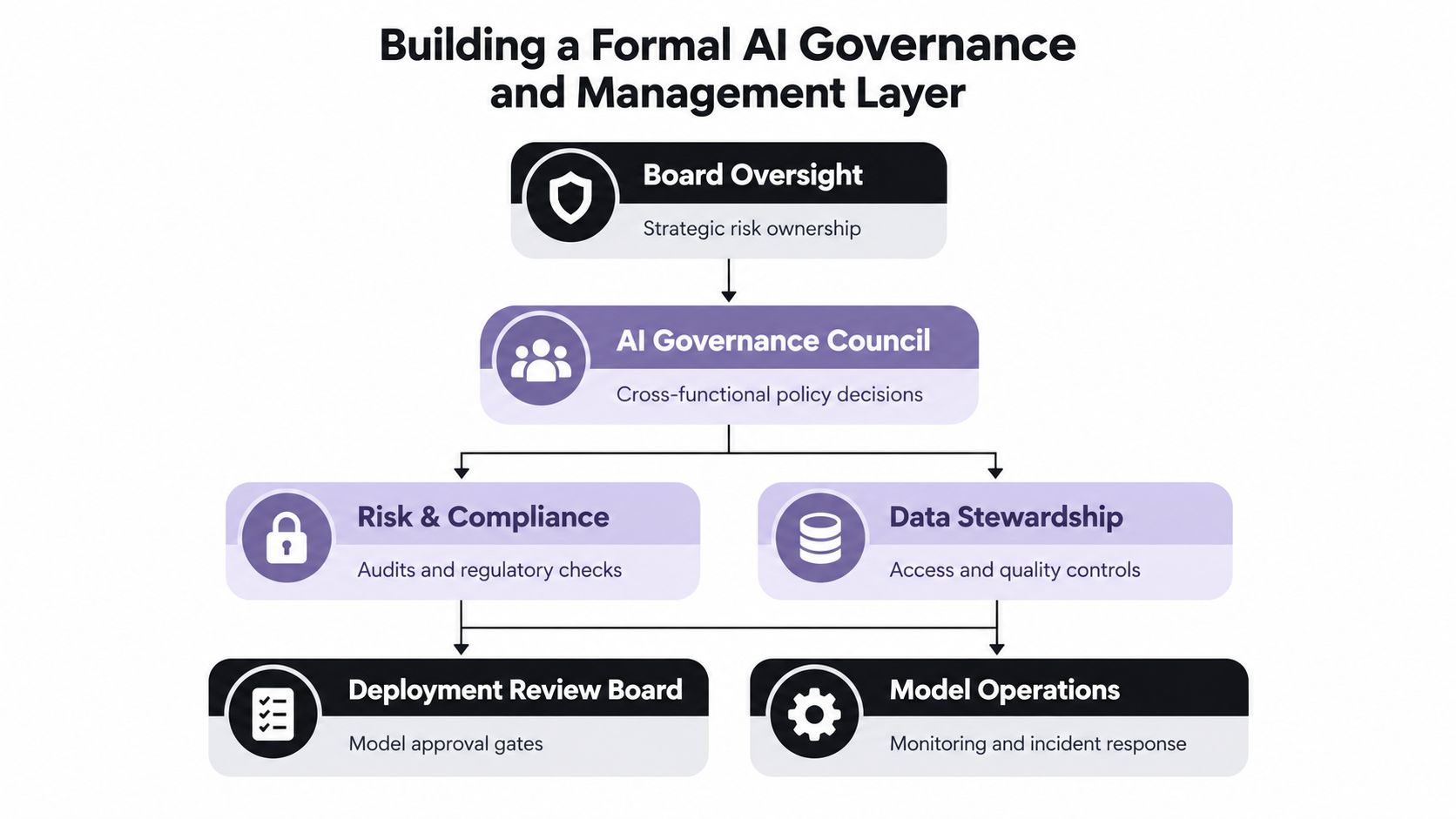
A practical management layer has several connected components:
- Strategic ownership: The board and executive team define risk tolerance, acceptable autonomy, and business priorities.
- Cross-functional governance: A council resolves policy conflicts, approves high-impact use cases, and assigns accountable owners.
- Risk and compliance review: Specialists assess privacy, regulatory exposure, model behavior, records retention, and third-party dependencies.
- Data stewardship: Data owners control access, quality, lineage, retention, and permitted use across connected systems.
- Deployment gates: A review board confirms that an agent meets testing, security, documentation, and rollback requirements before production.
- Model operations: An operational team monitors performance, tool calls, permissions, incidents, drift, and user feedback.
The important design choice is separation of duties. The person who wants an agent deployed shouldn't be the only person who approves its access or evaluates its risk. At the same time, governance can't become a queue that blocks every useful experiment. Establish risk tiers, standard evidence requirements, and pre-approved patterns for lower-risk workflows.
Deloitte's 2026 enterprise research reports that 48% of organizations introduced AI without redesigning workflows or roles, while 34% used AI to deeply transform products, processes, or business models. The gap explains why policy documents alone aren't enough. Leaders need a management mechanism that connects governance to operating redesign. Deloitte's State of AI in the Enterprise report also identifies a shift from experimentation toward execution, with infrastructure, data, risk, and talent remaining practical constraints.
Govern agents as operational actors
An agent needs an identity, a scope of authority, and a defined operating boundary. Record which systems it can access, which actions it can take, which actions it can recommend only, and when it must transfer control to a person.
Controls should cover:
- Permission boundaries: Give agents the narrowest access needed for the assigned workflow.
- Approval thresholds: Require human confirmation for sensitive communications, financial actions, personnel decisions, and irreversible changes.
- Evidence capture: Store prompts, tool calls, retrieved records, outputs, approvals, and overrides in a reviewable format.
- Testing conditions: Test ordinary inputs, incomplete data, conflicting instructions, malicious content, and system failures.
- Incident response: Define how to pause an agent, revoke access, investigate an action, and restore service.
- Financial ownership: Assign a budget owner for model usage, integration costs, maintenance, and exception handling.
KPMG's 2026 Global AI Pulse found that 86% of organizations with established ROI operated a formal cross-functional or enterprise-wide AI management layer, compared with 31% at the experimentation stage. The same evidence points to governance as a scaling capability, not a compliance ornament. For practical guidance on defining boundaries and ownership, review these practical steps for policy scope.
Teams also need a clear compliance operating model. This AI governance and compliance guide can help structure the discussion, but the final controls must reflect your systems, contracts, regulations, and risk appetite.
An effective governance layer makes AI financially legible. It tells the COO which workflow improved, which actions remain human-controlled, what exceptions cost, and whether the agent deserves broader authority. Without that layer, autonomy expands faster than accountability.
Designing Pilots for Cross-Application Agentic Automation
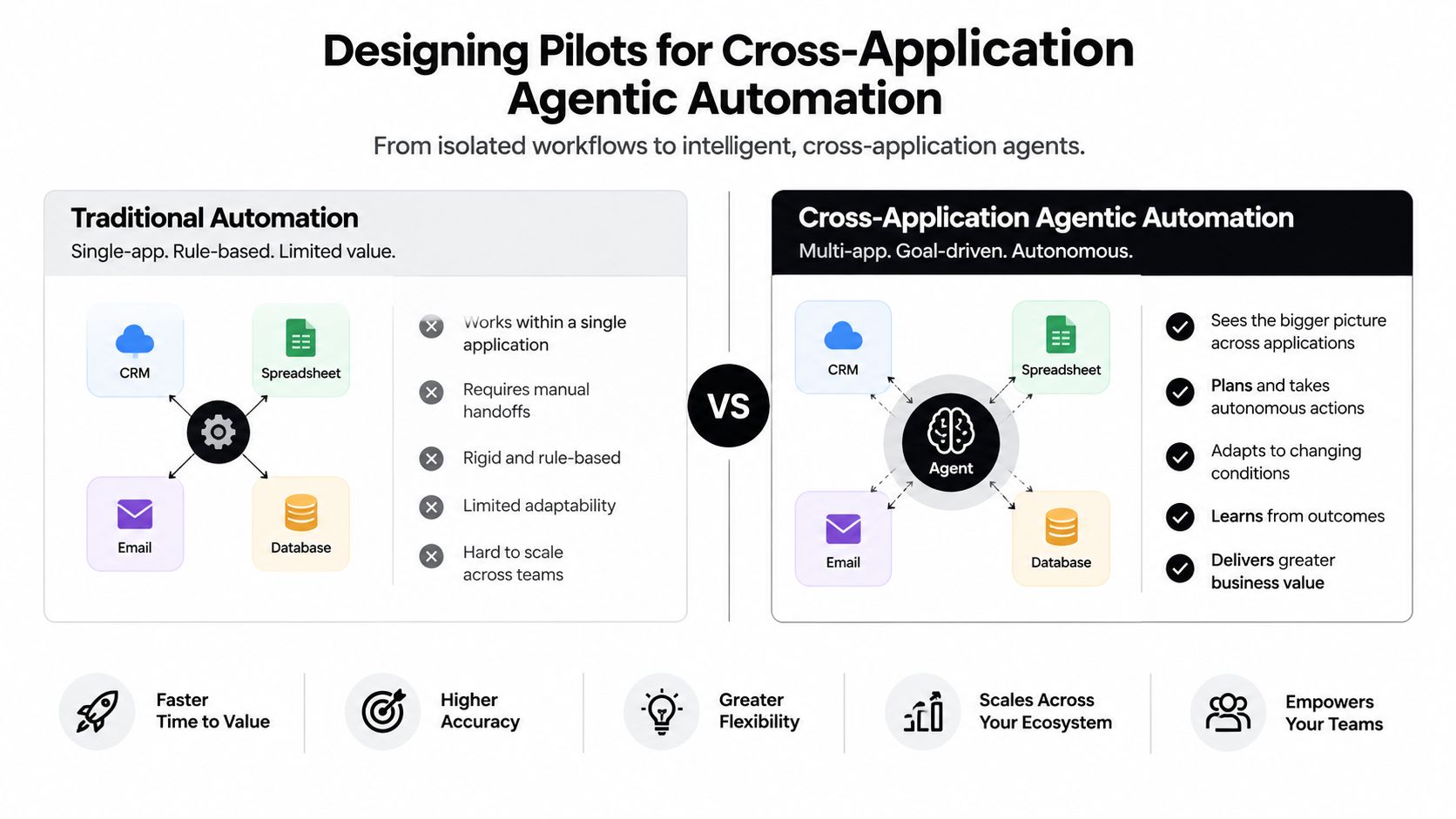
A chatbot that answers questions inside one application is not the same as an agent that completes a business process. The first responds within a narrow context. The second works across systems, carries state from one action to the next, handles conflicting information, and knows when it has reached the boundary of its authority.
That distinction should change how you design pilots. A serious pilot must test the entire workflow, not just whether the model produces fluent text.
Compare the operating experience
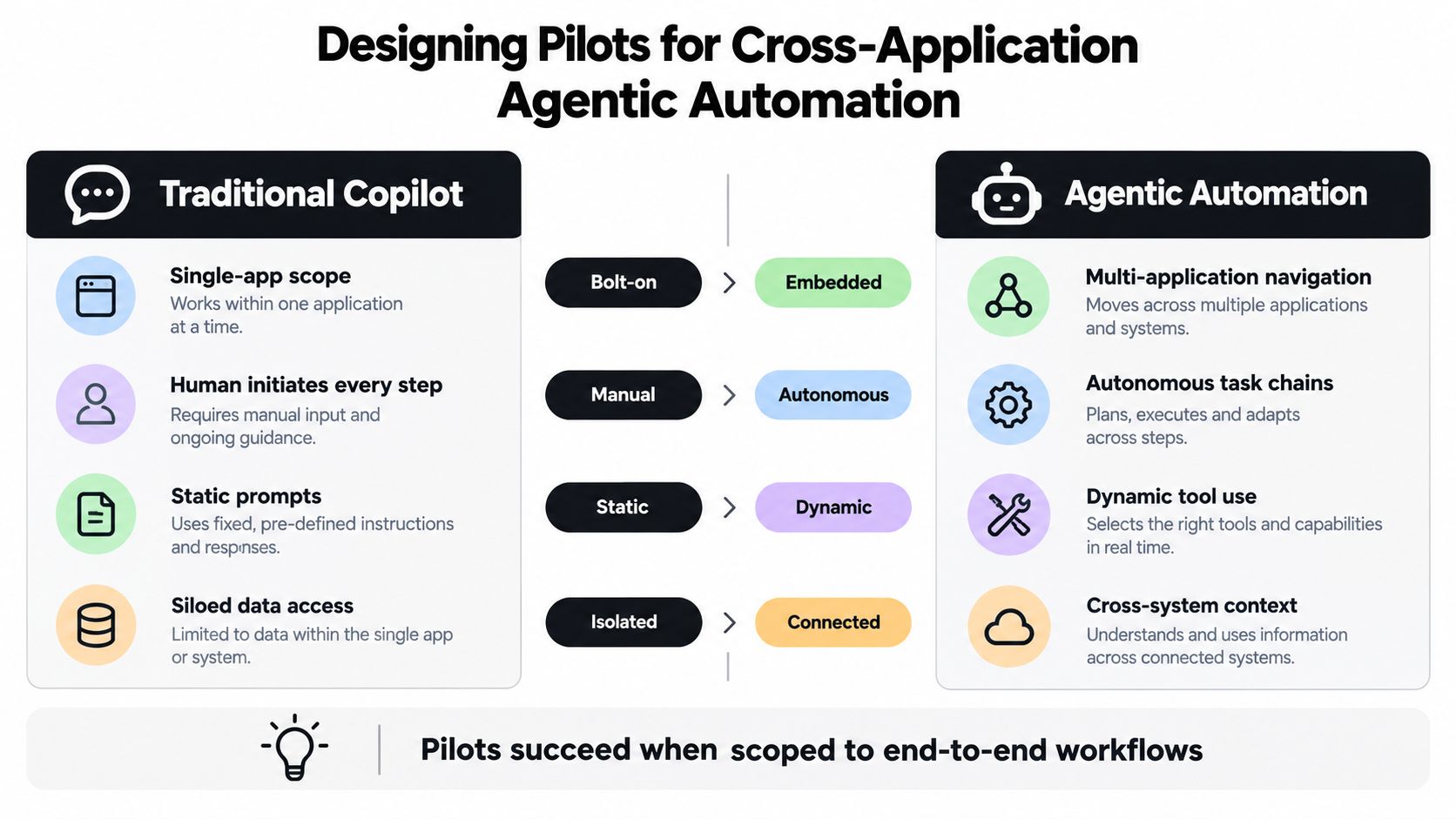
| Traditional copilot | Cross-application agent |
|---|---|
| Employee initiates each step | Agent executes an approved task chain |
| Single-application context | Context assembled across permitted systems |
| Static prompt and response | Dynamic tool selection and sequential actions |
| Human performs every update | Agent writes records and requests approval where required |
| Success measured by output quality | Success measured by end-to-end completion and control quality |
Consider a sales workflow. A conventional copilot might draft an email from a CRM record. An agentic pilot should research the account using approved sources, inspect prior correspondence, identify the relevant opportunity, draft a message within brand and policy limits, wait for approval if required, send it through the approved channel, schedule a follow-up, and record the activity in the CRM. Each transition creates a testable control point.
The AI agent integration guide is useful when mapping the systems, permissions, and handoffs required for this kind of design.
Test reliability under business conditions
A production pilot should include more than clean demonstrations. It should test:
- Sequential execution: Can the agent complete a chain of dependent actions without losing state?
- Application switching: Can it use CRM records, inbox threads, calendars, and other approved systems without confusing identities or fields?
- Distractors: Does it ignore irrelevant notes, stale records, duplicate contacts, and misleading instructions?
- Adversarial inputs: Does it resist malicious content, prompt injection, unauthorized requests, and conflicting data?
- Recovery behavior: Can it stop safely, explain the failure, and route the exception to a named person?
- Auditability: Can an operator reconstruct what the agent saw, decided, changed, and asked a person to approve?
AutomationBench evaluates agents across 47 real tools in six business functions, using live CRM data, inbox threads, calendars, sequential API calls, distractors, and adversarial inputs, as described in Zapier's AutomationBench benchmarks. The relevance for enterprise architecture is straightforward. Language quality is only one component of reliability. The essential test is controlled orchestration across software and business constraints.
Set a narrow pilot boundary, but make the boundary end to end. A pilot that drafts messages in isolation may look safe while revealing nothing about permissions, record integrity, exception handling, or downstream consequences. A smaller complete workflow produces better evidence than a larger collection of disconnected demonstrations.
Managing Change and Upskilling for Human-AI Collaboration
AI changes jobs first by changing task composition. Employees who once researched, entered, checked, routed, and reported may spend more time defining rules, supervising exceptions, validating outputs, and improving the workflow. That transition creates anxiety when leadership describes automation as a tool rollout instead of a redesign of responsibilities.
The answer isn't a generic training session. People need to know exactly what they remain accountable for, what the agent can do, what evidence they should inspect, and how they can challenge or correct a result.
Redesign roles around control and judgment
A useful role map separates four kinds of work:
- Execution: The agent performs repeatable actions inside defined permissions.
- Supervision: An operator reviews queues, approvals, alerts, and exceptions.
- Judgment: A subject-matter expert handles ambiguity, negotiation, sensitive context, and novel cases.
- Improvement: A process owner updates instructions, tests edge cases, measures outcomes, and removes unnecessary steps.
This model avoids the false choice between “employees do everything” and “AI replaces employees.” It also gives managers a practical basis for job design. A customer support specialist might move from answering every routine question to supervising response quality, managing escalations, and improving the knowledge base. A finance analyst might spend less time reconciling predictable transactions and more time investigating anomalies and strengthening controls.
Train people on failure, not just features
Employees should practice rejecting an incorrect recommendation, identifying missing context, escalating a risky action, and documenting an override. Training must include the actual systems and approval paths used in production, not an abstract demonstration environment.
Managers should publish a short operating playbook that answers:
- What does the agent own?
- What must a person approve?
- What evidence supports an action?
- How should a worker report a failure?
- Who can pause the workflow?
- How will performance be reviewed?
Measure adoption through behavior, not logins. Look for accurate approvals, appropriate escalations, fewer manual handoffs, cleaner records, and consistent use of the redesigned workflow. If employees bypass the agent, the problem may be poor design, weak trust, excessive review, or an incentive structure that still rewards the old process.
The employee's job is not to trust the agent. The employee's job is to operate the control system around it.
Change leadership also needs to address incentives. If a sales team is evaluated only on activity volume, representatives may avoid an agent that changes how activity is recorded. If support staff are punished for escalating uncertain cases, they may approve outputs they don't trust. Role redesign works only when performance management, training, and governance reinforce the same operating model.
Executing the Phased Engagement Model for Rapid ROI
A phased engagement model works because it reduces the distance between strategy and production. The phases should not be treated as a presentation sequence. Each phase must create an operational artifact that the next phase can use.
Consultation creates the operating brief
The first phase begins with interviews, workflow observation, systems inventory, and risk review. The team should follow work through the tools employees use, including the CRM, inbox, finance platform, Shopify, advertising accounts, recruiting systems, and internal documentation.
The output is a prioritized operating brief with:
- The target workflow and current failure points
- The tasks suitable for agent execution
- The tasks that require human judgment
- Required integrations and data permissions
- Approval and escalation rules
- Baseline measures and target outcomes
- A named business owner and operating team
This phase should challenge the requested solution. If a department asks for a chatbot but the underlying bottleneck is lead routing, record quality, or approval latency, the roadmap should say so. Good advisory work narrows the problem before development begins.
Implementation turns the design into a controlled worker
The implementation phase builds the agent around the approved workflow. A sales agent might research prospects, draft outreach, classify replies, update the CRM, and route qualified opportunities. An operations agent might assemble KPI dashboards from Shopify, advertising platforms, CRM records, and finance data. A recruiting agent might coordinate pipeline steps while leaving sensitive decisions with the hiring team.
The build should include the control plane from the beginning. Configure permissions, logging, approval gates, test cases, rollback behavior, and monitoring alongside the workflow logic. Don't bolt governance on after a successful demo, because the production constraints will change the design.
A deployment review should require evidence that the agent can handle incomplete data, conflicting records, duplicate requests, and unauthorized instructions. The team should also document what happens when an integrated system is unavailable. A controlled failure is a feature, not a defect.
Transformation compounds the result
The transformation phase expands the capability after the first workflow proves stable. The organization can add adjacent tasks, connect another system, or extend the agent to a related team, but only after reviewing evidence from real operations.
For example, a customer analysis workflow may begin with data assembly and reporting, then add anomaly detection and approved recommendations. A sales workflow may begin with research and CRM hygiene, then extend into follow-up coordination and pipeline summaries. A services team may replace a collection of narrow SaaS utilities with an internal system that reflects its actual delivery process.
The important measure is not how many agents exist. It is whether the business now completes valuable work with fewer unnecessary handoffs, clearer accountability, better records, and controlled exception handling. Review those outcomes with the workflow owner, finance lead, security team, and frontline operators. If the agent saves time but creates review work elsewhere, the operating model hasn't improved yet.
A disciplined engagement keeps the loop active:
- Observe the workflow in production.
- Review agent actions and human overrides.
- Remove friction from the process.
- Adjust permissions and instructions.
- Train the team on the revised responsibilities.
- Expand only when controls and outcomes remain stable.
That is how an AI transformation strategy moves from a promising deployment to a repeatable enterprise capability.
Future-Proofing Your Enterprise AI Roadmap
AI capabilities will change faster than most operating models can absorb. A static roadmap tied to one model, vendor, or interface will age badly. A durable strategy anchors the business to workflows, permissions, data contracts, outcome measures, and governance structures that can accommodate better tools later.
Use a quarterly operating review to ask:
- Which workflows now run differently because of AI?
- Which agents create measurable business value?
- Where do humans still perform avoidable manual work?
- Which exceptions occur repeatedly and deserve process redesign?
- Are permissions narrower or broader than the agent needs?
- Can the team reconstruct every consequential action?
- Does each agent have a named owner, budget, and shutdown procedure?
- What adjacent workflow should be redesigned next?
The roadmap should also preserve optionality. Keep business logic separate from model-specific prompts where practical, use portable data structures, document integrations, and avoid giving a single vendor unchecked control over critical decisions. The objective isn't to predict the next model. It's to make the operating model capable of adopting useful capabilities without repeating the original design work.
AI is now a permanent shift in capability allocation. The companies that benefit won't be the ones with the largest collection of tools. They'll be the ones that redesign work deliberately, govern agents as operational actors, and teach people how to supervise intelligent systems under real constraints.
Cyndra helps organizations audit workflows, design secure AI employee architectures, build production-grade agents, integrate them with existing tools, and train teams to operate them. Visit Cyndra to turn a priority workflow into a governed AI transformation plan and deployment.