 CYNDRA
The popular advice about contact center integrations is backwards. Leaders are told to pick a platform, connect the APIs, and launch an AI agent. That approach produces an impressive demo and a fragile operation. The failures appear later, when the agent can't authenticate a caller, issue a refund, retrieve a prior ticket, or pass useful context to a human.
An integration isn't finished when the connector works. It's finished when the right data reaches the right person, every workflow has an owner, and the team can detect silent degradation after launch. The operator accountable on day 30 matters more than the vendor demo on day 1.
Table of Contents
- Why Integrations Decide Whether AI in the Contact Center Actually Works
- The Four Integration Layers Every Contact Center Connects
- Three Architecture Patterns and When to Choose Each
- Latency, Security, and PCI Scope in Payment-Heavy Flows
- The AI-to-Human Handoff and What Must Travel With It
- KPIs That Tell You the Integration Is Healthy
- A 60-Day Rollout Plan for Operations Leaders
Why Integrations Decide Whether AI in the Contact Center Actually Works
AI agents don't create value in isolation. They need access to customer history, permission to update systems of record, and a dependable path to human assistance. Without those connections, an AI agent is often just a conversational front end attached to a narrow knowledge base.
The underlying idea isn't new. Computer-telephony integration established the foundational model by linking telephone systems with backend computer applications. Early CTI concepts developed in 1982, and the technology expanded significantly during the early and mid-1990s as contact centers connected call-handling infrastructure with databases and business systems. That progression enabled screen pops, automatic call logging, click-to-dial, coordinated reporting, and CRM-linked workflows, as documented in this history of CTI and contact center technology.
The modern version adds chat, SMS, email, AI reasoning, payment systems, and workflow automation. The operating principle remains the same: one event should update the systems that depend on it without forcing an employee to re-enter the information manually.
The failures that surface after launch
Six weeks after launch, leaders usually stop talking about model quality and start talking about broken state.
- Authentication fails: The AI verifies a caller, but that status doesn't reach the CRM or the human agent.
- Actions stop halfway: The agent promises a refund or account change, but lacks write access to the relevant system.
- History disappears: The human receives a warm transfer without the transcript, intent, previous troubleshooting, or unresolved question.
- Records conflict: The help desk shows one customer status while the billing platform shows another.
- Reports become unreliable: Interaction data, ticket data, and outcome data use different identifiers, so no one can connect the conversation to the final resolution.
These aren't isolated engineering defects. They're ownership defects. Someone must define the data contract, approve permissions, resolve conflicting records, monitor event failures, and decide what happens when a downstream system is unavailable.
Operational rule: Treat every integration as a product with a named owner, a service expectation, a change process, and a rollback path.
The evolution of contact centers followed a similar pattern. Early milestones solved customer access and call routing, then connected routing with databases and operational systems. The documented evolution of the contact center shows why today's omnichannel and AI workflows should be designed as connected operating processes, not a collection of independent features.
The Four Integration Layers Every Contact Center Connects
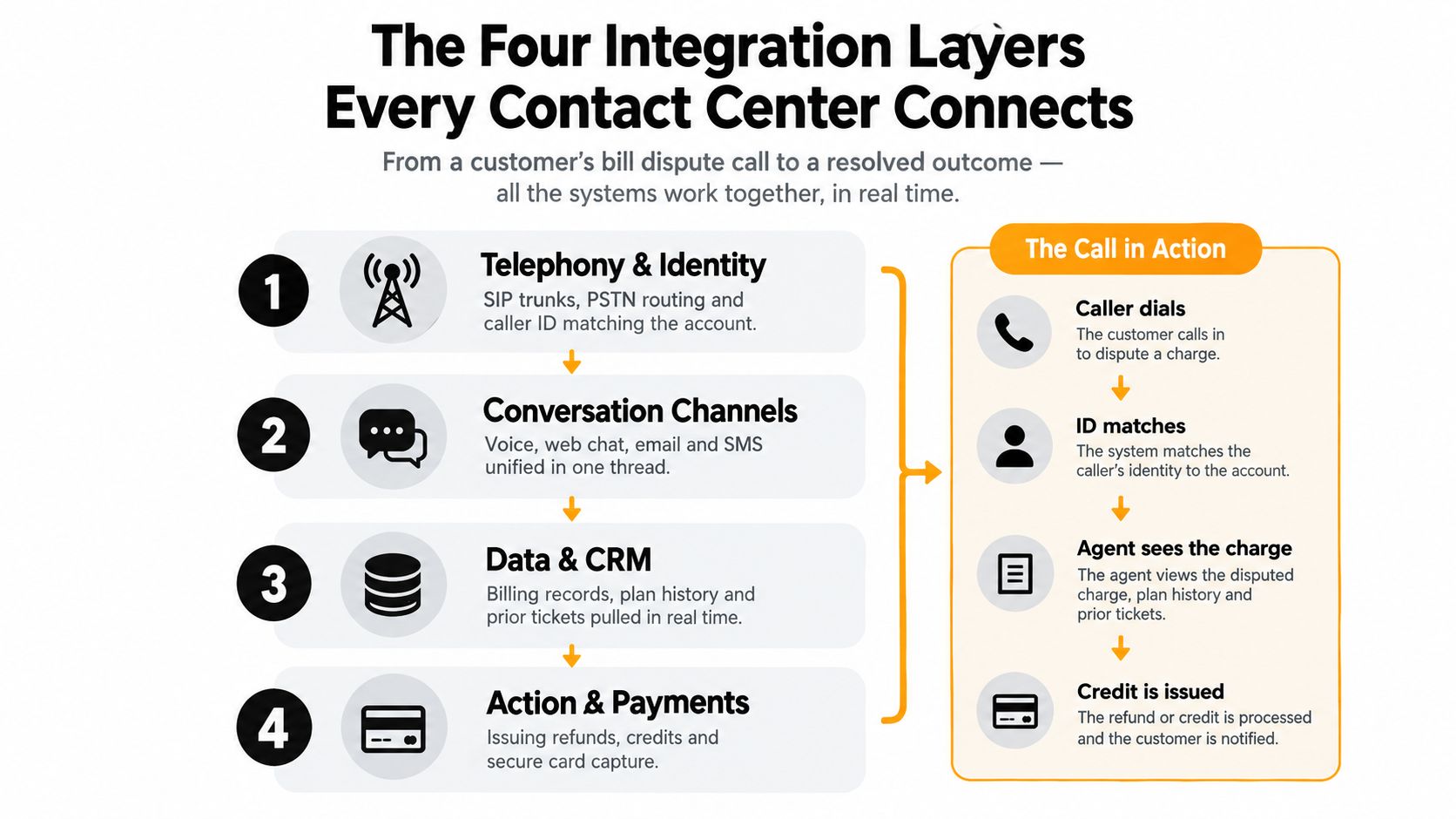
Take a bill-dispute call. A customer dials, the system identifies the caller, the agent sees the disputed transaction, and an approved credit is issued. That simple experience depends on four distinct layers.
Layer one connects telephony and identity
The first layer carries the interaction. It includes the public telephone network, SIP infrastructure, call routing, caller ID, authentication services, and the identifiers used to match a person with an account.
If caller ID points to the wrong customer record, every layer above it starts with bad context. If the identity service verifies the caller but fails to publish that state, the agent may ask for authentication again or take an action the policy doesn't allow.
This layer also determines where calls go. Skill-based routing, queue assignment, transfers, consults, and callbacks all depend on reliable interaction metadata.
Layer two unifies the conversation
Voice, web chat, SMS, and email are separate channels from a transport perspective. Customers experience them as one relationship, though, so the integration should preserve a shared thread or at least a consistent customer and case identifier.
A customer who starts a dispute in chat shouldn't need to explain the entire issue again by phone. The agent needs the prior messages, current intent, authentication state, and any promised follow-up. Channel unification isn't just a presentation feature. It's a state-management problem.
Layer three holds the operational truth
CRM records, ticketing platforms, order management, billing systems, and payment services live here. The contact center reads history and writes outcomes in this environment.
Define the system of record for each field before building workflows. The CRM might own contact details, the order platform might own fulfillment status, and the billing system might own balances and credits. If two systems can overwrite the same field without a clear precedence rule, the integration will eventually create contradictory records.
Layer four measures what happened
Transcription, quality assurance, workforce analytics, business intelligence, interaction summaries, and audit logs make up the observability layer. It tells managers whether the process worked and gives teams the evidence needed to improve it.
AI quality is bounded by the weakest layer. A strong model can't compensate for missing identity data, stale account records, or an analytics pipeline that loses transfer outcomes. Assess each layer separately, then fix the constraint that blocks safe action before adding another channel or model.
Three Architecture Patterns and When to Choose Each
There are three practical ways to connect an AI agent with the rest of a contact center.
Point-to-point connectors link the agent directly to the CRM, ticketing system, payment provider, knowledge base, and analytics tools. This is quick when the workflow is narrow and the vendor APIs are stable. It becomes difficult to govern as each new system adds another authentication method, event format, retry policy, and failure mode.
Middleware or an iPaaS layer sits between the agent and business systems. It translates schemas, manages authentication, applies routing and validation rules, and provides one place to observe failures. The trade-off is another platform to operate, but that platform can absorb vendor changes without forcing a rewrite of every workflow.
A unified agent desktop embeds telephony, AI assistance, customer records, and workflow actions into one workspace. It reduces application switching and can improve consistency for human agents. The risk is dependence on the desktop vendor's data model, release schedule, permissions model, and supported systems.
| Architecture Pattern Comparison | Time to Value | Governance Risk | Best Fit |
|---|---|---|---|
| Point-to-point connectors | Fast for a small, contained workflow | Grows quickly as systems and permissions multiply | A focused team with stable tools and limited integration scope |
| Middleware or iPaaS | Moderate, because the shared layer needs design | Lower duplication risk, but middleware becomes operationally critical | Ops-led teams that expect vendor changes and multiple workflows |
| Unified agent desktop | Fast when the chosen suite already owns the key systems | Concentrated dependency and possible lock-in | Centers standardizing on one customer-service workspace |
The choice should follow the workflow, not the vendor pitch. Ask who will own credentials, schema changes, retries, monitoring, and incident response. Ask what happens when the CRM is unavailable, a webhook arrives twice, or a human agent edits a record while the AI is still processing the conversation.
For most operations-led teams, middleware is the safest starting point. It creates a controlled boundary between conversational systems and systems of record. Use direct connectors when the process is simple. Choose a unified desktop when the organization is prepared to adopt its operating model rather than merely embed a phone panel.
Latency, Security, and PCI Scope in Payment-Heavy Flows
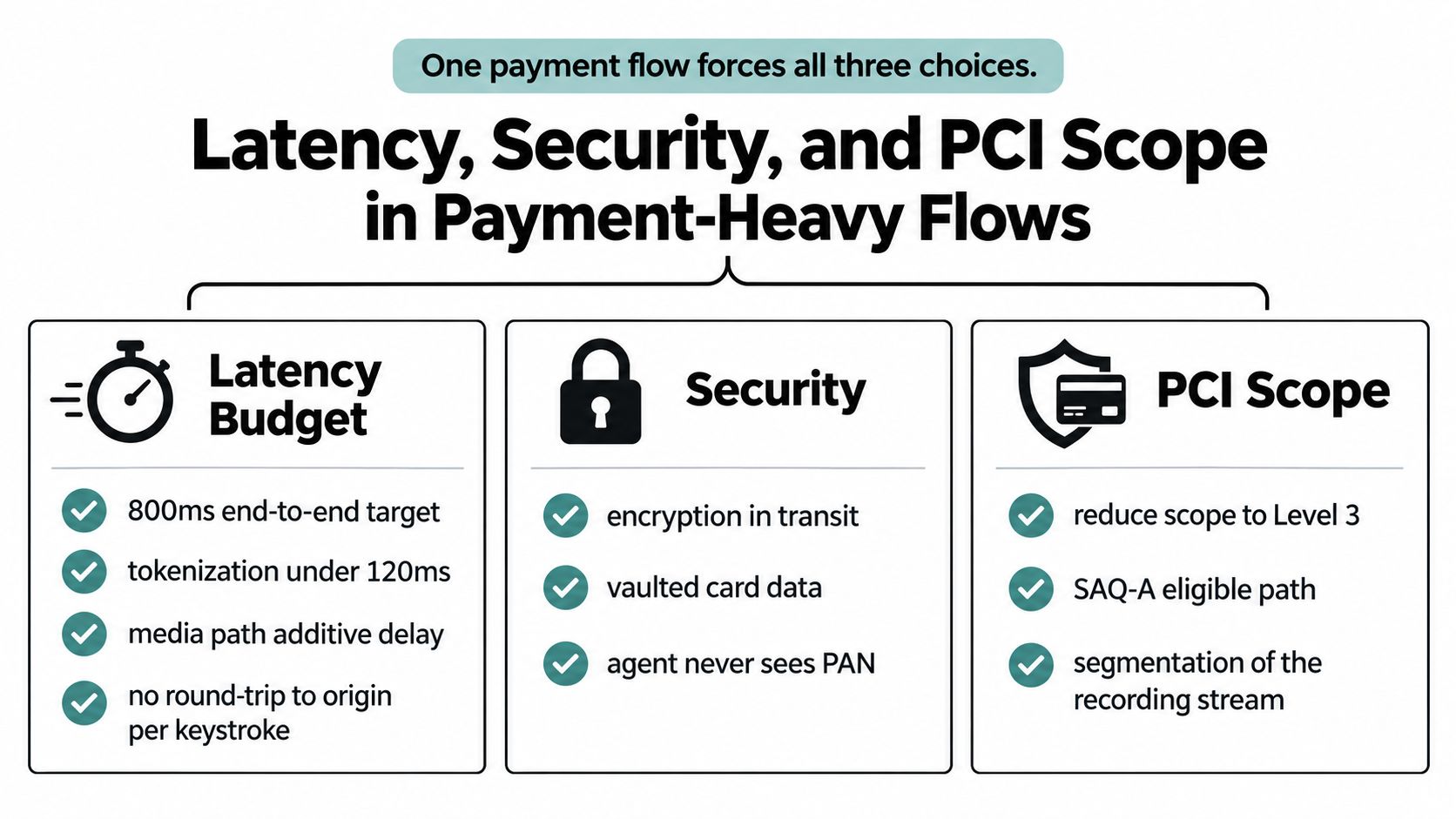
Payment interactions force three decisions at once. The team must decide how quickly the customer receives a response, how payment data is protected, and which systems fall inside the compliance boundary. Treating those as separate workstreams creates expensive rework.
A payment flow can feel broken even when every component works. Speech recognition adds delay, the AI needs time to reason, the payment gateway must respond, and the agent may wait for confirmation before continuing. Set an explicit response budget for each stage, then test the full path under realistic load. Don't evaluate latency by timing only the model response.
Choose the payment boundary before you choose the connector
Tokenization keeps sensitive payment values in a controlled vault and lets downstream systems work with a token. Audio pause-and-resume is weaker because it depends on an agent or workflow reliably stopping the recording at the right moment.
PCI DSS prohibits retaining sensitive authentication data, including CVV or CVC values, PINs, and equivalent authentication codes, after authorization, even when a recording is encrypted. A pause button can also leave values in media buffers, caches, transcripts, or downstream systems. The contact center PCI scope guidance.pdf) supports a stronger pattern: intercept keypad input through DTMF masking, replace tones with non-sensitive signals before recording, and keep raw payment values away from the agent desktop, CRM, quality warehouse, and transcription pipeline.
Before approving a design, map every data path. Include the telephony provider, recording service, transcription engine, CRM, analytics lake, backup system, and support tooling. Mark where sensitive values could appear, then verify that each hop excludes or automatically redacts them.
Useful review rules are simple:
- No raw card values in transcripts: The AI and quality systems should receive a masked or tokenized representation.
- No broad write permissions: Payment actions should use a narrowly scoped service identity.
- No hidden recording path: Confirm what happens to audio during transfers, holds, retries, and outages.
- No compliance assumptions: Require the vendor to document the data flow and responsibility boundary.
- No untested failure mode: Test interrupted calls, duplicate events, delayed gateway responses, and partial writes.
Security architecture belongs in the integration design. Guidance for cloud contact centers recommends OAuth 2.0, role-based permissions, SAML 2.0 federation, encryption in transit and at rest, tenant-specific encryption keys, short-lived tokens, automatic key rotation, access logging, rate limits, idempotency, webhook signature validation, replay protection, and correlation IDs. The cloud contact center threat model provides the relevant control framework. For a broader treatment of AI data controls, review AI data security practices.
The AI-to-Human Handoff and What Must Travel With It
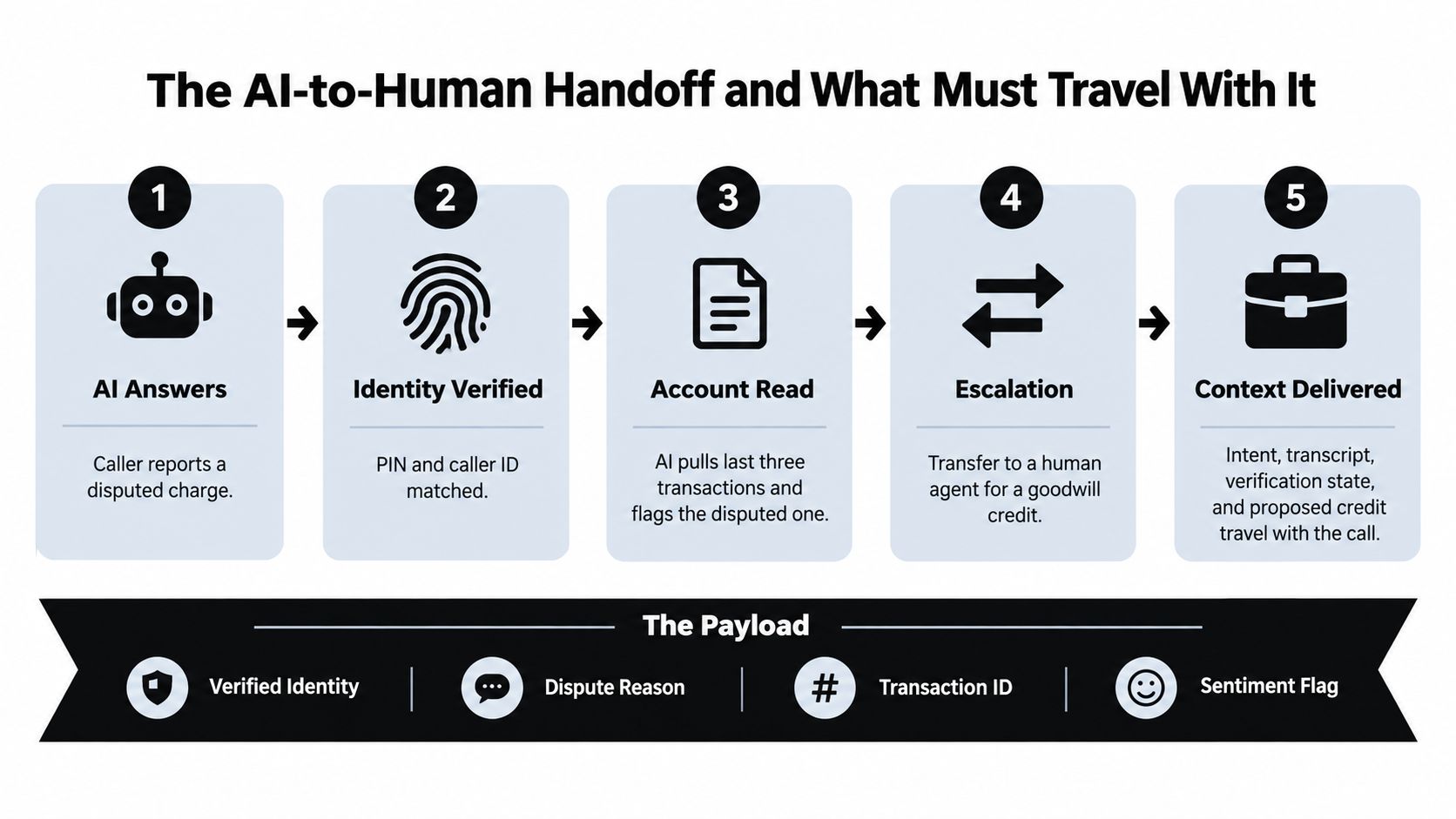
A customer calls about a disputed charge. The AI verifies identity, retrieves the account, identifies the relevant transaction, and determines that a human must approve a goodwill credit. The transfer itself is easy. The difficult part is preserving the work already completed.
The human agent needs more than a phone number and a transfer reason. They need to know whether identity verification passed, what the customer wants, which transaction is disputed, what the AI already attempted, why escalation occurred, and what the customer has been promised.
Build the payload around decisions
A useful handoff payload includes:
- Identity verification status: What was verified, through which method, and whether the result permits the next action.
- Customer intent: The request expressed in operational terms, not only the raw transcript.
- Conversation transcript: Enough history for the agent to understand the exchange, with sensitive data removed.
- Sentiment and urgency: A flag that helps the agent prioritize tone and escalation handling.
- Actions already taken: Searches, policy checks, account updates, and failed attempts.
- Reason for escalation: The exact boundary the AI reached, such as an approval requirement or unresolved ambiguity.
- Pending commitments: Any callback, credit, explanation, or follow-up promised to the customer.
- Identifiers: Customer, case, order, transaction, and interaction IDs that let the agent open the relevant records.
The payload should arrive before or with the transfer, not as a summary the human must request. If one system uses a case ID and another uses a conversation ID, the integration should carry both and preserve the relationship between them.
The handoff is not a transfer event. It's a structured operational event with a payload, an owner, and a failure policy.
The experience gap is measurable. Forty-one percent of customers report frustration when transferred from AI to a human because they must repeat information, while only 38% of contact centers report complete visibility into customer history across channels, according to the research on AI-to-human context continuity. Those figures point to an integration problem, not a training problem.
A handoff specification should also define what happens when systems disagree. If authentication says verified but the CRM says unknown, the human needs a visible warning and a safe fallback. If the transcript is delayed, the agent should receive the intent, identifiers, and escalation reason rather than a blank screen. If the transfer fails, the AI needs a recovery instruction instead of repeatedly attempting the same action.
The following video offers a useful visual reference for thinking about the transition from automated handling to human ownership.

Measure the handoff itself. Track repeat-contact rate, transfer abandonment, time to resolution, customer effort, re-authentication after transfer, transcript completeness, and whether the final outcome was written back to the system of record. If those signals worsen, adding another channel or a more capable model won't solve the underlying continuity failure.
KPIs That Tell You the Integration Is Healthy
A vendor dashboard filled with containment and average handle time isn't enough. Those metrics can look healthy while the handoff payload is incomplete, records are stale, or payment data is drifting into systems that shouldn't receive it.
Give the vendor a KPI contract organized around four families. Each metric should identify the integration layer it tests and the person responsible for responding when it moves outside the agreed range.
| KPI Families and Reporting Cadence | Example Metric | Definition | Review Cadence |
|---|---|---|---|
| Latency | Context delivery delay | Time between escalation initiation and the human receiving the required handoff fields | Daily operational review |
| Resolution | Successful action completion | Share of approved workflows that complete in the system of record without manual re-entry | Daily operational review |
| Handoff quality | Transcript completeness | Presence of the required transcript, intent, verification state, identifiers, and attempted actions | Weekly quality spot-check |
| Compliance | PCI scope drift | Any appearance of sensitive payment data in a system or stream excluded from the approved design | Immediate alert and weekly review |
Measure the hidden failure signals
Re-authentication after handoff exposes whether identity state travels with the interaction. A high rate means the customer or agent is repeating work.
Transcript completeness matters more than transcript availability. A transcript that arrives late, omits the escalation reason, or strips the relevant transaction context doesn't support resolution.
Action write-back success shows whether the AI completed the operational task rather than merely producing a convincing response. Check the downstream record, not the model's statement that it performed an action.
Duplicate event rate identifies weak idempotency. A repeated webhook shouldn't create duplicate tickets, duplicate credits, or conflicting status changes.
PCI scope drift catches the quiet expansion of compliance exposure. Review recordings, transcripts, caches, exports, analytics tables, and backups, not only the primary payment service.
For a broader approach to connecting operational outcomes with measurement, use these operational efficiency metrics as a complement to contact center measures.
Run the program on a fixed rhythm. Operations should review incidents, latency, failed actions, and queue effects daily. Quality leaders should inspect real handoffs weekly, including cases that appeared successful. Executives should receive a monthly readout covering customer effort, resolution quality, security exceptions, open defects, and ownership gaps.
The most important dashboard field may be owner. A metric without a named responder becomes a report, not a control.
A 60-Day Rollout Plan for Operations Leaders
A connector can work on day one and still fail by week three. Real customers expose missing context, incomplete permissions, conflicting records, and escalation rules that seemed reasonable in a workshop. Treat the rollout as a governance program with a fixed operating cadence, not as a connector installation.
Use three 20-day blocks. They are a practical control rhythm, not a promise that every implementation fits the same schedule. Each block should produce evidence that the workflow is safe to expand.
Days 1 to 20 establish control
Begin with an integration inventory. Record every channel, system of record, API, webhook, recording path, identity service, payment service, analytics destination, and backup location involved in the target workflow.
Assign a named owner to each connector and one accountable owner for the complete customer journey. Document every field that crosses a system boundary, the permissions it requires, retry behavior, failure handling, and the fallback used when a dependency is unavailable. Include the AI-to-human payload in this inventory. It should specify the customer identity state, conversation summary, transcript or relevant excerpts, intent, sentiment where used, authentication status, actions already attempted, transaction identifiers, promised follow-up, and reason for escalation.
Build the KPI dashboard before sending new traffic. Establish baselines for latency, action completion, handoff quality, authentication behavior, and compliance scope. Write rollback triggers in plain language so operations can stop the workflow without waiting for an engineering debate.
The governance requirement is substantial. A 2025 ICMI industry report found that 97% of respondents said AI requires iteration and refinement rather than a one-time launch, while roughly half believed legacy systems would not work well with new AI tools, 45% lacked in-house expertise for smooth deployment, and 41% worried inaccurate data would undermine performance. The findings are summarized in the 2025 ICMI and NiCE report.
Days 21 to 40 run a controlled pilot
Choose one high-volume intent with a measurable success condition and a firm escalation boundary. Avoid the most complex workflow first. Select a journey where the team can inspect each step from the customer request through the system-of-record update.
Run real handoffs and audit what the human received. Compare the approved handoff specification with the production payload. Check for missing identity state, truncated transcripts, absent identifiers, stale customer data, duplicate tickets, and commitments that never reached the case record. A handoff that sounds helpful but omits the next action, customer promise, or relevant authentication result is operationally incomplete.
Keep an incident log covering customer impact, technical cause, owner, temporary workaround, and permanent fix. Test degraded conditions deliberately. Pause a dependency, delay a webhook, revoke a token, create a partial write, and verify that the fallback protects the customer and the business.
Days 41 to 60 scale with discipline
Add a second intent only after the first has a stable owner, measured handoff quality, and an approved rollback procedure. Formalize change control for prompts, schemas, permissions, routing rules, knowledge sources, and model settings. A second intent often exposes unclear schema ownership or permissions that were hidden by the first workflow, so assign those decisions before increasing traffic.
Write the rollback runbook for operations to use. State who can disable the AI path, how open conversations are reassigned, how incomplete actions are reconciled, and how customers receive follow-up. Engineering should support the procedure, but live service should not depend on an unavailable developer.
The same ICMI and NiCE research cited earlier found that 67% of contact centers struggled to connect generative AI with their existing technology stack, and that data normalization represented 38% of total project time in legacy integrations. Make schema ownership and data-quality monitoring rollout requirements rather than cleanup tasks.
Before day 60, require these artifacts:
- Owner matrix: One accountable person for every system, connector, workflow, and customer outcome.
- Handoff specification: Required fields, timing, identifiers, fallback behavior, and privacy rules.
- Escalation policy: Conditions requiring a human, approval thresholds, and customer communication rules.
- KPI baseline: Definitions, data sources, review cadence, and response owners.
- Incident playbook: Rollback triggers, outage procedures, reconciliation steps, and post-incident review.
- Change-control calendar: Permission reviews, workflow tests, prompt regression checks, and data-quality reviews.
Teams connecting AI agents with help desks, CRMs, chat platforms, and internal tools can evaluate AI agent integration services against these requirements. The implementation method matters less than whether the workflow has observable state, controlled permissions, and an accountable operator.
If your contact center needs more than a connector, Cyndra can install, train, and manage AI employees that integrate with support, CRM, chat, and operational tools. Define the handoff payload, ownership model, and KPI contract before scheduling a working session.