 CYNDRA
Your CRM is full of names, your marketing team is publishing consistently, and sales still says the pipeline is weak. Leads arrive without context, high-intent requests wait too long for a response, and nobody can explain which channel created the opportunity. That isn't a traffic problem. It's a broken lead generation process.
A reliable process connects audience definition, channel selection, capture, enrichment, qualification, follow-up, handoff, and measurement. AI can remove repetitive work inside that system, but it can't rescue vague positioning, dirty data, or weak buying criteria. Build the operating model first, then automate the parts that deserve to scale.
Table of Contents
- Why Most Lead Generation Processes Fail
- Defining ICP, Channels, and Offers That Fit
- Capturing, Enriching, and Routing Leads in Real Time
- Qualifying and Scoring Leads With Real Buying Signals
- Outreach Sequences and the Sales Handoff
- KPIs, Attribution, and Dashboards Operators Actually Use
- Failure Modes and How AI Changes the Lead Generation Process
Why Most Lead Generation Processes Fail
A marketing team can publish daily, buy qualified traffic, and still hand sales a weak pipeline. The failure usually sits inside the operating system: unclear ownership, missing context, slow decisions, and no shared definition of a sales-ready lead.
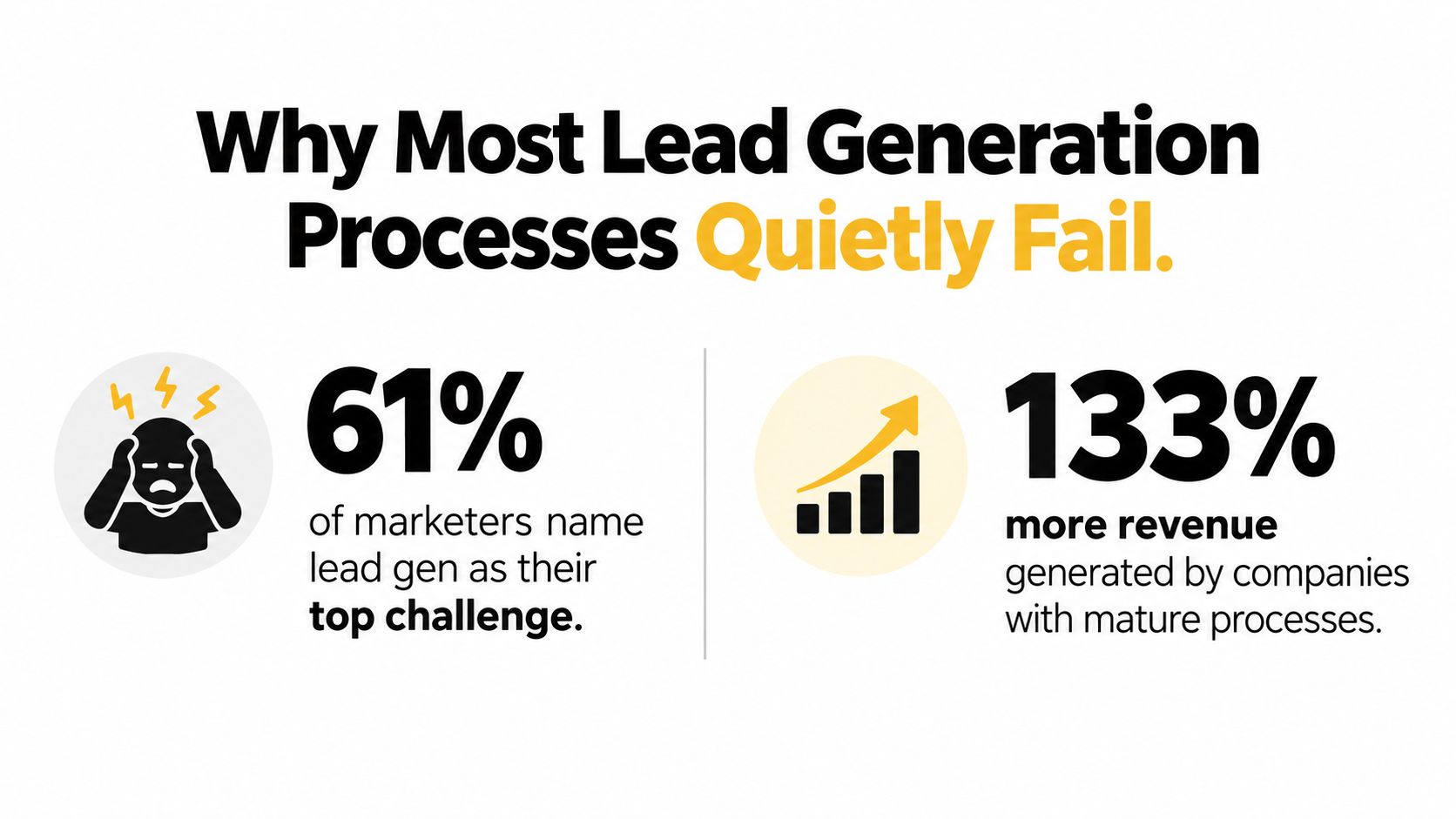
61% of B2B marketers identify generating high-quality leads as their biggest challenge, while companies with mature, documented lead generation processes report 133% more revenue than companies without a defined process, according to the CIENCE benchmark on lead generation. Activity alone does not create pipeline. A process must turn activity into a clear next action.
The usual breakdown looks like this:
- The ICP is vague: Marketing targets broad industries, while sales pursues whichever account seems familiar.
- Channels operate independently: SEO, paid search, events, outbound, and communities produce signals that never form one account view.
- Forms collect too little context: A name and email enter the CRM without the buyer's use case, urgency, or buying role.
- Response is slow: Interest fades while the lead waits for review or assignment.
- Qualification is subjective: One representative treats a content download as sales-ready, while another overlooks a high-intent page visit.
- Handoffs lose context: Sales receives a record instead of a reason to start the conversation.
The result looks healthy in a dashboard but fails under inspection. Revenue teams spend time sorting duplicates, correcting records, chasing unresponsive contacts, and deciding who owns each lead. The benchmark on lead generation reports that only 27% of B2B marketing-generated leads are ever contacted by sales. Whether the issue is capture, routing, follow-up, or qualification, demand is being lost after it enters the system.
Fix the sequence, not just the symptoms
Set the operating rules before increasing spend. Define who belongs in the funnel, which problem earns attention, what evidence indicates intent, and who acts next. Then make capture useful, route records immediately, and preserve the context sales needs.
AI employees should enforce that system, not compensate for its absence. An agent that generates more outreach for a poor ICP creates more low-quality noise. An agent that enriches records, detects intent, routes ownership, summarizes conversations, and follows explicit rules can reduce delays and protect pipeline quality.
Operator rule: Every lead needs a next action, an owner, a reason for that action, and a timestamp. If your CRM cannot show those four items, the process is not operational.
Defining ICP, Channels, and Offers That Fit
Don't buy traffic until you can describe the customer you want with enough precision for a salesperson to recognize them. Your Ideal Customer Profile should combine firmographic fit, buyer role, trigger events, pain intensity, and disqualifiers.
For a B2B SaaS company, that might mean finance teams at growing technology businesses using a specific accounting stack, with a newly hired finance leader and a manual reporting problem. For an agency, the ICP could be ecommerce brands with an internal marketing owner, an active acquisition budget, and a site that needs technical and content work. An operator-led consultancy may target founders who have validated demand but still run sales, reporting, and delivery from spreadsheets.
Match channels to buyer behavior
Use the channel where the buyer already expresses the problem:
- High-intent search: SEO and paid search work when prospects actively compare solutions, investigate pricing, or search for a defined fix.
- Trust-led discovery: Partnerships, communities, webinars, and expert content suit buyers who need proof before they share contact details.
- Account-specific selling: Events, targeted outbound, and account-based campaigns fit enterprise sales where several stakeholders influence the purchase.
- Owned relationships: Email and customer referrals become more valuable once you can segment by problem, role, and lifecycle stage.
The offer must match the buyer's awareness. A calculator or benchmark helps someone frame a problem. A template or playbook helps an active evaluator make progress. A demo, implementation guide, or pricing page serves a buyer who is already comparing options.
Use one message architecture per segment
An agency shouldn't send a generic “book a call” message to every visitor. A technical SEO prospect could receive a diagnostic offer, while a paid acquisition prospect gets a funnel review. The same agency may serve both, but the buying context is different.
An operator selling a service can use a short teardown for a triggered account, a practical checklist for an educational audience, and a direct consultation for a prospect who has examined delivery details. The offer should reduce the next decision, not force a premature sales conversation.
| ICP Segment | Best-Fit Channels | TOFU Offer | BOFU Offer |
|---|---|---|---|
| B2B SaaS finance team | SEO, paid search, partner integrations | Reporting benchmark or workflow calculator | Product demo and implementation plan |
| Ecommerce brand marketing team | Communities, referrals, SEO, events | Acquisition audit checklist | Channel strategy workshop |
| Founder-led services business | Operator content, outbound, partnerships | Process template or diagnostic guide | Workflow review and scoped engagement |
Your channel plan is working when each segment has a clear entry point, a relevant promise, and a defined next step. If one landing page tries to serve every role and industry, the problem is positioning, not conversion optimization.
Capturing, Enriching, and Routing Leads in Real Time
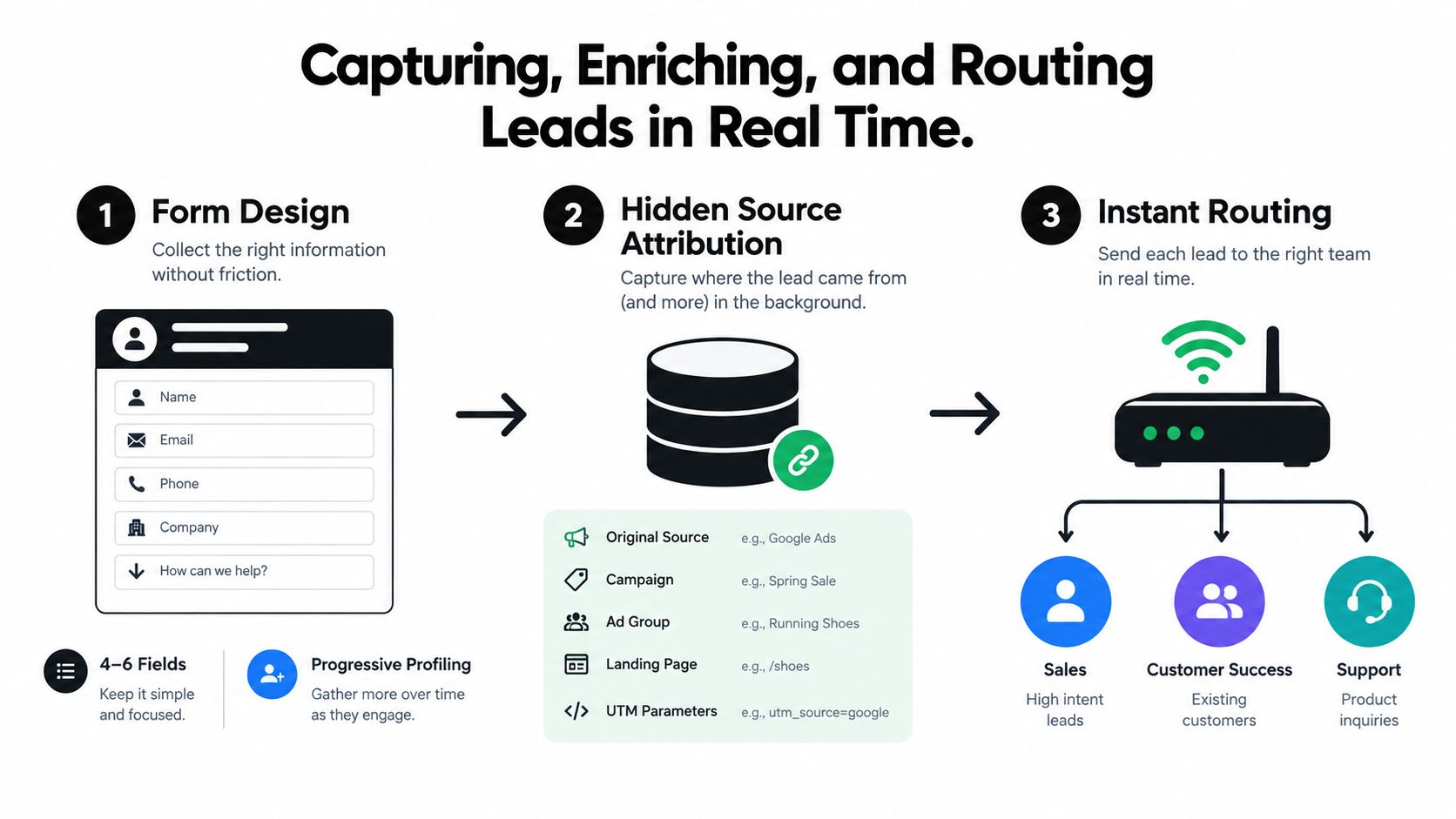
Capture is not a form isolated from the rest of the funnel. It is the first decision point in a data pipeline. The form should collect enough information to route and prioritize the lead, while avoiding unnecessary friction.
Use four to six fields for the initial exchange when those fields affect qualification. Ask for work email, company, role, use case, and perhaps a timeline or team size. Use progressive profiling later to collect details that aren't necessary for the first response. Add hidden fields for campaign, landing page, source, medium, and content asset, with clear consent language visible to the visitor.
Enrich before the record reaches a rep
Submission should trigger enrichment, not a manual research task. Append company size, industry, location, technology signals, account ownership, and available contact context before the record reaches the sales queue. Enrichment doesn't replace qualification, but it gives the rep a usable account view instead of an anonymous form response.
The CRM also needs hygiene rules:
- Required fields: Block progression when owner, lifecycle stage, source, or consent status is missing.
- Deduplication: Match on work email, domain, and account before creating another contact.
- Lifecycle control: Separate subscriber, lead, MQL, SQL, opportunity, and customer states.
- UTM governance: Keep one source-of-truth naming convention across campaigns and platforms.
- Fallback routing: Send unmatched records to a monitored queue rather than letting them disappear.
For a practical treatment of the enrichment layer, see CRM data enrichment. The point isn't to add more fields for their own sake. It's to make the next decision faster and more accurate.
Make response speed a service level
Treat the five-minute response window as an operational rule, not a suggestion. One cited benchmark reports that contacting a new lead within five minutes makes that lead 9× more likely to convert, as described in this lead follow-up benchmark. Use an immediate acknowledgement email, round-robin assignment, a Slack or CRM alert, and an escalation when nobody accepts ownership.
The routing logic should consider segment, territory, intent, and account status. A demo request from a target account shouldn't enter the same queue as an educational download. Automation can execute the assignment, but the rules must come from sales and marketing agreement.
Use the following video as a practical visual reference for the mechanics of lead routing:
Qualifying and Scoring Leads With Real Buying Signals
Legacy scoring treats activity as intent. A form fill adds points, a senior title adds points, and an email open adds points. That model is easy to configure and easy to fool.
Signal-based scoring asks whether the behavior reflects a buying problem. A prospect who revisits pricing, studies integration details, reads a competitor comparison, and replies with a specific implementation question has created a stronger pattern than someone who downloaded an ebook and opened several newsletters.
Score the full context
Use three dimensions: observed behavior, account fit, and engagement depth. The matrix below is a starting model for a B2B SaaS team. It isn't universal, and the weights should be tested against closed-won and closed-lost records.
| Signal Category | Example Signal | Point Weight | Rationale |
|---|---|---|---|
| Behavioral signals | Demo request | 30 | Directly expresses interest in a sales conversation |
| Behavioral signals | Pricing page revisit | 15 | Indicates commercial evaluation |
| Behavioral signals | Comparison-page visit | 15 | Suggests active vendor research |
| Firmographic fit | Target industry and company profile | 20 | Aligns the account with the ICP |
| Firmographic fit | Relevant decision-maker role | 10 | Increases access to the buying process |
| Engagement depth | Detailed email reply | 20 | Shows effort and problem specificity |
| Engagement depth | Integration or implementation question | 20 | Signals practical evaluation |
| Negative scoring | Student, job seeker, competitor, or personal email for an enterprise motion | -20 | Reduces false positives |
The exact score matters less than the logic behind it. A high score should mean “sales can act now,” not “this person clicked frequently.”
Set thresholds from outcomes
Choose the MQL threshold by reviewing a closed-won cohort. Identify the combination of signals that appeared before successful opportunities, then compare it with records that sales rejected or that stalled. If the threshold sends too many weak records to sales, raise the quality bar. If it hides opportunities that later close, reduce the threshold or add a missing signal.
The funnel is already under pressure. The channel and conversion benchmarks compiled by Callbox cite an average B2B lead cost of $198, a median B2B website conversion rate of 2.9%, and a median MQL-to-SQL conversion rate of 9.8% in 2026, down from 13.1% in 2024. Those figures make poor qualification expensive, because every false positive consumes scarce sales attention.
Document the model, then schedule recalibration every 60 to 90 days as an internal operating practice. Buying behavior changes, markets shift, and a model that once separated intent from curiosity can decay.
For the language your teams use during the human review, standardize what lead qualification means. A score should support a conversation, not replace judgment.
Outreach Sequences and the Sales Handoff
A single sequence for every lead is lazy automation. Branch the outreach according to the action that brought the prospect into the database.
A demo requester deserves a direct response tied to the stated use case. A whitepaper downloader needs education before a sales conversation. A visitor who studies a competitor comparison has created a reason to discuss evaluation criteria, switching costs, and implementation risk.
Build the cadence around intent
A practical five-touch sequence can look like this:
- Day one: Send a value-first email tied to the page or asset that generated the lead. Confirm the problem you believe they're investigating and offer a useful next step.
- Day three: Share a relevant case example or proof point matched to the prospect's industry and role.
- Day five: Send a short Loom, audit, or annotated observation that demonstrates useful thinking before asking for time.
- Day eight: Use a concise breakup email. Give the prospect an easy way to redirect the conversation if another colleague owns the problem.
- Day twelve: Move the contact into nurture with a relevant guide, comparison, or operational resource.
Every touch should earn its place. If the message could be sent to a stranger without changing a word, it isn't personalized enough.
Define the handoff payload
An SQL isn't just a score or a status value. Sales should accept the record only when the required context is present:
- Named contact: The person, role, company, and account owner are clear.
- Source and trigger: The original source and latest buying signal are recorded.
- Problem statement: The contact's stated or inferred business problem is documented.
- Account context: Relevant technology, segment, territory, and existing relationship are visible.
- Acceptance SLA: Sales has a defined response and acceptance window.
- Next action: A discovery meeting is booked or a specific follow-up task is assigned.
Require sales to accept, reject, or recycle the lead with a reason. Marketing then sees whether the problem is targeting, scoring, messaging, or follow-up. Without that feedback loop, the funnel becomes a political argument about lead quality.
Set a discovery expectation within 48 hours for accepted SQLs as an internal handoff standard. The exact timing matters less than making it visible, measurable, and owned.
KPIs, Attribution, and Dashboards Operators Actually Use
A dashboard earns its place by changing an operating decision. If it only reports clicks, opens, and sessions, it is an archive, not a control system. Build it around the points where demand becomes qualified pipeline, and show results by segment so an AI employee cannot hide poor-fit volume inside a healthy total.
Track four operating metrics:
- Cost per qualified lead: Shows whether acquisition spend produces records that meet the quality bar.
- MQL-to-SQL conversion rate: Reveals whether marketing qualification creates sales-accepted demand.
- Median speed to lead: Measures the delay between capture and human or automated response.
- Pipeline coverage ratio: Shows whether accepted opportunities provide enough potential value against the target.
If the MQL-to-SQL rate sits near the 9.8% median cited earlier, a month with 500 MQLs produces roughly 49 SQLs. Make that arithmetic visible by segment, source, and offer. A blended rate can look stable while one channel fills the system with records sales will not accept.
Build three dashboard panels
Panel one, acquisition: Show qualified lead volume by source, campaign, segment, and offer. Add spend where applicable, then compare quality and pipeline contribution rather than ranking channels by volume.
Panel two, conversion: Show capture-to-MQL, MQL-to-SQL, SQL-to-opportunity, and speed-to-lead. Add rejection reasons and response delays so the team can separate weak targeting from poor follow-up.
Panel three, revenue: Connect opportunity value, closed-won outcomes, sales-cycle movement, and source history. Preserve the original source and later touches. One channel may create awareness while another produces the final conversion.
Choose attribution for the decision
Multi-touch attribution suits growth teams running several channels because it preserves the sequence of influence. Last-click attribution is easier to operate and fits a focused direct-response campaign when one action clearly drives conversion. Neither model should override recorded revenue outcomes. Use attribution to allocate attention, not to manufacture credit.
AI employees can remove reporting labor by summarizing weekly pipeline movement, flagging unusual cost-per-qualified-lead changes, identifying missing source data, and connecting lead records to closed-won outcomes for review. They create noise when they explain a metric shift without checking the underlying records. Keep human review on the cause, segment, and action.
Run a Monday review in under 30 minutes:
- Check acquisition quality by segment.
- Inspect conversion and response delays.
- Review rejected SQLs and missing handoff fields.
- Compare pipeline movement with the prior review.
- Assign one process change and one experiment.
Failure Modes and How AI Changes the Lead Generation Process
AI doesn't fix a weak funnel by adding intelligence to every step. It often accelerates the wrong behavior. The practical test is simple: does the system improve the quality, speed, context, or accountability of a pipeline action?
ICP drift
First symptom: Lead volume rises while sales rejects more records.
Root cause: Messaging and targeting expanded beyond the customers who create durable value.
Diagnostic question: Which recently acquired customers match the original ICP, and which ones only matched a broad campaign audience?
Use account and opportunity data to refresh the target definition. An AI employee can detect patterns in rejected leads and closed-won accounts, but a human should decide whether the ICP changes.
Form friction
First symptom: Visitors engage with content but abandon the conversion path.
Root cause: The form asks for information before the offer has earned the request, or it creates ambiguity about what happens next.
Diagnostic question: Does every field change routing, qualification, personalization, or reporting?
Remove fields that do none of those jobs. Enrich the rest after submission.
Slow response
First symptom: A lead receives an acknowledgement but no useful human follow-up.
Root cause: Assignment depends on a manual queue, unclear ownership, or an alert nobody monitors.
Diagnostic question: Can the team show the exact timestamp, owner, and next action for the latest high-intent lead?
An AI employee can acknowledge, enrich, assign, schedule, and escalate. It can't compensate for a sales team that hasn't agreed to the service level.
Flawed scoring models
First symptom: Reps receive many “hot” leads that don't know the problem, while real evaluators remain in nurture.
Root cause: The model rewards easy activity instead of account fit and buying evidence.
Diagnostic question: Which score components appear most often in accepted opportunities, and which only appear in records that go nowhere?
Replace vanity activity with observed intent, negative scoring, and regular outcome review. The practical guide to AI for lead generation is useful when automation is assigned to defined workflows rather than asked to generate indiscriminate activity.
Disconnected handoffs
First symptom: Sales asks marketing where a lead came from, what they viewed, and why they should call.
Root cause: Marketing and sales use different lifecycle definitions or separate systems without a shared payload.
Diagnostic question: Could a new rep understand the account and next action from the CRM record alone?
AI enrichment and automated summaries can reduce this gap. They can also amplify it by filling the CRM with plausible but unverified details. Require source visibility, confidence labels where appropriate, and a human correction path.
Use AI only after the pre-flight check
Before deploying an AI employee into the funnel, confirm that:
- The ICP and disqualifiers are documented.
- Source fields and lifecycle stages are governed.
- Routing has an owner and a fallback.
- Qualification signals map to sales outcomes.
- Outreach branches by intent.
- Handoff acceptance is measurable.
- Human review exists for uncertain or high-impact decisions.
- The dashboard connects activity to pipeline and revenue.
Cyndra can install and manage AI employees that enrich leads, draft follow-up, route context to sales, and connect operational data across CRM and other tools. Use Cyndra to evaluate where an agent belongs in your lead generation process, then start with one measurable workflow instead of automating the entire funnel at once.