 CYNDRA
The popular advice about workflow automation AI is to pick a capable model, connect a few apps, and let an “AI employee” take over. That advice skips the difficult part. Production automation fails less often because the model is weak than because the workflow is poorly defined, permissions are too broad, exceptions are invisible, and nobody owns the outcome.
A reliable agent behaves more like a monitored production service than a digital employee replacement. It needs a business objective, restricted access, tested decision boundaries, approval gates, audit trails, and a fallback path. The teams that create durable value treat automation as an operating model, not a software purchase.
Table of Contents
- The Reality of Operational AI Adoption
- Selecting High Impact Workflows for Automation
- Designing and Training Production Grade Agents
- Building Governance and Preventing Compounding Errors
- Managing Human Adoption and Process Redesign
- Measuring ROI and Scaling AI Operations
The Reality of Operational AI Adoption
AI adoption statistics make the gap between interest and execution hard to ignore. OECD data shows that the share of businesses with at least 10 employees using AI across OECD member countries rose from 5.6% in 2020 to 14% in 2024, while AI use in core business functions remained below 10% in G7 countries (OECD data on AI adoption). Many companies have added AI to isolated tasks such as drafting, summarizing, or searching. Far fewer have embedded it into the processes that create revenue, serve customers, manage people, or update critical records.
That distinction matters. A model that drafts a sales email may save a person some time, but it doesn't necessarily improve lead routing, follow-up timing, CRM accuracy, or pipeline visibility. An agent that participates in the whole workflow can create value, but only when the surrounding process gives it reliable data, suitable tools, and clear decision rights.
Operator's rule: Automate a business outcome, not an impressive demo.
The first operational question is therefore not “Which model should we buy?” It's “Where does work stall, and what must be true for an automated decision to move it forward safely?” Answering that question requires process maps, system inventories, ownership decisions, and an honest account of how information enters and leaves the business. Teams working with fragmented market or customer inputs may also benefit from understanding how operational data is sourced and sold, because data provenance affects both agent quality and the commercial decisions built on top of it.
Why isolated AI tasks underperform
An AI assistant can summarize a meeting while the action items still sit in an inbox. It can classify an inbound lead while a salesperson manually copies the result into a CRM. It can draft a support response while an agent checks three systems to verify the customer's status. These partial improvements often shift effort rather than remove it.
A production workflow connects the trigger, interpretation, decision, action, and follow-up. It also records what happened. That means the organization can identify whether the agent improved throughput, introduced review work, increased correction volume, or created new operational risk.
The next phase of adoption depends on workflow redesign, integration, governance, and measurement. The model is only one component. An AI employee without an owner, service boundaries, and operating metrics is an ungoverned process with a conversational interface.
Selecting High Impact Workflows for Automation
The best candidate for an AI employee isn't always the task that consumes the most labor. It's the workflow where the organization has enough data to make decisions, enough repetition to justify integration, and enough tolerance for controlled automation.
Start by observing the current process from intake to completion. Talk to the person doing the work, inspect the records they touch, and document every exception. A workflow may look simple in a meeting but contain hidden approvals, undocumented policy decisions, duplicate data entry, and escalation habits that only an experienced operator understands.
A practical screening test
Score each candidate qualitatively against four questions:
- Repetition: Does the workflow occur frequently enough to produce a meaningful operational effect?
- Data readiness: Can the agent access current, relevant, permissioned information without relying on private spreadsheets or memory?
- Decision clarity: Can the team describe what a good decision looks like, including when the agent must stop?
- Error tolerance: Can a mistake be detected and reversed before it causes financial, legal, customer, or reputational harm?
High-potential examples include support triage, lead research, document classification, meeting follow-up, recruiting coordination, and internal reporting. High-risk examples include unsupervised payments, personnel decisions, binding legal commitments, and changes to systems of record without review.
The strongest early use cases usually combine structured inputs with bounded judgment. A support agent can classify a request, retrieve approved guidance, draft a response, and escalate ambiguity. It shouldn't invent a policy or change an account balance merely because a customer message sounds urgent.
Use AI to raise the baseline
A foundational NBER field experiment found that AI guidance increased customer-support productivity by 13.8% in issues resolved per hour, with the least skilled and least experienced workers improving by approximately 35% (NBER customer-support experiment). The most experienced workers saw little or no improvement, and some measures showed small negative effects.
The practical lesson isn't that every workflow will deliver the same lift. It's that decision support can reduce performance variability by helping less experienced employees follow proven patterns. Teams should therefore examine where work quality depends on individual memory, product familiarity, or judgment under time pressure.
For outbound teams, that may mean connecting research, enrichment, qualification, drafting, approval, and CRM updates rather than buying another isolated writing tool. A useful overview of sales automation software for outbound efficiency can help frame the surrounding process, but the buying decision should follow the workflow map, not replace it.
Define the outcome before building. Examples include reducing unresolved handoffs, increasing the share of complete records, shortening review queues, or improving response consistency. Then identify the baseline and the failure conditions. If nobody can say what success means or who owns an exception, the workflow isn't ready for an autonomous agent.

Designing and Training Production Grade Agents
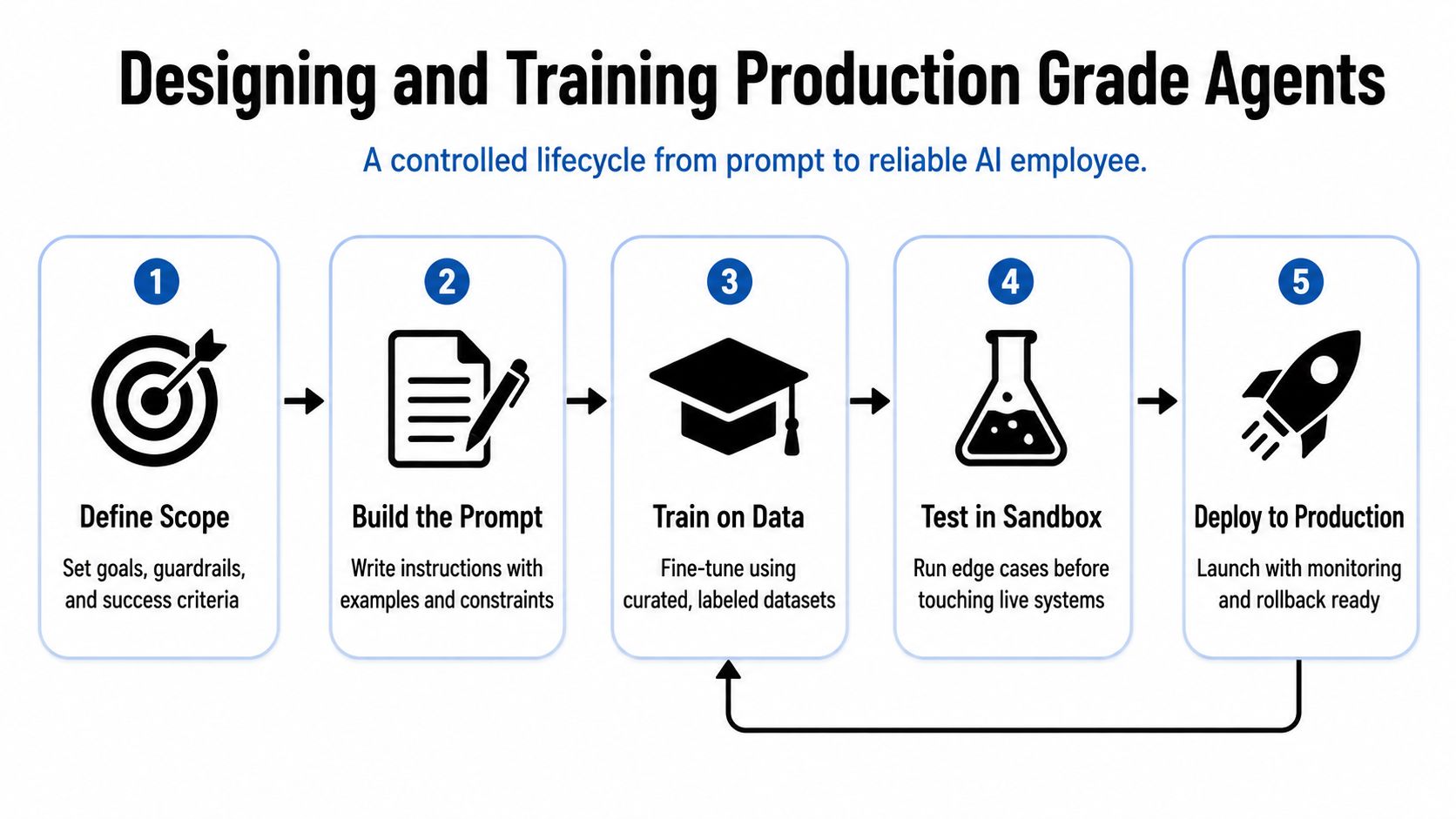
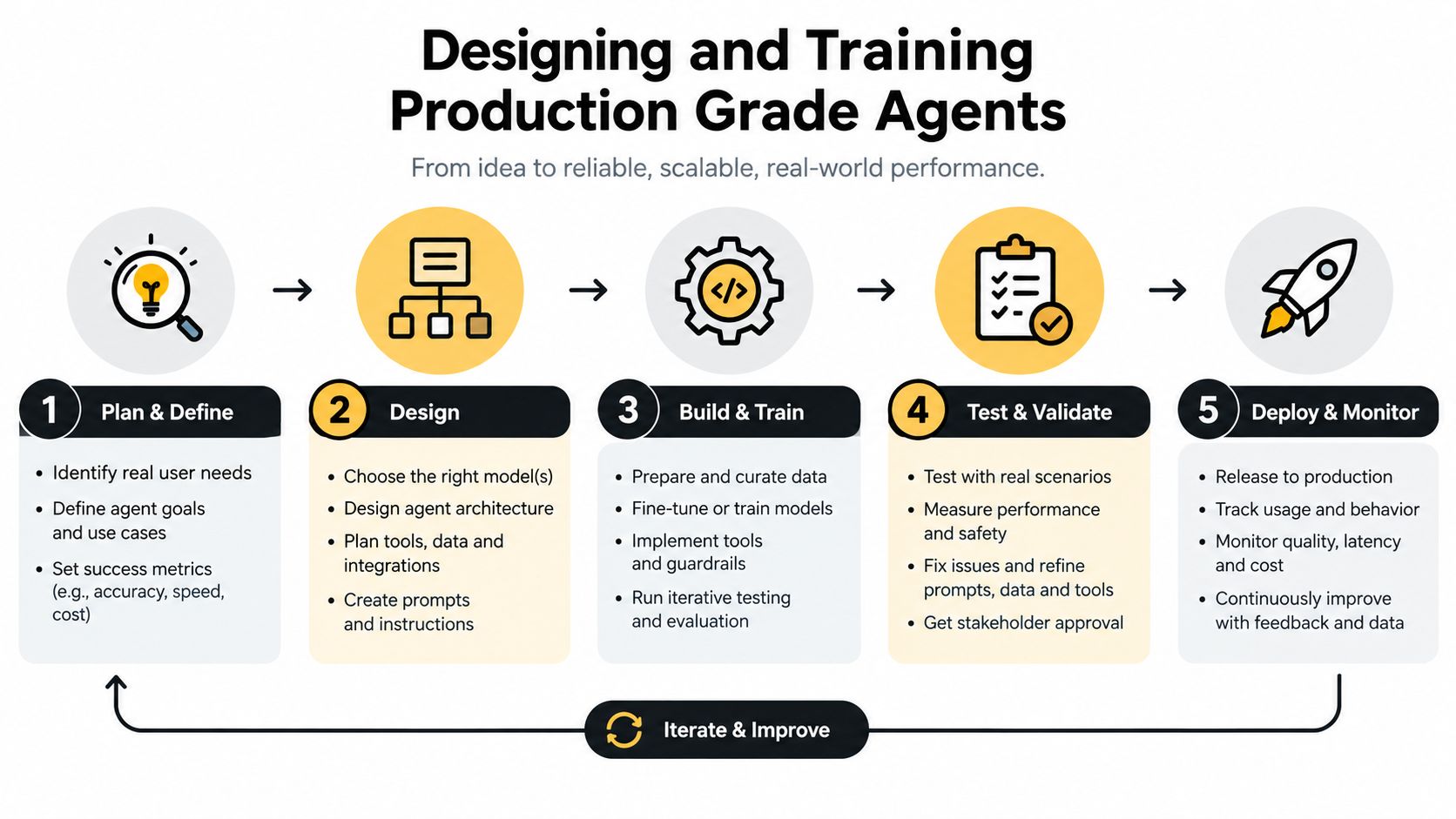
A production-grade agent follows a controlled lifecycle. Prompt quality matters, but a prompt alone can't define permissions, validate a tool response, or decide whether a consequential action requires human approval.
Define the operating boundary
Begin with the business outcome, failure tolerance, data boundaries, and escalation owner. Write down what the agent may read, what it may write, which systems it may use, and which actions are permanently prohibited. Map every handoff, tool permission, and irreversible operation before connecting live systems.
Then build an evaluation set from real workflow examples. Include normal requests, ambiguous inputs, adversarial attempts, missing data, conflicting records, and edge cases. A handful of successful demonstrations isn't evidence of reliability. The agent must perform consistently across the situations it will face in production.
Benchmark more than answer quality. Track task success, factuality, latency, cost per transaction, escalation rate, and human override rate. For a research-and-outreach agent, for example, evaluate source quality, field extraction, message accuracy, CRM write validity, and whether the system correctly stops when evidence is insufficient.
Release authority gradually
NIST's AI Risk Management Framework recommends launching AI in shadow or approval mode, then progressively authorizing low-risk actions while retaining approval gates for payments, legal commitments, and destructive changes (NIST AI Risk Management Framework). That sequence exposes integration problems without allowing them to become business incidents.
A sensible release path looks like this:
- Shadow mode: The agent produces recommendations while a human completes the workflow.
- Approval mode: The agent prepares drafts or proposed changes, and an owner approves each action.
- Low-risk execution: The agent performs reversible updates under restricted credentials.
- Expanded authority: Additional actions become available only after stable evaluation performance and acceptable incident patterns.
- Continuous review: New versions remain subject to replay tests, monitoring, and rollback rules.
Keep a versioned record of prompts, tools, policies, evaluation results, and deployment changes. Practical teams can also browse real AI agent implementations to compare patterns, but examples should inform design rather than substitute for testing against your own data and exceptions.
Training data needs the same discipline. Curate examples, label outcomes, remove sensitive information where appropriate, and capture corrections from human reviewers. Guidance on AI agents training can support that work, particularly when an organization needs to turn informal operator knowledge into repeatable agent behavior.
Set automatic rollback thresholds before launch. Unsafe outputs, permission violations, abnormal tool calls, and sudden escalation changes should pause or revert the agent without waiting for a quarterly review. Reliability means the system fails visibly and recoverably, not that it never encounters uncertainty.
Building Governance and Preventing Compounding Errors
The most dangerous automation error isn't always the first wrong answer. It's the next five actions taken because nobody challenged it.
Consider an agent that researches a prospect, extracts company details, drafts outreach, updates a CRM, and schedules a follow-up. If the extraction is wrong, the agent may create a bad record, send an inaccurate message, and trigger a sales sequence before a person notices. The workflow can look coherent in the final dashboard while every downstream action rests on a faulty intermediate state.
McKinsey identifies uncontrolled autonomy and fragmented system access as distinct agentic-AI risks, including chained vulnerabilities in which one faulty or compromised agent propagates harm to others (McKinsey on agentic AI risks).
Put contracts between steps
Treat every stage as a service boundary. An extraction step should return a typed object with required fields, confidence or evidence where relevant, and an explicit status for missing information. The next step should reject invalid data instead of interpreting a malformed response generously.
Use:
- Schema validation: Check every extraction and transformation against an agreed structure.
- Source attribution: Require evidence for externally verifiable claims.
- Idempotency keys: Prevent retries from creating duplicate records or transactions.
- Least-privilege access: Give each agent only the tools and actions its role needs.
- Read-write separation: Use different credentials and approval paths for retrieval and modification.
- Rate limits: Restrict outbound messages, updates, and tool calls.
- Deterministic policy checks: Block prohibited actions before the model can execute them.
Measure each node separately. Track precision, recall, invalid-schema rate, retry rate, escalation rate, and unauthorized-action attempts. An aggregate workflow score can hide a critical failure, so consider the workflow successful only when every high-risk node passes its own checks.
Make human review proportional to risk
Universal review creates bottlenecks and encourages people to approve without reading. No review creates unacceptable exposure. A risk-based design is more durable.
Low-impact drafts can run asynchronously. Sensitive-data transfers, regulated decisions, financial transactions, customer commitments, and destructive changes should require approval or dual control. Log who approved an action, what information they saw, which policy applied, and whether they later reversed the decision.
Governance belongs in the workflow itself, not in a policy document stored somewhere else. Teams that need a broader operating reference can use AI governance and compliance to structure ownership, oversight, and evidence collection.
Control principle: If an action can't be explained, audited, and reversed, the agent shouldn't perform it autonomously.
Maintain replayable traces and sample completed runs for review. Red-team tool boundaries, test prompt-injection paths, and quarantine new agent versions until they outperform the incumbent on both quality and safety. Monitoring isn't bureaucracy. It's how operators discover that an apparently successful workflow is generating correction work.
Managing Human Adoption and Process Redesign
An agent can be technically correct and operationally useless if the team doesn't trust it, can't find it, or must work around it. Adoption depends on the redesigned process, not the existence of the tool.
A 2025 global survey found that only 13% of employees said advanced AI tools were fully integrated into their daily workflows, while integration with existing systems was the leading implementation obstacle for 46% of organizations (BCG research on AI at work). That pattern reflects a familiar implementation failure: leadership funds an agent, but nobody redesigns the roles, queues, incentives, or exception paths around it.
Change the job, not just the interface
Map what employees do before, during, and after the automated step. If an agent drafts support responses, decide who reviews them, how corrections are recorded, and when a case moves to a specialist. If an agent researches leads, clarify whether salespeople own verification, outreach, or both.
Assign explicit human decision rights:
- Approve: The person who authorizes a consequential action.
- Review: The person who checks quality and handles ambiguity.
- Override: The person who can stop or reverse the agent.
- Improve: The person who turns recurring corrections into workflow or training changes.
- Own: The person accountable for the business result.
Training should happen in a role-specific practice environment using realistic cases. A support team needs to practice escalation and correction. A finance team needs to test approvals, evidence, and reconciliation. A recruiting team needs to understand where the agent can assist and where human judgment remains mandatory.
Measure adoption as process health
Usage alone doesn't prove adoption. An employee may open an agent repeatedly because its output needs constant repair. Track completion quality, exception volume, review latency, correction themes, and workload distribution alongside cycle time and throughput.
Invite frontline employees into evaluation design. They know which customer requests are ambiguous, which records are unreliable, and which exceptions create hidden labor. Their feedback can prevent a common outcome where automation removes the visible task but adds monitoring, rechecking, and manual cleanup.
The best process redesign makes the agent a useful teammate without hiding accountability. Employees should know what the system did, why it made a recommendation, how to challenge it, and what happens when it fails. That clarity builds informed use rather than forced compliance.
Measuring ROI and Scaling AI Operations
The first live workflow should be treated as an operating experiment with a baseline, an owner, and a review cadence. Don't declare success because the agent produced fluent text or completed a few demonstrations. Compare the whole process before and after deployment.
Measure the work at three levels:
- Business outcome: Revenue movement, cost savings, completed service, qualified pipeline, or another defined result.
- Workflow performance: Task success, cycle time, throughput, escalation rate, review latency, and cost per completed workflow.
- Control health: Error severity, override rate, unauthorized-action attempts, access-log anomalies, and rollback events.
These measures show whether the agent improves the system or merely moves effort to a different queue. A lower handling time with more corrections may be a failure. More automated completions with rising customer complaints may be a failure. A healthy program connects efficiency with quality, safety, and employee workload.
Monitor before expanding authority
Real-time monitoring matters because models, data, customer behavior, and connected systems change. Research found that organizations using real-time AI monitoring were 34% more likely to report revenue improvements and 65% more likely to report cost savings (Capgemini research on generative AI).
Use the monitoring layer to detect drift, unusual tool-call behavior, rising escalations, permission violations, and changes in review latency. Keep traces that let operators replay a decision and identify the exact step where quality broke down.
Scale authority in small increments. First expand volume, then add reversible actions, then consider higher-impact decisions only when the evaluation set, production metrics, and incident history support the change. Keep the incumbent workflow available until the new version demonstrates stable quality and safety.
A mature AI operation has version control, least-privilege credentials, named owners, approval gates, audit logs, rollback procedures, and a tested fallback path. It doesn't depend on one person's memory or a model's confidence score. It earns greater autonomy through evidence.
Cyndra helps teams turn real sales, support, operations, marketing, and recruiting workflows into secure AI agents that integrate with existing tools, route actions for approval, log results, and follow up automatically. Visit Cyndra to discuss a production-grade workflow with clear guardrails, measurable outcomes, and an adoption plan.