 CYNDRA
Only 21% of surveyed organizations maintain a complete, current inventory of agents, tools, and connections, leaving runtime authority unaccounted for. A workable AI agent governance framework starts with identity, permissions, observability, and recovery controls, not with another policy document.
That finding changes the order of operations. An agent that can read a CRM, update a finance record, send external messages, or trigger another workflow is not just a model with a risk profile. It's an operational identity with delegated authority. If you can't identify that identity, reconstruct its actions, or revoke its access quickly, human approval becomes a weak substitute for control.
The strongest governance programs treat autonomy as a production capability that must be scoped, monitored, tested, and periodically re-authorized. Policies still matter, but they should describe controls the runtime can enforce.
Table of Contents
- Why Agent Governance Fails Before It Starts
- Four Governance Pillars for Production Agents
- Standards Versus Regulation in AI Agent Governance
- Defining Roles and Accountability for Agent Outcomes
- Security Controls and Runtime Identity Requirements
- Compliance Checklist and Risk Classification Matrix
- Testing and Validation Procedures for Production Agents
- Monitoring, Audit Logging, and Incident Response Templates
- Phased Implementation Playbook for Operational Teams
- Common Governance Mistakes and Better Alternatives
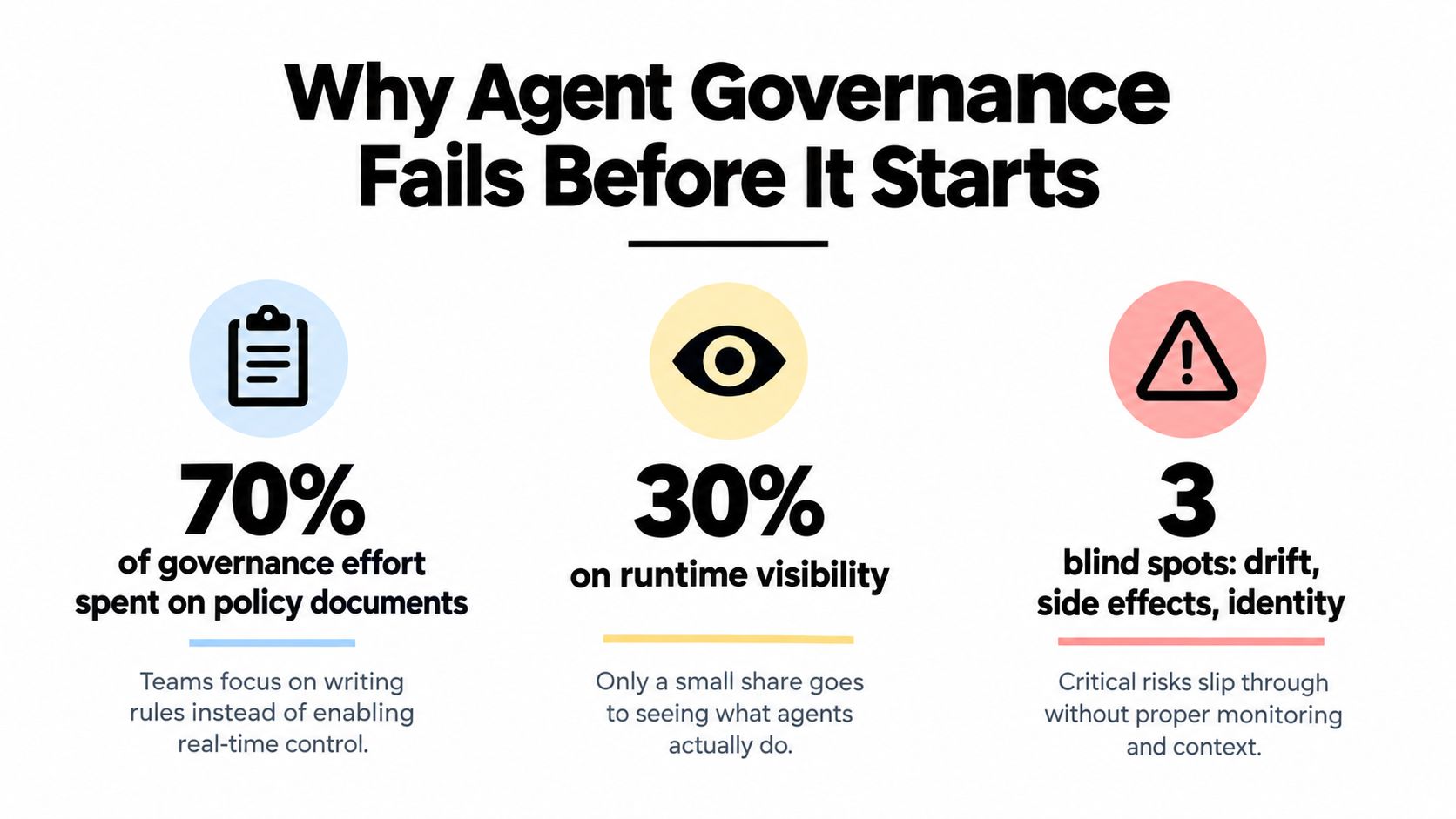
Why Agent Governance Fails Before It Starts
Only 21% of surveyed organizations maintain a complete, current inventory of agents, tools, and connections. The same research reports that 79% lack full visibility into agent permissions and system access, while fewer than half monitor agent activity end to end (Digital Commerce 360 reports on autonomous AI security risks and controls).
That gap appears before a risk committee reviews a deployment. Teams may know which vendor supplied a model, yet not know which service identity an agent uses, which tools were added last month, or whether a workflow can contact a third party without approval. A signed policy cannot govern an unknown capability.
Visibility precedes approval
Human oversight only works when the reviewer has enough evidence to make a meaningful decision. That evidence includes the agent's identity, intended purpose, accessible data, available tools, authority thresholds, escalation route, and recent behavior.
A production inventory should answer:
- What exists: Agent name, version, environment, business purpose, model and provider dependencies.
- What it can reach: Data sources, tools, service identities, write permissions, external communication channels.
- Who controls it: Business owner, technical owner, data owner, vendor contact, and incident approver.
- How it stops: Approval gates, credential revocation, workflow pause, rollback procedure, and retirement criteria.
The operational KPIs are more useful than a policy completion rate. Track inventory completeness, unauthorized-agent detection time, permission-review age, blocked-action rate, and recovery time after an agent failure. These measures tell operators whether governance works under pressure.
Practical rule: If an agent's permissions, identity, and side effects aren't visible in one auditable record, it isn't ready for consequential work.
Four Governance Pillars for Production Agents
A practical AI agent governance framework has four connected pillars. Each solves a different failure mode, and none can compensate fully for the others.
Identity and access
Give every production agent a distinct identity and a defined owner. Scope credentials to the task, separate read-only tools from write-capable tools, and require stronger approval for actions that alter records, contact outsiders, delete data, or move value.
Risk classification
Classify the workflow, not just the model. An agent that summarizes internal documents needs a different control set from one that reconciles transactions or screens candidates. Impact, autonomy, data sensitivity, reversibility, and external reach should determine the required controls.
Documentation and transparency
Maintain an auditable record of intended use, prohibited use, data sources, model dependencies, tools, permissions, evaluation thresholds, escalation paths, and retirement conditions. Documentation should be generated from the operating environment where possible, rather than maintained as a disconnected spreadsheet.
Monitoring and improvement
Governance is a recurring operating loop. Assess before deployment, validate in testing, monitor in production, review material changes, and record corrective actions. ISO/IEC 42001 and NIST's risk-management approach both support this lifecycle orientation, while runtime controls turn it into daily practice.
| Autonomy level | Risk classification | Required controls |
|---|---|---|
| Advisory, read-only | Lower impact, no state change | Scoped read access, source traceability, output review, activity logging |
| Proposed action | Moderate impact, human confirmation required | Fixed tools, approval before writes, documented reviewer, evidence retention |
| Bounded execution | Higher impact, autonomous work within limits | Task-scoped credentials, policy enforcement, escalation thresholds, rollback capability |
| Broad or continuous execution | Highest impact, external or irreversible effects | Strong identity isolation, step-up approval, immutable logs, active monitoring, emergency shutdown, tested recovery |
The point isn't to eliminate autonomy. It's to make authority proportional to consequence. A useful control plane lets low-risk agents move quickly while forcing high-impact workflows through stronger evidence and intervention points.
Standards Versus Regulation in AI Agent Governance
Standards and regulation solve different problems. Treating them as interchangeable creates either unnecessary administrative work or dangerous compliance gaps.
ISO/IEC 42001:2023 is an international management-system standard for artificial intelligence. It specifies requirements and guidance for establishing, implementing, maintaining, and continually improving an AI management system, and it applies to organizations of any size that provide or use products or services involving AI (ISO's overview of ISO/IEC 42001).
That makes ISO/IEC 42001 useful for organizing leadership responsibilities, policies, risk assessments, data governance, lifecycle controls, monitoring, performance evaluation, incident handling, and continual improvement. Its Plan-Do-Check-Act structure helps an enterprise govern a portfolio of agents instead of reviewing every automation as an isolated experiment.
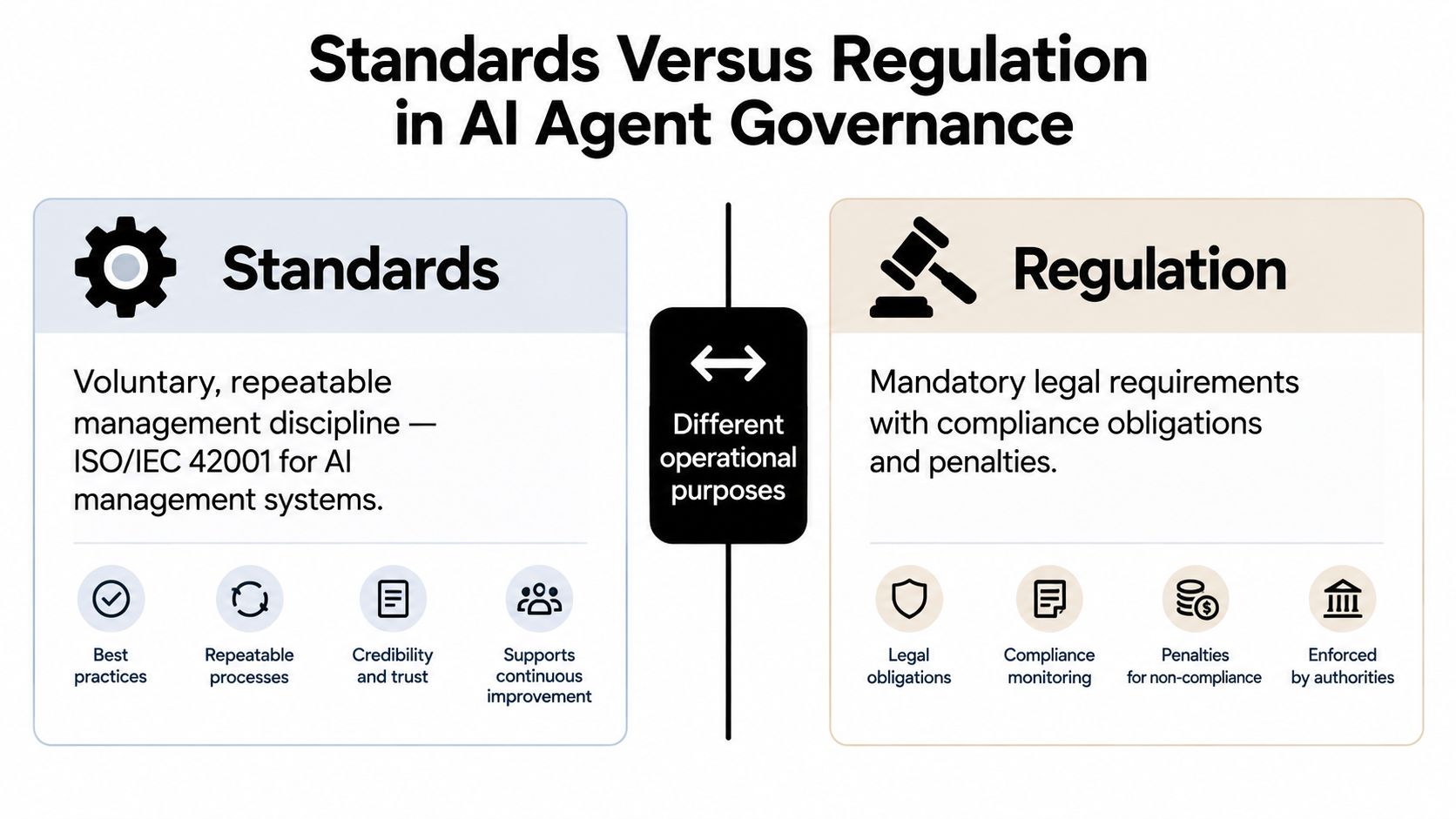
The EU AI Act has a different role. Regulation (EU) 2024/1689 established a legally binding, risk-based AI governance framework. It entered into force on 1 August 2024, with prohibitions on certain unacceptable-risk practices and AI-literacy obligations applying from 2 February 2025. Governance provisions and obligations for general-purpose AI models became applicable on 2 August 2025, while the principal application date is 2 August 2026, with some high-risk systems receiving transition periods into 2027 or 2028 (European Commission overview of the AI regulatory framework).
A mature program maps the legal obligations to management-system evidence and runtime safeguards. ISO/IEC 42001 can structure ownership, review, and improvement. The EU AI Act can define mandatory requirements, applicable dates, and enforcement exposure. NIST's AI Risk Management Framework adds a practical lifecycle for identifying, measuring, managing, and governing risk.
Certification alone doesn't stop an agent from using an excessive permission. Regulation alone doesn't create an operating process. The useful combination is a documented management system connected to enforced technical controls.
Defining Roles and Accountability for Agent Outcomes
Accountability breaks down at the boundary between the agent, the business process, and the vendor. Nearly six in ten organizations using agentic AI believe no single group oversees agents after deployment, while almost four in ten say accountability is undefined. The same survey reports that about 69% of senior AI leaders lack internal expertise to evolve governance controls, and 63% lack expertise to implement or design them (Cybersecurity Dive's coverage of agent governance accountability).
Assign responsibility according to control. The party that can set permissions, inspect logs, approve workflows, and remediate harm needs defined duties, even when another party supplied the model.
Use an outcome ownership map
For each consequential action, record the following:
- Business owner: Defines the process objective, acceptable outcomes, prohibited actions, and service-level expectations.
- Technical owner: Controls deployment, integrations, identity configuration, version changes, monitoring, and rollback.
- Data owner: Approves source data, retention, access boundaries, quality requirements, and permitted use.
- Human approver: Reviews actions that exceed the agent's authority or affect customers, employees, finances, or external parties.
- Vendor owner: Tracks provider obligations, model changes, support routes, incident notification, and evidence availability.
Then distinguish the failure type. An incorrect recommendation may belong to the business and technical owners jointly. An unauthorized action points toward identity and permission control. Poor source data belongs with the data owner. An integration failure may sit with the technical owner or vendor. Inadequate supervision indicates a process design failure, not merely a model failure.
Use a naming convention that survives reorganizations, such as business-process / agent-name / environment / owner. Store the owner mapping beside the capability manifest and deployment record. That makes accountability searchable during an incident instead of dependent on personal memory.
Executives should also understand the regulatory exposure under the EU AI Act when assigning oversight and documenting director and officer responsibilities. Legal review is most useful when it connects exposure to concrete controls, not when it produces a generic statement of responsibility.
Security Controls and Runtime Identity Requirements
An agent should be governed like a privileged operational user, not like a passive software component. Its identity, credentials, tools, delegated authority, memory, and external side effects belong in the security model from the start.

OWASP recommends an explicit, version-controlled capability manifest listing every tool an agent can invoke and identifying operations that can move value, contact users, delete data, or call third parties. The guidance also calls for IAM-style change control and automated CI checks (OWASP threat-modeling resources for AI).
That manifest should be treated as a release artifact. If instructions, permissions, service identities, approval conditions, or tools change, the build should require an independent review and a refreshed threat assessment.
Build authority in layers
Start with least privilege. Give each agent task-scoped credentials, separate reading from writing, and isolate identities across environments. A support agent may read an order record, while a separate action service handles refunds through an approval gate.
For irreversible or high-impact actions, require step-up approval. The approval request should show the proposed operation, affected records, source context, policy that applies, and the recovery option. Logging only the final result isn't enough. Capture prompts, retrieved context, tool calls, approvals, outputs, and resulting state changes.
Use AI agent security practices to extend conventional IAM into agent-specific controls, including prompt injection defenses, tool-output validation, memory protection, and multi-agent delegation boundaries.

Test the runtime against prompt injection, untrusted tool output, excessive agency, data leakage, identity abuse, memory contamination, and multi-agent delegation. Production dashboards should show unauthorized-action attempts, policy violations, tool-error rates, human overrides, and anomalous spending or communication volume.
A kill switch must revoke credentials or pause the workflow without waiting for a model response. Rollback must restore affected state where the underlying system supports it. These controls convert autonomy from an irreversible trust decision into a bounded operational capability.
Compliance Checklist and Risk Classification Matrix
A compliance review should produce evidence, not just a completed questionnaire. Apply the same checklist during design, deployment, material change review, and retirement.
The operating checklist
- Inventory: Record every agent, environment, version, tool, connection, model, provider, and service identity.
- Purpose: Define intended use, prohibited use, business process, autonomy level, and affected parties.
- Ownership: Name business, technical, data, approval, security, and vendor owners.
- Permissions: Document data sources, credential scope, read and write operations, external communication, and escalation conditions.
- Evaluation: Set task-specific quality and safety thresholds, then retain test results and approval evidence.
- Incidents: Define detection, containment, notification, investigation, remediation, and rollback procedures.
- Retirement: Specify when the agent, model, integration, credential, logs, and stored context will be disabled or deleted.
Use a classification matrix to make review intensity proportional to impact.
| Workflow class | Typical authority | Minimum governance response |
|---|---|---|
| Low impact | Read-only analysis or drafting | Inventory, owner, source controls, logging, human review |
| Moderate impact | Prepared updates or recommendations | Fixed permissions, approval before execution, evaluation evidence |
| High impact | Financial, employment, sensitive-data, or external actions | Strong approval, detailed evidence retention, monitoring, rollback |
| Portfolio-critical | Multi-agent or cross-system execution | System-level testing, isolated identities, emergency controls, recurring review |
High-impact workflows deserve particular attention because a technically correct output can still produce harm when the agent acts without adequate context or authority. Teams preparing for review can use practical EU AI Act audit steps to organize evidence collection and identify gaps before an assessment.
Testing and Validation Procedures for Production Agents
Validation should prove that controls constrain behavior, not merely that the agent performs a happy-path task. Run tests against the exact model, prompt set, capability manifest, permissions, integrations, and policy version intended for release.
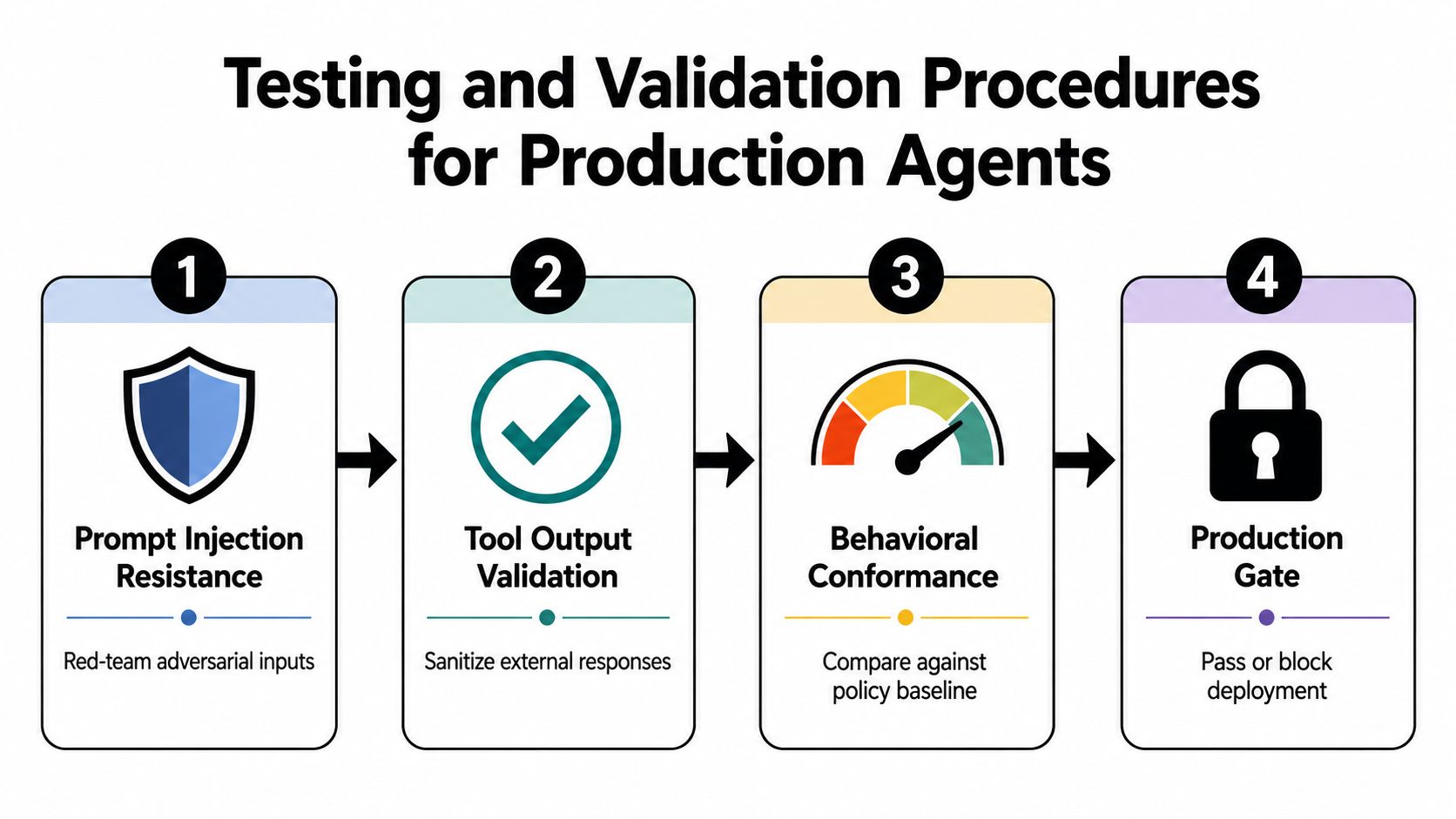
Begin with tool-level tests. Verify authorization boundaries, malformed inputs, denied operations, sensitive-data handling, timeout behavior, and safe failure. Then run integration tests across the full workflow, including downstream automations and agent-to-agent delegation.
Use explicit fail gates
- Adversarial inputs: Test prompt injection, instruction conflicts, malicious retrieved content, and attempts to override policy.
- Tool responses: Supply untrusted or contradictory outputs and verify sanitization, validation, and escalation.
- Behavioral conformance: Compare actions against the approved policy baseline, including prohibited tools and out-of-scope requests.
- Recovery behavior: Confirm that the workflow pauses, escalates, revokes access, or rolls back when a control fails.
Set evaluation thresholds before testing begins. A deployment should block when the agent exceeds an approved error boundary, calls an unapproved tool, leaks restricted data, or fails to escalate an ambiguous high-impact case.
Repeat regression tests after changes to permissions, instructions, model versions, integrations, or manifest entries. Retain the test configuration, result, reviewer, decision, and remediation record. That evidence supports ISO/IEC 42001 performance evaluation and NIST-aligned risk management without reconstructing the release from scattered messages.
Monitoring, Audit Logging, and Incident Response Templates
Production governance depends on telemetry that explains both what the agent did and what authority allowed it. A useful event record links the agent identity, user or trigger, timestamp, environment, policy version, capability manifest version, retrieved context, tool calls, approvals, output, and resulting state change.
Do not log only the final API request. Without the preceding context, responders may know that a record changed but not why the agent selected that action or whether a human approved it.
Dashboard signals
Monitor permission-review age, unauthorized-action attempts, policy violations, tool-error rates, human overrides, and anomalous spending or communication volume. Review these signals by agent, workflow, identity, tool, environment, and vendor so an aggregate view doesn't hide a failing integration.
Teams defining evidence retention can also consult the AI Video Detector guidance on logging rules. For agent-specific operational visibility, AI agents observability practices help connect traces, state changes, and intervention signals.
Use a compact incident template:
- Trigger: Record the alert, affected agent, identity, workflow, and first observed action.
- Containment: Pause the agent, revoke credentials, block the tool, or isolate the integration.
- Scope: Identify affected records, recipients, systems, decisions, and time window.
- Cause: Classify the failure as incorrect output, unauthorized action, poor data, integration failure, or inadequate supervision.
- Recovery: Roll back state, correct records, notify affected parties, and restore only after review.
- Prevention: Update permissions, tests, prompts, policies, vendor controls, or monitoring.
Keep the original evidence immutable and separate from remediation notes. That separation preserves the factual trail while allowing the team to document corrective action.
Phased Implementation Playbook for Operational Teams
Governance becomes manageable when teams install it alongside deployment rather than waiting for a perfect enterprise program. Start with the agents already touching business systems, then extend the same controls across the portfolio.
Phase one, inventory and identity
Create the agent register, assign owners, identify service identities, and discover tools and connections. The outcome is visibility, not certification. Unapproved agents should enter a review queue or lose access to production systems.
Phase two, permission scoping
Replace broad credentials with task-scoped access. Separate read and write operations, define approval thresholds, and document external side effects. The technical owner should demonstrate that the agent can't exceed its declared purpose.
Phase three, evidence and recovery
Add structured logs for context, tool calls, approvals, outputs, and state changes. Test pause, credential revocation, escalation, and rollback procedures before expanding autonomy.
Phase four, continuous operation
Create dashboards, schedule permission reviews, run regression tests after material changes, and record incidents and corrective actions. Governance now becomes a Plan-Do-Check-Act loop rather than a launch ceremony.
Teams integrating agents with CRMs, commerce platforms, finance tools, or recruiting systems should document data ownership and failure boundaries before connecting systems. Resources on AI agent integration can help frame those dependencies, but the operating team still needs to assign owners and enforce permissions locally.
Measure progress through control outcomes: inventory completeness, time to detect an unauthorized agent, age of permission reviews, blocked-action rate, and recovery performance. Portfolio review should retire unused identities and remove stale tools, not merely add new documentation.
Common Governance Mistakes and Better Alternatives
The most damaging governance failures create confidence without control. They leave a policy trail while the runtime continues to hold excessive authority.
| Anti-pattern | Operational symptom | Better alternative |
|---|---|---|
| Human approval as the primary safeguard | Reviewers approve actions without complete context or cannot keep pace | Enforce permissions, thresholds, and blocking rules before the human review |
| Static policy document | The document is current, but tools and identities have changed | Version the capability manifest and connect changes to deployment gates |
| One risk class for every agent | Low-risk work is slowed while high-impact work is under-controlled | Classify by impact, autonomy, data sensitivity, reversibility, and external reach |
| Vendor-only accountability | No internal team can inspect logs or revoke access | Assign internal business and technical owners, then specify vendor duties contractually |
| Logging outcomes only | Responders see the state change but not the context or approval | Capture prompts, retrieved context, tools, approvals, outputs, and resulting state |
| No retirement process | Dormant credentials and obsolete agents remain active | Define lifecycle exit criteria and verify decommissioning evidence |
Human review still has a place. It works best when the reviewer receives a bounded decision with clear evidence and the system technically prevents execution until approval arrives. It fails when the reviewer is expected to compensate for unknown identities, broad permissions, missing logs, or unclear ownership.
The same principle applies to vendors. Model ownership doesn't determine every duty. Accountability follows control, so the party that can configure authority, inspect activity, approve actions, or remediate harm needs a documented role.
Cyndra helps operational teams install and manage production AI agents with scoped access, policy enforcement, human approval gates, audit histories, and controls to pause agents, revoke access, or change rules. Visit Cyndra to discuss an agent governance setup aligned with your workflows, owners, integrations, and risk boundaries.