 CYNDRA
Companies that contacted a prospect within an hour were nearly seven times more likely to qualify the lead than companies waiting an additional hour, according to the Harvard Business Review study summarized in Martal's speed-to-lead guide. That reframes the first investment in AI for lead qualification: fix the delay before buying a more advanced prediction engine.
But faster decisions aren't useful if they're based on unreliable records. Start by deciding whether your outcome history supports predictive scoring, then give automation only the authority you can justify.
Table of Contents
- What AI Lead Qualification Does and Which Architecture Fits
- Check Your Data Before You Build a Model
- How to Build the Scoring Model Step by Step
- How to Turn Scores into Prompts, Routing and Actions
- How to Measure Whether the Qualifier Works
- Common Pitfalls and How to Fix Them
- Run a Pilot on One Lead Source First
What AI Lead Qualification Does and Which Architecture Fits
AI lead qualification uses software to read inbound inquiries, classify account fit and buying intent, assign a priority, and trigger the next action. It can extract requirements from a message, enrich the account, ask for missing information, and route the inquiry before a representative starts work.
Scoring and qualification aren't identical. A score estimates priority; qualification establishes whether there's enough evidence to justify a sales conversation.
Say a B2B software team receives demo requests through a form with a free-text field. Some prospects describe an active replacement project, others want technical support, and others are researching a category. The immediate question isn't which buyer will eventually sign. It's who needs a human response today.
Qualification architectures compared
| Architecture | Best fit | Data it needs | Main risk |
|---|---|---|---|
| Rules-based scoring | Clear ICP, low volume, no outcome history | Form answers, firmographics, lead source | Rigid; misses intent expressed in free text |
| Predictive ML scoring | Mature CRM with closed-won and closed-lost history | Labeled outcomes, CRM fields, behavioral data | Overfits easily; probabilities need calibration |
| LLM qualifier | Free-text inbound from chat, email and web forms | Message text, written ICP brief, enrichment data | Inconsistent without a rubric; can invent fit evidence |
| Hybrid: rules gate, model score, LLM reading | Most B2B teams after a pilot | All of the above | More moving parts to monitor |
Rules-based scoring isn't AI, but it's the baseline an AI system should have to beat. An LLM can help a cold-start team interpret messages without pretending to predict revenue from nonexistent history.
For examples to compare with your own workflow, review AI qualification strategies from SupportGPT. Use them to challenge your qualification criteria, not to copy another company's thresholds.
Choose the architecture your records can support, not the architecture your ambitions suggest.
A simple workflow that promptly identifies a credible buying request can be more useful than an advanced model whose output waits in an unattended queue.
Check Your Data Before You Build a Model
Does your company have enough trustworthy conversion history to train anything? A CRM full of contacts isn't the same as a usable training set.
The Stealth Agents industry synthesis estimates practical AI scoring accuracy at roughly 40–60% for typical teams. Treat that as a planning warning, not a forecast for your business: accuracy depends on the target, label quality, evaluation method, and underlying sales process.
Audit the records that will drive decisions
- Outcome labels: Measure the share of opportunities with consistent closed-won or closed-lost outcomes. Separate truly lost deals from abandoned records and still-open opportunities.
- Field completeness: Check whether the fields available at inquiry time are populated. A field completed during negotiation won't help qualify a new lead.
- Duplicate rate: Inspect contacts and accounts together. Duplicate buying committees can inflate activity and leak the same opportunity across training and evaluation sets.
- Source coverage: Confirm that forms, chat, referrals, events, and partner inquiries reach the CRM.
- Contact validity: Identify bounced addresses, invalid domains, and enrichment records matched to the wrong company.
- Lifecycle definitions: Write the exact conditions under which a lead becomes an opportunity. Sales and marketing must use the same definition.
Repairing missing company information may require CRM data enrichment, but enrichment can't reconstruct an outcome your team never recorded. Keep the original value, enrichment source, and update timestamp so corrections remain traceable.
Separate cold-start from mature qualification
In a cold-start operation, rules and human review provide a defensible starting point. Use explicit fit criteria, capture reasons for acceptance and rejection, and accumulate consistent outcomes.
A mature operation can test whether behavioral and firmographic signals predict commercial results. Record count alone doesn't establish maturity: a large archive built under obsolete products or inconsistent stages may be less useful than a smaller, coherent dataset.
Go/no-go rule: If outcome labels are incomplete or lifecycle stages conflict, repair those definitions before allowing predictive scores to control routing.
Run a limited, human-reviewed rules pilot while that repair happens. Don't make sales representatives compensate for unreliable records by reviewing a larger queue of questionable recommendations.
How to Build the Scoring Model Step by Step
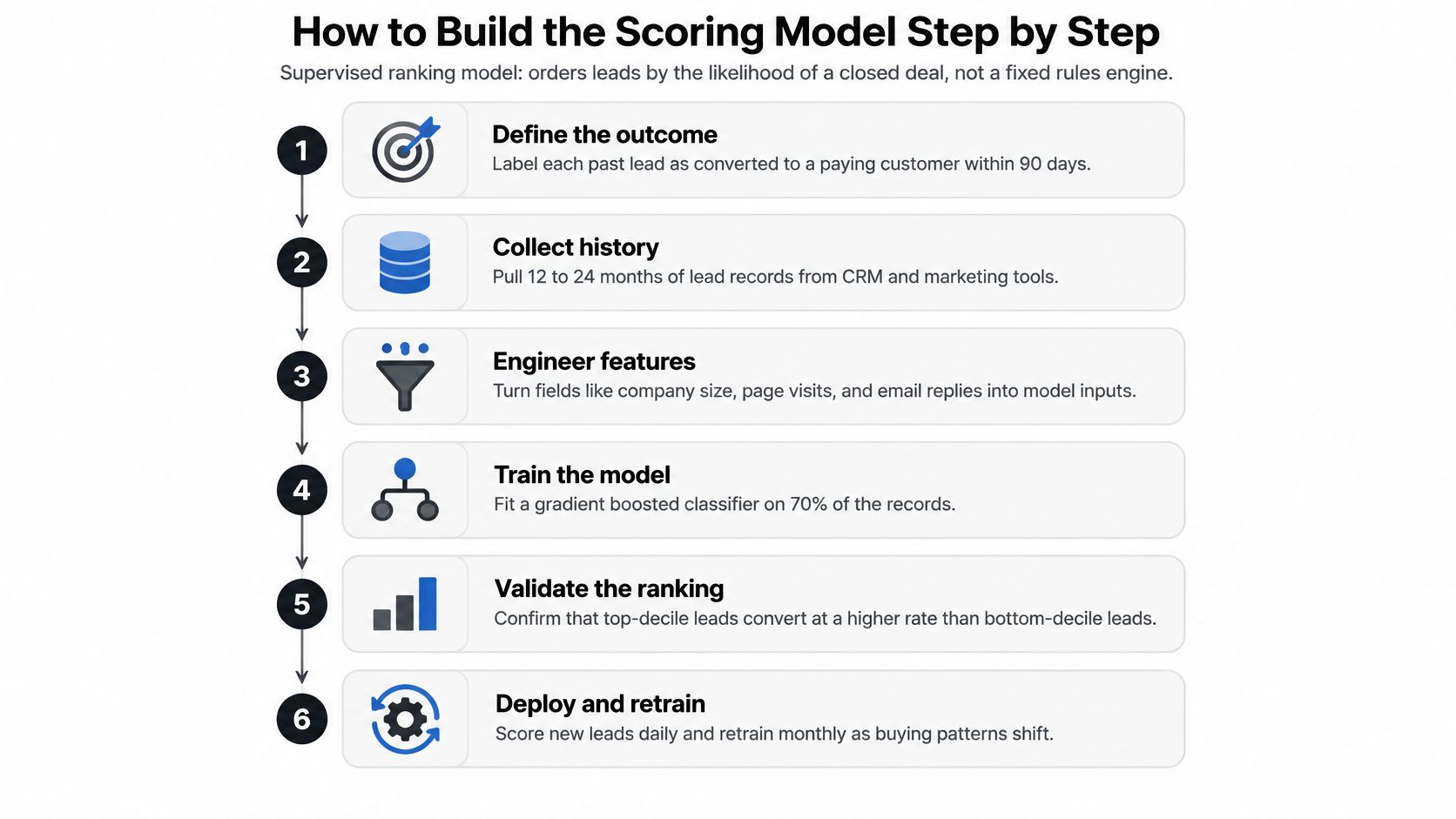
Build a supervised ranking model that orders leads by the likelihood of a defined future commercial outcome. Keep eligibility rules separate so the model can't override contractual restrictions, existing account ownership, or unsupported use cases.
The infographic provides a visual overview; the implementation decisions below determine whether the model is usable.
Build a reproducible training pipeline
Define the commercial outcome. Choose closed-won within a fixed window matched to your sales cycle, rather than an easily manipulated activity such as meeting booked. Exclude records whose outcome window hasn't finished, because an unresolved lead isn't a negative example.
Assemble firmographic, behavioral, intent, and acquisition-source features. Company size, industry, region, return visits, email replies, form answers, and message content are candidates, but each must be available at scoring time.
Reconstruct what was knowable then. Deduplicate records, resolve missing values, and remove fields populated after qualification. Negotiation notes, final opportunity stages, and later-stage activity can leak the answer into the training set.
Test class-imbalance treatments against an unchanged baseline. Apply sampling only inside the training partition, leaving validation and holdout records representative of incoming demand.
Start with logistic regression, then test gradient-boosted trees. The simpler model gives you an interpretable baseline; the more flexible candidate can capture interactions without requiring hand-written combinations. Select on holdout performance and maintenance burden, not training accuracy.
Evaluate on a time-separated holdout, keeping related account records from contaminating both sides. Track precision, recall, F1, and ROC-AUC, but prioritize precision among the leads your team can realistically work.
Calibrate probabilities and set an operating threshold. Check whether predicted likelihoods agree with observed outcomes, then choose the cutoff using representative capacity and the cost of missed opportunities. Save the feature definitions, model version, and threshold together.
Interpret model results cautiously
An RIT thesis examining more than 78,000 B2B opportunity records reported 98.3% precision and 95.9% recall for XGBoost after cleaning, preprocessing, and undersampling. Those are results for that model and dataset, not a service-level promise for your CRM.
A model can rank leads well while producing poorly calibrated probabilities. It can also perform strongly overall while delivering weak precision at the cutoff your team uses.
For a hypothetical capacity check, suppose representatives can work 40 qualified leads weekly, but the proposed cutoff admits 120. Raise the cutoff until the priority band fits capacity, then preserve overflow for review rather than deleting it without notice.
Keep separate routes for explicit hand-raise requests and strategic accounts. A capacity threshold should allocate attention, not prevent a buyer from reaching sales.
For a supplementary video walkthrough, use the embedded resource below.

How to Turn Scores into Prompts, Routing and Actions
The Lead Response Management study associated with James Oldroyd and InsideSales, summarized by Make It Loud, found that calling within five minutes made successful contact roughly 100 times more likely than waiting 30 minutes, while qualification odds were approximately 21 times higher. That's evidence about historical calling outcomes, not a guarantee for an automated email.
Set response targets by priority instead of putting every inquiry into the same queue. Assign a fallback owner so an absent representative doesn't block the handoff.
Score bands and their automated actions
These are proposed operating targets, not measured performance benchmarks.
| Score band | Automated action | Owner | Response target |
|---|---|---|---|
| Top band | Alert rep, send approved personalized reply, offer meeting slots | Senior rep | Within five minutes in working hours |
| Mid band | Draft a reply for the rep to approve and send | SDR | Same business day |
| Unclear intent | Ask qualifying questions individually | Automated, rep reviews replies | Next business day |
| Low band | Enter eligible nurture sequence, no routine rep assignment | Marketing automation | Weekly sample review |
Define after-hours handling explicitly. An approved acknowledgment and calendar options can run automatically, but a promise of immediate human contact requires actual coverage.
Existing customers, open opportunities, and named accounts should follow ownership rules before entering new-lead routing. Otherwise, automation can create duplicate outreach that makes your team look disconnected.
Give the LLM a bounded job
A useful qualifier prompt contains a written ICP, supported use cases, disqualifiers, and examples of ambiguous inquiries. Separate account fit from urgency: a large company asking a general question isn't automatically an active buying opportunity.
Require structured fields that downstream software can validate:
- Assessment: Fit, intent, recommended band, and rubric-based score.
- Evidence: Exact excerpts from the prospect's message, with references to approved enrichment fields.
- Unknowns: Missing requirements or contradictory information.
- Confidence: An explicit assessment of evidence sufficiency, not an invented statistical probability.
- Next action: A permitted route or the next qualifying question.
Ask a qualifying question at a time. Answer supported product questions first, and forbid promises about pricing exceptions, implementation capacity, or delivery dates.
Treat incoming messages as untrusted content. A prospect's instruction to ignore the rubric must never change tool permissions or routing policy.
Connect tools without granting unrestricted authority
Write the score, evidence, version, and routing result back to Salesforce or HubSpot. Check calendars before offering slots, preserve enrichment provenance, and log messages in the email system with duplicate-send protection.
The integration decisions behind AI for sales automation matter as much as prompt wording. At Cyndra, we map where AI is worth using, build agents, connect them to CRM, accounting, project systems, email, and documents, train the team, and keep them running within scoped permissions.
Until the pilot demonstrates acceptable performance, require human approval for new-prospect messages beyond approved templates and for changes to deal stage. Keep sensitive actions behind approval even after routine routing becomes autonomous.
How to Measure Whether the Qualifier Works
Randomly assign inbound leads to a control group and a test group. Keep the existing process in the control group; in the test group, send the top band to experienced representatives and record what happens to every remaining lead.
Keep territory, channel mix, and representative availability comparable. If only the test group receives your strongest sellers, you're evaluating the combined workflow, not isolating the model's contribution.
KPIs for judging an AI qualifier
Use the following review cadence as an operating schedule. Revenue conclusions must wait until the relevant sales cycle has matured.
| KPI | How to calculate | Read after | Watch for |
|---|---|---|---|
| Median time to first touch | Median elapsed time from submission to contact | Daily | Weekend mix and automated acknowledgments counted as human contact |
| Qualified-opportunity rate | Qualified opportunities divided by leads, per arm | Monthly, then after outcome maturity | Changes to the qualified definition |
| Sales acceptance rate | Accepted opportunities divided by opportunities routed | Weekly | Habitual rejection rather than evidence-based review |
| Win rate on scored leads | Won deals divided by opportunities, by band | A completed sales cycle | Small top-band samples and unresolved deals |
| Top-band precision | Qualified leads divided by top-band leads | After the qualification window | Changed ICP or inconsistent labels |
| Revenue per rep-hour | Closed revenue divided by lead-handling hours | Monthly, with mature cohorts | Attribution lag and omitted preparation time |
| Missed-lead audit | Human-reviewed low-band leads judged worth working, divided by sampled leads | Monthly | Auditors selecting only obvious cases |
Put cohort dates, denominators, and model versions beside the metrics. These CRM dashboard examples can help you organize the reporting without reducing the experiment to a headline conversion rate.
For conversational workflows, include realistic test inquiries and inspect the full interaction, not just the final label. Lighthouse Legal's AI answering walkthrough is a useful companion when planning that testing.
Hypothetical economics, not client results
Illustration A, a SaaS demo workflow: Suppose each experiment arm contains 200 leads collected during a month. If the control produces 30 qualified opportunities and the test produces 42, the qualification rates are 15% and 21%, and the test adds 12 qualified opportunities.
With an assumed 20% win rate and an $8,000 average deal, the calculation is:
12 × 20% × $8,000 = $19,200 in expected revenue from that monthly cohort.
Illustration B, an agency: Suppose an agency receives 120 monthly inquiries and its test produces 4 incremental qualified opportunities. At an assumed 25% win rate and $5,000 average deal, expected incremental cohort revenue is 4 × 25% × $5,000 = $5,000.
Neither calculation represents booked revenue or profit. Subtract tooling, implementation allocation, and incremental representative time; use contribution margin before deciding whether the investment pays back.
If qualification rises while sales acceptance falls, investigate the threshold and labeling before celebrating the extra volume.
Common Pitfalls and How to Fix Them
The most damaging failure is a strong aggregate result that hides weak performance in a particular market. A model can appear useful while systematically pushing viable smaller accounts, unfamiliar industries, or particular regions out of view.
Inspect who gets excluded, not only who reaches a meeting. Representatives can't reject a bad recommendation they never see.
Symptoms, causes and fixes for AI lead scoring
| Symptom | Likely cause | Fix |
|---|---|---|
| Reps ignore the scores | No evidence shown with each score | Show observable signals and recent activity |
| Strong overall accuracy, weak results in a region or size band | Aggregate metrics hide segments | Report precision and recall by channel, geography, and company size |
| Model degrades after a pricing or ICP change | Drift and changed labels | Review on a fixed schedule and reassess after ICP or routing changes |
| Offline results look too good | Leakage from later-populated fields | Reconstruct timestamped features and remove post-qualification information |
| Resampling improves training but not live results | Sampling altered the underlying signal | Compare with a no-sampling baseline on an untouched holdout |
| Qualified volume rises while pipeline quality falls | Loose threshold or absent human checks | Tighten admission and inspect excluded leads for missed demand |
Sampling isn't automatically an improvement. The Sci-Tech Today predictive-scoring summary discusses a thesis comparison in which models trained without sampling sometimes achieved higher accuracy than versions using random undersampling or SMOTE.
A retraining job also isn't a complete drift response. If your team changed what qualified means, rebuilding on old labels can preserve the wrong target.
Govern exclusions as carefully as outreach
Lead scoring can profile individuals. The Jahanzaib lead-qualification playbook notes that names, work emails, and job titles can constitute personal data in jurisdictions including the EU, UK, and Canada.
Review geography, language, company prestige, and employment history as potential proxy features. A variable can be commercially convenient while still causing unjustified exclusions.
Don't assume removing names solves the problem. Other fields may reproduce the same associations, and sparse records may disadvantage prospects whose companies have less public information.
For every deprioritized prospect, preserve:
- Signals used: The observable inputs and their provenance.
- Decision context: Model, prompt, rubric, and routing-policy versions.
- Confidence: Missing information and reasons for uncertainty.
- Override path: The person authorized to reconsider the decision.
- Correction process: How inaccurate information is corrected and rescored.
Set retention rules, restrict access to conversation records, and check consent and transparency obligations for the markets involved. Keep high-impact exclusions reviewable by a human rather than treating the model's recommendation as an irreversible decision.
Run a Pilot on One Lead Source First
Choose a source with enough activity to test and recorded outcomes you can inspect. Demo forms are often easier to control than a combined pool of chat, partner referrals, and outbound replies.
Put owners and decision dates on the calendar
Before launch: Name a RevOps owner, a sales reviewer, and a person responsible for integrations. Record a kickoff date and a scale-or-stop review date.
During the opening week: Audit the selected source and agree on lifecycle definitions. Resolve label disputes before building a target.
During the following week: Establish the rules baseline, instrument the KPI set, and build a candidate model only if the readiness checks pass.
During the remaining pilot period: Run the randomized comparison with bounded permissions. Keep unresolved revenue outcomes open rather than forcing an early conclusion.
At the review: Expand only if top-band precision improves, important segments don't deteriorate, and the economics justify the operating cost. Otherwise, pause expansion and repair the specific failure.
Cyndra's AI Consulting engagements run 6 to 12 weeks end to end, covering discovery, architecture, build, training, deployment, and team enablement. A limited pilot helps you decide whether that broader commitment is justified.
Our Setup Checklist, Day-of-Call Prep, and First Week resources help organize the preparation. Leave the planning meeting with a selected source, a dated review, and a decision rule everyone can apply.
Cyndra offers a free, confidential 30-minute AI audit that maps your highest-ROI opportunities and identifies which are worth building first. Visit Cyndra to assess whether lead qualification needs a predictive model, a rules-led workflow, or a data cleanup before either.