 CYNDRA
The most popular advice about AI in the hiring process is already outdated. It tells leaders to decide whether they should adopt the technology, then focus on speed, efficiency, and recruiter productivity. In practice, many organizations have already embedded automation into sourcing, résumé screening, scheduling, assessment, and candidate communication.
The operational question in 2026 isn't whether AI belongs in recruiting. It's whether your organization can explain where an algorithm intervenes, what data it uses, who reviews its recommendations, and how you detect harm when the same model operates across many roles. Efficiency matters, but an efficient process that systematically excludes qualified people creates legal exposure, reputational damage, and a weaker talent pipeline.
Table of Contents
- The Reality of Algorithmic Recruitment Today
- Mapping AI Across the Hiring Funnel
- Understanding Systemic Bias and Automation Blindness
- Navigating the New Compliance Requirements for AI Hiring
- Defending Against Synthetic Candidates and Fraud
- Building a Governed Implementation Blueprint
- Measuring Success and Continuous Auditing
The Reality of Algorithmic Recruitment Today
The assumption that AI hiring is an optional experiment no longer matches the market. The World Economic Forum data summarized by Workable says that more than 90% of employers use automated systems to screen or filter job applicants. That puts résumé parsers, ranking engines, chatbots, scheduling assistants, and automated assessments inside ordinary recruitment infrastructure, often without a single tool being labeled “AI” in the operating model.
That creates a governance gap. A recruiting leader may approve an applicant-tracking-system upgrade, a vendor may activate a ranking feature, and a hiring manager may rely on generated summaries, while nobody maintains a complete inventory of the decisions those systems influence. The result is automation without ownership. Teams can move candidates faster while losing visibility into why some candidates disappear from consideration.
Practical rule: If a system changes candidate visibility, priority, communication, or progression, treat it as a governed hiring system, even when it only produces a recommendation.
The scale of adoption also extends beyond large enterprises. Smaller organizations are adding automation to job writing, candidate search, scheduling, and applicant communication because the tools are increasingly accessible. Leaders evaluating that shift may find bringing AI HR to small business useful for understanding how smaller teams can adopt AI without copying an enterprise technology stack.
Speed is the benefit, not the control model
AI can remove repetitive work, but speed shouldn't become the primary success criterion. A recruiter who receives a ranked shortlist quickly still needs to know whether the ranking reflects job-related requirements, historical hiring patterns, résumé formatting, proxy variables, or vendor logic that can't be inspected.
The first control is a decision map. Document every automated touchpoint, the input data, the output, the responsible owner, and the human action that follows. A recruiting operations team can use an AI recruitment agent workflow as a reference point for separating administrative automation from decisions that require accountable review.
The right objective is controlled augmentation. Let software handle structured, repeatable work, but preserve human responsibility for exceptions, accommodations, ambiguous qualifications, and final decisions. If a recruiter can't override or investigate an automated recommendation, the system isn't merely assisting the process. It has become an unacknowledged decision-maker.
Mapping AI Across the Hiring Funnel
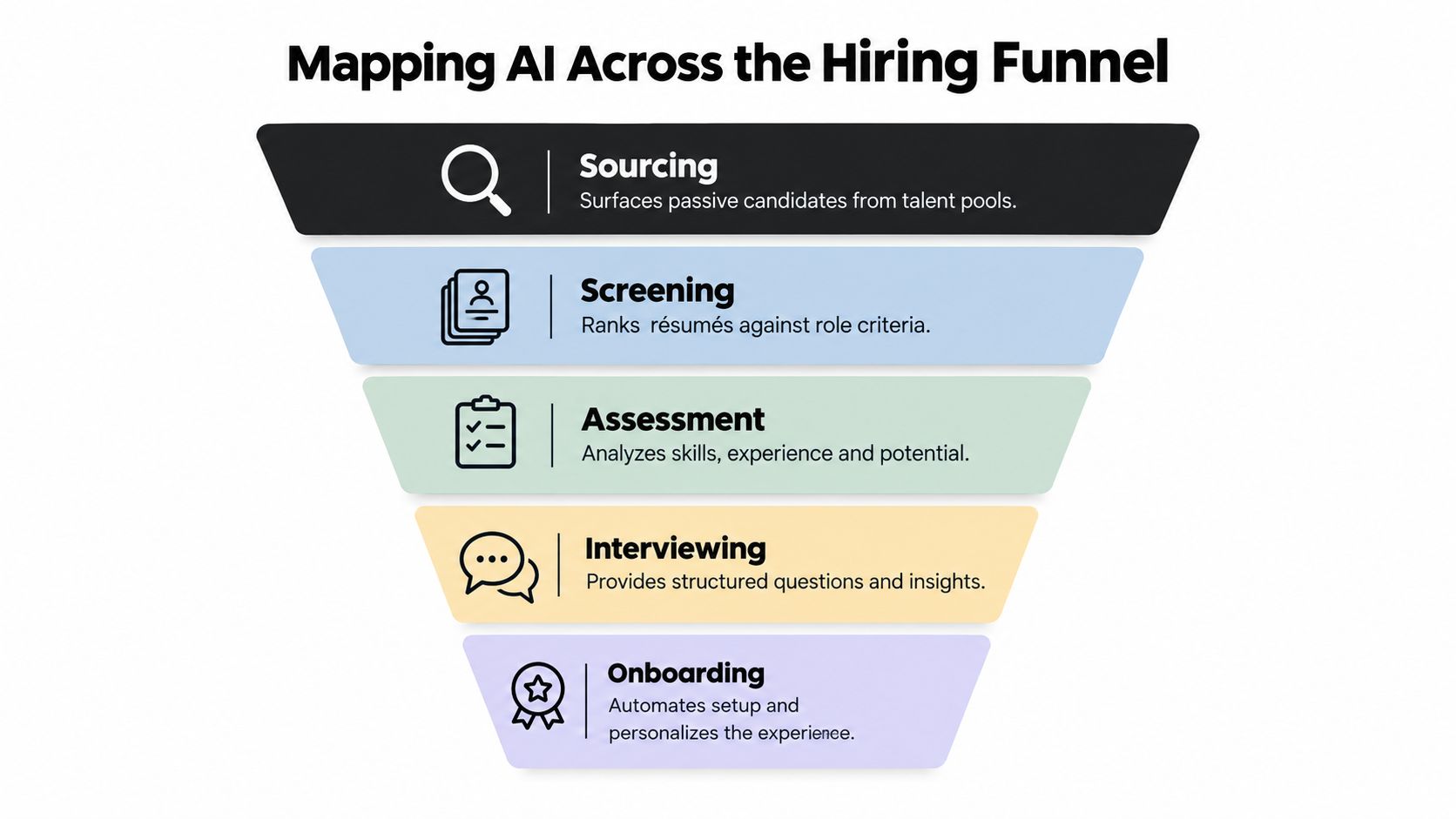
AI is easier to govern when the hiring funnel is treated as a set of separate interventions rather than one large technology category. Each stage creates a different risk profile, uses different data, and calls for a different human checkpoint.
Sourcing and job creation
At the top of the funnel, AI can draft job descriptions, suggest skills, identify internal candidates, surface passive prospects, and personalize outreach. These uses are relatively manageable when recruiters review the language and validate that the role reflects genuine business requirements.
The risk appears when generated language narrows the audience. A model may favor conventional career histories, overemphasize credentials, or reproduce the profile of previous hires. Human review should focus on essential qualifications, unnecessary filters, accessibility, and whether the description invites qualified candidates with nontraditional experience.
Screening and prioritization
Screening tools parse résumés, compare skills against role criteria, apply knockout questions, and prioritize applications for recruiter attention. These systems can reduce manual sorting, but the ranking should be understood as triage rather than proof of suitability.
A useful control is to preserve the underlying application and the reason for each recommendation. Recruiters should be able to see which job-related signals influenced a result and route unclear or incomplete profiles to manual review. A workflow such as an end-to-end AI hiring pipeline is most defensible when it keeps those handoffs visible instead of turning the funnel into an unreviewable score.
Assessment and interviewing
The adoption pattern is concentrated toward the front of the process. In 2024, 26% of organizations reported using AI for HR tasks, while 65% of U.S. HR professionals said their department used AI to generate job descriptions. Only 3% said they used AI to analyze applicants' interview performance, according to coverage of the relevant survey data.
That difference matters. Writing, scheduling, and administrative routing are easier to inspect than systems that infer personality, competence, or trustworthiness from speech, facial expression, or recorded answers. Keep structured interviews human-led, use consistent rubrics, and treat automated summaries as review aids rather than ratings.
For teams building a broader operating model, a practical guida pratica HR con AI can help connect individual use cases to HR workflows without assuming that every hiring decision should be automated.
Onboarding and handoff
After selection, AI can support offer preparation, document collection, reminders, and onboarding coordination. These tasks still involve sensitive personal data, so access controls and retention rules remain important. The safest design separates administrative execution from approval: the system can prepare and route documents, while an authorized person confirms the offer, compensation, and start conditions.
The practical dividing line is clear. Automate movement through the process where the action is reversible and rule-based. Add stronger review where the system influences eligibility, ranking, assessment, or rejection.
Understanding Systemic Bias and Automation Blindness
The most serious bias problem isn't always one bad recommendation. It can be the reuse of the same recommendation logic across many employers and roles, allowing a localized error to become a portfolio-wide pattern.
A Stanford-led analysis of about 4 million applications across 156 employers found that 25.87% of Black applicants' applications and 14.74% of Asian applicants' applications were submitted to positions where the algorithm produced outcomes that adversely impacted those groups, as reported by the Stanford Institute for Human-Centered Artificial Intelligence. The operational lesson is that a model can create harm through repeated exposure, not only through an obviously discriminatory rule in one requisition.
Audit the model portfolio, not just the job
A job-level review can miss the compounding effect. A candidate may apply for several positions, each using similar vendor logic, and encounter the same disadvantage repeatedly. That means governance should record the model version, vendor configuration, role criteria, applicant group, recommendation, progression, and final outcome.
A useful audit view has two levels:
| Audit level | What it reveals | Operational response |
|---|---|---|
| Job level | Whether a specific role produces unequal progression or rejection patterns | Review criteria, knockout questions, recruiter behavior, and role design |
| Application level | Whether candidates experience repeated exposure across multiple applications | Link applications to model versions and investigate portfolio effects |
| Vendor or model level | Whether the pattern follows a shared algorithm across requisitions | Escalate to the vendor, pause the feature, or require remediation |
Don't accept a vendor's aggregate fairness statement as a substitute for your own evidence. Your workforce, role mix, geography, and applicant behavior may differ from the vendor's test environment.
Humans can amplify the recommendation
Human review doesn't automatically neutralize algorithmic bias. In an experimental study summarized by the University of Washington, participants without AI support or with neutral AI selected white and non-white applicants at equal rates. When paired with a moderately biased AI, participants tended to follow the system's racial preference, and severe system bias still influenced human decisions.
This is automation bias in operational form. A recruiter may believe they are making an independent judgment while treating the ranking as an expert signal. Reduce that effect by requiring written, job-related reasons for advancing or rejecting candidates, displaying evidence before the recommendation, and routing outliers to a second reviewer.
The same research reported a 13% reduction in bias when participants first completed an implicit association test, with the figure documented in the University of Washington summary above. That finding doesn't justify a one-time training session as a complete control. It supports a broader practice of prompting conscious review before recruiters make high-impact decisions.
Navigating the New Compliance Requirements for AI Hiring
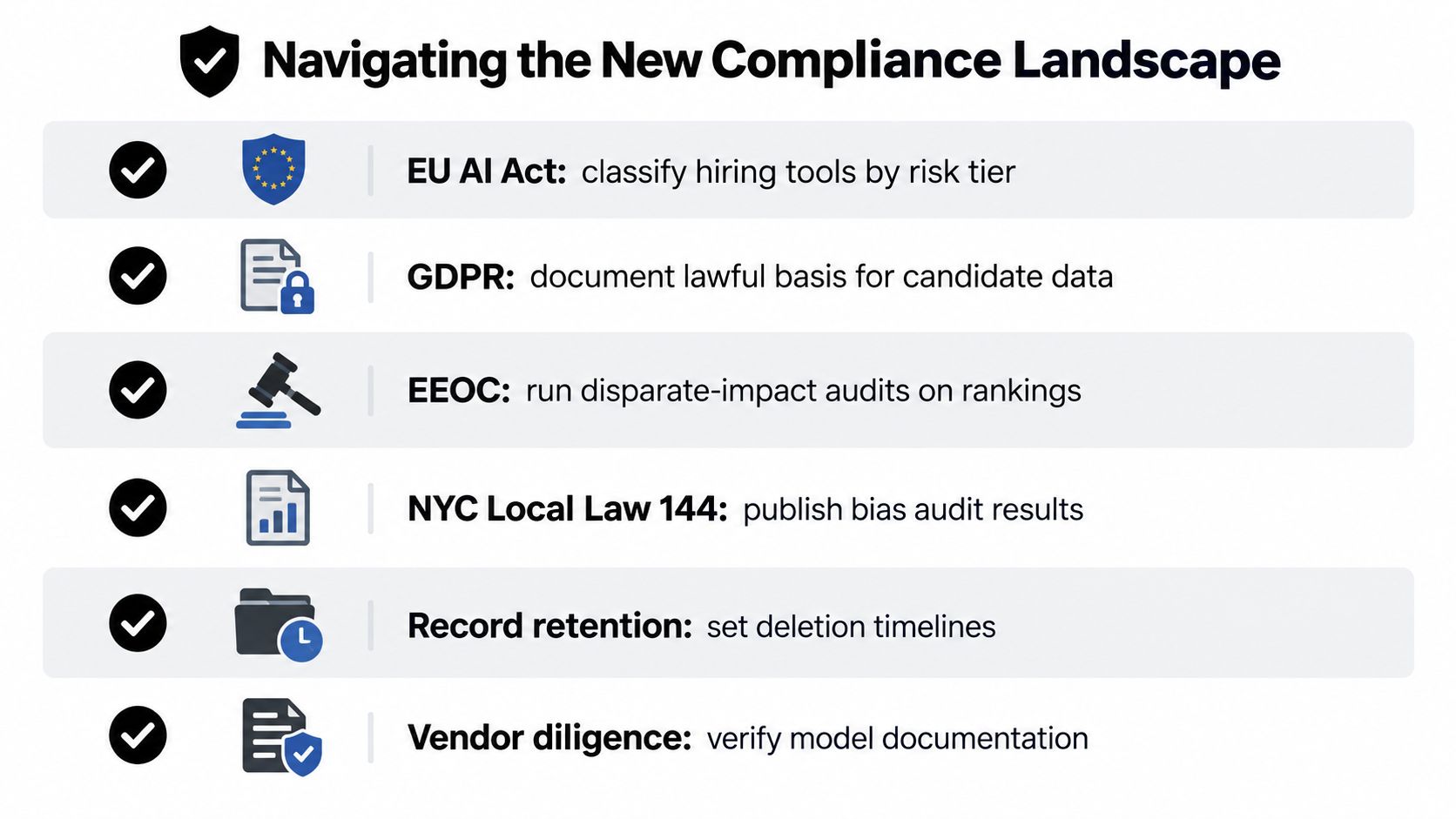
Compliance now operates inside daily recruiting workflows. By 2026, active or newly effective rules in multiple markets include New York City's annual independent bias-audit requirement, California's automated-decision-system regulations, Illinois' amended Human Rights Act, and Texas' Responsible AI Governance Act, as summarized by Resume Now's overview of AI hiring trends.
The exact obligation depends on the jurisdiction, tool, role, and decision the system supports. One global workflow will not reliably satisfy every market. Set a shared control framework, then configure local requirements for notices, reviews, records, and escalation.
Build the evidence before the audit
Start by inventorying tools and decisions. Legal, HR operations, procurement, information security, and recruiting should document which systems influence candidate evaluation, what data enters each system, and who owns the resulting decision.
Create a control file for every material tool:
- Purpose and scope: State what the system does and what it must not do.
- Data record: Document source systems, sensitive-data handling, retention, and access.
- Decision rights: Identify the human approver and the conditions requiring escalation.
- Vendor evidence: Request model documentation, testing methods, update notices, and incident procedures.
- Candidate communication: Prepare jurisdiction-specific notices, accommodation routes, and contact details.
- Audit trail: Preserve inputs, outputs, overrides, reasons, and relevant model versions.
An annual external audit may be required in one market, but that schedule is too slow for operational control. Run an internal review after a vendor changes its model, a role family changes materially, applicant composition shifts, or outcome patterns move unexpectedly.
Make transparency usable
A disclosure candidates cannot understand does not provide meaningful transparency. Explain where automation supports the process, what a human reviews, how candidates can request assistance or accommodation, and how they can raise a concern. Place the notice beside the relevant interaction rather than in general website terms.
The process should be explainable in consistent language by a recruiter, candidate, auditor, and vendor. If their descriptions differ, the organization has not defined the workflow clearly enough to govern it.
Defending Against Synthetic Candidates and Fraud
Bias isn't the only threat in the modern hiring funnel. Employers also have to assess whether the person behind an application, assessment, or interview is authentic. In iHire's 2025 recruiting report, fake or fraudulent candidates accounted for 24.4% of employer concerns, while inauthentic applications or résumés accounted for 24.2%, according to the iHire recruiting report.
That concern changes the design problem. A résumé can be polished by AI without being fraudulent, and a candidate can use legitimate assistance to improve clarity or accessibility. Conversely, a profile can look coherent while concealing identity substitution, fabricated experience, or coordinated behavior across applications.
Use layered verification
No single detector can establish authenticity reliably. Build a sequence of proportionate checks that become more personal only as the candidate advances.
- Application consistency: Compare résumé claims, application answers, portfolio evidence, and employment history for contradictions.
- Knowledge validation: Use structured, role-relevant questions that require the candidate to explain decisions, trade-offs, or work products.
- Identity confirmation: Apply appropriate identity checks before high-trust stages, with clear notice and an alternative route for candidates who need accommodation.
- Interview integrity: Watch for abrupt changes in voice, video quality, eye-line, or response behavior, but treat these as review signals rather than automatic rejection reasons.
- Human escalation: Send suspicious cases to trained reviewers who can request clarification and document the outcome.
The process should test capability, not punish candidates for using writing tools. A generated résumé may still describe genuine experience. Detection systems should flag a case for investigation, not remove the applicant from consideration without review.
Preserve candidate trust
Fraud controls can create their own fairness problem when they rely on opaque facial analysis, rigid identity matching, or inaccessible assessments. Tell candidates what verification involves, why it's necessary, what happens if a check fails, and how they can ask for human review.
A good operator also separates fraud risk from selection quality. A candidate might be authentic but poorly matched to a role, or highly qualified but unable to complete a particular automated check. Store those outcomes separately so a failed verification doesn't become an unexplained negative hiring signal.
Building a Governed Implementation Blueprint
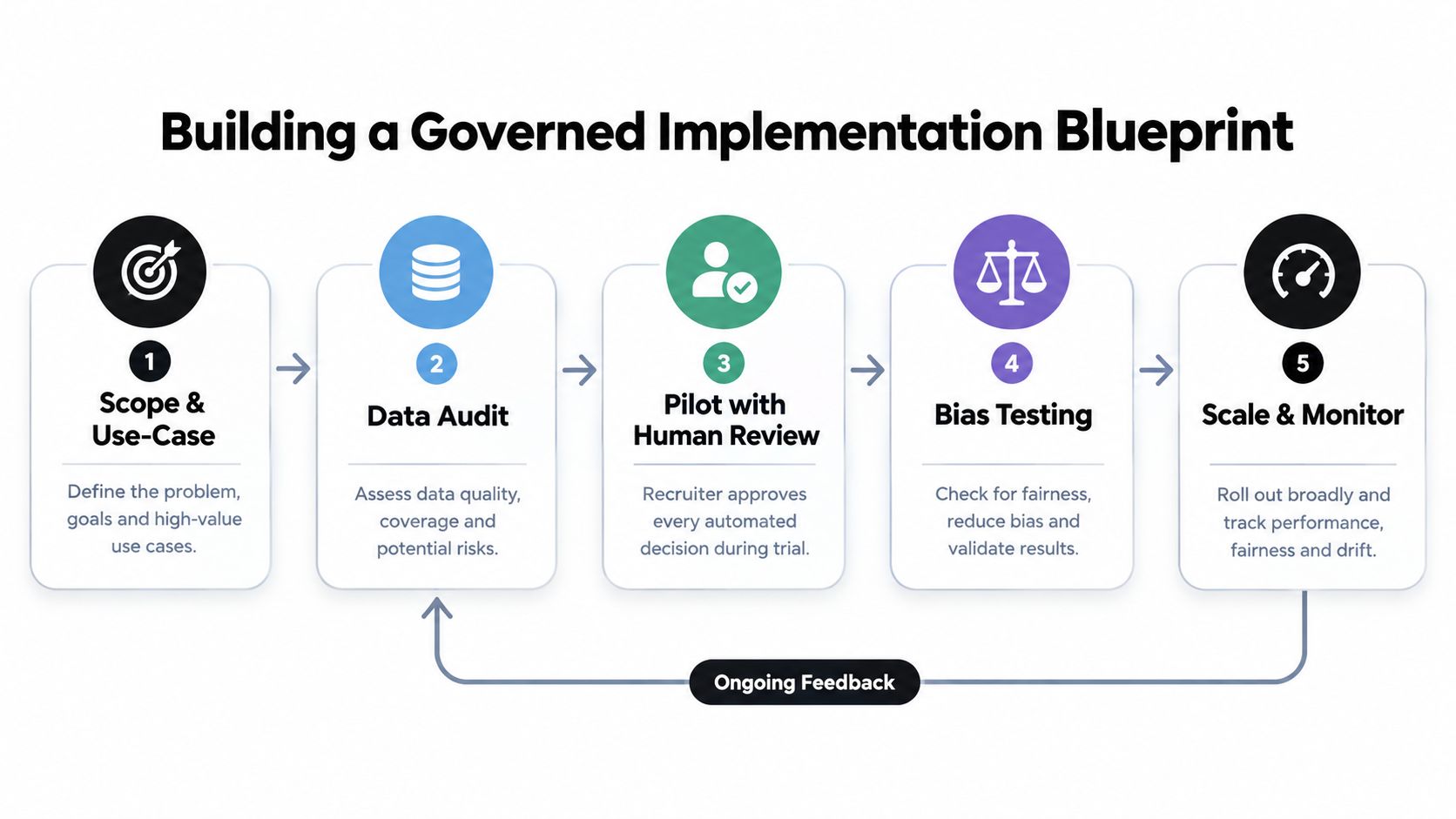
A governed implementation starts with a narrow use case and expands only after the organization can show reliable controls. Don't begin by connecting every recruiting system to an autonomous agent. Start with a workflow where the business value is visible, the data is understandable, and a human can review every material action.
Define the boundary
Write a short use-case charter before configuration. It should state the task, approved inputs, prohibited inferences, permitted outputs, reviewer, escalation path, and success criteria. “Screen candidates” is too broad. “Extract stated skills from résumés and route profiles to recruiter review” is specific enough to test.
Audit the data
Inspect historical outcomes, role criteria, labels, missing values, and proxy variables. Ask whether previous hiring decisions represent the standard you want to reproduce. If the training or reference data encodes inconsistent preferences, a faster model will reproduce the inconsistency at greater scale.
Pilot with visible human review
During the pilot, require recruiters to approve recommendations before the ATS advances a candidate. Record overrides and ask why they happened. Frequent overrides may indicate weak role criteria, poor parsing, missing context, or a model that isn't fit for the use case.
Control that matters: The reviewer needs both authority and time. A nominal human checkpoint fails when the system's recommendation is difficult to challenge or the recruiter is measured only on throughput.
Test outcomes and user behavior
Test progression, rejection, and override patterns across relevant groups and role families. Also test recruiter behavior. If users consistently accept the first recommendation without examining evidence, the interface is encouraging automation blindness.
For a broader explanation of risk controls and guardrails in business, the useful principle is to make boundaries explicit before a system reaches production. In recruiting, that means permissions, approval gates, audit logs, and escalation routes should be product settings, not informal expectations.
Scale with change management
Train recruiters on the tool's purpose, known limitations, override process, candidate communication, and incident reporting. Notify them when the vendor changes the model or ranking logic. Teams need a simple way to pause automation for a role or location without disabling the entire recruiting operation.
Organizations comparing implementation options can also review AI governance and compliance practices as part of their operating model. The central design choice remains the same: AI should route work and surface evidence, while accountable people retain authority over consequential decisions.
Measuring Success and Continuous Auditing
An AI hiring system isn't finished when it goes live. It changes as vendors update models, recruiters adapt their behavior, candidates change how they apply, and business teams rewrite job requirements. Measurement must therefore cover efficiency, fairness, candidate experience, authenticity, and control effectiveness.
Start with a baseline before activation. Record how applications move through each stage, how often recruiters override recommendations, where candidates abandon the process, and how frequently manual corrections occur. Without a baseline, a later improvement or deterioration can look like normal variation.
Track the right operating signals
A practical dashboard should include:
- Funnel movement: Applications received, reviewed, advanced, rejected, withdrawn, and hired, segmented by role and relevant protected groups where lawful.
- Adverse impact: Compare outcomes at both the job level and the application level, then connect patterns to the upstream model and configuration.
- Human intervention: Measure overrides, escalations, review time, and cases where recruiters cannot explain the recommendation.
- Candidate experience: Monitor questions, complaints, accommodation requests, disclosure-related drop-off, and response times.
- Authenticity controls: Track verification flags, confirmed fraud, cleared alerts, and false positives separately.
- System reliability: Record outages, parsing failures, stale data, permission errors, and vendor model changes.
Don't optimize for time saved alone. A faster shortlist isn't a success if qualified candidates are screened out, recruiters stop exercising judgment, or candidates leave because the process feels opaque.
Set review triggers
Use a scheduled review rhythm, but don't rely on the calendar alone. Trigger an investigation after a model update, a new role family, a significant workflow change, an unusual outcome pattern, a candidate complaint, or a confirmed fraud incident.
Keep an evidence packet for every review. Include the tool version, configuration, data sources, role criteria, outcome tables, sampled cases, overrides, incidents, and remediation decisions. That record helps legal teams assess exposure, gives recruiting operations a way to improve the workflow, and lets vendor managers demand specific fixes rather than general assurances.
A governed AI in hiring process is not the one with the most automation. It's the one that produces useful operational capacity while the organization can still explain, challenge, and correct its decisions.
Cyndra provides AI employees for recruiting workflows that can screen candidates, schedule interviews, send offers, and support onboarding across ATS, HRIS, calendar, and e-signature tools. Visit Cyndra to discuss how a governed recruiting workflow can automate administrative work while preserving human review and auditability.