 CYNDRA
At 8:47 on Monday morning, the recruiting leader's queue is already behind. Last week's applicants are unranked, two requisitions have been open long enough to attract executive attention, a hiring manager wants a status update, and nobody can say with confidence who owns the next sourcing action. The team doesn't need another chatbot. It needs volume triage, prioritization that reflects the hiring manager's actual intent, and pipeline visibility that doesn't depend on someone rebuilding a spreadsheet.
That's the practical test for AI recruitment agents. If a tool can't reduce those three fires during its first week, its feature list is irrelevant. AI adoption is already concentrated in recruiting. A December 2025 survey of 1,722 HR professionals found that 39% of organizations used AI somewhere in HR, with recruiting the most common use case at 27%. Another 7% planned to launch AI in HR during the year, according to Recruiterflow's state of AI in recruiting report.
Table of Contents
- The Monday Morning a Recruiting Agent Has to Fix
- What an AI Recruitment Agent Actually Is
- Core Capabilities From Sourcing to Pipeline
- Integrating With Your ATS and Communication Stack
- Compliance, Bias Exposure, and Candidate Trust
- Measuring ROI Without Vanity Metrics
- A 60 Day Implementation Roadmap With Cyndra
- The Operator Checklist Before You Switch Anything On
The Monday Morning a Recruiting Agent Has to Fix
A recruiter's first problem is volume triage. An agent should read incoming applications, identify the information that matters for the role, apply a defined screening rubric, and place candidates into an actionable queue. “Actionable” means the recruiter can see who needs review, who needs clarification, who can move forward, and who requires a documented disposition. A ranked list without reasons is just a faster backlog.
The second problem is priority alignment. Hiring managers rarely communicate requirements as clean data. They describe tradeoffs, urgency, must-have experience, acceptable adjacent skills, and concerns about the team. The agent has to preserve those decisions in the requisition workflow rather than reverting to keywords from an old job description. If the manager says customer-facing experience matters more than a particular software credential, the system should reflect that weighting and show the recruiter how it reached its recommendation.
The third problem is pipeline visibility. Recruiters should be able to answer basic operational questions without manually reconciling the ATS, email threads, calendar events, and Slack messages. Which candidates are waiting for feedback? Which hiring managers have not submitted scorecards? Which outreach sequences received replies but no follow-up? If the agent can't write reliable status updates back to the system of record, it creates another reporting layer instead of removing work.
Operator rule: Evaluate the agent against one live requisition in week one. Require evidence that it reduced triage, clarified ownership, and kept the pipeline current.
Start with the workflow, not the interface. A useful overview of broader hiring automation can provide context in this AI hiring transformation guide, but your buying decision should rest on observed execution. The recruiter who succeeds with an agent no longer owns every reminder, search, status change, and calendar exchange by hand. They own exceptions, judgment, candidate relationships, and the controls that govern the machine.
What an AI Recruitment Agent Actually Is
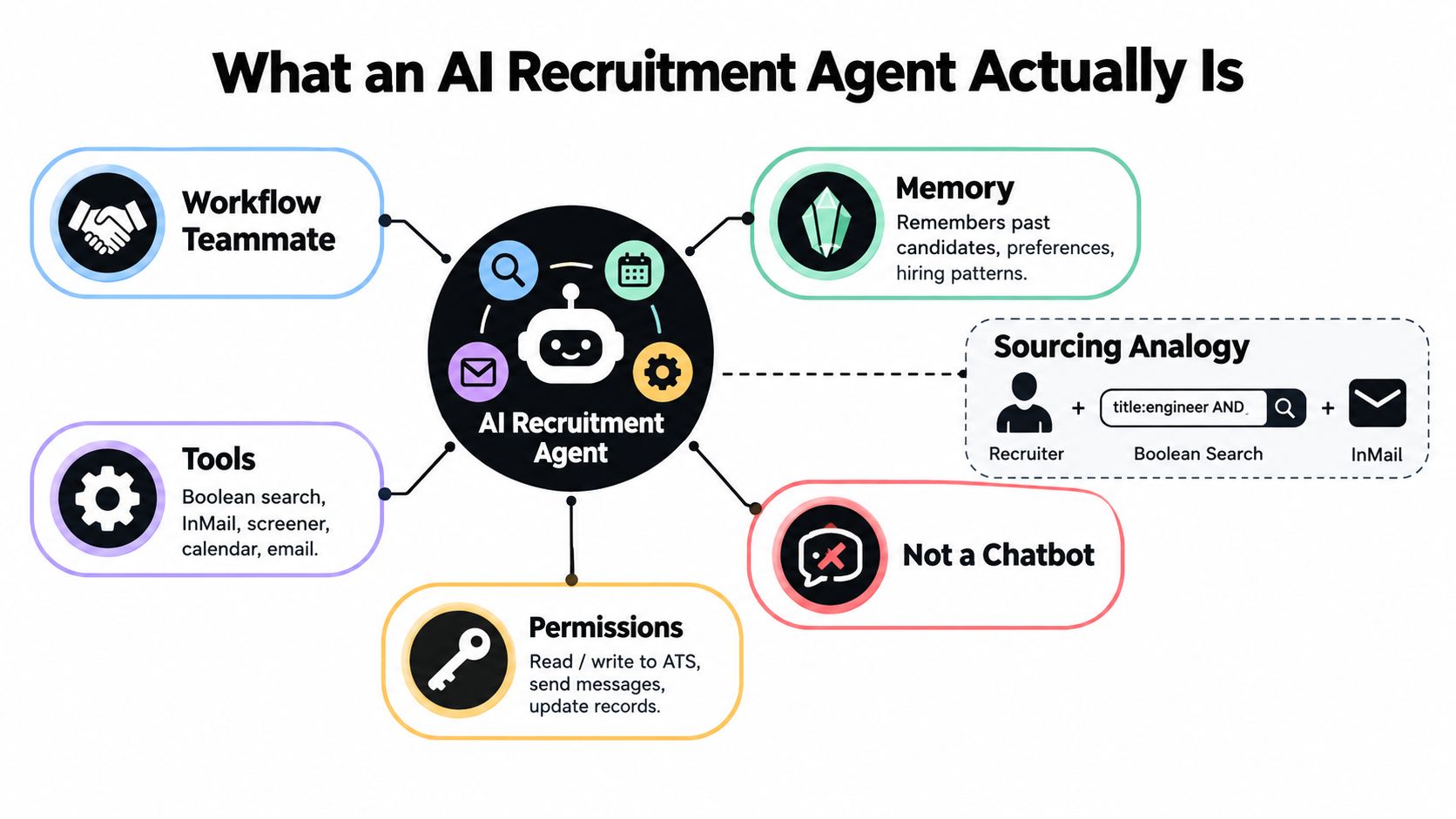
An AI recruitment agent is a workflow teammate with tools, memory, and permissions. It isn't a chatbot that answers a candidate's question, and it isn't a recommendation engine that produces a list for someone else to process. A real agent works toward a defined hiring objective across connected systems, taking approved actions and escalating decisions that require human judgment.
The sourcing analogy is straightforward. A recruiter with a Boolean search bar, an InMail inbox, a calendar, an ATS, and a talent CRM runs a repeatable loop. They read the requisition and hiring manager notes, search for candidates, review history, send outreach, monitor replies, schedule conversations, update the pipeline, and adjust the next step based on what happened. An agent performs the same loop programmatically, provided it has access to the relevant systems and clear operating rules.
The agent loop
A practical agent follows five stages:
- Perceive: Read the requisition, candidate record, prior messages, interview feedback, and relevant calendar or workflow events.
- Reason: Compare the available evidence against the approved rubric and determine the next permitted action.
- Act: Search, draft or send outreach, schedule, request feedback, update a stage, or escalate.
- Log: Record the input, action, result, permission used, and human intervention.
- Learn: Use outcomes such as replies, interview advancement, and recruiter corrections to improve future workflow decisions without changing governance.
The distinction matters because a conversational screen can make a product look autonomous when the underlying system only generates text. Ask the vendor to demonstrate a complete action chain, not a polished demo. The agent should read context, execute across systems, observe the result, and preserve an audit trail.
A strong technical benchmark is RecruitBench. It contains 1,594 resume-job pairs across 18 startup roles and tests interview advancement prediction plus resume-to-k job recommendation. The candidates were already screened by professionals, which makes the benchmark more demanding than open-pool filtering and useful for testing whether an agent can rank beyond obvious keyword matches.
For a broader buyer's view, AI hiring tools for CHROs can help frame categories and evaluation questions. The governing principle remains simple: an agent is only as accountable as its integrations, permissions, escalation rules, and human review.
Core Capabilities From Sourcing to Pipeline
Treat the recruiting workflow as a chain of dependent layers. Sourcing supplies candidates to screening. Screening determines who receives outreach. Outreach creates activity that must be captured in the pipeline. Pipeline management closes the loop with scheduling, feedback, and disposition. A buyer who purchases only the first layer gets a faster top of funnel and a broken middle.
| Capability | What It Does | Most Common Failure |
|---|---|---|
| Sourcing | Discovers profiles, expands Boolean searches, rediscovers past applicants, and interprets intent signals | The agent can't access the talent CRM or internal candidate history |
| Screening | Parses resumes, extracts skills, applies knockout questions, and scores candidates against a structured rubric | The rubric is vague, outdated, or copied from an old job description |
| Outreach | Sends sequenced messages, handles replies, personalizes follow-ups, and re-engages silver-medalists | Messages sound generic, misread context, or damage the employer brand |
| Pipeline management | Schedules interviews, aggregates scorecards, updates ATS stages, and nudges hiring managers | Integrations are read-only, leaving recruiters to reconcile records manually |
Sourcing needs institutional memory
A credible sourcing agent should search beyond public profiles. It should find relevant people in the existing CRM, identify prior applicants who now fit a different role, and distinguish active interest from stale profile data. It also needs a way to represent adjacent skills. A candidate who uses different terminology may be relevant, but the agent should show the evidence rather than broadening the match.
The failure mode is predictable. If the agent sees only a job description and a public database, it can produce plausible names without understanding your hiring history, previous outreach, or internal mobility options.
Screening needs a living rubric
Resume parsing is useful, but parsing isn't screening. Screening requires explicit criteria, weighted evidence, knockout rules, and a review path for exceptions. Hiring teams should approve the rubric before the agent scores candidates, then review whether the rubric reflects the role rather than inherited assumptions.
Outreach is where automation becomes visible to candidates. Personalization should use relevant context, not superficial name insertion. The agent needs reply handling, consent rules, suppression lists, and a clear escalation path when a candidate asks a question outside the approved knowledge base.
Pipeline management is the operational test. Scheduling, reminders, scorecard collection, stage transitions, and manager nudges must update the ATS reliably. If those actions remain outside the system of record, recruiters still carry the coordination burden, only now they have to monitor the agent too.
Integrating With Your ATS and Communication Stack
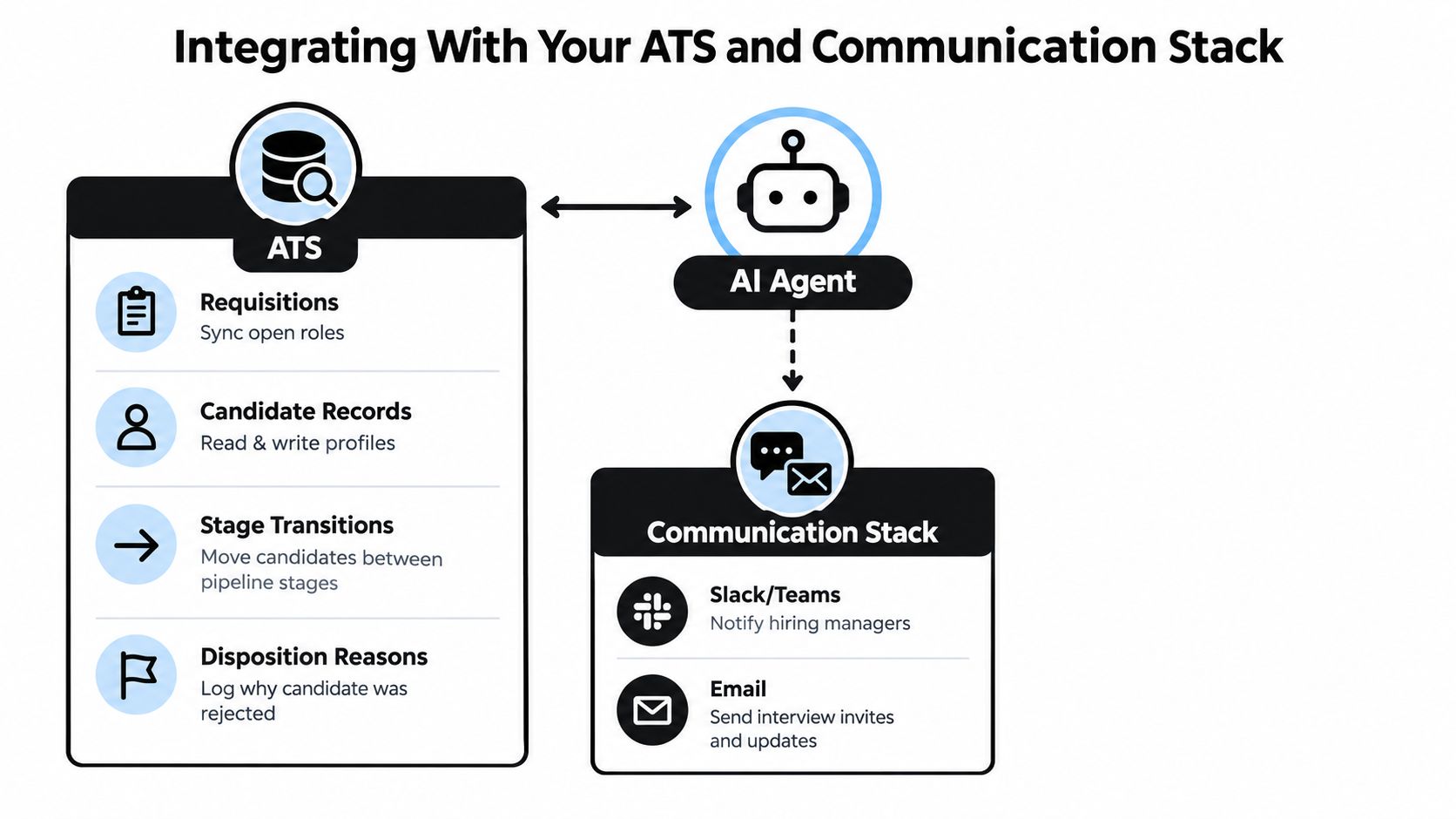
An agent that can only read your recruiting systems is an assistant. An agent that can read and write under controlled permissions can become an operating layer. The distinction affects data quality, accountability, and whether recruiters trust the pipeline.
The ATS should generally sync requisitions, candidate records, stage transitions, and disposition reasons in both directions. The agent needs the current role definition, candidate history, and workflow state. When it schedules an interview, receives a cancellation, or records a disposition approved by a recruiter, that event should return to the ATS with the relevant timestamp and actor.
Move the right data
The HRIS remains the system of record for employee identity, compensation, payroll, benefits, and other sensitive employment data. Don't export entire HRIS tables into an agent because the connector makes it possible. Pass only the fields required for the approved recruiting workflow, and define retention and deletion behavior before production use.
Email and calendar belong in the same conversation layer as the ATS, but they shouldn't operate without ownership controls. Slack or Microsoft Teams can notify hiring managers, request scorecards, and escalate exceptions. Email can send candidate updates and interview invitations. SMS may be appropriate for approved reminders, but it requires explicit consent and careful handling of personal contact data.
Two integration failures cause disproportionate damage:
- Stale stage data: The agent believes a candidate is awaiting a screen while the recruiter has already rejected them, so the system sends an inappropriate message.
- Silent double-sends: The agent and recruiter both believe they own outreach, resulting in duplicate messages, contradictory instructions, or an embarrassing follow-up after a human reply.
Use APIs for structured, near-real-time reads and writes. Use webhooks to notify the agent that an event occurred, such as a stage change or calendar cancellation. Use flat-file connectors only where legacy systems leave no practical alternative, and add reconciliation checks because files introduce delay and ambiguity. Guidance on dealing with older infrastructure is available in this legacy system integration guide.
SSO matters because access should follow the user's identity and role. Audit logs matter because you need to reconstruct what the agent saw and did. Field-level permissions matter because a scheduling agent shouldn't have authority to alter evaluation criteria or access unrelated HR data.
Compliance, Bias Exposure, and Candidate Trust
Bias and liability aren't ethics footnotes. They're procurement requirements. The employer can't outsource responsibility by placing an AI vendor between the recruiter and the candidate, especially when the system changes who advances, who receives outreach, and who disappears from the funnel.
The exposure is measurable. A Stanford study reviewed 3.4 million real applicants and 4 million applications across 156 employers. It found that more than 25% of applications from Black candidates and nearly 15% from Asian candidates were routed to positions producing adverse impact under Title VII-style four-fifths rule standards, as reported in the algorithmic hiring study. The lesson isn't that every agent produces the same result. The lesson is that protected attributes don't need to appear in the model for automated screening to alter candidate flow across groups.
The operator owns the control environment
The employer should define the job-related criteria, approve the scoring rubric, test selection patterns, review exceptions, and preserve evidence of human oversight. The vendor should explain the model, data lineage, update process, access controls, audit support, and limits of the product. If the contract says the vendor provides a tool while the employer makes decisions, that doesn't remove the employer's operational duties.
The legal allocation remains contested. Reporting on the Workday lawsuit highlights the unresolved question of whether liability rests with the employer, the vendor, or both. Rules are also diverging. NYC requires annual independent bias audits and public summaries, Illinois prohibits AI that has a discriminatory effect in hiring, and California has separate automated-decision rules, according to Reuters' coverage of AI hiring accountability.
| Regulation | Scope | Operator Obligation | Penalty Exposure |
|---|---|---|---|
| EEOC and Title VII principles | Employment selection and adverse impact | Validate job-related criteria, monitor selection patterns, and document review | Discrimination claims, investigation, remediation, and litigation |
| NYC Local Law 144 | Automated employment decision tools used in New York City | Arrange the required independent bias audit and publish the required summary | Enforcement and public accountability risk |
| Illinois AI hiring rules | AI use that has a discriminatory effect in hiring | Test tools and prevent discriminatory deployment | Statutory and litigation exposure |
| California automated-decision rules | Covered automated employment decisions | Review applicable notices, data, and decision controls | State enforcement and dispute risk |
| EU AI Act and GDPR Article 22 | High-risk employment systems and certain automated decisions involving individuals | Apply risk management, transparency, human oversight, and lawful processing controls | Regulatory enforcement and individual rights claims |
Candidate trust is a separate operating risk. Only 26% of applicants trust AI to evaluate them fairly, and 49% of U.S. job seekers believe AI recruiting tools are more biased than human recruiters, according to Yena's 2026 coverage of candidate trust. Tell candidates whether AI is used, what it does, how they can challenge an outcome, and when a human can override it. Maintain model cards, data lineage, consent records, retention rules for sourced profiles, and human-review logs.
A candidate who discovers they were filtered without disclosure may not only withdraw. They may share the experience publicly, challenge the decision, or treat every later interaction as suspect. Transparency is part of candidate experience, not a legal disclaimer added after launch. Practical governance controls belong in the deployment plan, as outlined in this AI governance and compliance resource.
Measuring ROI Without Vanity Metrics
The CFO won't fund an agent because it sent more messages. Finance will fund a system that lowers the cost of a hire, shortens vacancy time, improves conversion through the funnel, or returns recruiter capacity to revenue-producing work.
Start with a baseline before activation. Use a consistent historical window that includes comparable roles, recruiters, channels, and hiring conditions. Then compare the agent-assisted workflow with the baseline while separating agent actions from human decisions.
The metrics that survive scrutiny
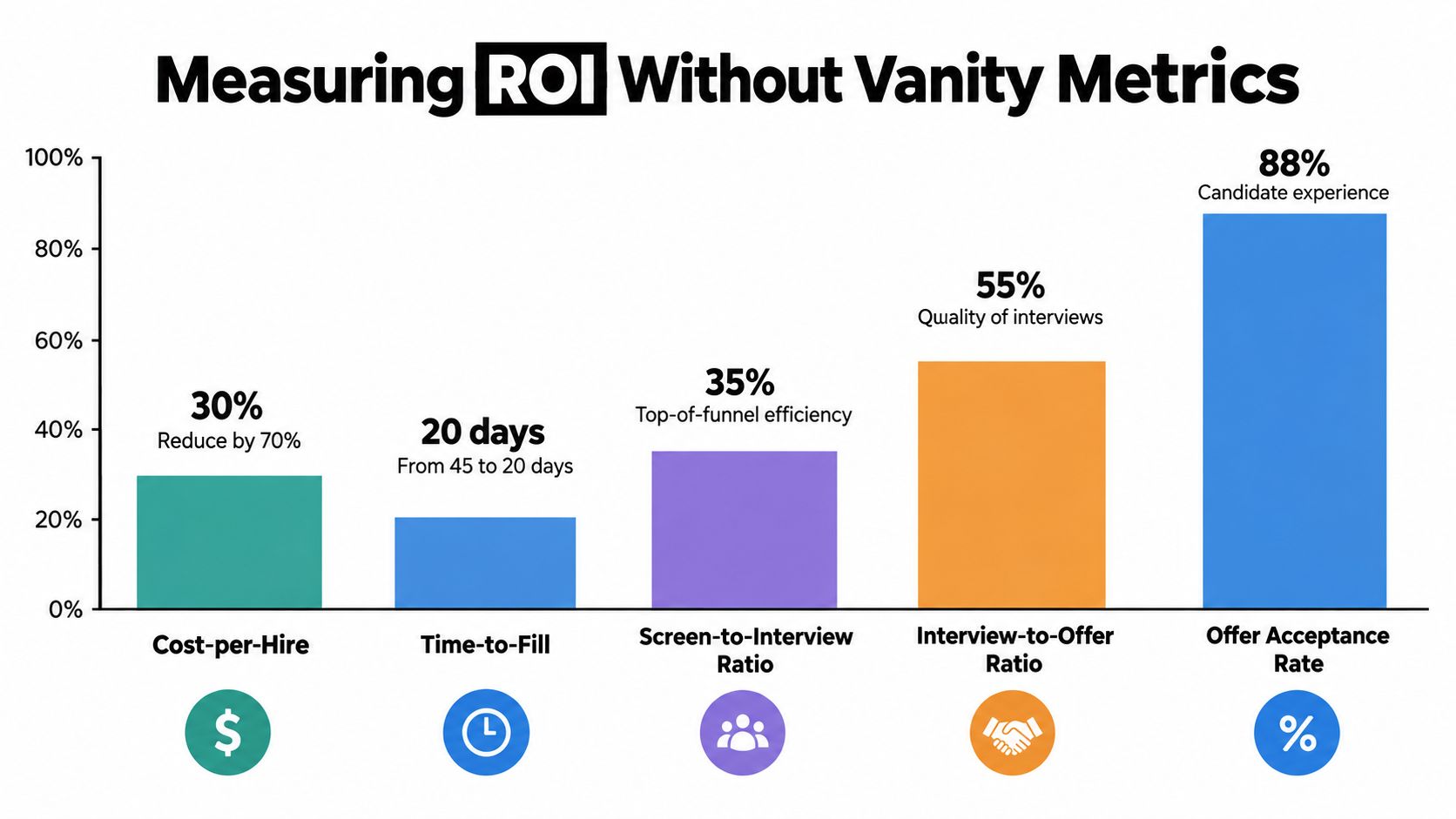
- Cost per hire: Total recruiting expense divided by completed hires. Include agency fees, advertising, assessment costs, recruiter labor, and the agent contract allocation.
- Time to fill: Calendar time from approved requisition to accepted offer. Track the median and inspect outliers instead of relying on a single average.
- Screen-to-interview ratio: Interviews completed divided by candidates screened. A lower ratio isn't automatically better. Review whether the agent is removing unqualified candidates or excluding viable ones.
- Interview-to-offer ratio: Offers made divided by interviews completed. A change may reflect better screening, stronger intake, or hiring-manager calibration, so preserve decision notes.
- Offer acceptance rate: Accepted offers divided by offers made. Break the result down by role, location, recruiter, and candidate source.
- Recruiter hours reclaimed: Verified hours no longer spent on triage, scheduling, reminders, status updates, and ATS administration per requisition.
Don't accept message volume, chatbot deflection, or engagement scores as primary KPIs. They measure activity, not hiring outcomes. A high reply count can coexist with weak interviews, poor offer acceptance, and a damaged employer brand.
For a 50-hire-per-year organization, calculate the annual baseline cost of recruiting, estimate the portion attributable to automatable work, and assign a conservative value to reclaimed recruiter time. A six-figure annual contract only makes sense if the documented value from lower recruiting cost, reduced vacancy exposure, and returned capacity exceeds that fee with room for implementation and oversight. Don't reverse-engineer the target from the vendor's forecast. Set the payback threshold first, then require the pilot to prove it.
A 60 Day Implementation Roadmap With Cyndra
Use an install, train, manage sequence. Cyndra frames this as Consultation, Implementation, and Transformation. The practical version below keeps the operator in control and gives every phase a rollback signal.
Days 1 through 5, establish the baseline
Owner: Recruiting operations, HRIS owner, legal, and the recruiting leader.
Output: Stakeholder map, locked KPI definitions, ATS and email data audit, permission inventory, and a bias-risk memo signed by legal. Record current funnel movement, disposition reasons, stage aging, communication ownership, and candidate disclosure language.
Rollback signal: The team can't agree on KPI definitions, the ATS contains contradictory stage data, or legal hasn't approved the risk memo. Don't configure the agent until those gaps are resolved.
Days 6 through 20, configure and test
Owner: Implementation lead, ATS administrator, recruiting operations, and selected recruiters.
Output: Role permissions, escalation rules, approved prompts, structured screening rubrics, integration tests, sandbox records, and a low-volume sourcing run. Test both API actions and event handling. Create explicit suppression rules so the agent won't contact candidates who already have active human conversations.
Rollback signal: Records fail to reconcile, actions appear without audit entries, duplicate sends occur, or the agent can't explain a recommendation against the approved rubric.
Days 21 through 35, run a controlled live pilot
Owner: Two or three trained recruiters, with one recruiting operations owner observing every action.
Output: Live sourcing and outreach for one role, parallel comparison with the manual workflow, recruiter corrections, candidate questions, escalation records, and early funnel data. A recruiter should shadow every send, stage update, and scheduling action during this period.
Rollback signal: Candidate replies receive irrelevant responses, recruiters override most recommendations, or ownership conflicts create duplicate outreach.
Days 36 through 45, extend to screening
Owner: Recruiting leader, legal or compliance partner, and pilot recruiters.
Output: Human-in-the-loop review of every rejection, rubric adjustments, documented exception patterns, and an updated candidate-disclosure process. Review selection patterns by relevant protected-group data where lawful and available, and investigate unexplained differences.
Rollback signal: The agent rejects candidates without sufficient evidence, the review log is incomplete, or adverse-impact indicators worsen without a documented job-related explanation.
Days 46 through 60, manage and decide
Owner: Executive sponsor, recruiting operations, finance, legal, and the vendor or implementation partner.
Output: Go or no-go recommendation against cost per hire, screen-to-interview ratio, recruiter hours reclaimed, candidate experience signals, integration reliability, and adverse-impact indicators. If approved, expand role coverage gradually and schedule the 45-day performance review after broader operation begins.
Rollback signal: The pilot misses the agreed threshold, data quality deteriorates, or the team can't reproduce the agent's actions from the logs.
For implementation details, review AI agent integration guidance. The point of the 60-day path isn't speed for its own sake. It's controlled exposure, measurable learning, and a clear way to stop before a bad configuration becomes a production habit.
The Operator Checklist Before You Switch Anything On
Run this checklist in one working session. Every item needs a yes or no answer, not a verbal assurance.
- Legal approval: Has legal signed the data-minimization and retention review?
- ATS permissions: Are read-write permissions limited to the fields and actions the agent needs?
- Communication ownership: Is there one recorded owner for every outbound channel and workflow?
- Candidate disclosure: Is approved AI-use and challenge language live at every relevant candidate touchpoint?
- Human review: Does a human review every rejection or other consequential negative decision?
- Auditability: Can the team retrieve the agent's inputs, actions, permissions, and escalations?
- Rollback: Has someone tested the runbook for disabling sends, reversing stage changes, and restoring records?
- Baseline KPIs: Are cost per hire, time to fill, funnel ratios, offer acceptance, and recruiter hours recorded?
- Training: Has each recruiter completed role-specific training, with attendance and competency logged?
- Candidate experience: Is a survey or feedback mechanism in place to detect confusion, distrust, or unwanted contact?
The mistake that derails most rollouts is treating go-live as the finish line. Go-live is week one of a tuning cycle, and the operator must own that cycle for the first ninety days. Vendors can fix defects and provide updates. They can't decide whether your rubric reflects the role, whether your recruiters trust the workflow, or whether a candidate received a fair explanation.
Cyndra offers AI employees for recruiting workflows that can coordinate interviews, send reminders, collect structured feedback, and keep ATS records current across connected systems. If your team is ready to test an agent against the operational and compliance standards in this guide, visit Cyndra to start with a focused consultation.