 CYNDRA
You're probably not asking whether an artificial intelligence sales assistant can write an email. You've already seen that demo. The harder question is whether it can work inside your CRM, respect your sales process, improve seller output, and remain useful after the launch team stops watching every response.
That's where most implementations struggle. Adoption is broad, but durable automation is still rare because sales data is fragmented, workflows are inconsistent, and governance often arrives after the first production incident. The operators who get lasting value treat AI as revenue infrastructure, not as another chat window.
Table of Contents
- Beyond the Hype - What AI Sales Assistants Actually Deliver
- Market Growth and Real-World Adoption of AI Sales Agents
- Sales Workflows AI Can Automate Today
- Benchmark Evidence - When Specialized AI Outperforms General Chat
- How to Evaluate Vendors and Build Custom AI Sales Agents
- Vendor Approaches Versus Internal Build Options
- Measuring ROI and Tracking Sales AI Performance
- Pitfalls, Risk Mitigation, and Long-Term Success Strategies
Beyond the Hype - What AI Sales Assistants Actually Deliver
An AI sales assistant can find prospects, start conversations, qualify buyers, update the CRM, and advance deals. Those capabilities make a strong demo. They do not make a production-ready sales operation. The true test is whether the system completes a defined workflow accurately, records its actions, and hands exceptions to the right person.
The dependable gains come from repetitive revenue work. An artificial intelligence sales assistant can gather account context, identify missing CRM fields, summarize meetings, prepare follow-ups, surface stalled opportunities, and route routine requests. These tasks recover selling time by reducing data transfer between systems. They also create a cleaner operating record for managers and sellers.
Learn how AI can support sales automation while keeping isolated task automation separate from a fully autonomous sales representative.

Adoption doesn't equal operational depth
A 2026 industry summary reported that 81% of sales teams either use AI or are experimenting with it, while 61% of sales professionals say AI is important to their sales strategy. It also reported that 35% of companies globally use AI in sales and marketing, and that 68% of high-performing sales teams use AI to improve forecasting accuracy. The industry summary describes broad use in prospecting, forecasting, and administration. Those figures do not establish that companies have connected AI to the full sales motion or granted it unsupervised authority.
The practical distinction is between assistance and delegation. Assistance drafts a follow-up for approval or summarizes a call. Delegation lets a workflow read a defined trigger, check account rules, create a task, send an approved message, and log the outcome. Delegation demands clear permissions, trustworthy data, exception handling, and monitoring. Without those controls, a polished pilot becomes an unreliable production dependency.
Operator's rule: If a workflow cannot explain what it did, which data it used, and when a human must intervene, it is not ready for unsupervised execution.
Choose one repeatable revenue process first. Define its inputs, approval points, failure states, and audit trail. Prove safe completion under real conditions, then expand authority. The result may look less impressive in a demo, but it gives the sales team infrastructure they can keep using after the pilot ends.
Market Growth and Real-World Adoption of AI Sales Agents
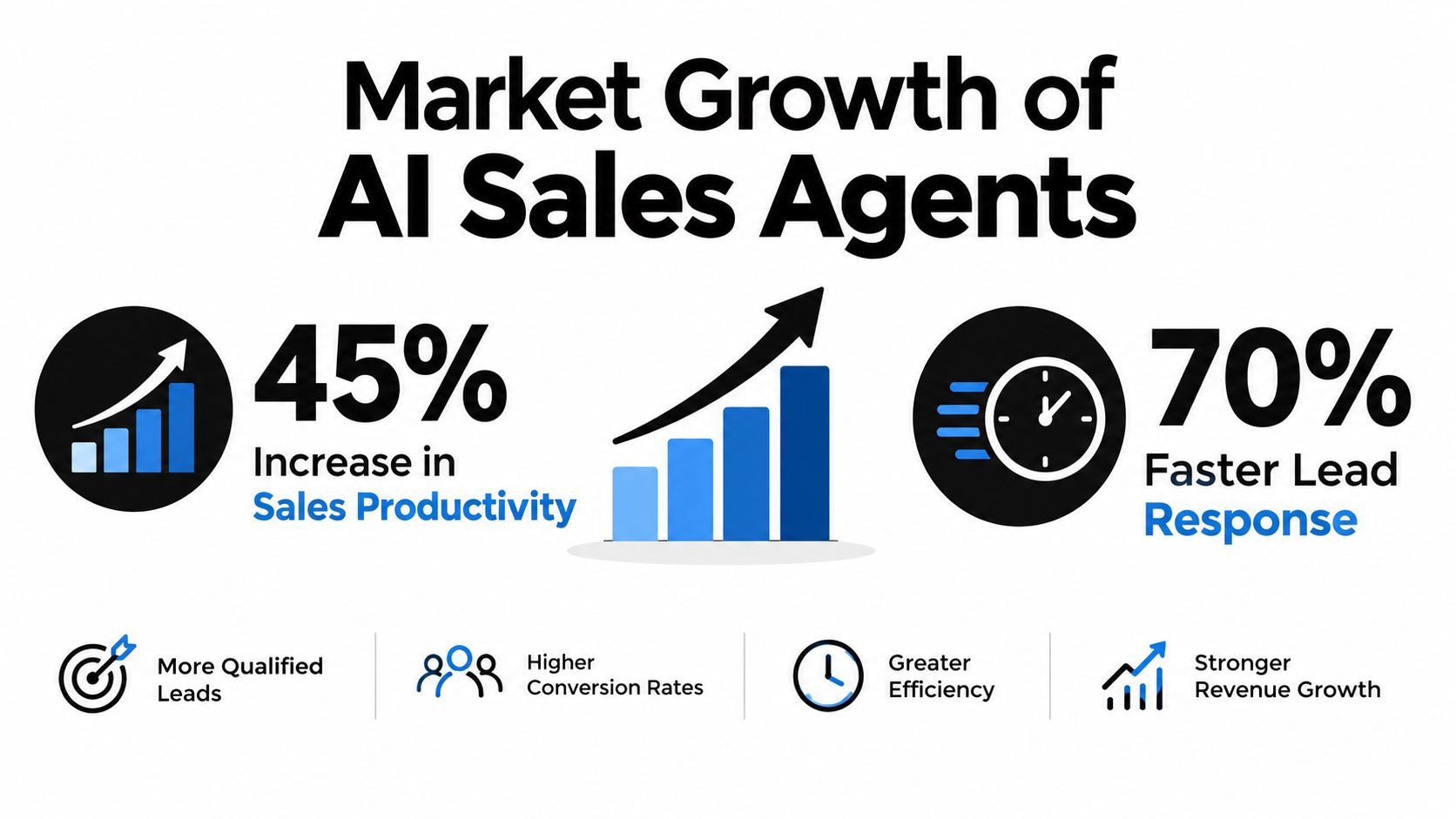
A sales organization can run an impressive AI pilot while leaving its core revenue process unchanged. That gap explains the current market: companies are buying AI sales assistants, but relatively few have turned them into dependable systems that operate across the sales motion. Adoption is broad. Deep automation remains selective because integrations, permissions, data quality, and governance determine whether a tool survives contact with production work.
One estimate values the global AI sales assistant software market at approximately USD 3.11 billion in 2025 and projects roughly USD 26.09 billion by 2035, with a 23.7% compound annual growth rate from 2026 to 2035. A separate estimate places the market at USD 3.2 billion in 2026 and USD 14.2 billion by 2033, also using a 23.7% CAGR. The market estimate reports different absolute valuations, but both forecasts point to sustained double-digit growth.
The disagreement is useful, not alarming. Market reports define the category differently, include different vendors, and apply different forecasting methods. Treat the figures as directional evidence rather than precise accounting. The commercial signal is clear: buyers now budget for AI sales assistants as enterprise software, while vendors compete to own recurring workflows instead of isolated chat experiences.
What the category actually includes
An AI sales agent extends beyond a website chatbot. A production deployment may connect several activities:
- Research: Assemble account, contact, product, and interaction context before seller outreach.
- Outreach: Draft or send approved messages using buyer signals, segment rules, and conversation history.
- Qualification: Ask defined questions, identify buying intent, and route qualified opportunities.
- Forecasting: Compare CRM activity, stage definitions, and deal evidence to flag weak forecasts.
- Administration: Update records, create tasks, summarize calls, and prepare pipeline reports.
North American organizations have been early adopters and represent a substantial share of commercial demand. That concentration gives the category credibility, but a regional playbook will not transfer unchanged. Language, consent requirements, sales cycles, data residency, and CRM practices affect implementation quality.
Evaluate vendors by workflow coverage and operational control, not feature count. A tool that drafts excellent messages but cannot reliably record outcomes in the CRM creates review work instead of removing it. Start with the workflows your team can monitor, then expand only after the system performs consistently under real operating conditions.
Sales Workflows AI Can Automate Today
The strongest starting point is a process with a clear trigger, a known data source, and an observable outcome. Don't begin with “automate sales.” Begin with a narrow job such as preparing every qualified opportunity for a first meeting.

Start with research and preparation
An assistant can pull firmographic details, previous communications, open opportunities, support history, product usage, and relevant marketing activity into a pre-call brief. It can also identify missing information and show the source for each important fact. That gives the seller a concise starting point instead of a scavenger hunt across Salesforce, email, documents, and browser tabs.
The workflow should end with a human-readable brief and explicit uncertainty. If the system can't verify a detail, it should label the gap rather than fill it with a plausible guess.
Move from drafting to controlled outreach
AI can propose a follow-up based on meeting notes, buyer objections, product context, and the next agreed action. With approved templates, audience rules, and escalation conditions, it can also handle routine communication. Sales outreach automation guidance is most useful when it treats messaging as a governed workflow, not a collection of disconnected prompts.
A sensible sequence looks like this:
- Trigger: A meeting ends, a lead reaches a qualification threshold, or an opportunity remains inactive.
- Context check: The assistant retrieves current CRM data and confirms that the account is eligible for the workflow.
- Draft or action: It prepares a message, creates a task, or requests human approval.
- Recordkeeping: It writes the decision, message status, and next step back to the system of record.
- Exception handling: It routes sensitive, unusual, or ambiguous cases to the right person.
The same pattern supports continuous lead scoring. The assistant can combine engagement signals, account fit, sales activity, and disqualifying conditions, then explain why a score changed. Sellers need that reasoning because unexplained prioritization quickly erodes trust.
This video offers a practical visual reference for how conversational interfaces can fit into sales work:

Build the reporting loop
A useful sales assistant doesn't stop at outreach. It can prepare pipeline reports from CRM, finance, advertising, and commerce data, then surface inconsistencies such as opportunities without recent activity or forecasts that lack supporting evidence. Keep the dashboard definitions fixed and versioned. Otherwise, changing prompts will make performance comparisons meaningless.
Human oversight still belongs on pricing, legal commitments, strategic accounts, sensitive customer communications, and any action that changes commercial terms. Automation should remove repetitive coordination, not remove judgment where the cost of an error is high.
Benchmark Evidence - When Specialized AI Outperforms General Chat
Fluent writing is a weak test for a sales assistant. A general chatbot may produce a polished email while missing the account's buying stage, ignoring a recent event, or asking a question the buyer already answered. Sales teams need task performance measured against commercial outcomes.
Microsoft's Sales Qualification Agent provides a useful benchmark. In testing across more than 300 leads with identical knowledge sources, the specialized agent was 6% more effective at relevant and thorough company research, 20% better at personalized outreach with timely event references, and 16% higher on engagement quality for precise responses and targeted qualifying questions. Microsoft's benchmark supports a clear conclusion: constrained workflows and sales-specific evaluation can outperform generic conversational capability.
Why specialization changes the result
A specialized agent has a defined job, access to structured lead data, and a set of actions it is allowed to take. It can be evaluated on whether research is relevant, whether outreach uses credible context, and whether its questions advance qualification. A general chatbot is usually evaluated on response quality, which is not the same thing as deal progress.
SalesLLM makes this distinction more rigorous. The bilingual benchmark uses 30,074 scripted configurations and 1,805 curated multi-turn scenarios, assessing both buying intent and selling performance. Its automated pipeline combines an LLM judge for process progress with fine-tuned BERT classifiers for end-of-dialogue buying intent. The SalesLLM benchmark also reports that CustomerLM reduced role inversion from 17.44% with GPT-4o to 8.8%, while benchmark scores aligned with human judgments at an average Pearson correlation of 0.86 and Krippendorff's alpha of 0.86.
Those measurements don't mean a benchmark can predict every live deal. They show how operators should test vendors. Ask whether the system measures movement through the sales process, not just linguistic quality.
A sales assistant earns authority by improving a defined decision, not by sounding confident.
Require vendors to demonstrate source grounding, structured permissions, failure handling, and end-to-end evaluation using your own sales scenarios. If a demo avoids messy records and ambiguous buyers, it hasn't tested production readiness.
How to Evaluate Vendors and Build Custom AI Sales Agents
Choose a vendor when your workflow resembles a well-supported category and speed matters more than control over every component. Consider a custom build when your sales process depends on proprietary rules, unusual systems, strict data boundaries, or actions that commercial software can't safely represent.
Start the evaluation with integration depth. Ask whether the assistant can read and write the exact fields your team uses in Salesforce or HubSpot, whether it can work with Gmail and LinkedIn where appropriate, and whether it preserves permissions across connected tools. A list of integrations means little if the agent can only export a spreadsheet instead of completing the workflow.
Test the data before testing the model
Run a data audit across account ownership, lifecycle stages, contacts, opportunity values, activity timestamps, product records, and consent status. Identify duplicate records, stale fields, conflicting definitions, and missing history. An assistant will expose these weaknesses quickly, but it won't resolve them automatically without explicit rules.
Use a representative test set that includes clean records, incomplete records, duplicate contacts, changed account owners, and contradictory signals. Score every output for factual accuracy, source visibility, appropriate escalation, and correct system updates.
Treat governance as a product requirement
Your vendor or internal team should document:
- Data boundaries: Which records the assistant can access, store, summarize, or transmit.
- Action permissions: Which steps it can execute and which require approval.
- Auditability: How prompts, retrieved sources, outputs, and actions are logged.
- Change control: Who approves workflow, prompt, model, and integration changes.
- Human escalation: How sellers take over and how the assistant preserves context.
Security review should happen before the pilot, not after the first customer complaint. Also check retention, deletion, subcontractor access, model-training terms, regional processing, and incident response. These questions apply equally to a vendor and an internal build.
For teams assessing bespoke options, custom AI agent development should be judged by the same operational standards as packaged software. A custom interface isn't valuable if nobody owns monitoring, testing, access reviews, and maintenance after launch.
Build a production path
Create separate development, testing, and production environments. Give the agent a limited action scope at launch. Log every tool call, measure exceptions, and review outputs with sellers who understand the commercial context. Expand permissions only after the workflow performs reliably against real examples.
The best implementation plan includes a retirement rule. If the assistant doesn't reduce manual effort or improve a defined sales outcome, stop the workflow rather than protecting the project because the model is impressive.
Vendor Approaches Versus Internal Build Options
The choice isn't just buy versus build. It is a decision about where you want to own complexity.
A specialized vendor usually provides a faster route to a familiar workflow, along with prebuilt connectors, user interfaces, and support. The tradeoff is less control over model behavior, release timing, data architecture, and pricing. An internal build gives your team more authority over those decisions, but your organization also becomes responsible for reliability, security, evaluations, and ongoing integration work.
Vendor Solutions vs Custom Build Comparison
| Factor | Vendor Solution | Custom Internal Build |
|---|---|---|
| Speed to deployment | Faster when the workflow matches the product's supported use case | Slower because the team must design, integrate, test, and operate the system |
| Cost structure | Recurring software and usage costs, with possible implementation fees | Upfront engineering and continuing infrastructure, support, and maintenance costs |
| Customization | Configuration within the vendor's permissions, connectors, and workflow model | Deep control over data access, business logic, interface, and actions |
| Integration | Prebuilt connectors can accelerate adoption, but coverage and write-back depth vary | Can match internal systems precisely, but every integration becomes an ownership obligation |
| Governance | Vendor controls part of the security and release surface | Internal team controls the architecture, policies, logs, and change process |
| Long-term ownership | Shared with the vendor, which creates dependency and continuity risk | Fully internal, which creates staffing and knowledge-retention risk |
| Best fit | Standardized sales operations seeking rapid adoption | Differentiated or sensitive workflows that require unusual controls |
Pick a vendor when time to value and predictable implementation matter most. Build internally when the workflow itself is a strategic advantage, when the required controls aren't available commercially, or when integration depth determines whether the system can operate.
A hybrid route often works well. Buy commodity capabilities such as meeting transcription or basic enrichment, then build the orchestration, approval logic, and reporting layer that reflects your operating model. Keep the boundary clear so your team knows which components it can replace and which it merely configures.
Measuring ROI and Tracking Sales AI Performance
Judge an artificial intelligence sales assistant as part of a revenue process, not as a novelty. Measure the work it completes, the quality of its decisions, the review burden it creates, and the commercial results tied to each workflow. Adoption can be broad while automation remains shallow, so separate pilot activity from dependable production performance.
Track five categories:
- Execution: Research briefs completed, CRM records updated accurately, follow-ups approved, and leads routed correctly.
- Quality: Factual accuracy, source coverage, message relevance, qualification consistency, and escalation precision.
- Seller impact: Time spent preparing for calls, handling administration, reviewing drafts, and correcting records.
- Revenue effect: Qualified pipeline progression, meeting quality, opportunity aging, forecast reliability, and conversion by workflow cohort.
- Operational health: Failure rates, permission errors, latency, persistent usage, and unresolved exceptions.
Measure deployment speed and payback separately. A 2026 industry report found that 70% of AI sales tools go live in under a month, while 48% of AI sales buyers report payback in under six months and 86% reach payback within a year. The reported deployment and payback figures provide benchmarks, not promises. Results depend on data readiness, workflow scope, seller adoption, and human review costs.
Set the baseline before launch. Compare the assisted workflow with a similar unassisted process, then review performance after initial enthusiasm fades. More drafts do not prove productivity if sellers spend longer checking them. Track hours saved, corrections required, and revenue movement together before expanding automation.
Pitfalls, Risk Mitigation, and Long-Term Success Strategies
Most failures begin before the model generates its first response. The CRM contains conflicting ownership, the approval path is unclear, and nobody has decided what the assistant must never do. The team then blames the model when sellers stop trusting the workflow.
One 2026 summary reported that roughly 79% of organizations show some level of agentic AI adoption, while about 51% of enterprises run AI agents in production. The adoption summary frames the central implementation problem: many teams experiment, but fewer operate agents as durable systems. Broad adoption can coexist with shallow automation.

Protect the deployment with a small set of hard controls:
- Clean ownership: Assign a business owner for each workflow and a technical owner for each integration.
- Review high-stakes actions: Keep people in the loop for pricing, commitments, sensitive accounts, and unusual customer requests.
- Monitor real outcomes: Compare recommendations with deal progression, not just acceptance rates.
- Run recurring audits: Review permissions, source freshness, failure patterns, and brand consistency.
- Design for takeover: Let sellers interrupt, correct, and recover a workflow without losing context.
An AI sales assistant should become more dependable as your team learns from exceptions. If nobody captures those exceptions, the system will repeat them and accumulate operational debt. Build the review loop first, then expand autonomy deliberately.
Cyndra helps teams install, train, and manage AI employees that connect with sales tools to handle CRM hygiene, deal research, pipeline reporting, lead enrichment, follow-up drafting, and meeting preparation. If you want to move from a sales AI pilot to a secure production workflow, visit Cyndra to discuss your operating process and implementation path.