 CYNDRA
In 2017, sales of data generated USD 27.3 billion, rising to an estimated USD 33.3 billion in 2019, according to the OECD analysis of data access and sharing. That scale changes the question. Selling data isn't a side experiment reserved for data brokers. It can become a serious revenue line for companies that turn operational information into reliable, permissioned products.
The difficult part is rarely finding a marketplace. The difficult part is proving that your data has incremental value, that buyers can use it safely, and that your delivery model won't collapse after the first transaction. A raw export might contain useful information, but buyers pay for relevance, freshness, documentation, integration, and permitted use.
Table of Contents
- Understanding the Data Sales Opportunity
- Assessing and Packaging Your Data Assets
- Building a Compliant and Trustworthy Foundation
- How SourceX Can Help
- Choosing the Right Channels and Pricing Strategy
- Setting Up Delivery and Billing Operations
- Scaling Data Sales and Monitoring Performance
- Avoiding Common Pitfalls in Data Commercialization
Understanding the Data Sales Opportunity
Sales of data reached USD 33.3 billion in 2019, up from USD 27.3 billion in 2017. Those figures matter because they show data commercialization is already a real market, not a niche experiment. In the same period, exports of data services reached USD 18.6 billion from the European Union and USD 10.2 billion from the United States, according to the OECD's economic analysis of data markets.
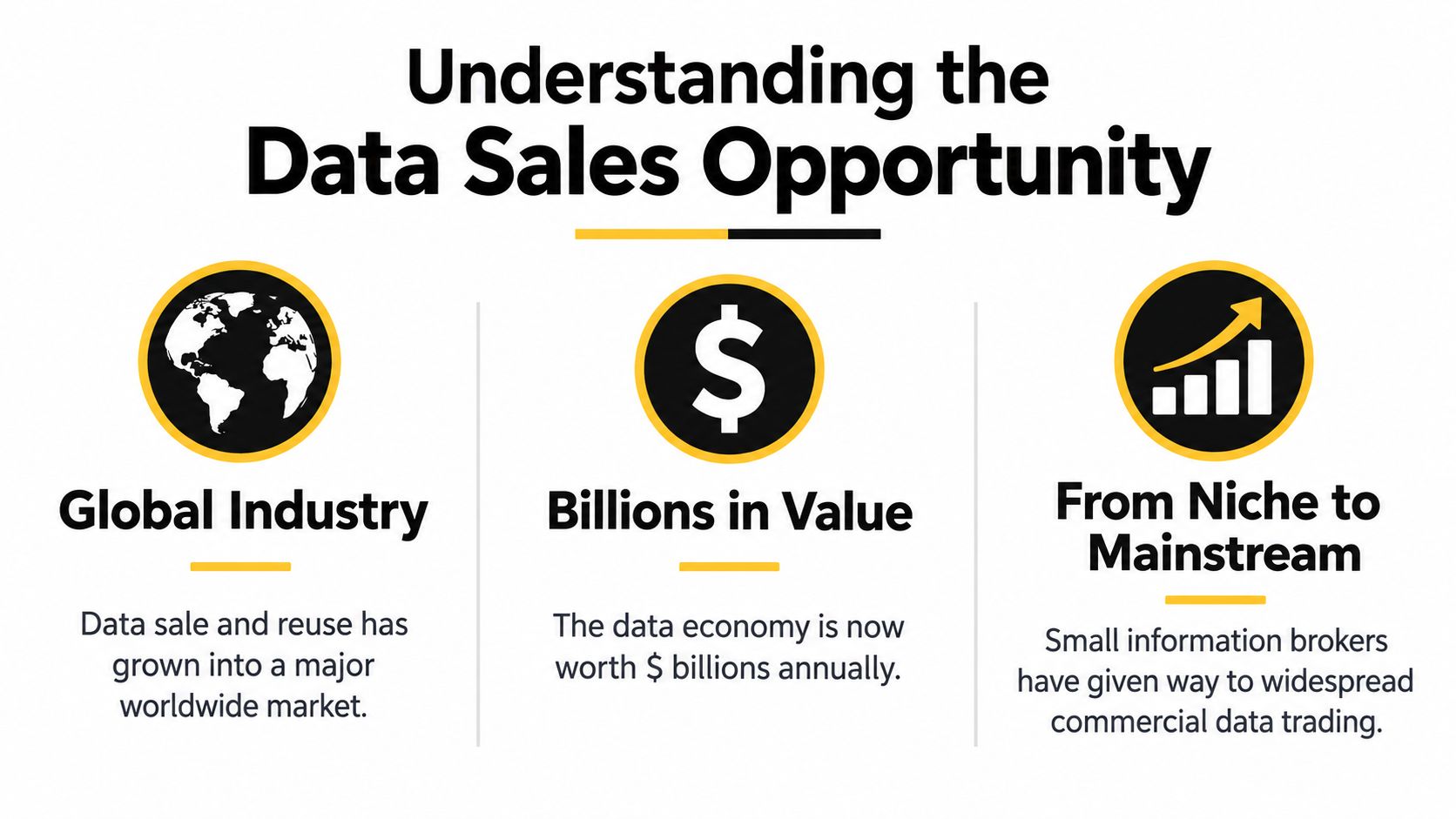
The commercial opportunity is broader than selling a spreadsheet. Buyers purchase data products, analytics, feeds, databases, and information services when those products save time, improve decisions, or fill a coverage gap they cannot solve internally. In practice, that often means recurring revenue from a maintained service, not a one-off transfer of raw records.
I have seen teams overestimate the value of volume and underestimate the value of usability. A large internal dataset can look impressive and still be hard to sell if definitions drift, documentation is weak, or usage rights are unclear. A narrower dataset with clear provenance, dependable refreshes, and a specific buyer use case usually commands more attention because it creates measurable incremental value with less adoption risk.
Consider an operations company with years of support tickets, product events, resolution histories, and internal documentation. The original records may be too disorganized or sensitive for direct licensing. Once the company removes unnecessary personal details, standardizes fields, documents provenance, and groups records into useful categories, it can offer a benchmark, a labeled dataset, an API, or a domain-specific report. The asset for sale is the bounded product, not the raw database.
Buyers pay for usability
Long-running public-sector reuse markets make the same point. Historical estimates referenced by the OECD show that public-sector information reuse across 27 EU countries was valued at EUR 28 billion in 2008 and EUR 32 billion in 2010. Across OECD countries, the comparable estimate rose from USD 97 billion in 2008 to USD 111 billion in 2010.
Those totals are useful context, but they do not tell you how to price your own data. In real deals, buyers pay when the package lowers effort and uncertainty. That usually comes down to five traits:
- Relevant: It supports a defined business or technical decision.
- Reliable: Accuracy and consistency can be demonstrated.
- Accessible: Delivery fits the buyer's workflow through download, query, or integration.
- Documented: Fields, lineage, refresh cadence, and limits are clear.
- Permitted: The proposed use matches the collection context and contract terms.
Valuation gets practical here. Price should reflect buyer-centric worth, not row count alone. If a dataset improves a model, shortens research time, or reduces operational guesswork, its value comes from that incremental impact and from the risk the seller has already removed through cleaning, permissions, and delivery design.
Start with the buyer's decision
Strong data products start with a decision the buyer needs to make. A model developer may need consistently labeled examples. A retailer may need category benchmarks. A finance team may need an alert feed. An operator may need a reference dataset that improves an internal workflow.
Each use case points to a different product, service level, and pricing logic. A historical archive may suit a research team. A refreshed API requires support, monitoring, authentication, and uptime discipline. An aggregated benchmark report can preserve much of the commercial value while reducing privacy, compliance, and redistribution risk.
Practical rule: Sell the decision your data improves, not the number of rows you happen to own.
Assessing and Packaging Your Data Assets
Start with an inventory, not a sales deck. List every available source, table, file, field, date range, geography, update pattern, and dependency. Record who owns the data, why it was collected, how it entered the system, and what agreements govern its use.
This inventory should answer uncomfortable questions early. Did a vendor contract permit commercial reuse? Were users informed about the intended purpose? Do different systems use conflicting definitions for the same field? Can you distinguish internal confidential information from personal data and non-personal records?

Build a buyer-facing product
Raw data is an input. A sellable asset has a defined interface and an obvious use case. Depending on the buyer, package the information as:
- An API: Suitable for recurring queries, automated workflows, and controlled access.
- A benchmark or index: Useful when the buyer needs comparative insight rather than individual records.
- An alert feed: Appropriate for events, changes, anomalies, or time-sensitive signals.
- An aggregated report: A practical first offer when row-level access creates unnecessary risk.
- A structured archive: Valuable for historical analysis, model development, or one-time research.
Include a schema, field definitions, sample records, known limitations, update cadence, validation approach, and proposed service levels. A buyer should be able to understand what they'll receive without reverse-engineering an export.
Teams working with model-development customers can also use AI training datasets guidance to think more clearly about structure, labeling, documentation, and downstream usability. The same principles apply outside AI. A dataset becomes easier to buy when its purpose and quality are legible.
Score quality before showing buyers
Assess quality across accuracy, completeness, timeliness, and consistency. These dimensions are commercially connected. An inaccurate field can create operational mistakes. Missing values can reduce match rates. Stale records can make a current-use product irrelevant. Inconsistent formats increase integration work and support costs.
Research on quality-based data markets finds that prices decline as errors increase, supporting quality-adjusted pricing rather than a single flat fee. That gives operators a practical basis for valuation. Don't hide defects in the hope that a buyer won't notice. Classify them, quantify their effect where possible, and price or remediate them deliberately.
A useful product record includes:
| Product element | What the buyer needs to know |
|---|---|
| Coverage | Which sources, periods, regions, and categories are included |
| Freshness | How often records are updated and how quickly changes appear |
| Quality | Validation checks, known gaps, duplicates, and error handling |
| Lineage | Where the information originated and how it was transformed |
| Access | File, API, query, delivery, authentication, and support method |
| Rights | Permitted use, redistribution limits, exclusivity, and deletion rules |
Don't sell technical availability as commercial readiness. A database can be accessible to your engineers and unusable to a buyer because it lacks field definitions, freshness guarantees, integration support, or a clear license. Packaging closes that gap.
Building a Compliant and Trustworthy Foundation
Compliance isn't paperwork added after a buyer says yes. It determines what you can sell, to whom, in what form, and under which restrictions. A defensible process starts by mapping each data element to an owner, collection purpose, legal basis, and permitted use.
Separate personal, confidential, and non-personal data before designing the product. Then review contracts, notices, and consent language for commercial reuse. Professional context doesn't automatically remove privacy obligations. The European Data Protection Board's GDPR overview makes the central principle clear: organizations need a lawful basis for processing personal data, regardless of where the information came from.
Design the safest commercial layer first
The safest first product is often an aggregated benchmark, trend report, or privacy-preserving insight rather than a row-level file. That choice can reduce buyer risk and simplify the explanation of value. It may also reduce the price, because some buyers need granular records, but lower complexity can make the first transaction possible.
Anonymization alone isn't a guarantee. Combinations of geography, date, employer, transaction size, or rare events can identify people or organizations even after direct identifiers are removed. Use aggregation, minimum cohort sizes, suppression of outliers, field minimization, and contractual restrictions before commercialization.
A practical governance sequence looks like this:
- Map ownership: Identify the source system, controller, processor, vendor, and internal owner.
- Classify sensitivity: Mark personal, confidential, regulated, proprietary, and non-personal fields.
- Confirm permission: Check contracts, notices, consent, lawful basis, and opt-out obligations.
- Assess impact: Run a privacy-impact assessment for sensitive or large-scale processing.
- Control access: Use encryption, authentication, audit logs, retention limits, and deletion workflows.
- Screen buyers: Verify identity, intended use, security practices, redistribution plans, and jurisdiction.
The AI data security guide offers useful operational context for access controls, secure handling, and production-grade data workflows. Those controls aren't only defensive. They help a sales team answer the questions that serious buyers ask before signing.
Define what happens after licensing
Consent withdrawal, correction requests, deletion, and downstream use need clear answers before the first deal. Your agreement should specify update cadence, suppression obligations, redistribution limits, permitted derived products, audit rights, and remedies for misuse.
The buyer also needs to know whether the license is exclusive, whether it can train or operate a model, whether it can share outputs, and whether the seller can continue serving other customers. Ambiguity creates friction during procurement and can make a promising dataset commercially unattractive.
Trust has a cost. Legal review, deidentification, documentation, security controls, and buyer due diligence consume time and money. But skipping them doesn't remove the cost. It shifts the cost into disputes, failed renewals, remediation, and reputational damage.
A trustworthy data product doesn't claim that risk is absent. It shows who controls the data, what the buyer may do, and how both parties respond when circumstances change.
How SourceX Can Help
Some companies have valuable operational data but lack the internal capacity to map systems, validate rights, prepare deidentified extracts, negotiate licenses, and coordinate delivery. SourceX is designed for that situation. It acts as an enterprise data transaction layer for licensing operational datasets to AI labs and other data buyers, while keeping supplier approval at each stage.
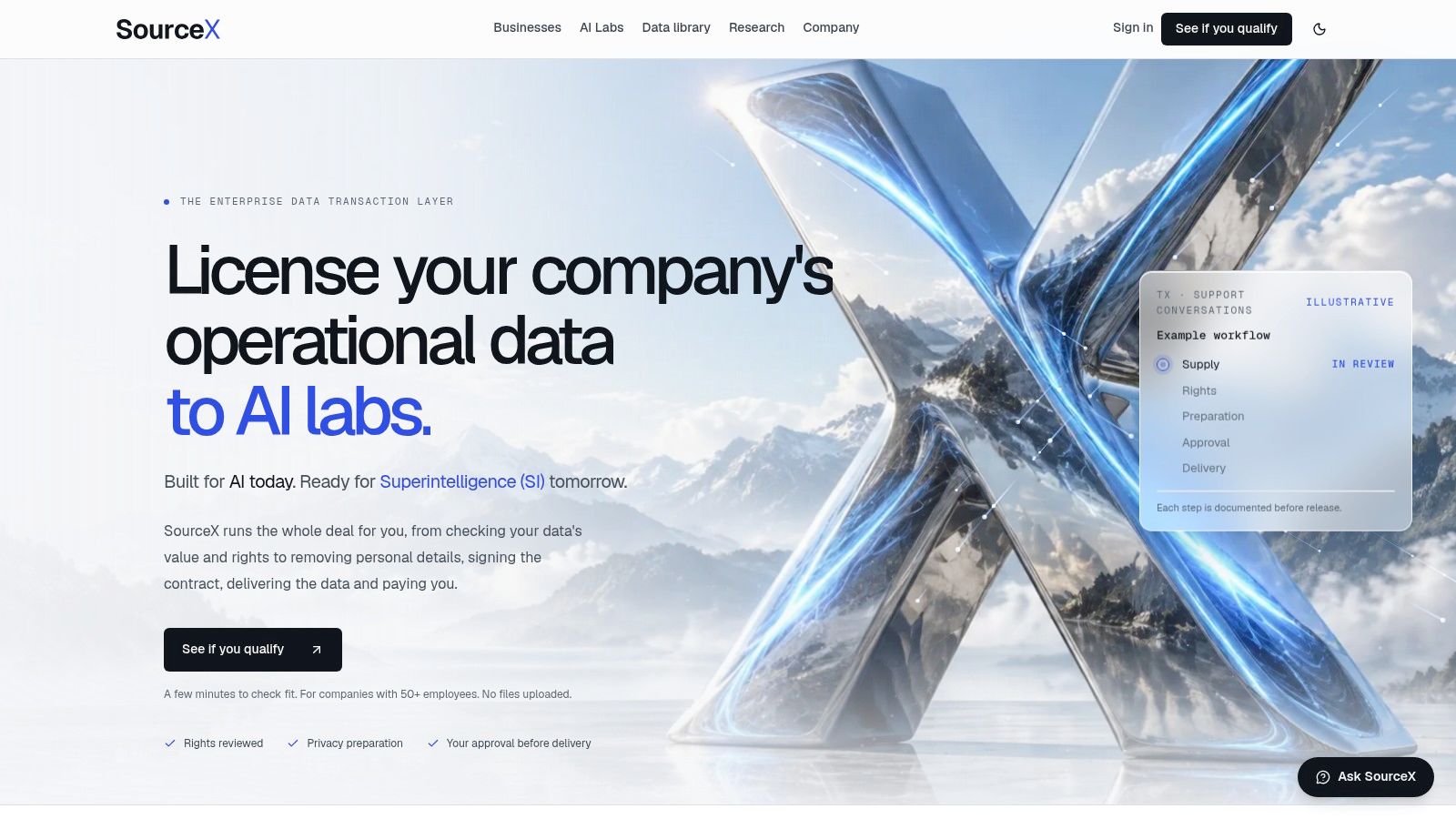
The workflow begins with a fit assessment that doesn't require an immediate upload. SourceX can then create a private inventory covering sources, fields, depth, and availability across systems such as Zendesk, Salesforce, GitHub, Jira, SharePoint, and Google Workspace. Rights review, provenance confirmation, dataset-specific deidentification, pricing, contracting, buyer outreach, and delivery coordination sit within the same transaction process.
That structure solves a common operational problem. A company may know that its support, sales, engineering, document, or finance records have value, but it may not know which parts buyers can legally use or how to package them. SourceX assembles an evidence packet before release, records preparation steps, and keeps scope and permitted uses in the signed agreement.
A supplier retains ownership of its original data, while the commercial terms define how selected deidentified datasets may be licensed. SourceX also provides buyer-facing resources, trust information, use-case guidance, and request portals for AI developers evaluating operational records.

This isn't the right route for every seller. If you already have a mature API, an established buyer base, and an experienced privacy and commercial team, direct licensing may offer more control and margin. SourceX is more suitable when the main obstacle is transaction complexity, especially rights validation, preparation, buyer access, and predictable deal mechanics.
Companies exploring that path can apply to sell your data after documenting the systems, ownership context, and intended commercial use. The useful decision question isn't whether an intermediary exists. It's whether the saved coordination effort outweighs the fees and reduced control compared with building the capability internally.
Choosing the Right Channels and Pricing Strategy
The channel should match the product, buyer, and risk profile. A public marketplace may create discovery, but it can expose too much information and attract buyers who don't fit the intended use. Direct B2B sales support qualification and negotiation, although they require a sales process. An API subscription can create recurring revenue, but it also creates continuing infrastructure and service obligations.
| Channel | Works best for | Main trade-off |
|---|---|---|
| Direct licensing | Specialized datasets with identifiable enterprise buyers | More sales effort, stronger control |
| Marketplace listing | Standardized, lower-risk products with broad demand | Less context and weaker buyer qualification |
| API subscription | Fresh information used repeatedly in workflows | Ongoing uptime, support, and security work |
| Reports and benchmarks | Aggregated insights and privacy-sensitive material | Lower granularity for the buyer |
| Managed data service | Buyers needing interpretation, integration, or alerts | Higher delivery complexity and staffing needs |
Use incremental value, not record count
A practical valuation framework starts with the buyer's alternative. Ask what the buyer would otherwise spend on collection, cleaning, matching, labeling, research, integration, and maintenance. Then estimate how your product changes the buyer's outcome.
The calculation doesn't need false precision. Use a structured score:
- Commercial relevance: How directly does the dataset support a revenue, cost, risk, or product decision?
- Replacement difficulty: Can the buyer reproduce the information internally or obtain it elsewhere?
- Freshness: Does current information matter, or is historical coverage sufficient?
- Quality: What are the accuracy, completeness, consistency, and match-rate limitations?
- Exclusivity: Can competitors buy the same asset, or does the buyer receive protected access?
- Rights quality: Are consent, provenance, usage limits, and downstream permissions clear?
- Delivery burden: How much integration, support, monitoring, and customization will the buyer require?
Price the result as a buyer outcome adjusted for risk and delivery cost, not as a flat amount per row. A small, exclusive, well-documented dataset can justify a stronger offer than a huge, duplicated, stale archive.
Test price without pretending certainty
Personal-data valuation research shows why universal pricing rules fail. A 2021 study of Facebook users reported a median willingness to accept of USD 750, but responses were highly polarized, clustering below USD 250 and above USD 10,000, as described in the University of Pennsylvania summary of the valuation research. A separate 2021 study of patient-generated health data found an average value of EUR 237.30 per month for sharing all types of health-app data with pharmaceutical or medical-device companies, under the study conditions.
Those results don't provide a price list for your dataset. They show that data type, buyer identity, downstream use, sensitivity, and trust materially affect willingness to share. Price experiments should therefore test packaging and restrictions, not just a single number.
Offer tiers based on:
- Access: Historical archive, current feed, API volume, latency, or query limits.
- Rights: Internal use, model development, commercial use, redistribution, or exclusivity.
- Quality: Standard dataset versus validated, enriched, or matched output.
- Coverage: Geography, category depth, history, and update scope.
- Support: Documentation only, implementation assistance, monitoring, or managed service.
Run a paid pilot with a small number of qualified buyers. Measure activation, query volume, time-to-first-value, retention signals, renewal intent, and business impact. A pilot should prove that buyers use the product, not merely that they compliment the sample.
Setting Up Delivery and Billing Operations
A signed agreement creates an operational promise. Before accepting payment, define exactly what the buyer receives, how often it arrives, how access is authenticated, and what happens when the source changes or a delivery fails.
Start with a delivery specification. It should include the product version, schema, file or endpoint format, update schedule, validation checks, support contact, service-level targets, incident process, and permitted use. Include a change-management rule so a field doesn't disappear without notice or change meaning.
Protect the transfer and the product
Use controlled access rather than sending sensitive exports through ordinary email. Apply encryption in transit and at rest, separate credentials by buyer, log access, limit retention, and revoke permissions when the contract ends. For APIs, define authentication, rate limits, usage monitoring, and response behavior. For files, use expiring access and a documented handoff.
Keep the master dataset separate from the licensed derivative. That separation protects intellectual property and makes it easier to honor field-level restrictions. Maintain a release record showing which version was delivered, which transformations were applied, who approved it, and which contract governed the transfer.
The contract should distinguish:
- Ownership: What remains with the supplier and what the buyer may own.
- License: Purpose, duration, geography, users, exclusivity, and redistribution.
- Derived outputs: Whether models, reports, embeddings, or benchmarks can be retained.
- Confidentiality: What each party must protect and for how long.
- Corrections: How errors, updates, suppression requests, and withdrawals are handled.
- Payment: Milestones, invoices, taxes, late payment, and acceptance criteria.
Make billing match the product
One-time access, recurring updates, API usage, and managed services create different billing events. Tie invoices to something observable, such as delivery acceptance, subscription renewal, query consumption, or a defined milestone. Avoid manual reconciliation when the product has recurring access. Connect entitlement records, usage logs, invoices, and payment status so finance can see what was sold and operations can see whether access should remain active.
Order-to-cash automation guidance is relevant here because data sales often fail between commercial agreement and cash collection. A dependable process links contract terms to provisioning, delivery confirmation, invoice creation, reminders, reconciliation, and renewal review.
Start with a narrow service level you can meet. It's better to promise a well-defined weekly update with visible quality checks than to claim real-time freshness without the monitoring to support it. As demand grows, automate validation, release approvals, access provisioning, usage alerts, and incident communication before adding more buyers.
Scaling Data Sales and Monitoring Performance
More buyers don't automatically create a better data business. If every customer receives a custom export, special schema, private transformation, and separate support process, revenue can grow while margins deteriorate.
Track the product as an operating system, not just a sales line. Useful measures include activation, query volume, time-to-first-value, retention, renewal intent, support demand, quality defects, and measurable buyer impact. These signals reveal whether customers are using the data and whether the product needs better documentation, enrichment, freshness, or packaging.
A high download count can mislead you. Buyers may download a file once and never integrate it. An API with modest traffic may support a critical workflow and produce stronger renewal potential. Ask what action the data enables, how quickly the buyer reaches that action, and which fields or signals they use.
Build feedback into the product
Review failed matches, rejected records, support tickets, empty queries, and buyer requests. Feed that evidence into the quality backlog. Remove fields nobody uses when they create privacy or maintenance burden. Add documentation where buyers repeatedly ask the same question. Adjust tiers when customers consistently need different combinations of history, freshness, volume, or rights.
Don't scale raw access when a privacy-safe insight would serve the use case better. Aggregated benchmarks, forecasts, alerts, and verified segments can deliver commercial value without exposing unnecessary granular records. That approach can also reduce buyer-side integration work and make the product easier to govern.
Use a release calendar, data-quality dashboard, customer feedback log, and renewal review. Every update should answer three questions: what changed, why it changed, and whether the buyer needs to act. Sustainable growth comes from making the product more dependable, not from distributing more records indiscriminately.
Avoiding Common Pitfalls in Data Commercialization
The most dangerous mistake is assuming that willingness to share equals willingness to buy any form of data. A preregistered study of 2,500 U.S. participants found that 67% were willing to sell X/Twitter data, yet more than 64% selected prices between USD 0.25 and USD 2 when a marketplace suggested a range. The study's marketplace research also found that marketplace framing increased willingness to sell by 12 to 25 percentage points without significantly increasing minimum acceptable prices.
The lesson is uncomfortable. Better presentation can expand supply without creating much pricing power. Sellers need to increase buyer value through relevance, validation, rights, packaging, and workflow integration rather than assuming that more records will command more money.
Trust can also break quickly when companies oversell privacy. Deloitte's 2025 survey of 3,524 U.S. consumers reported that privacy and security concerns rose from 60% to 70% in one year, while only 27% expressed high or very high trust that technology providers protect data and 20% said providers were very clear about collection and use, according to Deloitte's connectivity and mobile trends research. Yet separate 2025 research found that over 70% of U.S. consumers were willing to share data to support free, ad-funded internet access. Context, benefit, and transparency shape acceptance.
Avoid these failure modes:
- Selling raw records: Package benchmarks, segments, alerts, or workflow-ready outputs when granular access isn't necessary.
- Hiding limitations: Show freshness, missingness, duplicates, match rates, and known restrictions before procurement discovers them.
- Treating consent as permanent: Define suppression, correction, deletion, and derived-output obligations in advance.
- Using vague rights language: Specify purpose, users, geography, duration, redistribution, and model or report retention.
- Pricing by volume alone: Adjust for buyer value, exclusivity, quality, freshness, risk, and delivery cost.
- Scaling bespoke work: Standardize schemas, validation, contracts, access, billing, and support before expanding demand.
Selling data responsibly is a product discipline. The strongest offers give buyers a useful outcome while giving data subjects, suppliers, and downstream users clear boundaries. That balance protects revenue because buyers renew products they can defend internally.
If your company has operational data that may be commercially valuable, start with a structured inventory of sources, rights, quality, and buyer use cases. Then identify the smallest permissioned product you can validate with a real buyer, whether that's a benchmark, API, alert feed, or controlled dataset. For help turning messy workflows into secure, production-grade AI and data systems, Cyndra can help you assess the opportunity, prepare the workflow, and move from an idea to an operating revenue asset.