 CYNDRA
Competitive intelligence is the ethical, continuous process of collecting, validating, and analysing information about competitors, customers, suppliers, technologies, regulations, and market conditions so leaders can act sooner with better evidence. It becomes useful not when a team gathers more data, but when a signal changes a decision.
You may already be seeing those signals: a rival has changed its pricing page, a familiar competitor is hiring for a new specialty, or customers keep mentioning a feature you don't offer. Without a clear process, those clues can end up scattered across sales calls, browser tabs, and dashboards. Competitive intelligence gives your team a way to assess what matters, decide who should act, and check whether that action helped.
Table of Contents
- Competitive Intelligence in One Clear Definition
- How CI Differs From Market Research and Business Intelligence
- How the Intelligence Cycle Turns Signals Into Decisions
- Ethical Limits and AI Reliability Risks
- Where CI Data Comes From and Which Tools Help
- Where CI Pays Off and How to Measure It
- Start Your First Competitive Intelligence Loop
Competitive Intelligence in One Clear Definition
A sailor looking out of a window sees only what's close. Radar scans farther out, turning faint blips into information that may help the sailor adjust course. Competitive intelligence (CI) works like a business radar, but a blip alone isn't a reason to change direction. The signal has to matter to a real decision.
A competitor's hiring pattern might suggest it's preparing to expand into a new area. A pricing change could indicate a shift in how it wants customers to see its offering. A product launch may suggest that customer priorities are changing. Each is a clue to investigate, not proof of what the competitor intends.

The distinction is important: raw data isn't intelligence until someone interprets it in context and connects it to an action. Competitive intelligence is a structured business discipline, not gossip or a collection of competitor updates. It brings together relevant information, tests its reliability, analyses its significance, and delivers the findings to people who can make decisions. An academic overview of competitive intelligence describes the discipline in terms of environmental scanning and actionable information for decision-making.
CI also has a professional history. The Society of Competitive Intelligence Professionals, or SCIP, was founded in 1986, helping establish the field as an ongoing, recognised business function. Its focus broadened beyond rivals alone to include customers, suppliers, technologies, regulations, and other external forces. That wider scope reflects a practical truth: a business can be affected by changes across its environment, not just by direct competitors. (SCIP's history and mission)
The ethical boundary is clear: use open sources and ethical inquiry, not theft, unauthorised access, or misuse of confidential information.
A useful starting question: Which decision in your business would change if a competitor made its next move?
How CI Differs From Market Research and Business Intelligence
| Discipline | Core question | Main inputs | Time orientation | Typical output |
|---|---|---|---|---|
| Competitive intelligence | What will rivals and the market do next, and what should we do about it? | Competitor websites, pricing pages, hiring, filings, win/loss notes, customer feedback | Forward-looking and continuous | Decision briefs with an owner, deadline, and confidence level |
| Market research | What do customers want, and how large is the opportunity? | Surveys, focus groups, consumer panels, market sizing studies | Mostly point-in-time, run periodically | Market size estimates, segment reports, concept test results |
| Business intelligence | What happened in our business, and why? | Internal CRM, ERP, finance, and sales data warehouses | Backward-looking, often near real time | Dashboards, KPI reports, drill-down analysis |
The simplest distinction is about where each discipline looks and what it's trying to answer. Market research looks outward at customers and market size. Business intelligence looks inward at the company's own numbers. Competitive intelligence looks outward at rivals and external change, then asks what the business should do next.
The boundaries overlap. A customer survey might reveal that buyers see a competitor's onboarding as a weakness. A sales dashboard might show that deals are being lost after a rival offers a discount. The tool or data source doesn't decide the category. The decision the information serves does.
Try this test:
- If the question concerns a specific rival, market shift, or external threat and could change a business decision, it's CI.
- If the question is about sizing demand or testing a product concept, it's market research.
- If the question is about explaining your company's revenue, costs, or sales activity, it's business intelligence.
CI can borrow inputs from both neighbouring disciplines, then add external monitoring and interpretation. A customer interview may inform market research and also reveal a competitor's weakness. Internal sales data may help analysts understand whether an external pricing change is affecting deals.
For a quick self-check, write down the last few questions your leadership team asked. Sort each into the discipline that best fits its purpose. If a question doesn't have a clear category, clarify what decision it's meant to support.
How the Intelligence Cycle Turns Signals Into Decisions
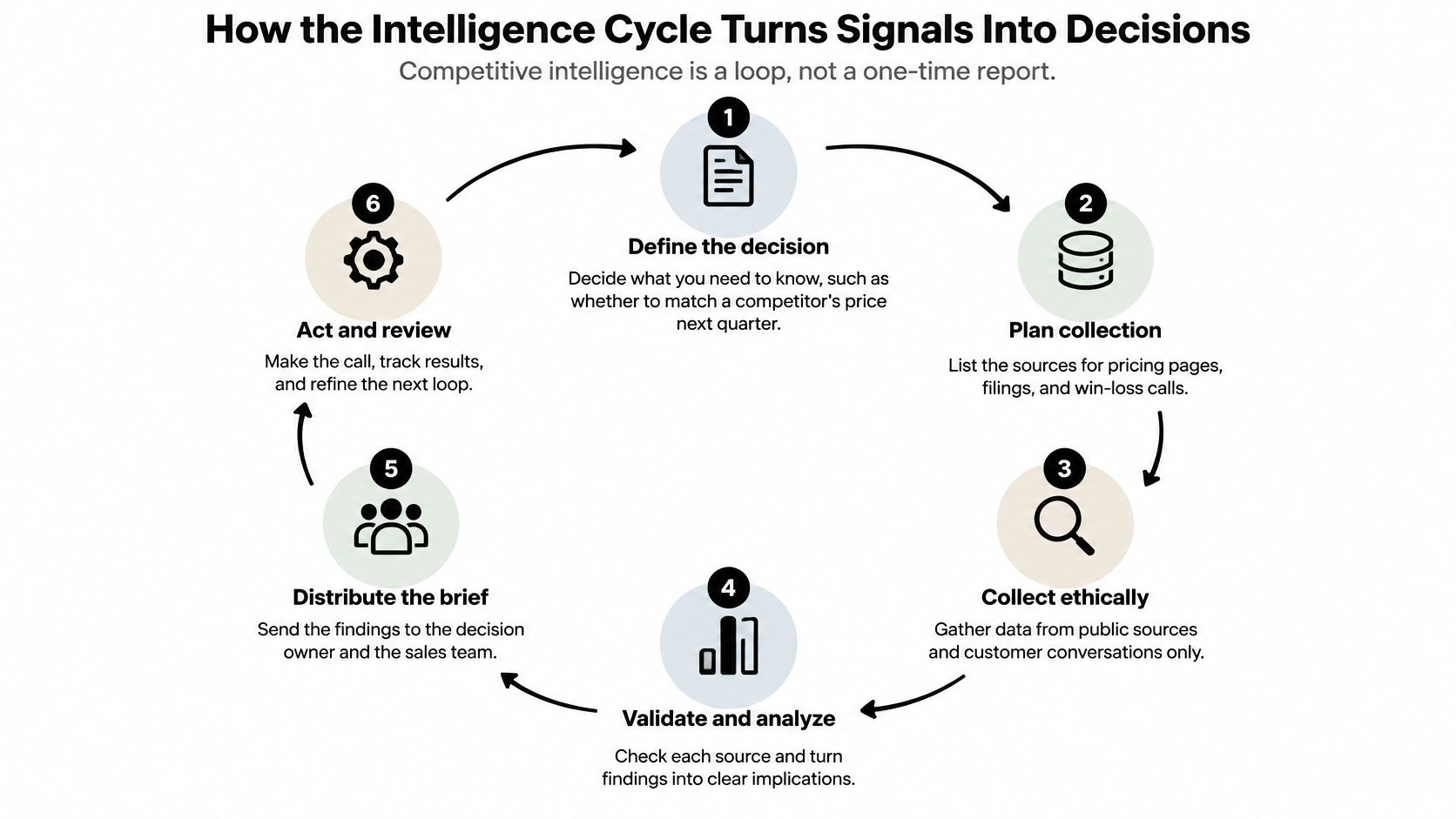
CI is a loop, not a report created once and filed away. A useful process moves from a decision need to evidence, analysis, action, and review. The five linked stages of a complete process are defining requirements, collecting information, processing it, analysing implications, and delivering findings to decision-makers. (Research on the CI generation process)
Define the decision. Begin with a choice the business needs to make, such as whether to match a competitor's price next quarter. Specify what you need to know to make that choice, rather than starting with a broad request to “track competitors.”
Plan and collect ethically. Identify relevant internal and external sources, and record where each item came from and when it was captured. For a pricing question, that might include a public pricing page and internal sales notes from relevant deals.
Process the information. Remove duplicate entries, standardise product names and currencies, and flag information that may be out of date. Without this step, a team might mistake an old price or a renamed product for a current change.
Analyse the implications. Assess whether the signal is significant, how confident you are, and what it could mean for the business. A rival's price cut has limited value until the team considers whether it appears temporary, which customers it affects, and how it might affect the company's own position.
Send a decision brief. Deliver the findings in a format the named decision-maker can use. A short brief should explain the evidence and its limits, rather than burying the recommendation in a stream of alerts.
Act and review. Record what the decision-maker chose and what happened afterward. If the team changed its sales messaging, check whether that action affected the outcome the team was trying to improve, then use what you learned in the next cycle.
For a market signal to become actionable, give the brief a clear destination:
- Decision: What choice needs to be made?
- Owner: Who is accountable for making it?
- Expected effect: What outcome is the action intended to influence?
- Confidence level: How reliable is the evidence and interpretation?
- Review date: When will the team revisit the decision and its result?
Keep verified facts, analyst inferences, and hypotheses in separate, labelled fields. “The public page now lists a lower price” is an observation. “The competitor is targeting smaller customers” is an interpretation. “It will soon discount other plans” is a hypothesis. When an automated summary blends these categories, a guess can start to look like established market truth.
This video about competitive intelligence offers another way to consider the process and its role in business decisions.
Ethical Limits and AI Reliability Risks
CI relies on open sources and ethical inquiry, never theft, unauthorised access, or misuse of confidential information. A common mistake is to assume that information is fair game just because it can be found online. The source, collection method, purpose, and local rules still matter.
| Collection case | Status | Why |
|---|---|---|
| Public pricing page visible to any visitor | Acceptable | Publicly published; check site terms before automated monitoring |
| Public job postings and press releases | Acceptable | Published for public use and routinely analysed |
| Buying a competitor's product as a customer | Acceptable | Ordinary customer interaction, with no deception |
| Public professional profile of a rival's sales rep | Use with care | Personal data rules apply; keep to a stated business purpose |
| Scraping content behind a login or paywall | Off-limits | Bypasses access controls and often breaches terms |
| Accessing a competitor's private customer portal | Off-limits | Unauthorised access |
| Former employee's confidential decks or pricing files | Off-limits | Misuse of confidential information |
Three governance rules make the boundary easier to put into practice:
- Limit personal data. Privacy requirements can restrict what an organisation collects and stores, and why. Keep personal details out of CI files unless there's a defined business purpose and a retention limit.
- Check collection rules. Review the relevant site's terms and rules for automated access before setting up a monitor. Don't bypass logins, paywalls, or other access controls.
- Treat automated findings as evidence to review. An out-of-date page, incomplete customer reviews, or an AI-inferred feature can lead to a confidently wrong conclusion. Record source provenance, label confidence, require human review before high-impact pricing, hiring, or product decisions, and keep an audit log of the information used.
Automated analysis can speed up monitoring, but it doesn't make sources complete or interpretations correct. Coverage of AI-enabled competitive analysis identifies privacy compliance, integration complexity, data freshness, and hallucinations as potential constraints on trust in automated recommendations. (AI-era risks in competitive analysis)
Rules vary by country and sector. Before launching a collection process, have legal counsel confirm that its sources, methods, and data handling fit the requirements that apply to your business.
Where CI Data Comes From and Which Tools Help
| Source | What it reveals | How to collect it | Example signal |
|---|---|---|---|
| Competitor websites and pricing pages | Pricing, packaging, and positioning | Scheduled monitoring of public pages | A new plan appears between existing tiers |
| Job postings | Expansion areas and technology choices | Public career pages and job boards | Several new roles point toward investment in a specialty |
| Press releases and earnings calls | Strategy, guidance, and priorities | Investor relations pages and published transcripts | Guidance language shifts toward a new region |
| Patents and regulatory filings | Research direction and compliance exposure | Public patent office and securities filing databases | A group of filings focuses on a particular technology |
| Customer reviews and forums | Strengths, weaknesses, and switching triggers | Public review sites and community forums | Buyers repeatedly complain about onboarding time |
| Public ad libraries | Campaigns, messaging, and target segments | Platform ad transparency libraries | A campaign targets a previously unaddressed industry |
| Win/loss interviews and CRM notes | Why deals are won or lost | Internal CRM fields and structured sales debriefs | Sales notes repeatedly identify price as a lost-deal reason |
| Trade shows and webinars | Roadmap hints and partnerships | Attend or watch recordings, with consent where required | A speaker announces a partnership |
Source quality depends on the question. A company's own pricing page or a public filing is a primary source for what the company published. A second-hand summary can help you find a lead, but verify important details against the original material. Internal win/loss notes can add context that public sources can't: they may show how buyers describe the trade-offs behind a choice.
Tools generally fall into three groups. Dedicated CI platforms such as Crayon and Klue monitor pages, track changes, and route alerts. Broader enterprise suites combine intelligence with other analytics, while lightweight setups use alerts, shared spreadsheets, and a signal log. Crayon reported that 25% of surveyed CI leaders were already using AI in their CI responsibilities in 2024, while 56% planned to adopt it soon; its survey covered more than 700 CI professionals. (Crayon's 2024 State of Competitive Intelligence findings)
The size of the tools market doesn't tell you which platform fits your workflow. Mordor Intelligence estimated the global CI tools market at USD 0.59 billion in 2025 and forecast a 19.96% compound annual growth rate from 2025 to 2030. (Mordor Intelligence's competitive-intelligence tools market estimate) Choose based on how your team collects, validates, shares, and uses findings, not a long feature list. For a practical overview of options, see this guide to tools for analyzing rival strategies.
A sensible starting setup is focused rather than exhaustive:
- Choose a few decisions that matter to the business.
- Select sources that inform those decisions, including relevant internal sales or customer feedback.
- Use a shared signal log with source, capture date, confidence, and decision owner.
- Add monitoring only when a real decision lacks evidence.
For a practical approach to setting up monitoring, see how to monitor competitor activity.
Where CI Pays Off and How to Measure It
Suppose a rival cuts the price on its core tier while your sales team is working open deals against that rival. The sales lead updates the battlecard, then compares the win rate in affected deals before and after the change. The useful result isn't the alert itself. It's the documented decision and the measured outcome.
| Function | Signal monitored | Decision it changes | KPI to track |
|---|---|---|---|
| Sales | A rival offers a new discount on shared deals | Update battlecard and talk track | Win rate against that rival |
| Pricing | Competitor changes the price of its core tier | Hold, match, or reposition the price | Margin per unit and price-driven churn |
| Product | Rival launches a feature that customers praise in reviews | Reprioritise the relevant roadmap item | Feature adoption and retention in the affected segment |
| Marketing | Rival shifts messaging toward a new claim | Change claims or campaign angle | Cost per qualified lead |
| Operations | Supplier or logistics change appears in industry news | Renegotiate a contract or shift sourcing | Cost per order and lead time |
| Recruiting | Rival shows increased hiring in a specialist niche | Adjust compensation or sourcing channels | Time to hire and offer acceptance rate |
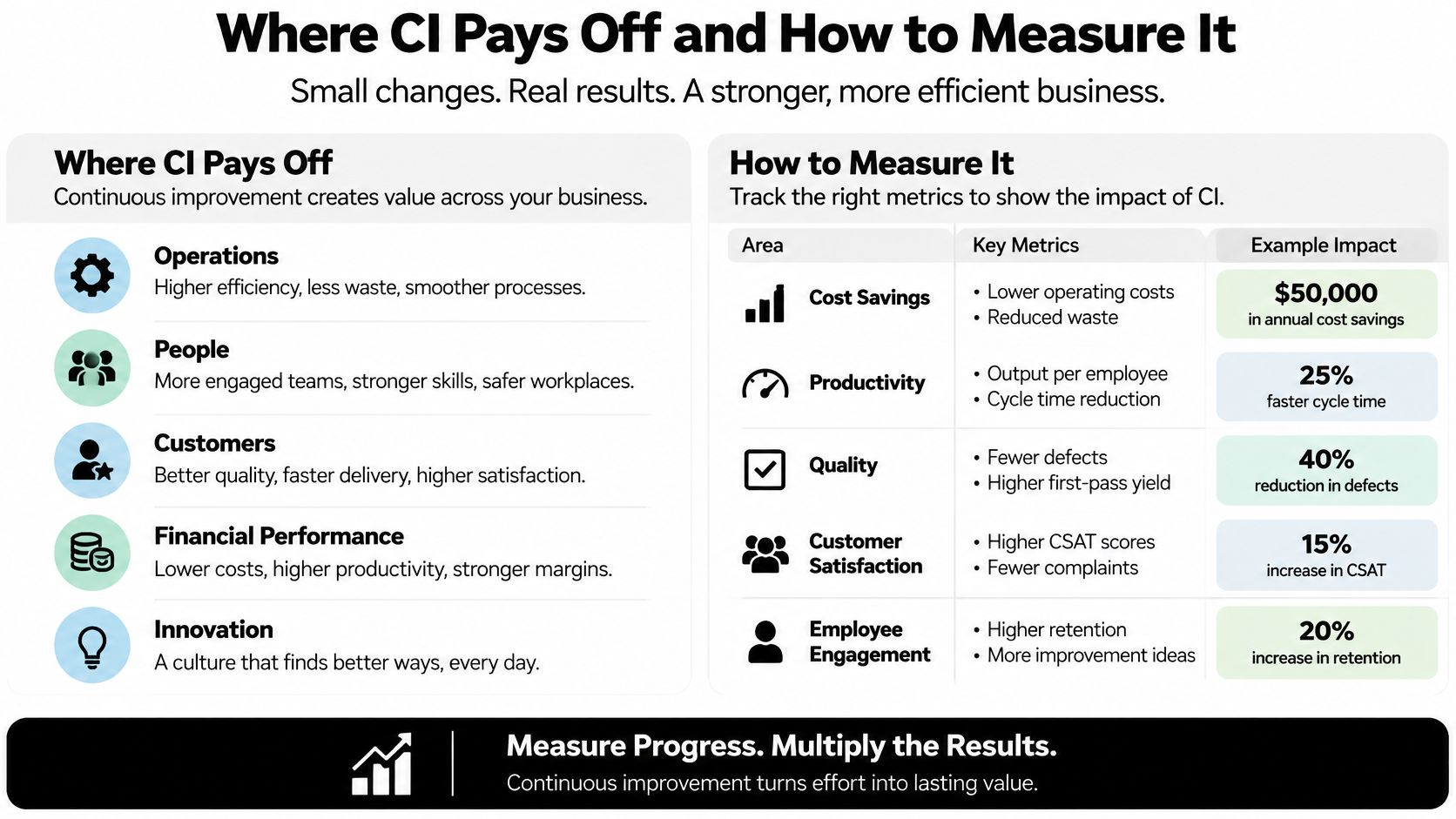
Track process measures that show whether CI is influencing decisions:
- Signal-to-action conversion rate: How often a meaningful signal leads to a recorded action.
- Time to brief: How long it takes to deliver an executive brief after a relevant market event.
- Documented-decision rate: The share of briefs that result in a recorded decision.
- Detection lead time: How early the team identifies a potential threat or opportunity.
- Impact per action: The revenue or cost effect attributed to an implemented response.
Prioritise signals by considering expected impact, probability, and urgency against the effort needed to verify them. This keeps the team focused on a small number of consequential questions rather than accumulating alerts that don't affect a choice.
Set a baseline before acting so you can compare what happens afterward. That comparison can help you assess whether CI contributed to a result, but it can't prove CI caused it on its own. Pricing, product, sales execution, and broader market conditions may all affect the same outcome. For a related discussion of applying competitive intelligence to search decisions, see competitive intelligence for SEO.
Start Your First Competitive Intelligence Loop
A first CI loop doesn't need a large platform or a sprawling competitor database. It needs a business question, a responsible owner, relevant evidence, and a way to review what happened after the decision.
- Name the decisions. Choose decisions due in the coming quarter that would benefit from external evidence, such as a pricing choice, a product priority, or a live sales battle.
- Assign an owner. Put a person's name next to each decision. Without an owner, an alert can reach the team and still go nowhere.
- Choose relevant sources. Use the source table to identify public and internal information that can inform those decisions.
- Set a baseline and alert threshold. Define what's normal for the signal and what kind of change deserves review.
- Use the decision brief. Record the owner, expected effect, confidence, and review date. Keep observed facts separate from interpretations and hypotheses.
- Run a 30-day pilot. Log signals, briefs, decisions, and follow-up results so you can see where the process is useful and where it creates noise.
- Review the operating measures. Check signal-to-action conversion, time to brief, and whether briefs led to documented decisions.
- Fill evidence gaps selectively. Add sources only when a decision lacked useful information. More monitoring isn't automatically better monitoring.

If you want to automate monitoring, Cyndra's Competitor Intelligence monitors competitor websites, pricing pages, and product updates in real time and alerts customers when they change. The key is to connect any alerting workflow to your decision owner, validation rules, and follow-up measures, rather than treating notifications as the finished product. You can review the competitor monitoring and intelligence use case as an example of that workflow.
Choose one decision from your list this week, then write the owner's name beside it.
Cyndra offers a confidential, free 30-minute AI audit to map the opportunities worth building first, or a free strategy call to help shape a clear roadmap. If you're ready to connect competitor signals to decisions your team can act on, visit Cyndra.