 CYNDRA
A lead submits a form at 11:47 p.m. The CRM records it, an enrichment job waits for its next scheduled run, and the assigned SDR sees it the following morning between meetings. By then, the prospect may have spoken with a competitor, lost urgency, or decided that your company isn't responsive.
That scenario makes agent lead generation look like an outreach problem. In production, it's usually a funnel-quality problem. The agent must decide whether the record is valid, whether the account fits, what signal indicates intent, which channel is appropriate, and when a human needs to take over. Sending more messages before solving those decisions only scales waste.
Table of Contents
- Why Agent Lead Generation Changes the Funnel
- Designing the Inbound Workflow Step by Step
- Building the Outbound Research and Sequencing Loop
- Buy a Tool or Build an In-House Agent
- Integrating the Agent with CRM, Outreach, and Ad Platforms
- Measuring What Matters Without Fooling Yourself
- Production Readiness Checklist and Deployment Timeline
Why Agent Lead Generation Changes the Funnel
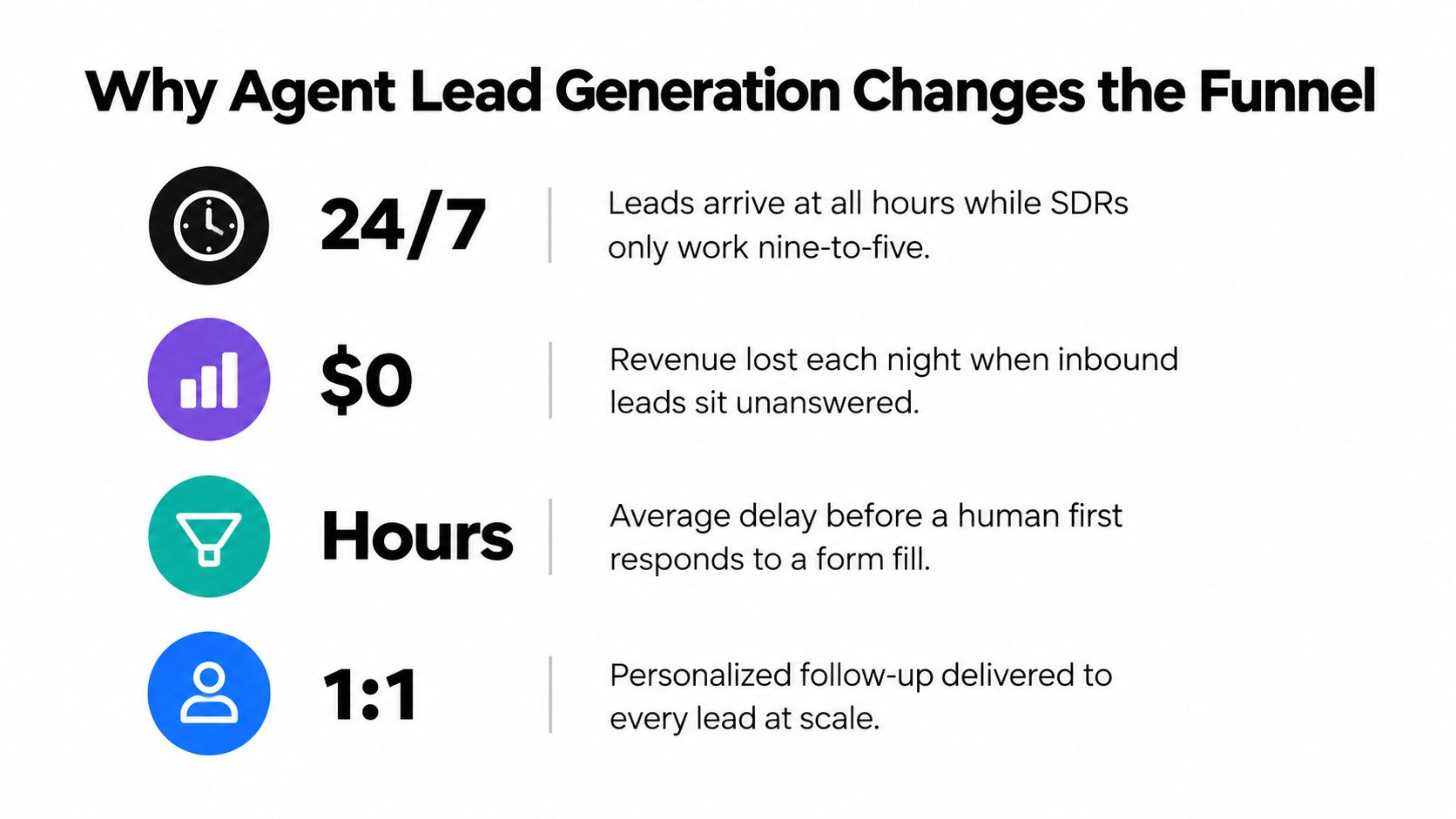
A lead comes in after hours, asks for a demo, and expects a reply while the problem is still urgent. If your process waits for a rep to notice a notification, open the CRM, and decide what to do next, the funnel starts leaking before outreach even begins. That is why agent lead generation changes the funnel. It reduces the delay between intent and action, but only if you treat it as an operations problem first.
Analysts cited in research on lead response time reported that contacting an inbound lead within five minutes made companies far more likely to reach that prospect than waiting 30 minutes. The same summary notes that responses within one hour were much more likely to produce a meaningful conversation than slower follow-up. Those numbers do not promise revenue on their own. They do show that latency changes who you get to speak with.
The common mistake is to treat the fix as a volume problem. Send more emails. Add more sequences. Let the agent fire instantly. In production, that approach usually scales bad data, weak routing, and avoidable compliance risk. A useful agent does something less glamorous first. It checks whether the record is real, whether the account fits, whether the intent signal is strong enough to act on, what channel is appropriate, and whether the case belongs with a human before any autonomous send.
That is where the funnel improves.
The first version should protect response speed and data quality at the same time. I would rather ship an agent that acknowledges, routes, and flags uncertainty than one that writes confident nonsense to the wrong contact. Humans should still handle pricing conversations, strategic accounts, edge cases, and any situation where the evidence is thin or the downside of a wrong message is high.
The value is straightforward. The agent turns scattered prospect intent into a fast, traceable, appropriately routed next action. Once you frame it that way, message volume becomes secondary. The operating measures shift to coverage, contactability, qualification accuracy, response latency, and qualified pipeline.
Historical response patterns reinforce the point. A Harvard Business Review audit summarized in the speed-to-lead benchmark found that only 37% of companies responded within one hour, while 23% never responded at all. Always-on workflows will not rescue poor targeting or a weak offer. They do prevent silence and delay from becoming your first impression.
Designing the Inbound Workflow Step by Step
A prospect fills out a demo form at 9:12. By 9:13, the agent should have created a record, checked whether the person already exists, confirmed consent and contactability, and decided whether this deserves a routed handoff, a safe acknowledgement, or a human review queue. If that sequence breaks, speed stops helping. You just get a faster version of bad routing.
Start with the event itself. A form submission, chat request, demo booking, pricing-page interaction, or high-intent ad conversion should create a timestamped job immediately. The agent needs the raw facts first: what happened, when it happened, which source produced it, and whether the person or account is already in the system.
Capture and validate before enrichment
The first pass should return a structured record:
- Capture the event. Store the original timestamp, source, campaign, page or conversation context, and requested action.
- Validate identity and consent. Check required fields, consent status, contactability, region, and duplicate records. Don't let an agent create a second contact because a prospect used a different form or email alias.
- Enrich cautiously. Add firmographic and behavioral context, but preserve the source and freshness of every field. If the agent can't verify a title, company, or trigger, it should mark the field unknown rather than guess.
- Score fit and intent separately. Fit tells you whether the account belongs in your market. Intent tells you whether the timing is relevant. Combining them into one opaque score makes routing harder to audit and harder to fix.
Treat sub-five-minute response handling as a system design target. The point is not to force every inbound lead into an instant sales reply. The point is to make sure every valid inquiry gets the right next action while the context is still fresh.
That usually means splitting the first move into controlled paths. A pricing request from a known target account may justify immediate routing to sales with context attached. A vague content-download lead with thin evidence may get an acknowledgement, a qualification check, and a nurture path instead. If the record is incomplete or risky, stop the autonomous send and create a task for a human.
Route, respond, and record the outcome
Routing should run on explicit policies, not hidden prompt logic. A high-fit, high-intent account can go to the right representative with a concise context packet. A low-confidence record can receive a safe acknowledgement and enter review. A duplicate, opted-out contact, or unsupported request should stop before any outreach.
| Stage | Agent Output | Target Metric |
|---|---|---|
| Event capture | Timestamped inbound record | Capture completeness |
| Validation | Consent, duplicate, and identity status | Validation accuracy |
| Enrichment | Sourced account and behavior fields | Field freshness |
| Qualification | Fit, intent, confidence, and reason codes | Qualification precision |
| Routing | Owner, queue, or escalation path | Routing accuracy |
| First response | Context-aware reply or draft | Median response latency |
| Feedback | Outcome, disposition, and next action | Qualified-opportunity rate |
The first response should reflect the actual context. A pricing request needs a different reply from a webinar registration. Keep the message inside approved claims, include one clear next step, and avoid filling gaps with invented product detail just because the prompt expects a complete answer.
Teams refining the broader operating model can also use this practical guide to grow with inbound strategies. The agent should never behave like an isolated autoresponder. It should write the decision, evidence, handoff, and outcome back to the CRM so the team can see which paths produce qualified opportunities and which ones only produce fast replies.
Building the Outbound Research and Sequencing Loop
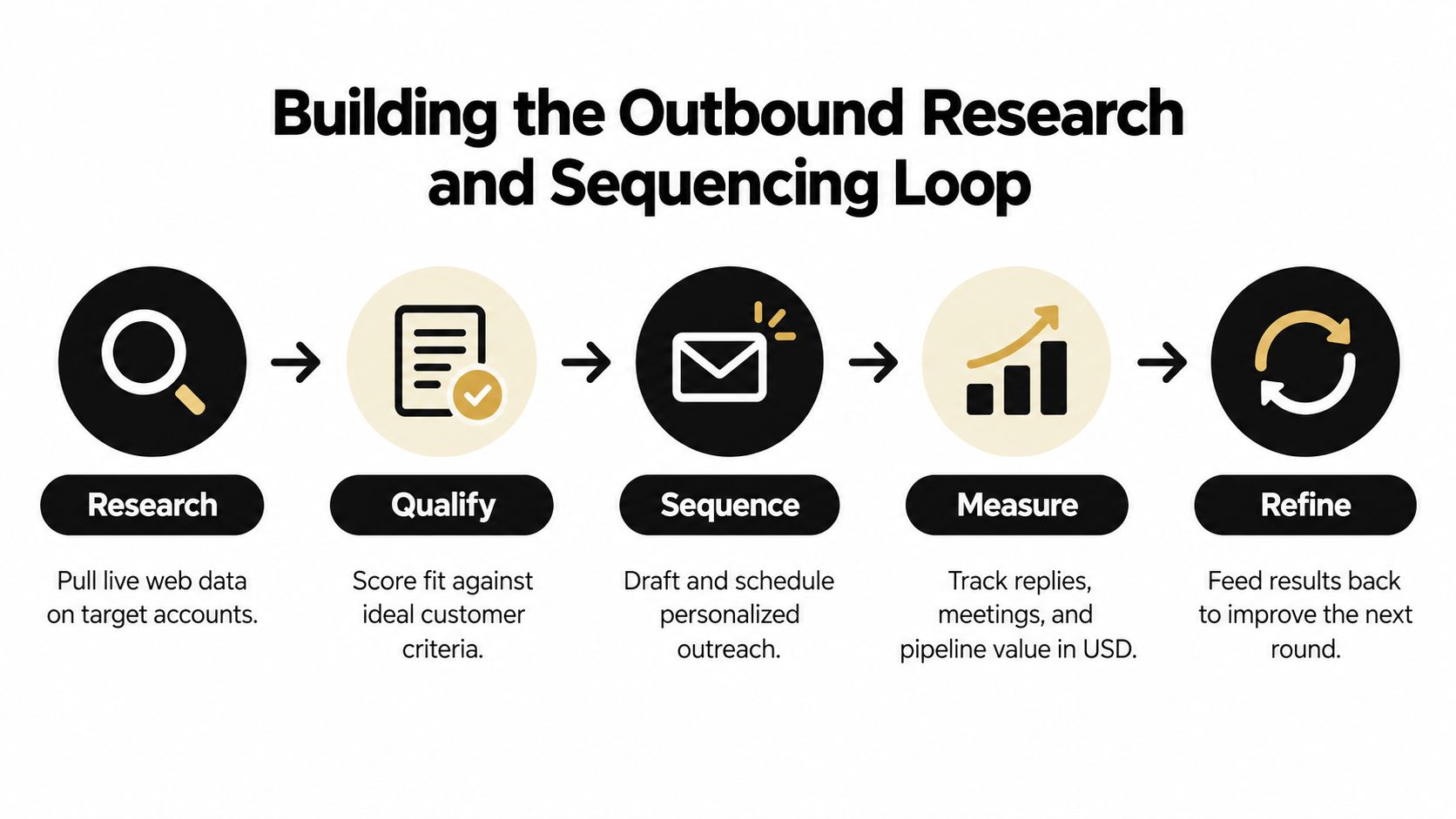
Outbound fails when an agent treats a list as permission to send. A good system first decides which accounts should be excluded, verifies who works there, identifies a current reason to engage, and refuses to draft a claim it can't support.
Research for evidence, not decoration
Define the ideal customer profile with inclusion and exclusion rules. Industry alone is too broad. Add the operational conditions that make your offer relevant, then specify disqualifiers such as unsupported geography, incompatible stack, existing customer status, or an account already in an active sales process.
Verify account and contact data against current sources. Require the agent to attach an evidence link or source label to each trigger. A hiring event, product launch, funding announcement, technology change, or public operational problem can justify research. A vague statement that a company is “growing fast” can't.
The draft should contain one hypothesis and one call to action. For example, a verified expansion signal might support a hypothesis about process capacity. If the agent can't establish that connection, it should create a review task instead of filling the gap with confident language.
The benchmark picture reinforces the need for disciplined measurement. A large cold-email benchmark reported median performance of 35.2% opens, 2.4% clicks, and 1.8% replies, while top performers reached 3.9% replies, as reported in the B2B lead-generation benchmark. A separate dataset found a 0.3% average meeting-booked rate compared with 2.3% for the top 10%. These figures are directional benchmarks, not promises, and they make meeting quality more important than send volume.
Sequence within hard limits
Set cadence caps, respect opt-outs, and classify every reply as positive, neutral, objection, unsubscribe, or invalid. Feed booked meetings, qualified pipeline, disqualifications, and revenue back into scoring. Opens are weak feedback for strategic decisions, especially when privacy-related measurement changes distort them.
An account-research resource such as Gritt.io investor search can help operators understand how public signals are organized, but the agent still needs to verify each fact before using it in outreach. For a broader implementation perspective, review sales outreach automation alongside your own approval and suppression rules.
Four failure modes deserve an automatic pause:
- Stale enrichment: The agent references an old role, outdated product, or closed initiative.
- Hallucinated triggers: The system invents a funding event, hiring plan, or business problem.
- Cadence abuse: Multiple systems contact the same person without sharing suppression state.
- Uncontrolled sending: The agent scales before positive replies, complaints, bounces, and human edits are understood.
The highest-value outbound agent may send fewer messages. Its contribution is preventing poor-fit accounts and unsupported claims from entering the sequence.
Buy a Tool or Build an In-House Agent
The build-versus-buy decision isn't really about whether software contains an AI feature. It's about where you want the operating knowledge to live. An off-the-shelf AI SDR can provide a faster starting point, while an in-house agent can encode your qualification logic, CRM conventions, approval paths, and institutional language more precisely.

A SaaS product usually wins when your process is conventional, your team needs a quick pilot, and vendor-managed integrations or compliance features reduce internal workload. The trade-off is constrained customization. You may need to adapt your qualification model to the platform, accept limited evidence handling, or maintain another system alongside the CRM.
An internal agent takes longer to specify, test, and govern. In return, it can use your actual account definitions, route by territory and ownership rules, preserve your data model, and expose the exact evidence behind decisions. That control matters when a generic “qualified” label hides the difference between a strategic account and a disposable contact.
| Situation | Sensible starting point | Main trade-off |
|---|---|---|
| Standard inbound qualification | SaaS agent | Faster adoption, less control |
| Complex routing and approval logic | In-house workflow | More implementation responsibility |
| Small team testing a repeatable motion | SaaS pilot | Limited institutional learning |
| Multiple systems and custom data rules | Internal agent | Integration and maintenance burden |
| High-risk claims or regulated outreach | Human-reviewed internal flow | Slower autonomy, stronger accountability |
Choose based on the cost of being wrong. A generic tool is acceptable when a mistaken draft is caught before sending and the workflow can be paused cleanly. Build more control when an incorrect claim, bad routing decision, or missed suppression request can damage a strategic relationship.
A Cyndra-style in-house agent can be configured around company workflows, connected to the existing stack, and deployed with human checkpoints rather than treated as an unrestricted sender. That approach is useful when the goal is to compound internal knowledge instead of renting a generic sequence engine indefinitely.
The practical middle path is often best: buy infrastructure where it is mature, build the decision layer where your process is distinctive, and keep high-consequence actions behind approval until the evidence supports autonomy.

Before choosing, document the workflow in plain language. If your team can't agree on what makes a lead qualified, buying software won't resolve the disagreement. It will automate it.
Integrating the Agent with CRM, Outreach, and Ad Platforms
An agent in a chat window is a demonstration. An agent connected to the revenue stack becomes an operating system for decisions, provided each integration has a limited and auditable purpose.
Define the system of record
The CRM should own identity, account relationships, lifecycle state, owner, consent status, suppression status, qualification reasons, and disposition. The agent may write structured fields, notes, tasks, and approved activities. It shouldn't overwrite source data or alter opportunity stages without a policy and audit trail.
Outreach tools should handle delivery, reply capture, bounce events, and unsubscribe events. The agent can propose or schedule approved messages, but the sending system must remain able to enforce frequency limits and suppressions. If a contact opts out in one channel, that state needs to propagate everywhere before another sequence runs.
Ad platforms contribute source and behavioral signals. Keep those inputs separate from the agent's conclusions. A campaign interaction can support prioritization, but it shouldn't become proof that a person wants a sales conversation.
Connect value to outcomes
Finance or revenue analytics should receive qualified pipeline and closed-business outcomes, not just activity counts. The dashboard should let leadership compare response latency, contactability, qualification, meetings, pipeline, and revenue by source, segment, geography, and channel.
Across industries, one benchmark compilation reports an average lead-to-customer conversion rate of 2.46%, with government administration at 4.92% and banking and manufacturing around 1.52%, as reported in the industry conversion benchmark. The spread is a useful reminder that integration quality affects economic value. A lead that never reaches the correct owner or loses its consent state isn't merely a data problem. It changes the value of the acquisition channel.
For teams reviewing architecture, AI agent integration offers additional context. Keep permissions narrow, log every write, and make rollback possible. The agent should read broadly enough to form context, but write only the fields and actions that operators have explicitly approved.
Measuring What Matters Without Fooling Yourself
A dashboard full of sends and opens can make a weak program look busy. The useful question is whether the agent improves the path from valid intent to qualified business conversation without increasing compliance, brand, or operational risk.
Track response latency at the median and 95th percentile. The median shows typical performance. The 95th percentile exposes the cases that wait because of enrichment failures, queue congestion, integration errors, or human handoff gaps. Pair latency with contact rate, qualified-opportunity rate, meeting rate, and revenue per lead.
A separate quality panel should include:
- Data validity: Duplicate rate, missing required fields, freshness, and contactability.
- Decision quality: Fit precision, false-positive rate, disqualification reasons, and routing accuracy.
- Message safety: Unsupported-claim rate, hallucinated-claim rate, complaint rate, and unsubscribe rate.
- Human control: Override frequency, approval burden, edits per draft, and rollback events.
- Commercial impact: Qualified meetings, show rate, opportunity creation, pipeline contribution, and revenue.
Open rate shouldn't be a primary success measure. Privacy-related measurement changes make it a noisy proxy, and an opened message isn't evidence of buying intent. Positive replies, qualified meetings, attendance, opportunities, and revenue provide stronger signals.
A B2B decision-maker survey found that 82% of respondents believed outreach could be substantially more effective with better data and technology, while 77% expected AI-powered outreach tools to become more effective over time, according to the Outbound Pulse report. That expectation makes measurement discipline more important, not less. Teams need to show whether better data produced better decisions.
Use a rolling operating rhythm:
- First 30 days: Validate event capture, response latency, suppression behavior, evidence quality, routing, and human review load.
- By 60 days: Compare segments and agent variants using controlled holdouts. Remove weak triggers and revise qualification rules.
- By 90 days: Judge qualified pipeline, opportunity quality, revenue per lead, and the cost of human oversight. Scale only where the funnel remains healthy.
Report confidence intervals where possible, and separate agent-attributable changes from source mix, seasonality, geography, and process changes.
Production Readiness Checklist and Deployment Timeline
Before autonomous sending, confirm that the agent has:
- Approved targeting and exclusion rules
- Synchronized consent and suppression lists
- Evidence requirements for generated claims
- Defined escalation and human override paths
- Narrow write permissions and complete activity logs
- Rollback procedures for sequences and routing
- Segment, geography, and channel-level reporting
- A named owner for policy changes and incident review
Use the first phase to observe and draft, the next to run controlled sends with review, and the final phase to expand only the workflows that meet quality and safety thresholds. Governance must answer who approves targeting, how opt-outs propagate, which claims require verification, and when the agent loses permission to act.
PwC found that 79% of surveyed executives said AI agents were already being adopted, 66% of adopters reported measurable productivity gains, and 54% planned to use agents across sales and marketing within six months, according to PwC's AI agent survey. Adoption doesn't remove the need for controls. It increases the cost of leaving them undefined. For deployment guidance, use how to deploy AI agents as a reference point, then adapt the checkpoints to your systems and jurisdictions.
Cyndra helps teams turn real sales workflows into production-grade AI employees that research prospects, enrich and route inbound leads, draft outreach, and connect with CRM and reporting systems. If you want to build agent lead generation around evidence, human override, and measurable pipeline quality, visit Cyndra to discuss the workflow you need to deploy.