 CYNDRA
A founder can spend the morning copying lead details into a CRM, the afternoon chasing invoice approvals, and the evening wondering why the new automation tool still needs so much babysitting. The software is bought and the pilot works, but the daily operation hasn't changed. That gap between a promising demo and a dependable process is where a business automation agency can help.
A good partner doesn't connect apps. It helps decide what's worth automating, builds the workflow around how people work, and stays involved as the system meets real exceptions, permissions, and customer needs. The right choice depends on whether your problem is process design, technical integration, team adoption, or all three.
Table of Contents
- What Is a Business Automation Agency
- Why Businesses Hire Automation Agencies
- Core Services and AI-Enabled Offerings
- Real Business Outcomes and Measurable KPIs
- How to Choose the Right Agency
- From Consultation to Transformation
- Making the Final Decision
What Is a Business Automation Agency
A business automation agency helps organizations identify manual work, design automated workflows, connect the necessary systems, and support those workflows after launch. Its work can range from straightforward rules-based automation, such as routing a form submission into a CRM, to AI-enabled systems that classify requests, draft responses, or retrieve information for staff.
Consider a founder whose team handles every inbound inquiry by hand. Someone checks a shared inbox, looks up the company, decides which salesperson should respond, and enters the details into a spreadsheet. Buying an automation platform might help with one step, but it won't automatically resolve unclear lead ownership, inconsistent data, or what happens when the inquiry doesn't fit the normal pattern. An agency can map the process, identify those decision points, connect the inbox and CRM, and build a review path for ambiguous cases.
That's different from the two common alternatives. An in-house team offers deep knowledge of the business and direct control, but building process-design, integration, and ongoing support capacity takes time. Point solutions can address a narrow task quickly, but each new tool adds another workflow to manage. A specialist partner brings implementation experience across systems without requiring a company to create a full automation department before it knows what it needs.
What the agency actually takes on
A capable partner usually helps with:
- Workflow discovery: Documenting who does what, which systems they use, where information gets re-entered, and which exceptions cause delays.
- Process and technical design: Choosing the right approach, defining permissions, and planning how tools will exchange information.
- Implementation and testing: Building the workflow, checking it against normal and unusual cases, and preparing users for the change.
- Ongoing operations: Monitoring errors, refining rules, maintaining integrations, and deciding when a human should take over.
This is why the best starting point isn't “Which AI tool should we buy?” It's “Which process is worth changing, and what must remain under human control?” Companies considering external support for customer interactions can also use this guide for businesses outsourcing support to think through service boundaries, escalation, and operating responsibilities.
Expect the rest of the work to be practical: assess whether the workflow is ready, choose the right services, define measurable outcomes, and compare agency proposals based on delivery and governance, not just a polished demo.
Why Businesses Hire Automation Agencies
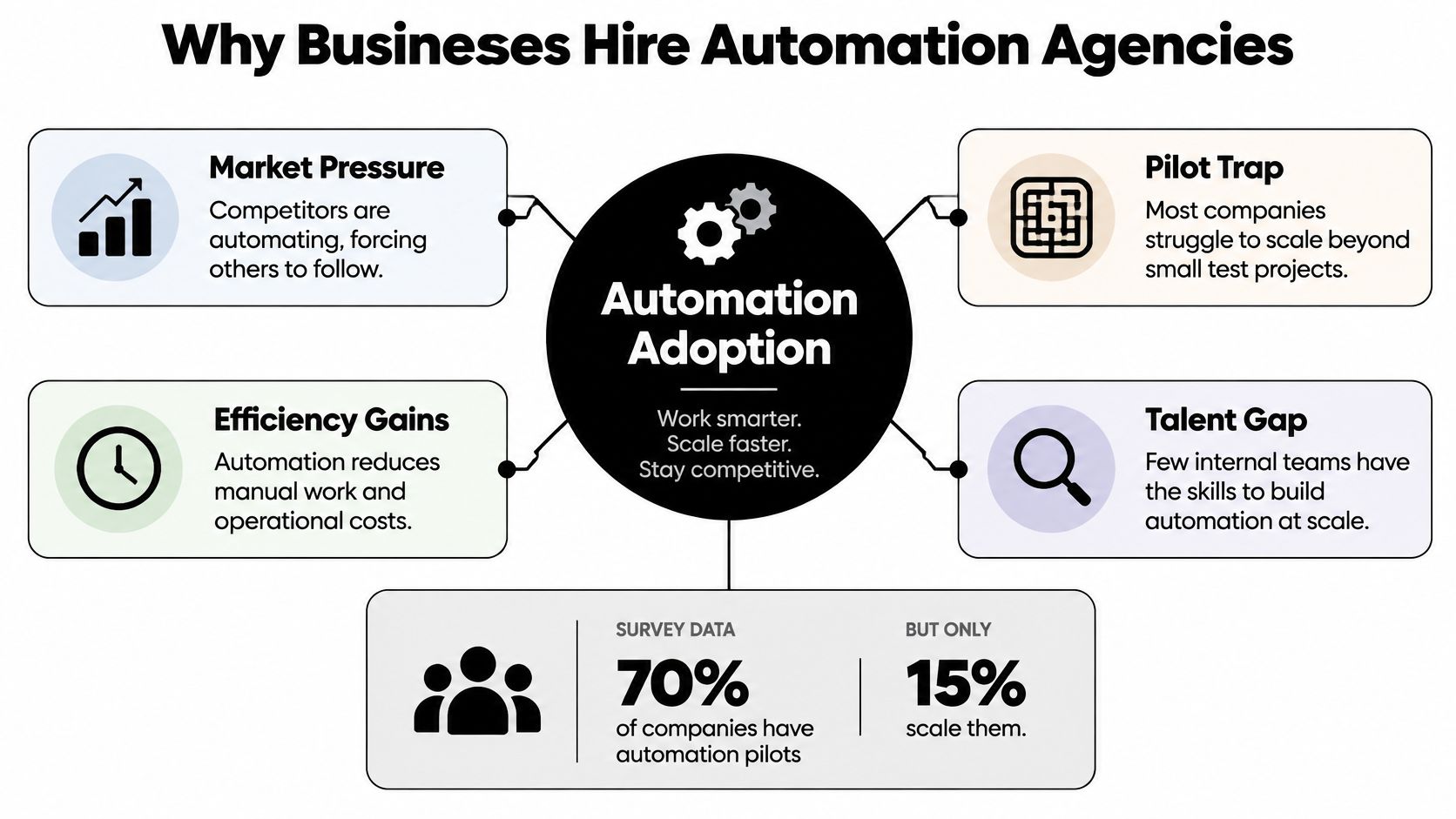
The demand isn't driven by curiosity about automation alone. Many organizations are testing it, while far fewer have extended it across the business. In a McKinsey Global Survey conducted from October 5–22, 2021, 70% of 639 executives and managers said their organizations were piloting automation in at least one business unit or function, up from 66% in 2020 and 57% in 2018. Yet fewer than 20% said their organizations had scaled automation across multiple parts of the business (McKinsey's automation survey).
That difference between pilots and scaled operations is where many projects lose momentum. A demo typically handles a clean, predictable example. Production must cope with missing information, duplicate records, changing staff responsibilities, permission limits, and systems that don't share data neatly. If the team hasn't agreed on the process, automation may move confusion faster.
Why pilots stall
The first difficulty is choosing the right workflow. Teams often automate the task that's easiest to demonstrate, not the one that causes the most operational drag. A useful candidate has a clear owner, repeatable steps, accessible data, and an outcome the business can measure. A process full of exceptions and undocumented judgment may need redesign before it's ready.
Then comes integration. Sales may live in a CRM, support in a help desk, finance in accounting software, and approvals in email. Connecting systems is only part of the work. The agency must also decide which record is authoritative, how failures are surfaced, and who resolves them.
The third challenge is adoption. Employees need to know what the automation does, when to trust it, and how to correct it. If the workflow makes decisions without a clear owner or creates extra review work, staff will route around it. A responsible partner includes training and change management, rather than treating the handoff as the finish line.
Smaller and growth-stage companies can feel these constraints especially sharply. They may understand that automation could help but lack dedicated process architects, integration specialists, and engineering time. An agency can supply that expertise for a defined engagement, while helping the company build internal understanding rather than leaving behind a system nobody can maintain.
Core Services and AI-Enabled Offerings
Most engagements should start with the work, not the technology. A team should first map the current process, identify delays and failure points, and agree on the business outcome. Only then does it make sense to decide whether a CRM rule, an integration platform, a custom application, or an AI agent is the right tool.

From workflow design to AI agents
Core services often include process analysis, integration design, workflow automation, and custom software development. For example, an agency might connect a website form to HubSpot, route qualified leads to the right representative, and create a review queue for incomplete submissions. If the process involves interpreting documents or language, an AI component may help classify or draft, but it still needs clear boundaries and validation.
AI-enabled offerings can support sales research, customer-support triage, recruiting coordination, marketing content, and operational reporting. The key distinction is that an AI agent can interpret information and generate a response, while traditional automation usually follows defined rules. That flexibility is useful, but it also introduces uncertainty. An agent that drafts a response for approval is a different risk from one authorized to send messages or change customer records.
Production-grade means the system works within the company's operating rules. It uses approved data, follows role-based permissions, records its actions, and escalates cases it can't safely handle. A polished chat window isn't enough. Teams need to know what the agent can do, what it can't do, and how staff can intervene.
Practical rule: Let an agent prepare or recommend an action before you authorize it to execute that action.
Deliverables beyond a workflow
An agency may also build KPI dashboards that bring together data from Shopify, advertising platforms, CRMs, and finance tools. Other projects replace unwieldy SaaS configurations with a custom internal system, automate lead generation or competitor monitoring, or reconcile transactions for human review. Those solutions still need clear ownership, documentation, and a plan for maintenance.
Data quality often determines whether these projects work. If teams are comparing data-enrichment options, see looot's enrichment picks as a starting point for evaluating how enrichment fits into a broader workflow. Enrichment can improve the information available to a process, but it won't fix unclear qualification rules or inaccurate source records.
For a closer look at how AI fits into process workflows, read this overview of business process automation with AI. Cyndra is one provider of AI consulting and implementation, including agents connected to existing business systems and managed in production.
A useful agency conversation should leave you with a process map, a defined scope, integration requirements, acceptance tests, and an operating plan. If the proposal jumps from a quick demo to broad promises without explaining those pieces, ask what the team will deliver and who will own it afterward.

Real Business Outcomes and Measurable KPIs
An automation project can make a process faster without reducing headcount. It may give employees more time for judgment-heavy work, reduce rework, improve throughput, or lower the cost of handling each transaction. Those are different outcomes, so an agency should agree with the client on what success means before building.
A global Deloitte survey of 441 executives across 29 countries found that organizations implementing or scaling intelligent automation reported an average 24% cost reduction, compared with 19% in the earlier survey period; respondents also expected a further average 24% reduction over the following three years (Deloitte's intelligent automation survey). Those figures are survey findings, not a guarantee for an individual workflow. A credible business case still depends on the process, the baseline, implementation costs, and whether the released capacity can be put to productive use.
A practical example is invoice handling. Before changing anything, the team records the time spent receiving, checking, entering, and correcting invoices, along with the number of cases that need escalation. The new workflow might extract fields, match records, and send uncertain cases to a person. If exceptions remain high, the answer may be better supplier data or a redesigned approval process, not another layer of automation.
Build the measurement plan before launch
| KPI | What It Measures | Why It Matters |
|---|---|---|
| Cost per transaction | Operational cost to complete each case | Shows whether the process is becoming less expensive to run |
| Straight-through-processing rate | Share of cases completed without manual intervention | Indicates how often the workflow handles normal cases successfully |
| Exception rate | Share of cases requiring review or recovery | Reveals brittle rules, poor data, or cases outside the system's scope |
| Median completion time | Typical elapsed time from start to finish | Shows whether the customer or employee waits less |
| Human hours per 100 transactions | Staff effort needed for a consistent volume of work | Makes capacity released visible, even when headcount stays the same |
Capture a representative baseline before deployment, then compare like with like after launch. Don't celebrate fewer manual steps if the team now spends more time fixing bad outputs. Track service quality and risk alongside efficiency, and record whether the business saved cash, avoided future hiring, or used capacity to handle more work.
For a wider view of how to choose operational measures, see this guide to operational efficiency metrics. The agency should show how its chosen KPIs connect to your actual process, rather than presenting a generic dashboard that looks impressive but doesn't answer whether the operation improved.
How to Choose the Right Agency
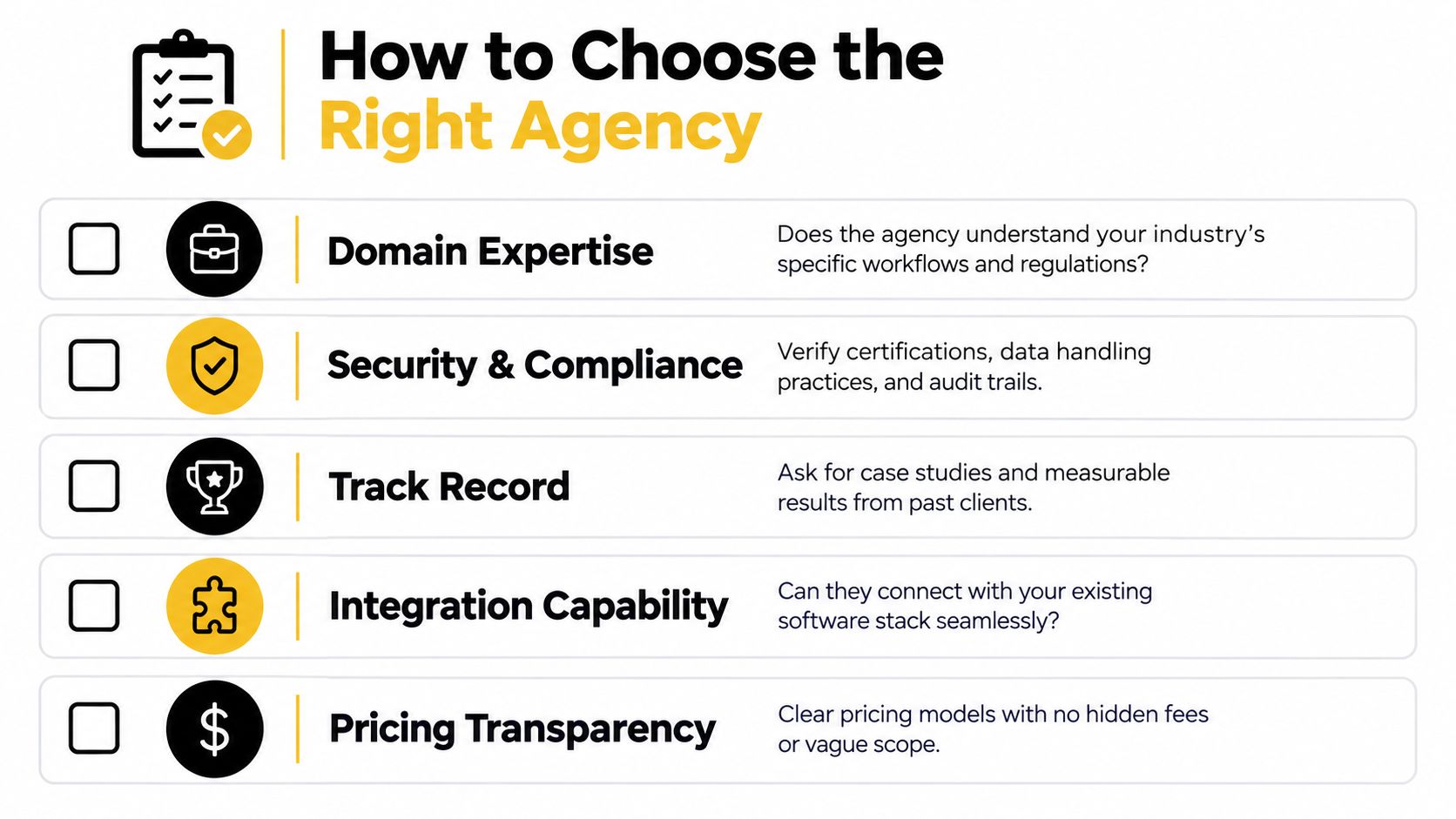
A proposal is only useful if it explains how the agency will get from your current process to a reliable operating workflow. Compare candidates on implementation capability, domain understanding, integration experience, security practices, measurement, and support after launch. A strong sales presentation can't substitute for a clear scope and accountable delivery.
Compare what each agency will actually do
| Evaluation area | Questions to ask |
|---|---|
| Domain expertise | Can the team explain your process, its exceptions, and the rules your staff must follow? |
| Integration capability | Have they worked with the systems you use, and how will they handle failed connections or conflicting records? |
| Security and governance | What data can the automation access, which actions require approval, and how are logs and incidents handled? |
| Track record | Can they describe comparable work, the implementation scope, and how outcomes were measured? |
| Pricing and scope | Does the proposal define deliverables, exclusions, ongoing costs, and who pays for changes? |
The governance conversation deserves more attention than it often gets. Grant Thornton's 2026 survey of 950 business leaders found that 78% lacked strong confidence they could pass an independent AI-governance audit within 90 days, while governance or compliance barriers were cited as the largest scaling obstacle by 46% (Grant Thornton's AI impact survey). Ask an agency to demonstrate how it handles access, human approvals, audit trails, and changes to an agent's instructions or data sources.
The NIST framework and practical governance controls matter in your own environment, so don't accept “we take security seriously” as an answer. Ask who approves an agent's actions, how a human can stop or correct it, and what records you'll receive. Agencies should be able to explain the controls in plain language, then show how those controls appear in the design.
A red flag is a promise of rapid results without a discovery process or a plan for exceptions. Another is a one-time build with no handover, documentation, monitoring, or named owner. For agencies building customer-facing digital experiences, a white-label DXP platform for agencies can be relevant when choosing how content systems fit into the wider delivery stack, but it doesn't replace the need to assess workflow ownership and security.
Choose a partner who will challenge an automation request when the process isn't ready. That may mean redesigning the workflow first, narrowing the pilot, or keeping a high-risk decision with a human.
From Consultation to Transformation
A sound engagement progresses through discovery, implementation, and ongoing operation. Each stage should have a decision point. If the team can't explain what it has learned, what it will build next, and how it will test the result, the project is moving on assumptions rather than evidence.
Consultation
The agency and client map the workflow, identify its owner, inspect the systems involved, and agree on the problem to solve. Bring examples of normal cases and exceptions, existing process documentation, access requirements, and baseline performance measures. The consultation should clarify whether the process is ready to automate or needs redesign first.
Implementation
The team builds integrations and automation, then tests them against realistic cases. Start with a bounded task and restrict permissions to what it needs. For an AI agent, test against a fixed evaluation set, then run in shadow mode, where people review its proposed outputs without letting it execute them. Once behavior is acceptable, authorize low-risk actions gradually and keep irreversible actions under human approval.
NIST's AI Risk Management Framework groups operational governance into GOVERN, MAP, MEASURE, and MANAGE, and its generative-AI guidance recommends documenting human overrides and maintaining oversight across the system lifecycle (NIST's AI Risk Management Framework). Those functions are useful operating habits, not paperwork to complete after the build. They encourage teams to define responsibility, understand risks, evaluate performance, and respond when the system behaves unexpectedly.
Transformation
After launch, people need training, the team needs monitoring and a clear escalation path, and the owner needs to review exceptions. The agency should hand over documentation, explain how to report problems, and help the client decide when a workflow is stable enough to expand. Cyndra describes its engagement path as consultation, implementation, and transformation; see this overview of the AI implementation process for a practical view of the stages.
Set a review cadence around the workflow's actual risk and volume, rather than adopting a generic schedule. If staff overrides rise, investigate the reason before expanding access. The system may be seeing new cases, relying on poor data, or following rules that no longer match the business process.
Making the Final Decision
A business automation agency is a good fit when your team has a real operational problem, but lacks the capacity or expertise to turn the solution into a maintained process. The agency should bring workflow design, integration capability, implementation discipline, and a credible plan for oversight. It shouldn't sell AI as a shortcut around unclear ownership or unreliable data.
Before signing, name the process owner, define the outcome, agree on baseline measures, and ask how the workflow will behave when it encounters an exception. Compare proposals by what they make operational: working integrations, clear permissions, documented tests, staff training, and support after launch. A smaller, well-governed workflow is more valuable than a broad pilot that nobody trusts.
The right partner helps your company move beyond buying software and toward running a dependable operation. If a candidate can explain what should remain manual, how humans stay accountable, and how the team will know whether the workflow works, you're evaluating the right things.
Cyndra helps organizations assess workflows, build and integrate AI agents, train teams, and manage those systems in production. Visit Cyndra to discuss where a carefully scoped automation could take manual work out of your operation without giving up control.