 CYNDRA
Buying AI software is the most popular advice in the market, and it's also the least reliable definition of progress. A license can give an employee a chatbot, but it won't repair a broken approval chain, connect customer data to the CRM, or decide who owns an automated exception.
AI transformation means redesigning workflows, decisions, skills, and operating models around AI-enabled capabilities. The practical ambition isn't to replace every employee with a machine. It's to let bounded AI employees handle repeatable processes so a team can increase output without increasing headcount at the same rate.
That distinction matters because adoption can look impressive while operations remain unchanged. The 2025 AI Deployment and Governance Survey found that 90% of organizations used AI, yet adoption was generally shallow and isolated by function. 88% reported difficulty integrating AI with legacy systems, 93% struggled to quantify business impact, and 47% had received no workplace AI training.
Table of Contents
- Adoption Is Not Transformation: What Actually Changes
- How AI Employees and Autonomous Agents Operate
- The Three Stages of AI Implementation
- Measurable ROI Across Core Business Functions
- Establishing Governance and Risk Management
- Overcoming the Workforce Readiness Bottleneck
- Common Pitfalls and How to Avoid Them
Adoption Is Not Transformation: What Actually Changes
A company can place AI subscriptions in every department and still run the same operation. Marketing may use a writing assistant, sales may test a prospecting tool, and support may deploy a chatbot, while handoffs, data permissions, quality checks, and accountability remain unchanged.
That is tool adoption. Transformation begins when leaders redesign how work moves, who owns each decision, and where AI can complete a bounded process without adding equivalent headcount.
Stanford's 2025 AI Index economy research reported that 78% of organizations said they used AI in 2024, up from 55% in 2023. Generative AI adoption in at least one business function rose from 33% in 2023 to 71% in 2024. The figures show broad experimentation, but they do not establish that companies changed their operating models or improved unit economics.
What changes in a transformed workflow
A standalone chatbot answers a question. A production agent participates in a controlled process with defined inputs, permissions, review points, and success measures.
A sales research agent might:
- Collect context: Pull approved information from the CRM, product records, and public company materials.
- Apply rules: Score the account against a defined qualification framework.
- Create work: Draft an account brief and outreach sequence in the required format.
- Use tools: Create a task or update a record only when its permissions allow it.
- Escalate judgment: Send unusual accounts, sensitive claims, or low-confidence outputs to a human reviewer.
The surrounding system of inputs, permissions, process rules, review points, and measurable outcomes matters more than the model alone. Without that system, a capable model produces work inside an unchanged process.
Practical rule: If nobody owns the workflow after launch, the company has deployed software, not transformation.
Why agents change the economic question
Traditional predictive AI identified patterns or forecast outcomes. Generative AI added the ability to create content and interpret unstructured information. Autonomous and semi-autonomous agents extend those capabilities by coordinating several steps and taking permitted actions.
The useful operating question becomes: “How much work can the operating system complete reliably, and what does each completed transaction cost?” That measure is more informative than counting how many employees opened a tool.
The Stanford report also recorded $33.9 billion in global private investment in generative AI in 2024, an 18.7% increase from 2023 and more than 8.5 times the 2022 level. Investment at that scale shows that organizations are treating AI as an operating capability, rather than a short-lived software category.
Capital alone creates no operational value. A chatbot attached to a slow process may generate more drafts, tickets, or recommendations without improving the final result. Transformation requires a redesigned workflow, a named owner, a baseline, and a financial measure that holds up in daily operations.
How AI Employees and Autonomous Agents Operate
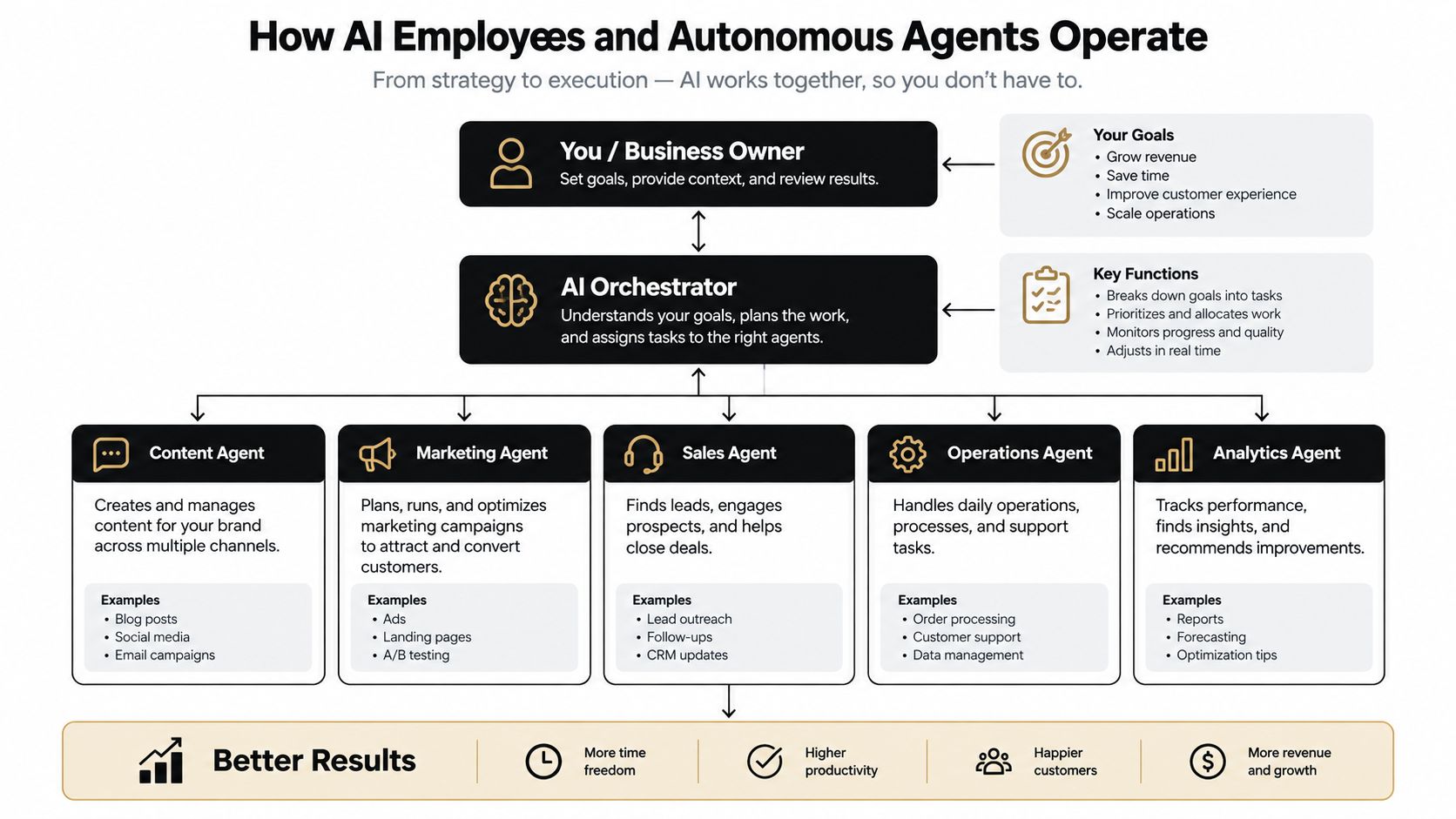
An AI employee is best understood as a role with controlled access, not as a magical digital person. It receives defined inputs, reasons over approved context, uses specific tools, produces structured outputs, and escalates when it reaches a boundary.
A customer-support agent, for instance, might read a ticket, retrieve the relevant policy, classify the issue, draft a response, check account status, and route the case. It shouldn't be allowed to issue an unrestricted refund just because the model sounds confident.
The operating components
A reliable agent usually has several layers:
- Business context: Playbooks, product information, customer records, policies, and approved knowledge sources.
- Orchestration: A process controller that determines which action happens first, what happens next, and when a task is complete.
- Tool access: Limited connections to systems such as a CRM, Shopify, finance software, email, ticketing, or recruiting platforms.
- Output schema: A required structure that makes results usable by the next system or reviewer.
- Escalation logic: Clear conditions for uncertainty, sensitive data, policy exceptions, or consequential decisions.
- Monitoring: Logs and quality checks that show what the agent received, decided, changed, and handed to a person.
A standalone AI application might draft an email in a blank window. An integrated agent can inspect an account, identify the next action, draft the message in the company's format, create a follow-up task, and wait for approval before sending.
For a deeper technical explanation of agent loops, tools, memory, and orchestration, see this guide to how AI agents work.
Why workflow integration creates value
MIT research on more than 187,000 software developers found that developers who received early access to GitHub Copilot increased the share of time spent on core work by 12% and reduced time spent on managerial tasks outside coding by 25%. The MIT research summary points to a workflow effect, not merely a software-access effect.
The lesson applies beyond engineering. An agent creates advantage when it removes coordination work around the task, makes institutional knowledge available at the moment of action, and returns a result that fits the next step. If an employee still has to copy information between systems, check five sources, reformat the output, and manually reconstruct the audit trail, the company has automated only the easiest fragment.
A useful design test is simple: name the process start, the permitted actions, the human decision points, and the finished business outcome. If those elements remain vague, the agent is still a demo.
The Three Stages of AI Implementation
A practical implementation can move from uncertainty to a working production process in 60 days, provided the team chooses a bounded workflow and assigns decision-makers early. The timeline isn't a promise that every transformation takes the same amount of time. It's a forcing function that prevents endless discovery without operational ownership.
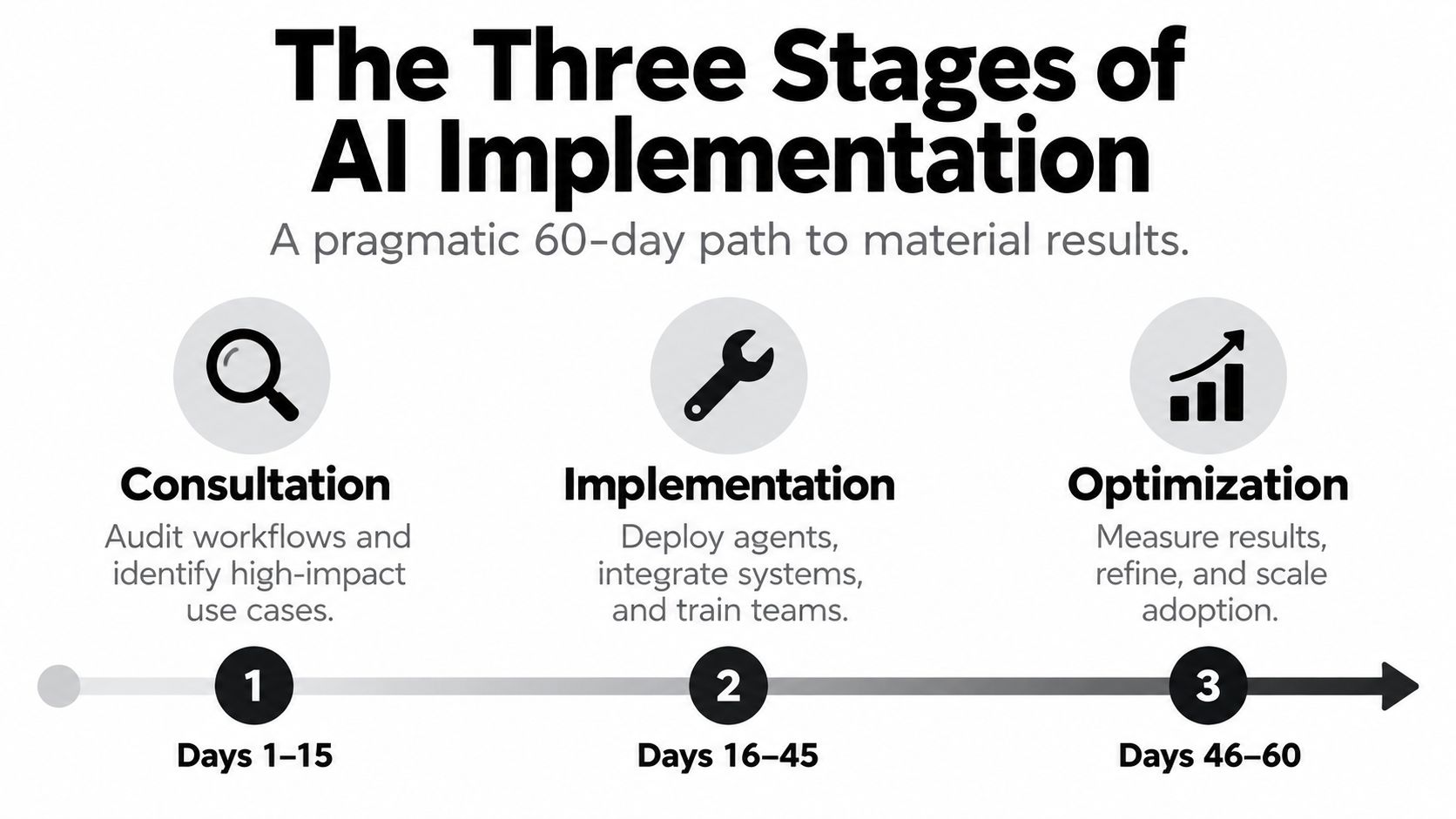
Consultation
During the first stage, the team maps how work happens in practice, not how the process document claims it happens. That means observing handoffs, identifying duplicate entry, locating approvals, listing systems involved, and recording where employees spend time correcting or searching.
The team should also establish a baseline for the selected workflow. Useful measures include cycle time, exception rate, rework, escalation volume, labor minutes, conversion, and cost per completed transaction. A vague goal such as “use AI in sales” won't support a credible investment decision.
A strong first use case has repeatable inputs, a visible output, accessible data, and a risk level that permits human review. Prospect research, support triage, recruiting coordination, finance reconciliation, and operational reporting often meet those conditions.
Implementation
The second stage connects the agent to the organization's knowledge and tools. Operators define the instructions, retrieval sources, credentials, output formats, and approval rules. Subject-matter experts test realistic examples, including incomplete records and edge cases, because clean demonstrations hide the problems that appear in production.
The agent should enter the existing workflow rather than create another destination. If the team works in a CRM, ticketing platform, or finance system, the agent should return structured work there wherever possible. Replacing a bloated SaaS stack may be appropriate, but only after the organization understands which functions the old tools provide.
Transformation
The final stage moves responsibility from the build team to operational owners. Human reviewers learn when to approve, edit, reject, or escalate outputs. A workflow owner monitors quality and cost, while an escalation manager handles cases that fall outside the agent's authority.
The team then compares results with the original baseline and decides whether to refine, expand, or stop. Transformation isn't the moment the agent goes live. It's the point at which the business can operate, measure, and improve the new process without depending on a perpetual experiment.

Measurable ROI Across Core Business Functions
AI transformation earns support when it improves the economics of a real workflow. The relevant comparison isn't “AI versus no AI.” It's the cost, speed, quality, capacity, and risk of the redesigned process compared with the previous process.
The strongest early deployments usually capture what experienced employees already do well. They turn tacit judgment into accessible guidance, then give that guidance to people while they're working. This can raise the floor for less experienced workers, but it can also expose gaps in training, data quality, and process design.
A National Bureau of Economic Research study analyzed 5,179 customer-support agents using an AI assistant that supplied real-time conversational recommendations. Access to the system increased issues resolved per hour by approximately 14% on average, while novice and lower-skilled workers improved by roughly 34% to 35%.
The result isn't a license to assume every agent will produce the same gain. It demonstrates why embedded assistance can distribute effective practices across a team. It also shows why the baseline must be task-level and role-specific.
| Department | Primary AI Agent Function | Key Success Metric |
|---|---|---|
| Sales | Research accounts, qualify opportunities, prepare outreach, and maintain follow-up tasks | Qualified pipeline per seller and time from research to first action |
| Customer support | Triage tickets, retrieve policy context, draft responses, and route exceptions | Resolution time, first-contact resolution, and escalation quality |
| Operations | Reconcile records, monitor exceptions, and coordinate repeatable handoffs | Cost per transaction, exception rate, and cycle time |
| Marketing | Convert approved research into briefs, content drafts, and campaign variations | Production capacity, review time, and contribution to qualified demand |
| Recruiting | Coordinate screening, scheduling, and candidate communication | Time spent per completed stage and candidate response quality |
Track capacity, not activity
A team can celebrate thousands of generated drafts while its approval queue grows. That's not ROI. It's inventory.
Measure the completed outcome. For sales, track qualified opportunities and seller time returned to customer conversations. For support, measure resolved issues and rework rather than the number of suggested replies. For finance, examine reconciliation accuracy and unresolved exceptions. For recruiting, track completed pipeline stages and reviewer workload.
Revenue and cost measures matter, but quality controls belong beside them. A faster process that creates more refunds, incorrect claims, missed candidates, or compliance escalations may be economically worse.
The useful unit is a completed, accepted business outcome, not an AI interaction.
The financial model should include implementation effort, integration maintenance, human review, exception handling, and the cost of errors. It should also account for capacity released, because the value may appear as more customers served, faster response, better analysis, or reduced need for additional hiring rather than immediate payroll reduction.
Establishing Governance and Risk Management
Autonomy increases the consequences of a mistake. An agent that can only draft text has a different risk profile from one that can alter customer records, move money, contact candidates, or change production systems.
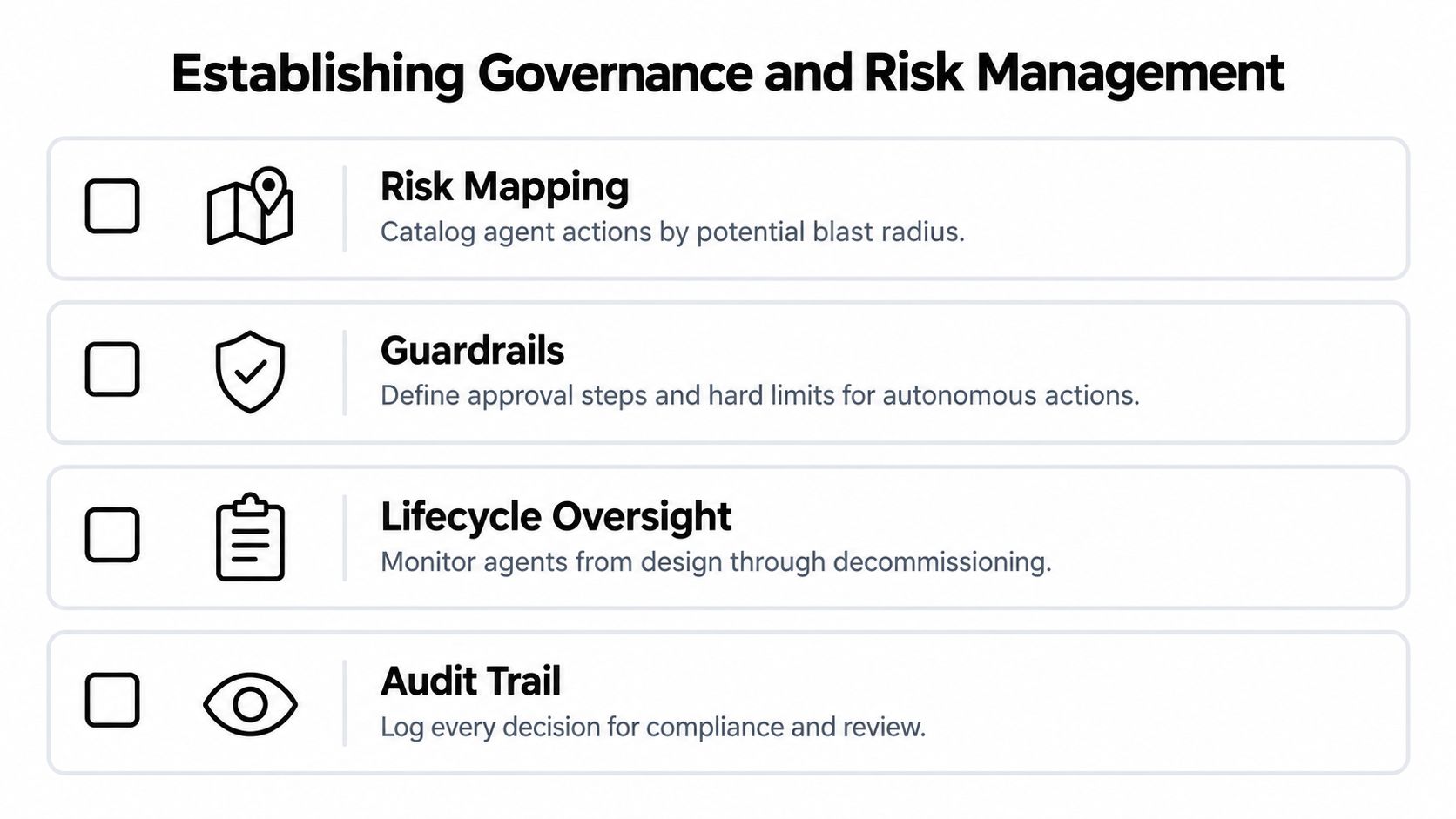
NIST treats governance as a cross-cutting function across the design, development, deployment, evaluation, and acquisition of AI systems. Its AI Risk Management Framework also highlights inaccurate outputs, privacy exposure, security vulnerabilities, and insufficient content provenance as generative AI risks.
Start with the agent's blast radius
Before deployment, document what the agent can see and what it can change. The answer should be specific enough for an operator to test.
- Map the use case. Record data sources, users, outputs, downstream systems, and decisions affected.
- Limit permissions. Give the agent only the credentials and tools required for its assigned process.
- Define approval gates. Require human confirmation for financial, legal, employment, customer-impacting, or irreversible actions.
- Set validation rules. Check required fields, source grounding, policy constraints, and output format before work moves forward.
- Log the trail. Preserve inputs, retrieved context, tool calls, outputs, approvals, edits, and escalations.
- Prepare rollback. Make it possible to disable the agent, reverse permitted changes, and return the process to a known safe state.
The governance design should match the consequence of failure. A low-risk internal summary may need sampling and review. An agent that changes a financial record needs stricter permissions, validation, and approval.
For a practical view of policy ownership, access controls, evaluations, and compliance workflows, review this resource on AI governance and compliance.
Stage autonomy gradually
Start with human-in-the-loop work where the agent recommends or prepares and a person approves. Measure accuracy, exception patterns, and review effort before granting additional authority.
This staged approach prevents a common error: scaling an agent because it performs well on normal cases while ignoring unusual cases that carry most of the risk. The organization should advance autonomy only when reliability, compliance, and exception handling meet the threshold defined by the workflow owner.
Overcoming the Workforce Readiness Bottleneck
AI transformation stalls when people are asked to operate a redesigned workflow without clear responsibilities, training, or authority. Employees need to know which outputs to trust, which to challenge, and how their decisions affect cost, quality, and throughput.
A 2025 global workforce survey from PwC covered nearly 50,000 workers across 48 countries and 28 sectors. Only 14% reported using generative AI daily. The same survey found that only 15.8% strongly agreed they had received adequate training to use AI tools effectively.
That gap creates two operational risks. Some employees avoid agents because the redesigned process feels slower or threatens their role. Others accept fluent outputs without checking evidence because training never showed them where the system is likely to fail.
Redesign roles before measuring adoption
A transformed workflow needs named human responsibilities:
- Workflow owner: Owns the process outcome, baseline, service level, and improvement backlog.
- Reviewer: Approves, edits, or rejects outputs against documented quality rules.
- Escalation manager: Handles ambiguity, exceptions, and cases beyond the agent's authority.
- Data steward: Maintains source quality, access rules, and institutional knowledge.
- Quality auditor: Samples completed work and identifies drift, recurring errors, or unsafe behavior.
Training should match each responsibility. Reviewers need evaluation practice and escalation judgment. Workflow owners need unit economics and monitoring skills. Data stewards need to understand source quality and permissions. Generic prompt training does not prepare people for these jobs.
Temporary operational support can help while internal roles change. Teams may hire a virtual assistant to absorb coordination work, document procedures, or keep routine administration moving during the transition. Define responsibilities and data access before assigning that work.
An AI readiness assessment can identify process, skills, data, and governance gaps before tool selection. The goal is not to make every employee technical. It is to give each person a safe, useful role in an operating model where AI employees handle bounded processes and people manage judgment, exceptions, and improvement.
Common Pitfalls and How to Avoid Them
Most failed programs don't fail because the model can't generate text. They fail because the organization automates a poorly understood process, skips measurement, or spreads effort across too many disconnected experiments.
Use this diagnostic before expanding an agent:
- Check the starting workflow: Can the team describe the current inputs, handoffs, approvals, exceptions, and final outcome?
- Confirm the baseline: Are cycle time, error rate, rework, escalation volume, labor minutes, and cost per transaction recorded before launch?
- Test the data path: Can the agent reach authoritative information without relying on copied spreadsheets, stale documents, or unowned databases?
- Define decision rights: Which actions can the agent take, which require approval, and who handles an exception?
- Measure accepted output: Does the organization track completed work and business outcomes rather than prompts, logins, or generated drafts?
- Audit the human experience: Do employees know how their responsibilities change, what training they'll receive, and how performance will be evaluated?
- Remove duplicate systems: Does the new agent reduce handoffs, or has it created another queue that someone must maintain?
- Review unit economics: Do savings or capacity gains exceed integration, review, maintenance, and error-handling costs?
A common anti-pattern is automating the visible step while leaving the bottleneck untouched. Faster lead research doesn't help if approvals still sit in a shared inbox. Faster ticket drafting doesn't improve service if routing rules are unclear. More content production doesn't create demand if review and distribution remain manual.
Another failure mode is treating the first launch as the finish line. Production agents need feedback loops, quality sampling, updated knowledge, permission reviews, and a clear path to retirement when the process changes.
The right maturity question is not “How much AI have we deployed?” It's “Which business processes now run better, with evidence, because humans and AI were assigned complementary responsibilities?” That's the standard required for a genuine increase in output without matching headcount growth.
Cyndra audits workflows, designs and deploys production-grade AI employees, connects them to existing tools, and trains teams to operate and improve the new processes. Visit Cyndra to assess which bounded workflows could deliver measurable gains without adding another disconnected chatbot.