 CYNDRA
Your agent has access to the CRM, support inbox, pricing system, and finance platform. It can retrieve records, draft responses, update fields, and trigger workflows. The question on your desk isn't whether it can do those things. It's whether you can explain, stop, and reverse what it does when the context is incomplete or the next action carries consequences.
That distinction defines agentic AI decision making in production. The winning operating model isn't unrestricted autonomy. It's supervised delegation, where the agent owns bounded work, people retain authority over consequential decisions, and every action passes an evidence-based control.
Table of Contents
- Why Agentic AI Decision Making Is a Supervision Problem
- How Agentic Decision Making Evolved from Rules to Plans
- The Perceive Plan Act Loop Inside Every Agent
- Three Autonomy Tiers and the Decisions Each One Owns
- Why Pass at One Hides the Decisions That Matter
- Building an Accountability Map for Multi-Step Decisions
- A 30 60 90 Day Plan for Production Agent Governance
Why Agentic AI Decision Making Is a Supervision Problem
Executives usually meet agentic AI through a productivity promise. An agent can qualify leads, summarize tickets, reconcile records, or prepare a customer reply without waiting for a person at every step. That promise is useful, but it skips the operating question: which decisions are safe to delegate, and what evidence proves that delegation works?
A 2026 systematic review across eight high-stakes sectors reported that developers use AI assistance in roughly 60% of their work, while complete delegation is feasible for only 0% to 20% of tasks (systematic review of AI delegation). Assistance and ownership aren't the same thing. An agent can help prepare a decision without being allowed to make it.
Start with the decision, not the model
Before connecting an agent to a business system, define four things:
- The decision: State exactly what the agent may decide, such as whether a lead meets a qualification rule.
- The evidence: Specify which records, policies, and live system states it may use.
- The authority: List the tools and fields it may access, change, or trigger.
- The intervention: Define when execution pauses and which named person approves the next step.
This framework is more useful than asking whether an agent is “autonomous.” A lead-enrichment agent can operate independently if it only appends reversible, verifiable data. A payment agent needs a different boundary because a mistaken action can create financial and compliance exposure.
For a practical overview of how organizations are applying agents across business workflows, see this guide to understanding agentic AI in business. Use it to expand your use-case inventory, not to avoid the harder work of defining authority.
Use four operating tests
Every production workflow should pass four tests:
- Decision loop: Can you see how the agent gathered context, formed a plan, used tools, and verified the result?
- Autonomy tier: Is the action reversible, moderately risky, or irreversible?
- Reliability gate: Does the agent remain dependable across repeated runs, changed inputs, and tool failures?
- Accountability map: Can a named owner intervene with enough context and authority?
Human-in-the-loop design only works when the human has meaningful control, not when a reviewer receives a vague approval prompt after the agent has already committed the change. Teams implementing these controls can use human-in-the-loop automation as a reference point, then adapt the pattern to their own systems.
Operating rule: Don't give an agent a broad goal and broad permissions. Give it a narrow decision, explicit evidence, bounded tools, and a clear stop condition.
How Agentic Decision Making Evolved from Rules to Plans
The first business automation systems didn't plan. They followed instructions someone had already written. From the 1960s through the 1980s, expert systems represented knowledge as explicit if-then rules and used forward or backward chaining to infer an action (history of AI agents).
That architecture made the operator's job straightforward but laborious. If a rule missed an exception, a person had to write another rule. A support system might route a ticket based on product and severity, but it couldn't easily adapt when the customer used unfamiliar language or when several policies conflicted.
Reinforcement learning changed the shape of the problem. Researchers modeled sequential decisions as Markov decision processes. An agent observes a state, selects an action, receives a reward, and updates its policy through experience. The operator no longer had to specify every action, but had to define states, rewards, constraints, and acceptable outcomes.
Deep reinforcement learning demonstrated that learned policies could operate at practical scale. DeepMind's Deep Q-Network learned Atari games from raw screen pixels and reward signals, while AlphaGo combined learned policies with search in a complex strategic domain. Those achievements shifted the operator's role from writing every instruction to designing the environment in which the system learns and acts.
Modern agents combine three styles
Today's business agents inherit capabilities from each generation:
- Symbolic logic supplies hard guardrails, such as blocking a payment above an approved limit.
- Learned policies help rank options and adapt to patterns that rules don't capture.
- Language planning turns a goal into ordered steps and selects tools to execute them.
In 2023, Meta AI's Toolformer demonstrated a language model that could autonomously decide when to call external tools. That pattern connects language reasoning to concrete operations, but it also creates a new control point. The agent isn't merely generating text. It's choosing which system to query, what arguments to send, and whether to continue after receiving the result.
The operator's job is to decide which layer gets final authority. Let language planning propose a customer response. Let deterministic validation check the recipient, price, and permissions. Let the system block execution when those checks fail.

The history matters because it explains why agentic systems feel flexible and unpredictable at the same time. They combine fixed rules, learned behavior, and probabilistic planning. Production design must separate those responsibilities instead of treating the model as one indivisible decision maker.
The Perceive Plan Act Loop Inside Every Agent
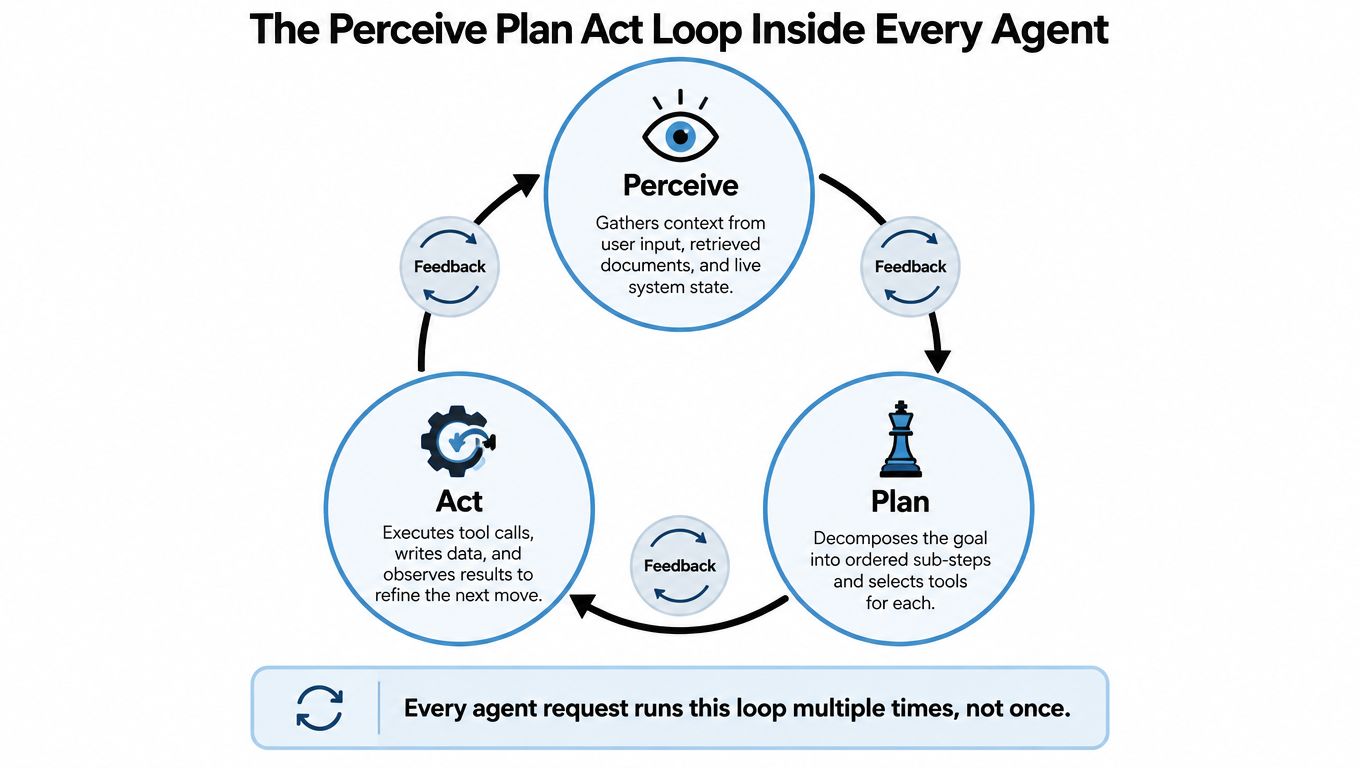
An agent doesn't make one decision and finish. It cycles through a loop. It perceives the current state, plans the next step, acts through a tool, observes the result, and repeats until it reaches a defined outcome or hits a stop condition.
Consider a sales agent responding to a pricing request. It retrieves the account record, checks the customer's segment, reads current pricing guidance, drafts an offer, calls a pricing API, and prepares a CRM update. Each stage can fail differently, so each stage needs its own checkpoint.
Perceive means assembling usable context
The agent might retrieve a CRM record, recent support history, contract terms, and product availability. A search result can look relevant while omitting the relationship that matters, such as an active discount or unresolved billing dispute.
Set a context checkpoint before planning:
- Confirm that the account identity matches the request.
- Record which sources were retrieved and when.
- Detect missing or conflicting fields.
- Stop when a required fact is unavailable instead of filling the gap with a guess.
Context quality is a workflow control, not a prompt-writing detail. If the agent sees an outdated account tier, every later action can be internally consistent and still wrong.
Plan means selecting a sequence and tools
The agent turns the goal into ordered steps. It may decide to retrieve a contract, calculate an eligible price, draft an email, and request approval. The plan should identify the intended outcome, the tools required, the assumptions being made, and the conditions that end the workflow.
Use a structured plan critique before execution. Ask a validator to check whether each step serves the original goal, whether the selected tool is permitted, and whether the plan includes an action that needs human approval.
Act means committing carefully and checking the result
Tool calls are where reasoning becomes operational risk. Validate tool arguments deterministically before an irreversible action. Check the recipient, record identifier, currency, amount, permission, and requested operation against system rules.
After execution, verify the expected database state. If the agent intended to update a CRM stage, confirm that the record changed once, to the permitted value, and under the correct account. Don't treat a successful API response as proof that the business outcome occurred.
For teams connecting agents to browser environments, customer data platforms, or enterprise tools, this overview of MCP and CDP for AI agents provides useful implementation context. The same principle applies regardless of the integration method: every tool call needs an explicit contract.
The most important design choice is where to gate the loop. Gate missing context during perception, questionable intent during planning, dangerous arguments before action, and unexpected state after action. A single approval screen at the end won't catch every failure that happened earlier.
Three Autonomy Tiers and the Decisions Each One Owns
Don't classify an agent as autonomous or supervised. Classify the decision it makes. Reversibility, impact, ambiguity, and permission scope should determine the operating tier.
| Tier | Example Workflow | Reversibility | Oversight Model |
|---|---|---|---|
| Tier 1 | Enrich a CRM record and route a lead | High | End-to-end execution with audits and exception alerts |
| Tier 2 | Draft an outbound message or first-line support reply | Moderate | Dynamic approval for low-confidence or high-impact cases |
| Tier 3 | Send a payment, change permissions, or delete a record | Low | Human approval before execution |
Tier 1 for bounded execution
Use Tier 1 for high-volume work with a clear expected state and an easy rollback. Lead enrichment, duplicate detection, internal categorization, and routine field updates fit this pattern when the agent's tools enforce field-level permissions.
The human doesn't approve every action. Instead, the team audits samples, monitors exceptions, and reviews drift. If the agent can't explain which source justified a field update, it doesn't qualify for this tier.
Tier 2 for dynamic approval
Use Tier 2 when the action is useful but ambiguity matters. An outbound sales email may be safe in one context and damaging in another. A support reply may follow policy for a standard request but need escalation when the customer mentions a legal threat or a service outage.
Route the routine cases automatically and send uncertain cases to a person with the retrieved evidence, proposed action, and reason for escalation. A Dynamic Intervention Framework tested on 5,000 synthetic enterprise tasks reported 98.2% task success, human intervention on 14.5% of decision steps, and 89% lower mean latency than a static approval baseline (Dynamic Intervention Framework). Treat those findings as evidence for risk-sensitive routing, not as a promise that every deployment will produce the same result.
Tier 3 for consequential actions
Use Tier 3 for payments, permission changes, external commitments, record deletion, and other actions that are difficult to reverse or could create material exposure. The agent can gather evidence, calculate options, and prepare the action. A named human must approve the final tool call.
Don't let an approval request hide the important details. Show the action, affected entity, evidence, policy checks, expected consequence, and rollback path. If the reviewer can't understand the decision quickly enough to intervene, the workflow isn't ready for production.
Why Pass at One Hides the Decisions That Matter
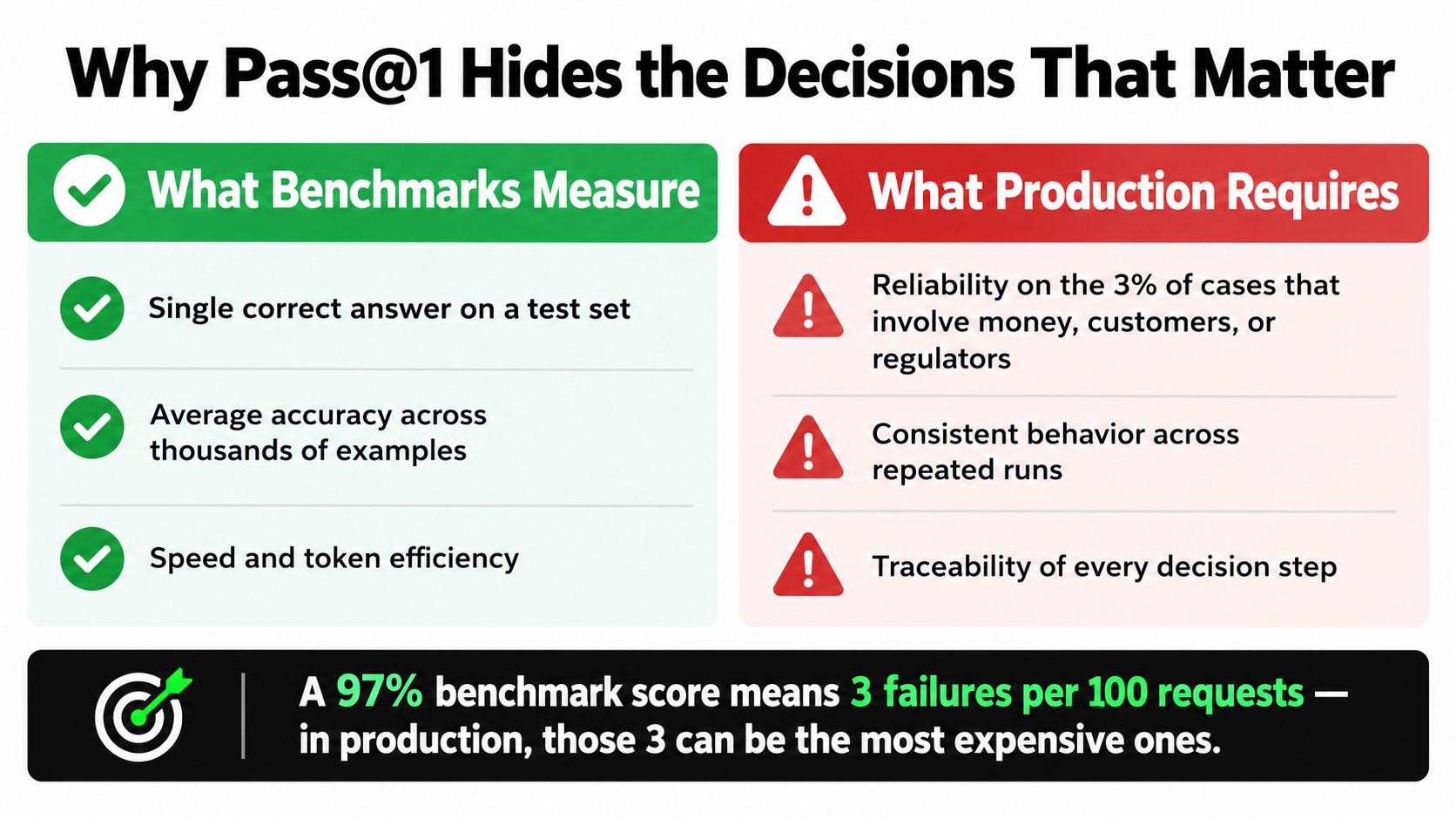
A single successful run proves that an agent can succeed once. It doesn't prove that the agent will behave consistently when the prompt changes, a document is missing, an API times out, or the same task runs again with a different ordering of retrieved records.
ReliabilityBench evaluates three production-relevant dimensions: consistency across repeated trials, resilience to task perturbations, and fault tolerance under infrastructure failures. Its reported results show agents moving from a 96.9% pass@1 rate to 88.1% at perturbation level ε = 0.2, an 8.8-percentage-point decline caused by small changes in input, context, or environment (ReliabilityBench results).
Replace one-shot testing with release gates
Before promoting an agent, run a test suite that reflects the workflow's actual failure surface:
- Repeated execution: Run the same scenario across multiple trials and compare tool choices, arguments, final states, and escalation behavior.
- Perturbation testing: Change wording, document order, irrelevant context, and available records without changing the correct outcome.
- Failure injection: Simulate timeouts, stale records, malformed responses, duplicate events, and partial writes.
- State verification: Confirm that the resulting database state matches the intended state and that the agent doesn't duplicate an action after retry.
- Decision-quality review: Measure accuracy, consistency, business impact, reversibility, false positives, false negatives, override quality, and correction cost.
Set thresholds by workflow risk. A Tier 1 enrichment agent can tolerate a different failure profile from a Tier 3 payment workflow. The exact threshold is an operating decision, but it must be written before launch so the team doesn't move the goalposts after seeing attractive benchmark results.
Practical rule: Never approve production autonomy because pass@1 looks high. Approve it only after repeated-run, perturbation, and failure-injection tests show that the agent fails safely.
Building an Accountability Map for Multi-Step Decisions
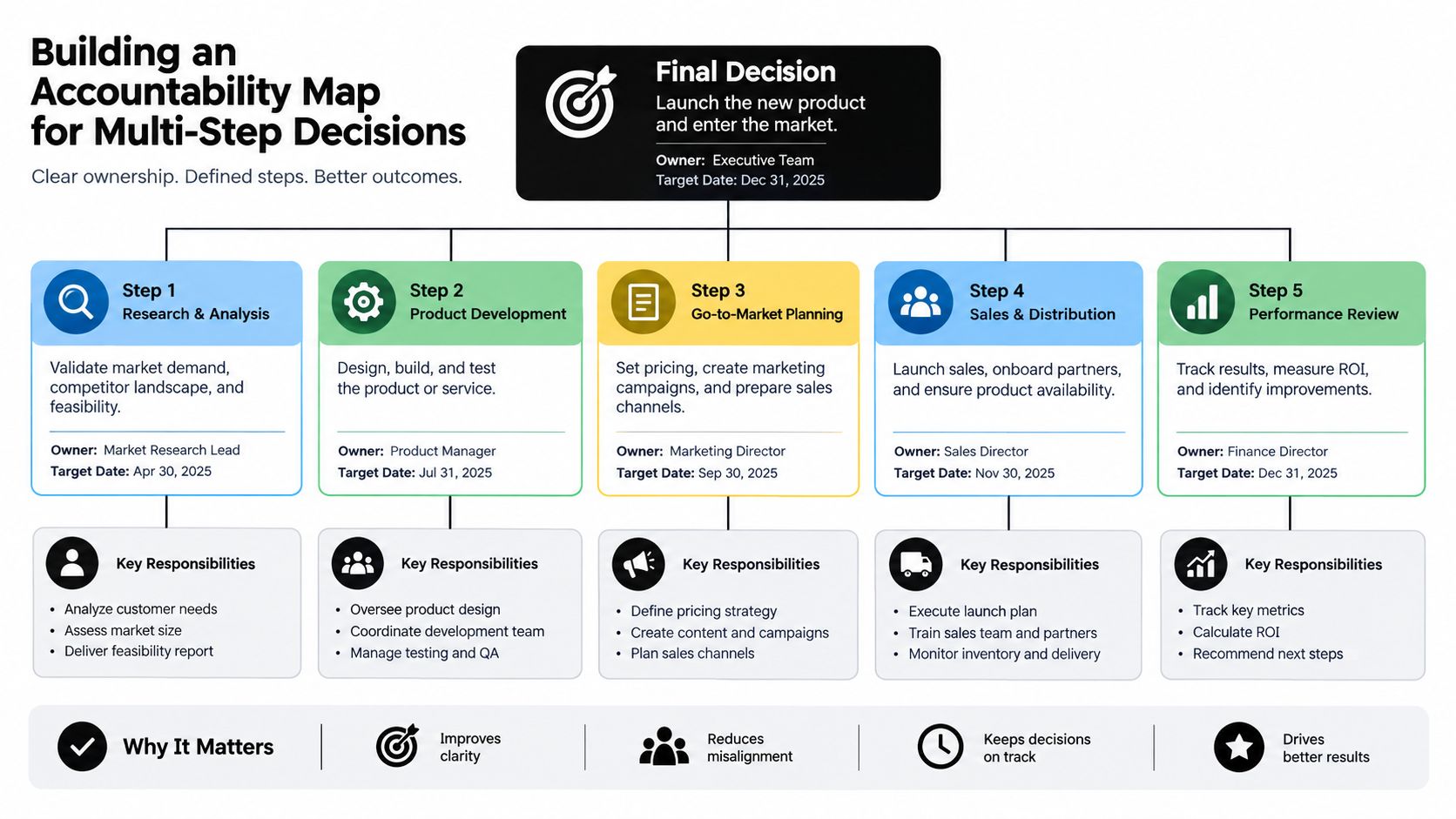
A production agent may retrieve a policy, query a customer system, update a record, and trigger another workflow before anyone reviews the result. Assign accountability at each handoff. Otherwise, the team may know that a process failed without knowing which decision, permission, or missing check caused it.
A 2025 analysis of 150 publicly documented AI incidents reported that approximately 78% were associated with inadequate human oversight, while 62% of surveyed governance stakeholders expressed distrust of highly autonomous systems (AI incident and oversight analysis). Treat those findings as an operating requirement: capable models still need defined supervision at every consequential step.
Assign ownership before granting access
Create one accountability record for every production agent. Name these roles:
- Business owner: The leader accountable for the business outcome, including harm caused by an incorrect decision.
- Workflow owner: The person who maintains policies, exceptions, and success criteria.
- Technical owner: The person responsible for tools, permissions, monitoring, and incident response.
- Approver: The person authorized to stop or release Tier 2 and Tier 3 actions.
- Escalation route: The path for security, legal, customer, or operational incidents.
Record the decision boundary beside each role. Specify which actions the agent may complete, which it may propose, and which require approval. Then enforce those boundaries in the tools. Grant access only to the required fields, records, APIs, and operations. Separate read, propose, and commit permissions so an instruction cannot override the control model.
Preserve a reconstructable trail
An action log should capture the triggering request, user identity, retrieved evidence, plan version, tool name, arguments, validation results, approval event, output, and final system state. Make it tamper-resistant and retain enough context to reproduce the decision without trusting the agent's generated explanation.
Observability must cover the full workflow, including decision inputs, tool calls, state changes, and outcomes. The AI agents observability guide provides a practical reference for joining those events into one operational trace.
Build recovery requirements into the design before launch. For reversible updates, preserve the prior state and define the restore mechanism. For irreversible actions, require approval before commitment and specify which downstream effects the operator must contain.
Run one simulated failure with the named owner. If that person cannot stop the workflow with the authority, context, and mechanism available, the approval steps in the interface are decorative.
A 30 60 90 Day Plan for Production Agent Governance
A production agent should earn authority in stages. Over the first quarter, build the inventory, define release gates, and assign one accountable owner to every decision that reaches production.
Days 1 through 30 establish the boundaries
List every agent, prototype, automation, and embedded assistant that touches business data. Record its workflow, inputs, tools, outputs, affected systems, permissions, rollback option, and business owner. Include experiments that have not yet reached production if they can access live records or services.
Classify decisions as Tier 1, Tier 2, or Tier 3. Classify the decision, not the entire agent. An agent may enrich a record under bounded execution while requiring approval before sending an external message or changing a customer-facing status.
Before drafting the register, use this AI agent governance framework to structure policy areas and ownership. Finish the month with a signed decision register that answers five questions:
- What may the agent decide independently?
- What evidence must it retrieve?
- Which actions require approval?
- Which conditions force a stop?
- Who owns the outcome?
A 2025 IDC-reported survey of 308 US business executives found that trust in AI agents was a top-three challenge for 28% of respondents, while connecting agents across applications and workflows challenged 19% (PwC survey data). Treat those findings as a reason to set trust and integration controls before launch, rather than after an incident.
Days 31 through 60 add reliability gates
Build a workflow-specific test set from historical cases, edge cases, and known incidents. Repeat trials, vary inputs and context, inject tool failures, and inspect the final database state. A convincing response is insufficient if the system writes the wrong record or performs the same action twice.
Write the release gate before testing begins. Define the required pass^k behavior, permitted escalation rate, tool-argument validation, duplicate-action protection, and stop behavior. Require deterministic checks before irreversible commits, followed by human approval at the final boundary.
Startup teams can use this governance guide for startups to organize an initial policy set. Larger teams should connect the same controls to procurement, security review, audit, and business continuity.
Days 61 through 90 operationalize accountability
Turn logs into an operating review. Track successful and failed outcomes, escalations, overrides, correction work, rollbacks, permission denials, and unresolved incidents. Separate healthy caution from poor agent quality by examining why overrides occur, not just how often.
Run both a rollback drill and an approval drill. The named business owner should reconstruct a decision from the audit trail, stop a pending action, and explain the next containment step. Reauthorize goals and permissions on a recurring schedule, especially after a workflow, policy, model, or integration changes.
Use a board-ready scorecard with three views:
- Value: Which approved workflows produce reliable business outcomes?
- Control: Where do agents escalate, fail validation, or require correction?
- Residual risk: Which decisions remain outside the approved autonomy boundary?
The operating test is simple: which decisions may an agent make independently, which require approval, and what evidence proves that autonomy improves outcomes? A deployment that cannot answer all three is not governed. Cyndra helps organizations install, train, and manage AI employees across sales, support, operations, marketing, and recruiting, with supervised workflows and explicit decision boundaries. Visit Cyndra to discuss a production agent with accountable human oversight.