 CYNDRA
Only 1% of organizations in a 2025 workplace assessment describe their AI rollout as mature enough to change how work gets done and produce substantial outcomes. Adoption is no longer the scarce part. Stanford's 2025 AI Index puts the share of surveyed organizations using AI at 78% in 2024, up from 55% in 2023. Generative AI in at least one business function jumped from 33% to 71%. Among organizations using AI, 49% reported cost savings in service operations, 43% in supply chain, and 41% in software engineering, yet the most common savings level was below 10%. Revenue gains showed up for 71% of AI users in marketing and sales, 63% in supply chain, and 57% in service operations, most often below 5%.
An AI transformation roadmap that starts with a tool list will stall on those modest numbers. One that works as a value-realization system does not. Baselines, finance-accepted metrics, and permission design come before any scale decision. Bounded autonomy is what lets an agent leave a single workflow and survive a second department.
Table of Contents
- The 90-Day AI Transformation Roadmap at a Glance
- Assign Roles and the Steering Group Before Day 30
- Choose and Redesign the First Workflow in Each Function
- Set Baselines and KPIs Finance Will Accept
- Permission Tiers and Governance for AI Agents
- Stop Pilots From Stalling and Fix the Cause Early
- Run the Go or No-Go Check Before Pilot
The 90-Day AI Transformation Roadmap at a Glance
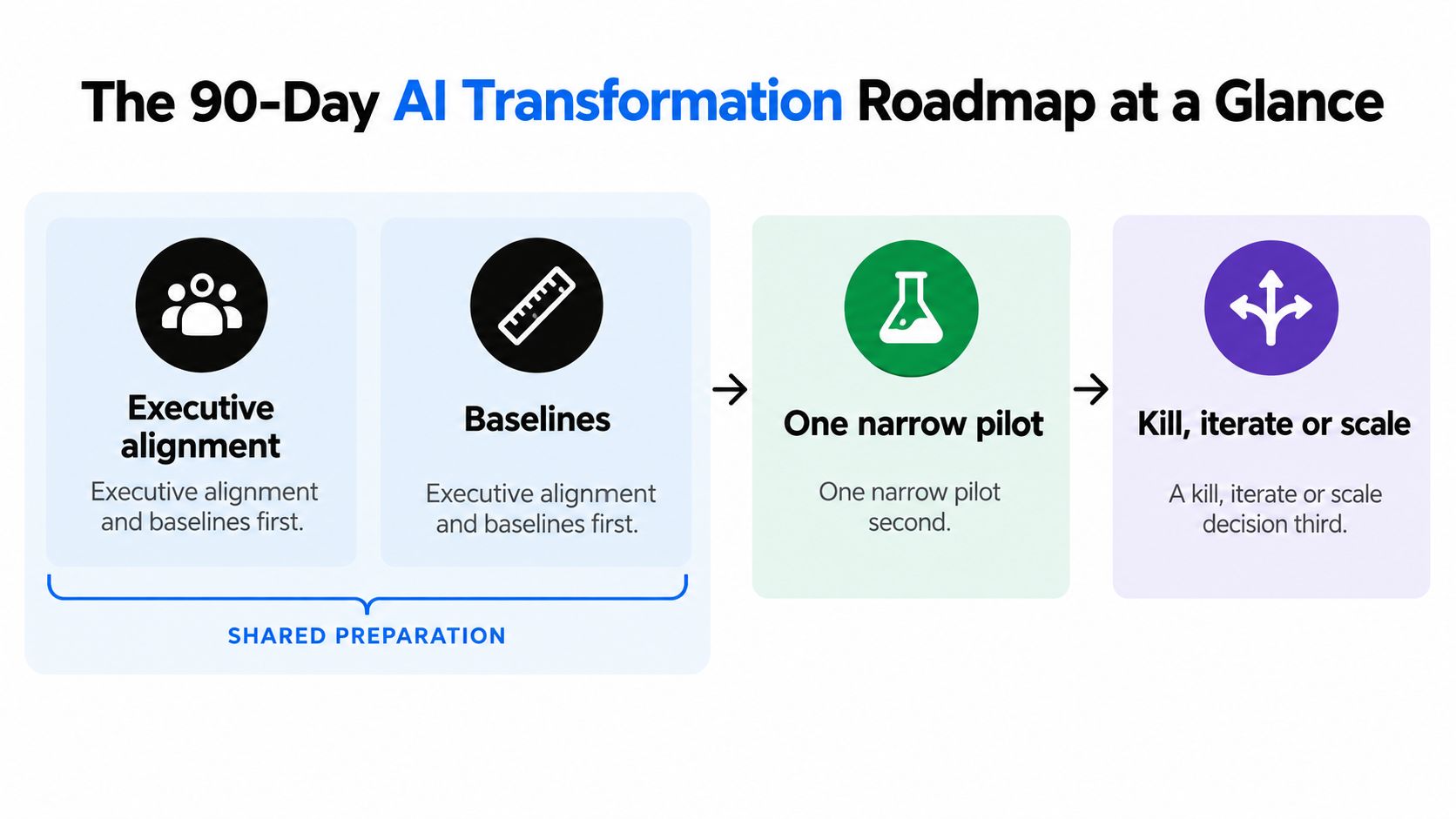
The first year has four bands, and you don't skip ahead. Executive alignment and baselines come first, one narrow pilot second, a kill, iterate, or scale decision third, and expansion only after that written decision.
| Phase | What happens | Owner | Exit gate |
|---|---|---|---|
| Days 0-30: Align and baseline | Executive sign-off on scope, red lines, and success metrics; inventory of 15-25 candidate workflows; baseline metrics captured | CEO or COO as sponsor, process owners | Signed scope and baseline dataset |
| Days 31-60: Pilot one workflow | One agent live in a time-boxed pilot against the pre-AI baseline, with human approval on every external action | Business owner and technical lead | Pilot meets agreed cycle-time and quality thresholds |
| Days 61-90: Decide | Steering group reviews reliability, access controls, observability, and exception handling; written scale, iterate, or kill decision | Steering group | Written decision recorded by day 90 |
| Months 4-12: Scale patterns | Proven patterns rolled to adjacent departments; quarterly portfolio review | COO and function leads | Two or more workflows in production with KPIs reported to finance |
What has to be true before the next band
Days 0-30. Executives agree where AI fits, what it must not touch, and how success will be judged. We run that alignment before any build. The team then inventories 15 to 25 candidate workflows and captures baseline metrics. You don't leave this band with a slide. You leave with a signed scope and a baseline dataset.
Days 31-60. One agent goes live on one workflow. A person approves every external action. Cycle time and quality are measured against the pre-AI baseline, not against how often someone opened the tool.
Days 61-90. The steering group reviews reliability, access controls, observability, and exception handling, then records a written scale, iterate, or kill decision. The roadmap ends in that decision, not in a finished company-wide rollout.
Months 4-12. Proven patterns move to adjacent departments, with a quarterly portfolio review. Two or more workflows should be in production, and the KPIs should be the ones finance already accepts.
Practical rule: At day 90 you should be holding one live workflow, a signed baseline dataset, named business and technical owners for each agent, and a written decision on whether to scale.
Assign Roles and the Steering Group Before Day 30
Name every role before anyone writes a prompt. A build without owners becomes a demo that nobody retires.
The CEO or COO sponsors the roadmap and owns the final scale decision. In McKinsey's global survey on how organizations rewire for AI value, 28% of organizations report CEO oversight of AI governance and 17% report board oversight. That same research ties well-defined KPI tracking to bottom-line impact, and it finds a clearly defined adoption roadmap especially influential in larger organizations. It also finds that 47% of AI-using respondents reported at least one negative consequence from generative AI, with inaccuracy, cybersecurity, and intellectual-property exposure among the common risks. Oversight is not a courtesy invite.
Who acts in which band
A steering group of the sponsor, a finance partner, a security or compliance lead, and two function leads reviews each gate. Each workflow gets a process owner, who owns the business result and signs the baseline sheet, and a technical lead, who owns integration, access scope, and monitoring. Each agent also gets a frontline champion who sits in the daily pilot review and logs exceptions.
During days 0-30 the sponsor signs scope and red lines while process owners capture baselines. During days 31-60 the business owner approves outputs and the technical lead manages access. During days 61-90 the steering group records the scale, iterate, or kill decision. Finance approves KPI definitions and the net-value calculation. Legal and privacy map controls to local rules.
If the internal bench can't cover integration and evaluation, teams sometimes Hire Developers for the build while keeping the business owner inside the company. Name the people who will run each agent after launch. The workflows and the know-how should stay with them, not with a contractor who leaves on day 91.
Choose and Redesign the First Workflow in Each Function
Pick a first workflow that is high-volume and measurable, not the demo that looks best in a steering meeting. Most reported savings and revenue lifts are small, so the cut has to be large enough to matter against the full cost of that workflow.
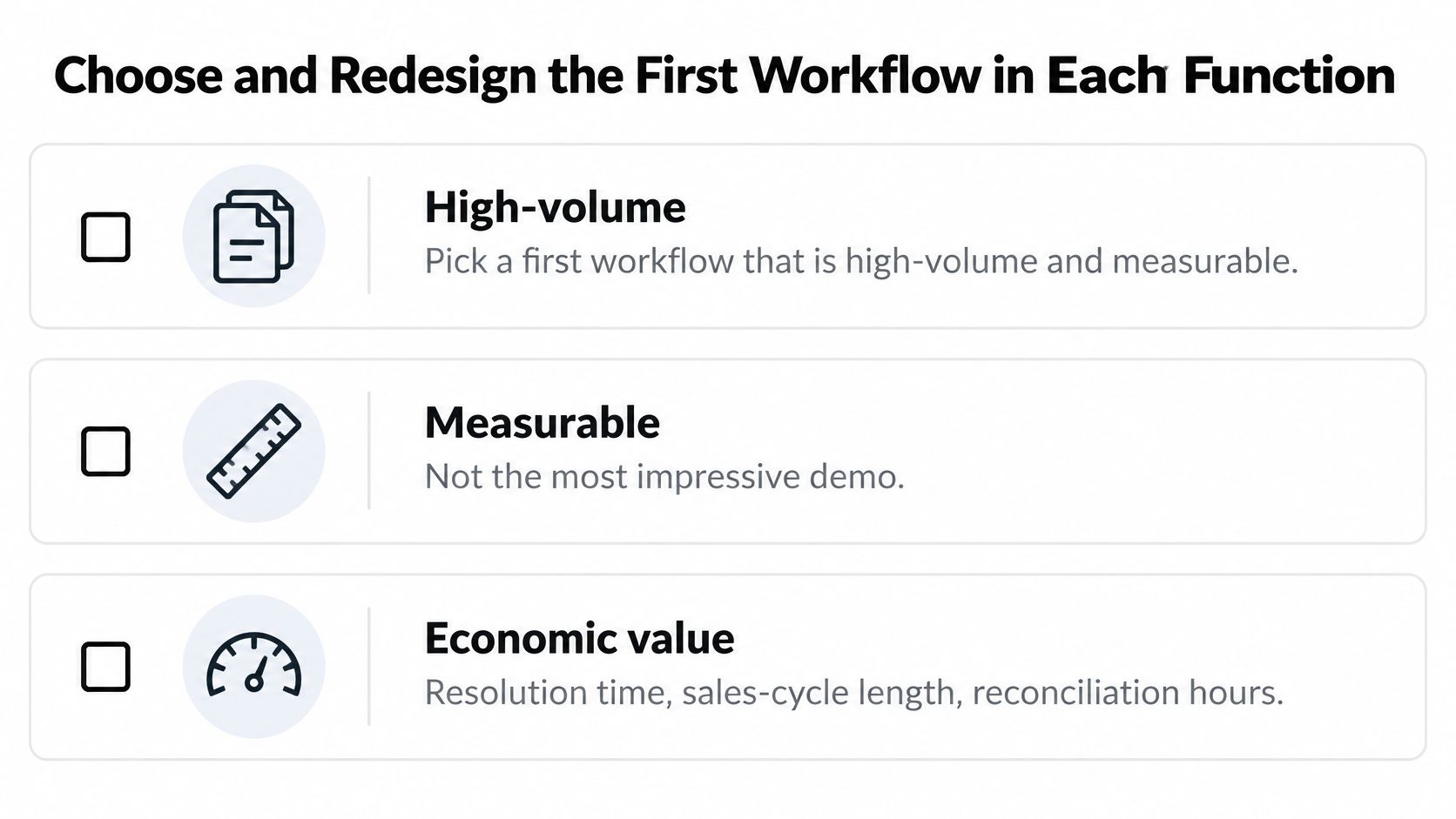
Score every candidate on five points before you shortlist.
- Economic value: Resolution time, sales-cycle length, reconciliation hours, or recruiting throughput.
- Volume: Several hundred repetitions a month, so a time-boxed pilot has a readable sample.
- Data readiness: Inputs live in one system of record, not in five inboxes.
- Risk tier: The cost of the worst wrong output, in money, customer commitment, or regulated data.
- Owner availability: A named person who will review outputs every week.
A 40-person support team handling about 1,800 tickets a month, where order-status and password questions are roughly a third of volume, scores well. A quarterly board-deck workflow does not. Low volume hides both the win and the failure.
Redesign before you connect tools
Document the current process first. List systems, handoffs, exception paths, and human approvals. Then redesign around what the agent can do. Adding a chatbot beside the old queue is how pilots produce activity without changing capacity. A clear method to design a workflow forces that sequence: select, document, redesign, set baseline and target metrics, assign owners, then run a controlled production phase.
We train leaders and teams, then build those workflows with them on their real work. You keep the workflows, the know-how, and the people who can run them.
| Function | First workflow | Systems connected | Human approval point |
|---|---|---|---|
| Operations | Invoice and transaction reconciliation | Accounting ledger, bank feed, email | Any ledger adjustment above a set amount |
| Sales | Prospect research and outreach drafts | CRM, enrichment data, email | Every outbound email during the first 60 days |
| Support | Tier-1 order status and policy questions | Helpdesk, order system, knowledge base | Refunds, exceptions, account ownership changes |
| Marketing | Brand-consistent content drafts and competitor monitoring | CMS, ad platform, analytics, brand guide | Publishing and any change to paid spend |
Operations starts with ledger and bank-feed reconciliation. Sales starts with research and drafts, not unsupervised sending. Support starts with tier-1 order and policy questions and routes refunds to people. Marketing starts with drafts and competitor monitoring, and a person still publishes and changes paid spend.
Every agent ships with a workflow specification, a tool-permission matrix, an evaluation set drawn from real cases, an escalation policy, audit logs, and a KPI dashboard tied to an operating outcome. Finish this step with a shortlist of two or three workflows. Pilot one.
Set Baselines and KPIs Finance Will Accept
Adoption and ROI often sit in different rooms. McKinsey's 2025 state of AI research finds that 41% of organizations struggle to define and measure the impact of generative AI initiatives, and only 16% regularly report AI-created value to the CFO. Almost all organizations see some measurable ROI, yet only about 20% report returns of 31% or more. Broad productivity claims can hide modest enterprise economics.
The measurement sequence is fixed. Capture a baseline before any build, log every run, deploy narrowly, audit outcomes, and scale only when the business case survives real exceptions.
| Metric family | Example metric | How to baseline it | Finance line |
|---|---|---|---|
| Cycle time | Hours from ticket open to resolution; days from first contact to signed deal | Pull four to six weeks of pre-AI timestamps from the system of record | Labor capacity freed, throughput |
| Error and rework | Reconciliation mismatches per 1,000 transactions | Sample four to six weeks of closed periods and count mismatches | Rework cost, write-offs |
| Conversion and revenue | Lead-to-meeting rate; win rate on accounts touched by outreach | Holdout group of comparable reps or segments | Revenue per employee, pipeline value |
| Capacity | Tickets or hours handled per FTE | Time-tracking sample of the current team | Avoided hiring |
| Human validation burden | Share of agent outputs edited or escalated | Log reviewer edits from pilot week one | Net time saved after review |
| Cost to serve | Fully loaded cost per resolved contact or per invoice | Current labor and vendor invoices | Margin, avoided vendor spend |
Three rules that keep the case honest
Separate gross time saved from realized value. Net out reviewer time, exception handling, integration maintenance, training, and governance overhead. Hours the model "saved" that a person spent fixing are not margin.
Pick two or three KPIs per workflow. A dashboard of twelve numbers gets ignored. Tie the pair to operating terms finance already uses: margin, throughput, revenue per employee, cost per resolved contact, or avoided vendor spend. A practical set of operational efficiency metrics beats model-quality scores and login counts.
Build a one-page baseline sheet for each candidate. Record the current value of every KPI and the person who will sign it. If that signature is missing, the pilot isn't ready.
Permission Tiers and Governance for AI Agents
Autonomy is not the destination. Treating it as one is why agents stall at the legal review or, worse, act before anyone can explain the action.
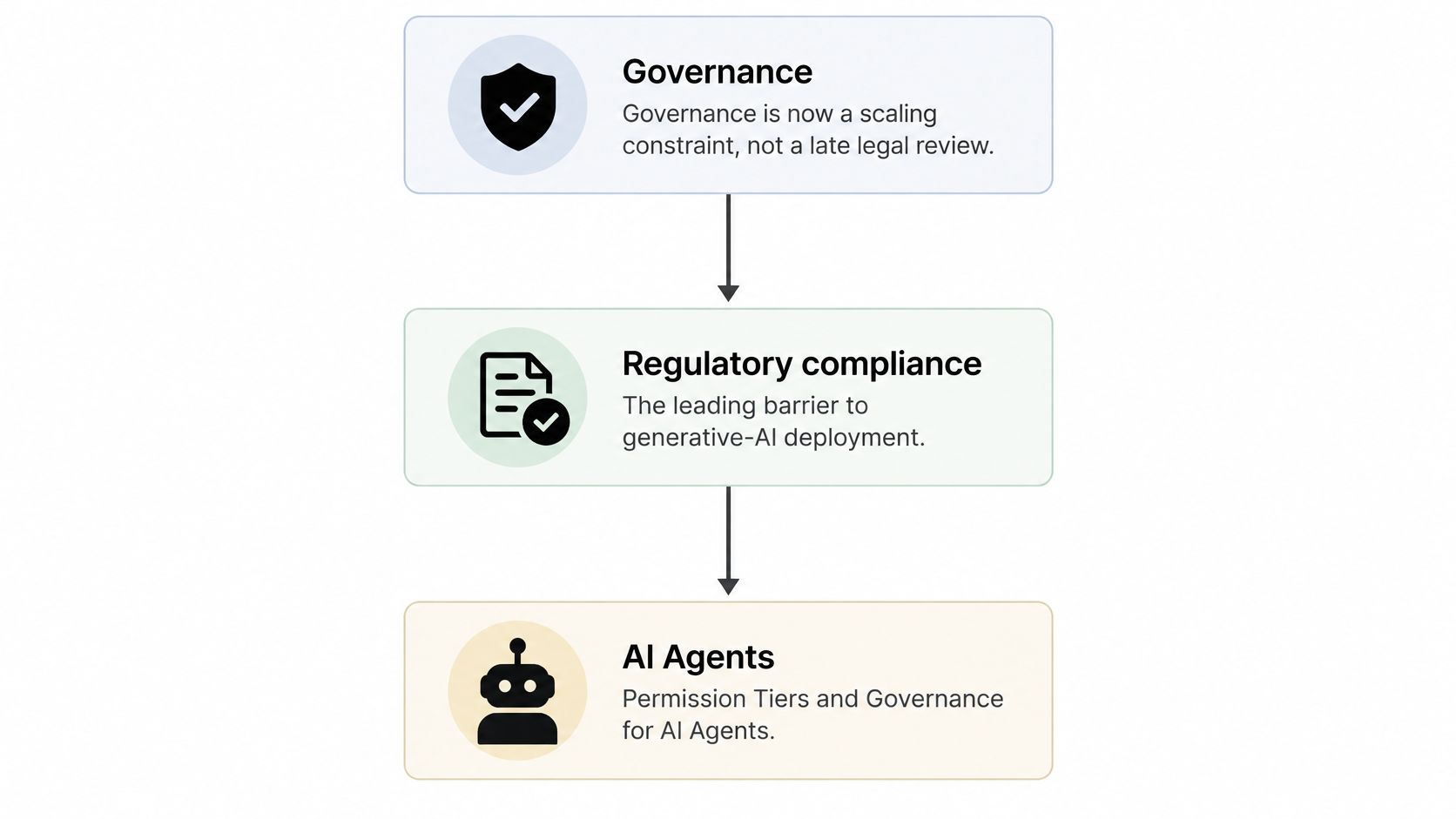
Governance is a frontline scaling constraint. In the State of AI findings on agentic systems and deployment barriers, regulatory compliance became the leading barrier to generative AI deployment at 38%, up from 28%, while 35% cited mistakes with real-world consequences as a major concern. At the same time, 23% of surveyed organizations report scaling an agentic system somewhere in the enterprise, and another 39% are experimenting. 55% have avoided some use cases because of data problems. The useful question is what authority each agent may exercise, under which evidence, and with which escalation rule.
| Tier | Example actions | Approval rule | Required controls |
|---|---|---|---|
| Tier 1: Observe and draft | Summarize tickets, draft replies, score leads | No approval; reviewers check a sample | Output logs, source links |
| Tier 2: Reversible actions | Update CRM fields, tag tickets, prepare invoices | Approval above a set threshold; daily review | Immutable audit log, rollback procedure |
| Tier 3: High-impact actions | Send customer commitments, issue refunds, move money, change hiring stages | Human approval on every action; dual sign-off above a set amount | Named approver, failure simulations, access review |
| Regulated data access | Personal, health, or financial records | Approval plus access scoped to each task | Data-residency mapping, periodic access review |
What bounded authority needs before go-live
Every tier needs a named owner, an immutable activity log, source traceability, approval thresholds, a rollback procedure, failure simulations before go-live, and periodic access reviews. Global companies map those controls to local privacy, employment, sector, and AI rules. One universal policy will not survive the first cross-border workflow.
Bounded autonomy often scales faster than open-ended access. Approvals become repeatable, and risk stays visible. A workable AI agent governance framework puts those rules in the operating design, not in a memo after launch. Teams that want an outside look at agent and model exposure can use LLM security assessments for MSSPs before write access expands.
No agent gets write access to a ledger, CRM, or payroll system until its Tier 1 outputs have passed a review sample for at least two weeks.
Our implementation work follows that boundary. We map where AI is worth using, build the agent, connect it to the CRM, accounting, project tools, email, and documents, train the team, and keep it in production inside scoped permissions, with a person approving the actions that matter most.
Stop Pilots From Stalling and Fix the Cause Early
A pilot can generate activity without changing how work gets done. The fix is to treat it as a value test: establish a baseline, redesign the workflow, and define what evidence will justify scaling.

McKinsey's 2025 workplace assessment reports four stages: 8% of organizations are nascent, 39% are emerging with pilots, 31% are changing selected workflows, and 22% are expanding across departments. These categories do not identify a separate mature share, so they should not be read as showing that 1% have reached maturity. The practical lesson is to judge progress by changes in work and business results, not by pilot counts or tool usage.
| Pitfall | Warning sign | Fix |
|---|---|---|
| Pilot beside an unchanged process | Agent output exists, but the team's queue has not changed | Redesign the handoff before launch and retire the old step |
| Measuring activity, not outcomes | Dashboard tracks prompts and logins | Compare cycle time and cost to serve against the baseline |
| Skipping frontline training | Staff bypass the agent or keep a shadow spreadsheet | Train on real tickets and name a workflow champion |
| Broad system access from day one | Agent holds admin rights in the CRM or ledger | Scope permissions to the task and begin with limited authority |
| Governance added after launch | Legal review arrives in week 10 | Set the owner and approval rules before the pilot |
| Pilot with no end date | Pilot continues past day 60 without a written decision | Set a 30-to-60-day decision point to kill, iterate, or scale |
| Gains reported as hours saved | Finance rejects the business case | Subtract review time, exceptions, and maintenance from claimed savings |
Use a stage gate to keep the pilot tied to value. Choose a workflow based on value, feasibility, data readiness, and risk. Test it against the baseline, then require evidence on reliability, security, exception handling, and adoption. Set finance-accepted thresholds for cost, quality, cycle time, and business value before launch. Scale only when results meet them, and keep checking whether the model, prompts, tools, and process still perform as intended.
Put the decision date on the calendar before launch. Include a frontline champion in daily reviews, and test bad inputs in week four. Those checks surface weak handoffs and failure cases while the pilot is still small.
Review each pilot every 30 to 60 days and record a formal kill, iterate, or scale decision by day 90. Adoption and workflow performance belong in the release decision, not just a follow-up survey. A short walkthrough of pilot failure patterns can help teams spot these issues early:

Run the Go or No-Go Check Before Pilot
Run this check in one meeting before any build starts. It is a gate, not a workshop.
- Scope and red lines. Executives have agreed where AI fits and what it must not touch.
- Baseline sheet. Each candidate lists its KPIs, current values, and the finance line each one feeds.
- Named owners. Every agent has a business owner and a technical owner.
- Permission map. Each planned action sits on a tier, with its approver named.
- Decision date. The day-90 scale, iterate, or kill review is already on the calendar.
If two or more items are missing, the roadmap isn't ready to pilot. Close the gaps first. A second workflow will not fix a missing baseline.
The first concrete step is to schedule the day-0 alignment meeting this week and send the baseline sheet template to each process owner. Copy the phase table and that sheet into your planning tool and use them as the working template. For teams whose customer-facing stack is the constraint, an outside pass such as AI readiness for enterprise web platforms can show whether the site and data layer can support the workflow you scored. It doesn't replace the five items above.
The day-30 baseline and the Tier 1 review happen whether you run this in-house or with a partner. Who delivers is separate from the checklist. We plan, build, and run agents inside the systems you already use, and we train your people to use them. The sequence we use is short: book a call, build one live workflow with your team on your stack, train and roll out, and your team owns what was built.
If you want that first workflow scoped against your real stack, we offer a free 30-minute strategy call that maps the highest-ROI opportunities and outlines a custom roadmap, with no commitment required. Bring one high-volume process and the baseline you can already pull. Visit Cyndra and book the call.