 CYNDRA
A customer calls during the busiest hour of the day. They explain the problem clearly, but the IVR offers no matching option, so they press the number that seems closest. The call lands with a generalist, who transfers it to billing. Billing sends it to technical support. By the time the right team answers, the customer has repeated the same story several times, and your operation has paid for every minute of that friction.
That failure isn't a queue problem. It's a decision problem. The system hasn't understood why the caller is contacting you, what context matters, or which person can resolve the issue with the fewest handoffs.
Table of Contents
- Introduction to AI Call Routing and Why It Matters Now
- How AI Call Routing Actually Works
- AI Routing Versus Traditional Rule Based Routing
- Core ML and NLP Techniques Behind Intelligent Routing
- Integrating AI Routing With Contact Centers and CRMs
- Benefits Limitations and How to Measure Real Impact
- Choosing and Implementing the Right AI Routing Approach
Introduction to AI Call Routing and Why It Matters Now
AI call routing uses speech, language understanding, customer context, and operational data to match a caller with the most appropriate resource in real time. That resource might be a specialist, a priority queue, an AI agent, or a human supported by an agent-assist workflow. Traditional routing usually assigns a call according to keypad selections, caller number, business hours, or a fixed queue. AI routing tries to understand the request itself.
The distinction matters during peak demand. A caller saying, “My replacement card still hasn't arrived, and I'm leaving tomorrow,” may need a combination of identity verification, card-status access, urgency handling, and travel-related guidance. A static menu hears a category. An intelligent system can identify the intent, entities, urgency, and required capability before choosing where the conversation should go.
Adoption has moved well beyond experimentation in large contact centers. A 2025 survey summary on AI support routing reports that 54% of large contact centers with 1,000 or more seats had deployed AI-powered ticket triage and intelligent routing, compared with 31% in 2023. The same source reports that AI-assisted routing can reduce average handle time by 18% to 26% versus static queue assignment. Those results point to a practical conclusion: routing quality affects both customer time and operating cost.
The important question isn't “Can AI route calls faster?” It's “Can AI help the right resource resolve the issue?”
That question changes how operations leaders evaluate the technology. A faster transfer can still be a poor outcome if the receiving agent lacks authority, context, or the tools needed to finish the job. AI call routing belongs inside a broader contact-center design, alongside telephony, CRM data, workforce management, agent assist, and resolution workflows. Enterprise teams exploring that broader model can review enterprise call center solutions as part of their planning.
The rest of this guide builds from the basic call path to the underlying language technologies, integrations, measurement model, and implementation choices. The central theme stays consistent: optimize for cost per resolved issue, not speed in isolation.
How AI Call Routing Actually Works
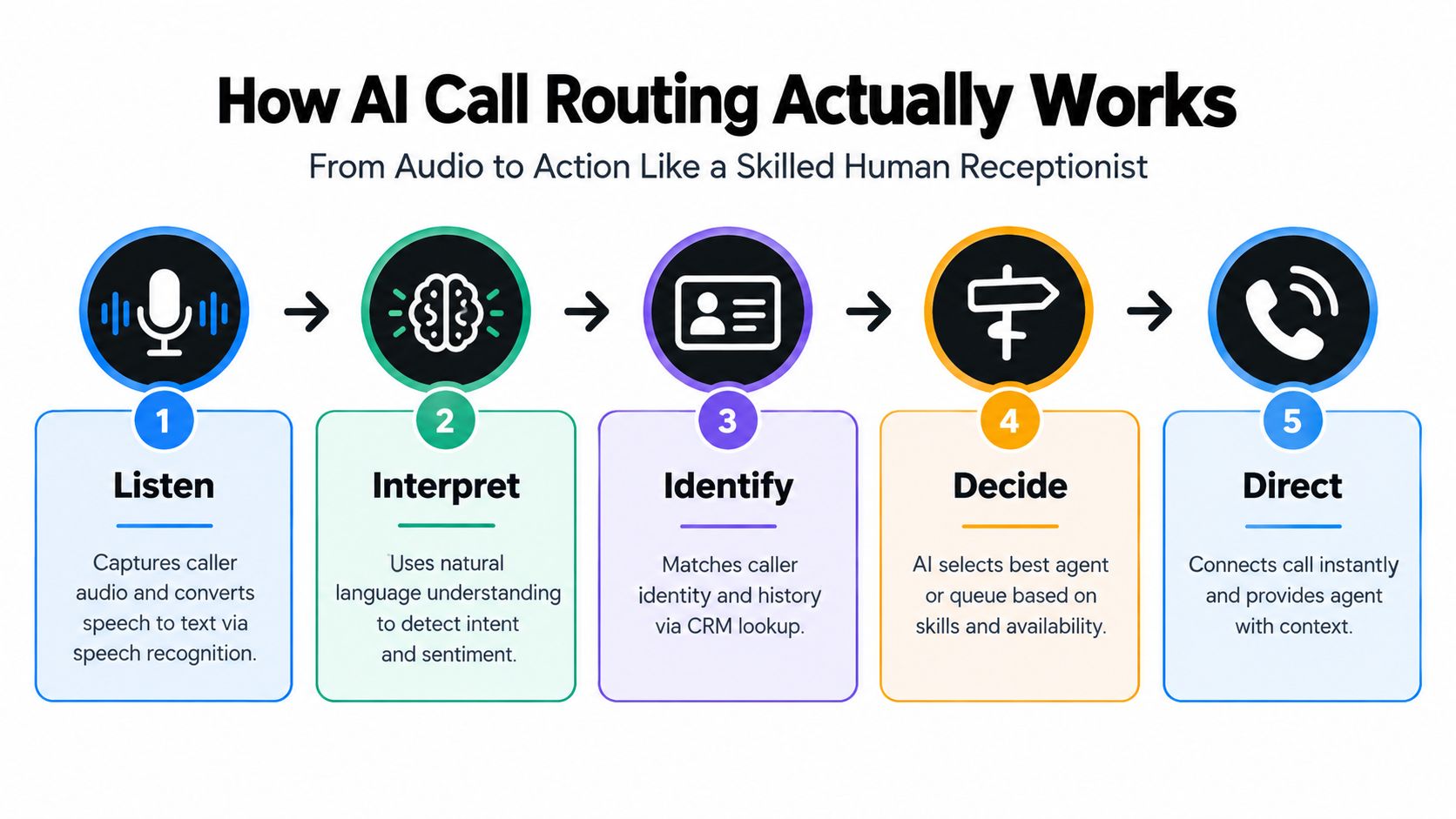
A useful mental model is a skilled receptionist. The receptionist listens to the caller, understands the request, checks relevant information, considers who is available, and connects the caller with someone who can help. AI routing performs the same sequence through connected software services.
From spoken audio to caller intent
The pipeline usually follows these stages:
- Listen. Automatic speech recognition, or ASR, converts the caller's audio into text. The system should process the stream while the caller is speaking rather than waiting for a complete recording.
- Interpret. Natural language understanding examines meaning, not just individual words. “I was charged twice” and “my payment failed” contain different service intents even though both mention payment.
- Identify. A CRM lookup can connect the conversation with an account, product, language preference, previous contact, or open case. Identity information should be handled according to the organization's privacy and authentication requirements.
- Decide. The routing engine compares the detected intent with agent skills, queue status, availability, priority rules, and escalation conditions.
- Direct. The system connects the caller and passes context forward, such as a short intent summary, detected entities, authentication state, and relevant case information.
Consider a caller who says, “The installation team missed the appointment, and I need someone to confirm the new date.” ASR produces text. Intent classification recognizes a missed installation appointment. Entity extraction identifies the appointment or order reference. The CRM supplies the account record. Routing then favors a scheduling or field-service specialist instead of a general support queue.
Why streaming and confidence matter
Voice systems have a narrow latency budget because each processing stage adds audible delay. Guidance on contact-center voice pipelines places ASR at roughly 200 to 300 milliseconds, natural language understanding at 50 to 150 milliseconds, routing logic at 10 to 50 milliseconds, and network overhead at 50 to 100 milliseconds, producing a practical end-to-end target of about 310 to 600 milliseconds and a hard ceiling below roughly 700 milliseconds to avoid noticeable pauses, as described in independent guidance on detecting caller intent.
A production system therefore uses partial ASR hypotheses and acts when intent confidence is sufficient. It doesn't need to wait for a perfectly complete transcript before preparing a route. If confidence is low, the system can ask a clarifying question, retain a safe default queue, or transfer with a warning rather than pretending certainty.
The final piece is the feedback loop. Resolution outcomes, transfers, escalations, repeat contacts, and agent corrections can show whether the initial decision was useful. The system shouldn't treat every transfer as success. A transfer that ends in another transfer is evidence that the routing policy, intent taxonomy, or integration needs attention.
The durable mental model is simple: AI call routing listens, interprets, enriches, decides, and directs. Resolution data then tests whether that decision worked.
AI Routing Versus Traditional Rule Based Routing
A caller with a simple request can move through a fixed menu quickly. A caller who says, “I was charged after cancelling, and I need the refund before the renewal,” presents a harder decision. Traditional routing may match one menu choice or send the call to a broad queue. AI call routing can interpret the combined request and select a destination using intent and context.
Traditional rule-based routing follows explicit instructions. If the caller presses a key, the platform sends the call to a defined queue. If the account belongs to a certain tier, the system applies a priority rule. These rules are predictable, auditable, and often easy to launch.
AI routing makes a richer decision from spoken language and available context. It can handle requests that do not fit neatly into a menu, distinguish similar intents, and consider caller history with current operating conditions. That flexibility requires testing confidence, defining fallback behavior, and monitoring wrong decisions.
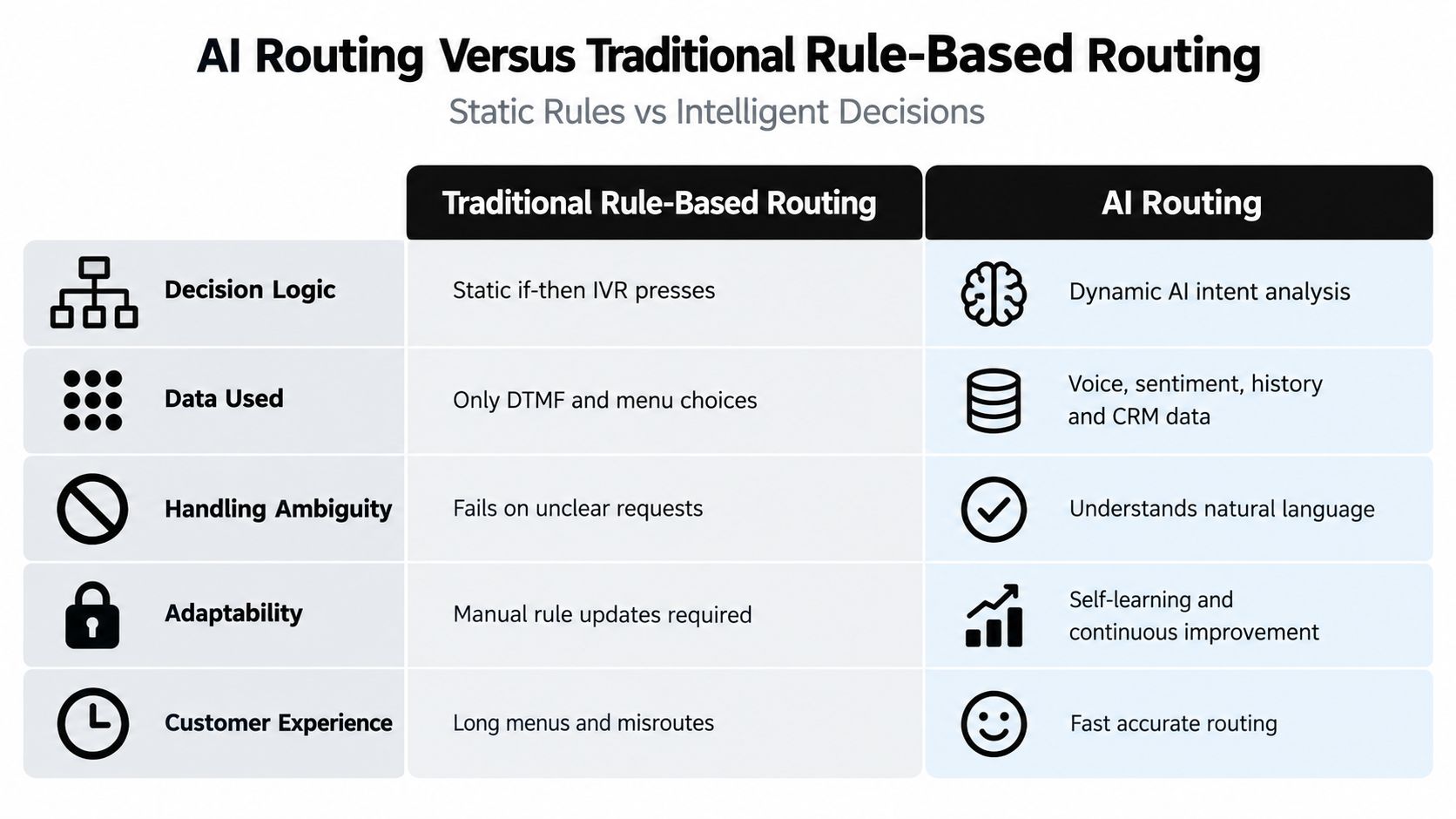
Rule Based vs AI Call Routing Comparison
| Capability | Rule Based Routing | AI Call Routing |
|---|---|---|
| Decision logic | Fixed if-then paths and keypad choices | Intent, context, skills, availability, and policy |
| Data used | Menu selections, phone number, schedule, and queue rules | Voice, language, CRM context, conversation signals, and operational data |
| Ambiguous requests | Often sends the caller to a broad default queue | Can ask for clarification or select a route from inferred intent |
| Maintenance | Teams update rules and menu trees manually | Teams maintain taxonomies, thresholds, integrations, and evaluation data |
| Failure mode | Predictable but potentially rigid misroutes | More adaptable, but confidence and data quality can create hidden errors |
| Scaling complexity | More branches can make menus difficult to manage | Broader intent coverage can reduce menu friction, but requires governance |
Rule-based design remains appropriate when call paths are simple, categories are stable, and auditability matters more than interpretation. Regulated workflows may require explicit routing conditions. A small operation with a narrow service catalog may gain little from adding language models to an effective menu.
AI has a clearer advantage when callers describe needs in their own words, products have overlapping support boundaries, or the right destination depends on case history. Speech-driven research reported 78% first-decision accuracy for a speech system versus 70% to 75% for a well-designed touch-tone system. It also reported average routing time falling from 35.9 seconds to 16.5 seconds, more than a 50% reduction, in measured research on speech-driven call routing.
Speed alone does not prove better routing. A fast transfer to the wrong team can create another transfer, repeat contact, or escalation. Operations leaders should compare cost per resolution across both human and AI workflows, including transfers and follow-up work, rather than measuring only time to queue.
The strongest design combines both approaches. AI interprets the request, while deterministic rules enforce authentication, legal restrictions, priority policies, business hours, and safe fallback paths.
Use AI for interpretation and rules for control.
Core ML and NLP Techniques Behind Intelligent Routing
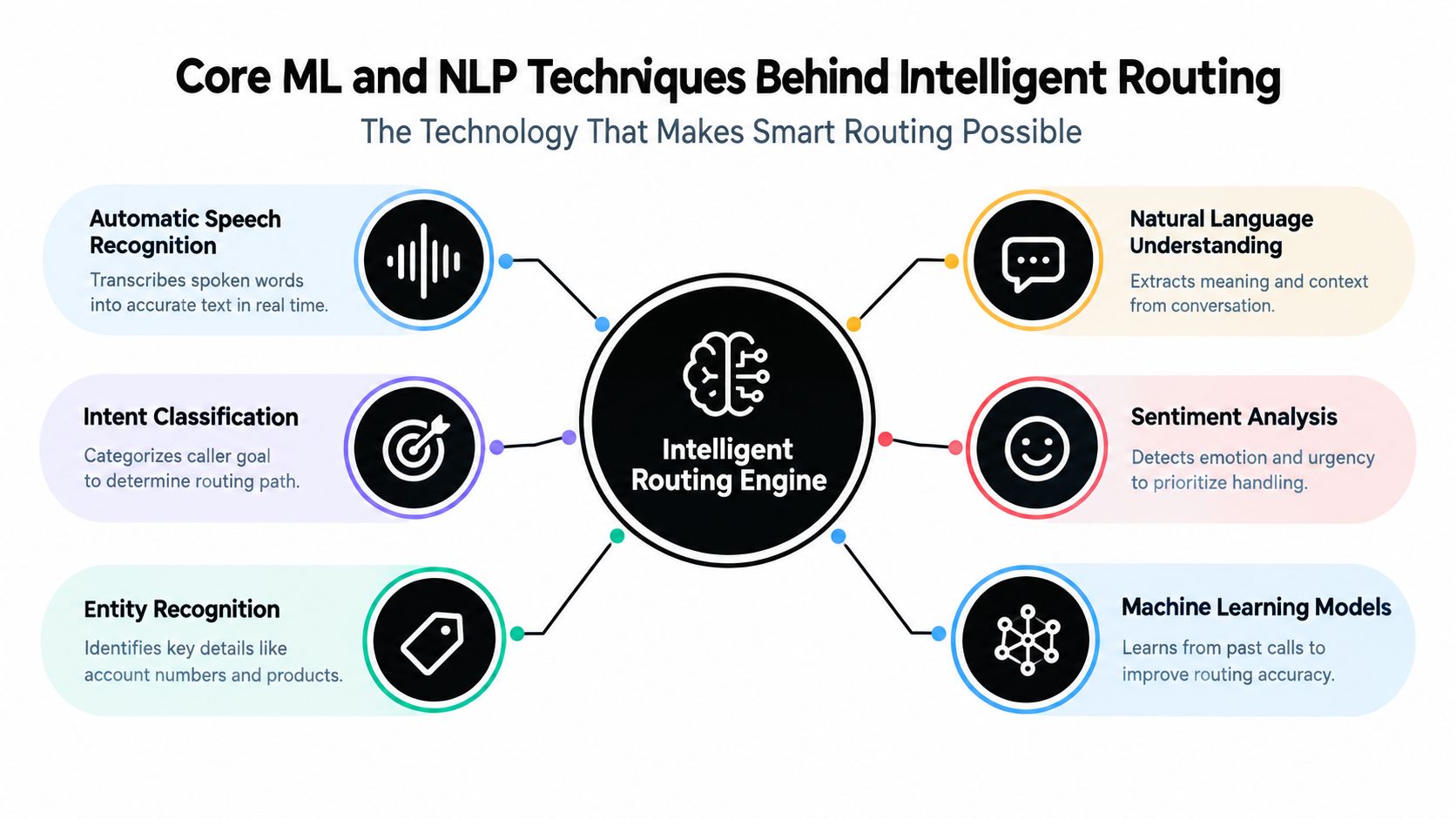
AI call routing sounds like one capability, but several technologies contribute to the final decision. Operations leaders don't need to train models themselves, yet they do need to know which layer is responsible when routing fails.
What each layer contributes
Automatic speech recognition turns audio into text. Accuracy depends on accents, background noise, domain vocabulary, speaking speed, and call quality. A routing system may not need a perfect transcript, but it does need reliable recognition of the words that distinguish intents, such as “refund,” “renewal,” “fraud,” or “installation.”
Natural language understanding extracts meaning and relationships. It helps the system recognize that “I can't log in after changing phones” concerns account access, even if the caller never uses the phrase “password reset.”
Intent classification assigns the conversation to a defined goal. Good taxonomies use operationally meaningful categories, such as “cancel subscription,” “check delivery status,” or “report suspected fraud,” rather than broad labels that map to several different teams.
Entity recognition captures details that refine the route. Entities can include an order identifier, product name, location, policy type, or appointment date. The entity may determine which system to query or which specialist can act.
Sentiment and urgency detection provide additional signals. A frustrated caller with a service outage may need a different treatment from a calm caller requesting general information, but sentiment shouldn't override hard safety, authentication, or fairness policies without clear governance.
Predictive routing models use historical outcomes and live conditions to select among qualified destinations. Their value depends on what the organization defines as success. If the model optimizes only for short queues, it may send complex cases to fast responders who lack the authority to resolve them.
Confidence is a control mechanism
Each interpretation should carry a confidence signal. High confidence may permit direct routing. Medium confidence may trigger a clarifying question. Low confidence should preserve a human fallback and pass the uncertainty to the receiving agent.
Training transcripts and live outcome data serve different purposes. Transcripts teach the system how callers express known intents. Resolution outcomes reveal whether the chosen destination solved the issue. Teams building or evaluating training material can examine AI training datasets for the data-quality principles that support reliable model behavior.
Ask vendors how they handle new intents, overlapping categories, multilingual speech, transcript corrections, confidence thresholds, and outcome labeling. Also ask whether their system can separate a caller's initial intent from the issue that ultimately required escalation. That distinction helps prevent the model from learning that every difficult call belongs in a generic queue.
Integrating AI Routing With Contact Centers and CRMs
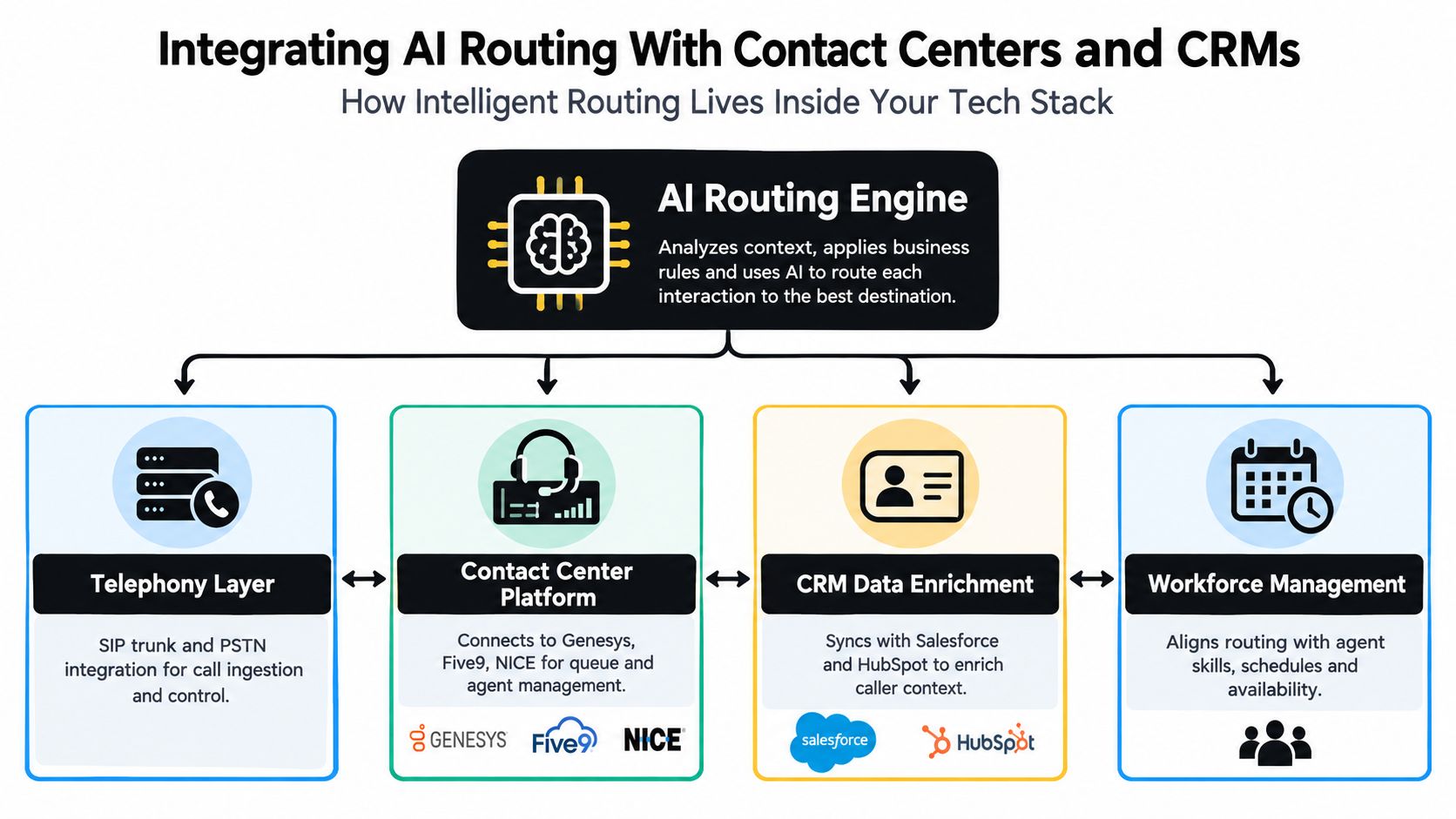
An AI routing engine can't improve resolution if it operates beside the systems that agents use. The useful path runs from telephony to interpretation, from interpretation to business context, and from context to a controlled handoff.
The connected call path
At the telephony layer, SIP and PSTN integrations provide call ingestion, transfer control, recording policies, and caller metadata. The contact-center platform manages queues, agent states, skills, schedules, and interaction records. Products such as Genesys, Five9, and NICE may expose native interfaces or APIs for these functions, though each deployment needs its own validation.
The CRM adds the context that a voice model can't infer reliably from audio. A lookup may reveal an open case, service tier, product ownership, previous transfers, or an account-specific restriction. The routing decision can then consider not only what the caller says, but what the organization already knows.
Workforce management completes the operational picture. A route is useful only if the selected team has the required skill and a realistic ability to respond. Routing can align with schedules, skills, availability, language capability, and workload rather than treating every available agent as interchangeable.
Streaming beats waiting for a finished transcript
Streaming architectures process partial audio and update the decision as evidence accumulates. Batch-style designs wait for a completed utterance or recording before taking action, which can make the caller experience feel slow. Heavy inference placed directly in the live path can create the same problem even when the rest of the architecture is sound.
The handoff should include more than a destination. Pass a concise intent summary, relevant entities, authentication status, customer context, and the reason for escalation. The agent should be able to begin with the case, not ask, “How can I help?” after the caller has already explained it.
Integration questions to answer early
- Telephony control: Can the system transfer, conference, record, and recover gracefully when a downstream service is unavailable?
- CRM synchronization: Does it read current data and write back outcomes without creating duplicate or stale records?
- Context preservation: Does the human agent receive the transcript, summary, detected intent, and unresolved questions?
- Fallback behavior: Can deterministic rules take over when confidence drops, integrations fail, or the caller requests a person?
- Operational ownership: Who monitors model quality, updates intents, reviews misroutes, and approves policy changes?
Legacy platforms don't automatically disqualify a project. They do make interface design and data contracts more important. Teams assessing that work can use legacy system integration guidance to identify where middleware, APIs, or staged migration may be needed.
Benefits Limitations and How to Measure Real Impact
A caller with a billing problem reaches a technical queue. The transfer is quick, yet the issue still needs another handoff. AI call routing creates value only when it improves the path to resolution, not when it merely shortens the first connection. Its strongest use is better allocation of resolution capability: the caller reaches someone who can act, the agent receives useful context, and the organization avoids preventable transfers.
Natural-language routing can classify topics with useful accuracy and reduce misroutes, but those results do not guarantee the same outcome in every contact center. Local accents, background noise, incomplete taxonomies, and unfamiliar phrasing can change performance. Measure the model against the calls, teams, and systems it serves.
Pair every benefit with its condition
- Lower handle time: Correct routing and useful context must come first. A short initial transfer followed by another transfer is not a real efficiency gain.
- Better service-level performance: Dynamic decisions can distribute demand, while poor forecasts or outdated skills data can still create queues.
- Higher first-contact resolution: Routing helps only when the receiving team has the authority, knowledge, and system access to finish the work.
- Fewer misroutes: Intent classification can handle varied language, but uncertain calls need clear fallback rules and a path to a human.
- Improved agent utilization: Matching skills to demand can reduce idle capacity, while aggressive optimization can overload specialists with complex cases.
The measurement model starts with a baseline of the current customer journey. Track the initial route, transfer count, time to a qualified resource, escalation rate, first-contact resolution, repeat contact, customer effort, and total handling cost. Compare the same measures for similar issue categories after rollout. A tracking window of 60 to 90 days can support operational review, although the appropriate duration depends on volume, seasonality, and how quickly reliable outcome labels become available.
Measure resolution, not only velocity
A practical cost-per-resolution calculation includes AI processing, telephony, platform fees, human handling time, transfers, escalations, repeat contacts, and remediation for incorrect decisions. Divide that total by issues resolved, not calls answered. The calculation should cover both automated and human work, because an AI step that creates extra agent effort can raise the true cost.
One 2026 industry analysis places routing within a broader resolution stack that includes conversation intelligence, agent assist, workflow orchestration, forecasting, and summary generation. It recommends validating cost per resolution before assuming automation costs less than human handling, since integration can become the bottleneck. The analysis cites a benchmark in which 88% of organizations deployed AI but only a quarter operationalized it into daily workflows, as reported in analysis of AI call-routing infrastructure.
A faster route that increases escalations is a worse operating decision. A slightly slower route that resolves the issue without another contact may deliver the better result.
Choosing and Implementing the Right AI Routing Approach
Start with the problem, not the vendor category. A point solution may fit a focused routing gap in an existing contact-center platform. Platform-native AI can reduce integration work when telephony, queues, CRM connectors, and agent workspaces already belong to one ecosystem. A full-stack approach makes more sense when the organization wants routing, autonomous resolution, agent assist, workflow orchestration, and analytics designed as one operating layer.
Use these selection questions:
- Call complexity: Do callers use varied natural language, or do a few stable categories cover most demand?
- System maturity: Can your telephony, CRM, and workforce tools expose reliable real-time data?
- Operational capacity: Who will own taxonomy design, model review, policy controls, and agent adoption?
- Resolution boundary: Which requests should AI resolve, which should it route, and which must go directly to a human?
- Failure tolerance: What happens when speech recognition is uncertain, the CRM is unavailable, or no skilled agent is free?
A controlled rollout usually starts with one high-volume or high-friction intent family. Prepare representative recordings and transcripts, define the taxonomy with frontline agents, establish confidence thresholds, and create explicit fallback rules. Test latency under realistic network and integration conditions, not only in a demonstration environment.
Give agents a clear handoff view. They should see why the caller was routed, what the system understood, which data it retrieved, and what remains unresolved. Train supervisors to review false positives, false negatives, unnecessary transfers, and successful resolutions separately.
Before approval, ask for evidence of:
- Intent evaluation: How does the vendor test overlapping and newly emerging intents?
- Latency behavior: What happens when the system must query a CRM or workforce platform during a live call?
- Human escalation: Can the caller reach a person without restarting the interaction?
- Outcome tracking: Can reporting distinguish answer speed from resolved-issue quality?
- Governance: Can managers audit decisions, change rules, protect sensitive data, and roll back a model or policy?
Cyndra offers AI transformation services that can help define escalation rules, build decision trees, integrate workflows, and move AI employees into production across support and operations. Visit Cyndra to discuss an AI call-routing workflow designed around your existing tools and resolution goals.