 CYNDRA
The global median time-to-hire is 38 days, but AI-assisted recruiting workflows can compress the first-contact-to-offer cycle to 28 days. That gap demonstrates why end-to-end automation creates more value than a collection of disconnected tools.
Recruiting process automation isn't about adding an AI screen to an otherwise manual funnel. It's about removing queue latency from sourcing, screening, scheduling, feedback, decisions, and handoffs while preserving the judgment and controls that make hiring defensible.
A fast funnel with weak standards creates expensive mistakes. A compliant funnel that takes too long loses strong candidates. The operating challenge is to shorten elapsed time without creating quality debt, privacy exposure, or a system nobody trusts.
Table of Contents
- Why Recruiting Process Automation Matters Now
- Mapping Workflows for Maximum Impact
- Measuring ROI and Defining Success Metrics
- A Step-by-Step Implementation Roadmap
- Navigating Technical and Privacy Considerations
- Selecting the Right Automation Vendor or Solution
Why Recruiting Process Automation Matters Now
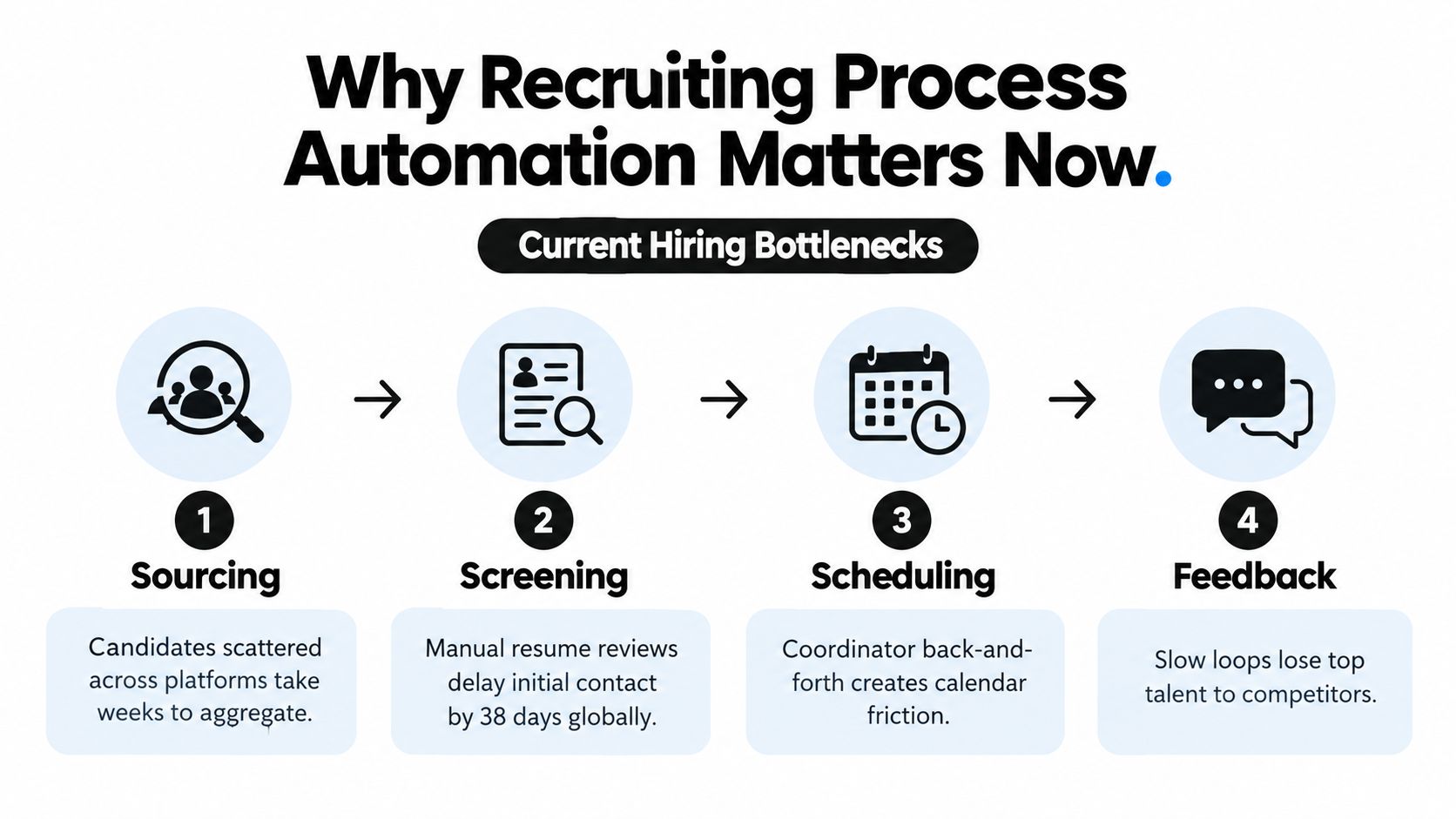
The 38-day global median time-to-hire gives operators a useful starting point, but it doesn't explain where those days accumulate. A recruiter may find a promising profile quickly, then wait for a hiring manager to confirm requirements. A candidate may clear screening, then spend days exchanging messages to find a suitable interview slot. After the interview, the team may wait again for feedback before anyone sends the next update.
Each handoff creates a queue. Automating only one task leaves the other queues untouched.
The bottleneck is elapsed time
Consider a common partial-automation setup. An applicant tracking system parses resumes, but a recruiter still reviews every recommendation manually. A scheduling platform offers calendar links, but interviewers don't keep their availability current. A scorecard exists, but interviewers submit feedback by email, leaving recruiting operations to consolidate it.
The business has purchased automation, yet candidates still move through a sequence of waiting rooms. The problem isn't the absence of software. It's the absence of connected workflow ownership.
Queue compression matters here. Resume parsing reduces the time required to organize information. Qualification scoring can establish a consistent first review. Calendar coordination removes back-and-forth. Automated feedback collection closes the loop while the interview is still fresh. When these steps connect, the candidate completes tasks faster without the need for simple manual effort. The entire journey contains fewer pauses.
Practical rule: Automate the handoffs that make people wait, not just the tasks that make recruiters work.
Industry benchmarks report that companies using AI in recruiting hire 26% faster than peers, while AI-assisted workflows reduce the first-contact-to-offer cycle from 41 days to 28 days. The same recruiting benchmarks report supports the operational case for applying automation across the funnel rather than treating screening as an isolated feature.
Speed must remain accountable
End-to-end automation doesn't mean allowing an agent to make every decision without review. It means defining which actions can run automatically, which require approval, and which must remain human-led.
For example, the system can gather candidates against an approved role brief, flag evidence against defined criteria, coordinate interviews, and request structured feedback. A recruiter or hiring manager should still review exceptions, challenge weak evidence, and make the final decision.
Teams evaluating an end-to-end AI hiring pipeline should therefore ask two questions together: Where does waiting occur, and where must human judgment remain visible? The strongest design answers both questions in the workflow itself.
Mapping Workflows for Maximum Impact
The highest-return automation target usually isn't the most impressive demo. It's the stage where work repeatedly stops, changes hands, or gets re-entered into another system.
Start by drawing the actual path of a candidate, not the process documented in an operations manual. Include every inbox approval, spreadsheet update, calendar exchange, scorecard reminder, and ATS correction. Then mark where a recruiter or coordinator waits for someone else.
Find friction by stage
Sourcing creates friction when recruiters search multiple channels, compare profiles manually, and rebuild the same candidate logic for every requisition. Automation can turn an approved role brief into a ranked research queue, but the ranking criteria must be inspectable. A shortlist without evidence only moves the review burden downstream.
Screening is a strong candidate for automation when volume is high and the criteria are clear. The system should separate essential requirements from signals that deserve human interpretation. Keyword-only filtering is dangerous because it can reject candidates whose experience is relevant but described differently.
Scheduling is valuable when several calendars or interview stages are involved. The system should coordinate availability, account for rescheduling, and write the confirmed event back to the ATS. A calendar link that leaves recruiting staff to repair conflicts isn't a complete solution.
Feedback collection often produces the largest downstream delay. Structured scorecards, reminders, and automatic ATS write-back can prevent an interview from disappearing into email.
A workflow case study found that automating screening, interview scheduling, and feedback collection reduced recruiter screening time from 22 hours to 4 hours per week, reduced time-to-first-response from 3.2 days to 8 minutes, and improved screening consistency from 68% to 94%. These results are documented in the candidate workflow automation case study.
Calculate value from recovered capacity
The case study provides three distinct value signals:
- Capacity recovery: Reducing screening work from 22 hours to 4 hours leaves substantial recruiter time available for candidate conversations, calibration, and stakeholder management.
- Responsiveness: Moving first response from days to minutes changes the candidate experience and reduces the chance that a qualified applicant sits without context.
- Decision consistency: Improving screening consistency from 68% to 94% indicates that standardized thresholds can reduce variation between reviewers.
Don't convert those savings into a financial forecast until you know your own loaded recruiter cost, hiring volume, and replacement cost for poor hires. First measure the operational baseline. A specialist workflow automation agency can help map dependencies and identify whether the proposed automation removes work or merely relocates it.
Move from tasks to ownership
Task automation answers, “Can software perform this step?” Agentic pipeline design asks, “Can the system move the candidate to the next valid state, with the right evidence and approval?”
That distinction changes the build. The agent needs a role brief, decision rules, escalation paths, candidate communication templates, system permissions, and a reliable write-back path. Without those controls, the team gets isolated automations rather than a dependable hiring machine.
Measuring ROI and Defining Success Metrics
Recruiting leaders often start with cost per hire because it's familiar. That metric matters, but it can hide the operational problem. A cheaper process that leaves roles open longer, creates inconsistent screening, or forces recruiters to repair broken integrations may be cheaper only on paper.
Measure the funnel as a sequence of elapsed-time and quality outcomes.
| Operating question | Manual process signal | Automated process signal |
|---|---|---|
| How quickly does a candidate receive an initial response? | Messages wait in recruiter queues | Approved triggers send timely communication |
| How long does scheduling take? | Recruiters exchange calendar options | Candidates and panels coordinate through defined rules |
| How quickly does feedback arrive? | Interviewers submit notes inconsistently | Scorecards and reminders close the loop |
| Can the team explain a screen? | Decisions depend on scattered notes | Criteria and evidence remain attached to the candidate |
| Does data reach the ATS? | Recruiters re-enter information | The workflow writes back automatically |
Use outcome metrics, not activity counts
Track time between stages, time-to-first-response, time-to-feedback, interview-to-offer progression, offer acceptance, and the quality of candidates advancing through each gate. These measures show whether automation is compressing the funnel or just increasing the number of actions recorded in it.
Bullhorn reports that firms automating candidate searching are 50% more likely to have an average placement time under 20 days, as described in its industry trends report. That comparison is useful because it connects a specific automated activity with a placement-time outcome. It shouldn't be treated as a guarantee for every organization. Your baseline, role mix, market, and process discipline still determine the result.
For a broader operating view, use a framework such as operational efficiency metrics to connect recruiting measures with business consequences. A role that remains open can increase workload for an existing team, delay delivery, or force managers to spend time covering operational gaps.
Audit the hidden costs
A credible ROI model includes more than hours saved. Review whether the automation:
- Creates integration work: If data must be copied between the ATS, calendar, email, and HRIS, the team may inherit a new administrative burden.
- Weakens candidate quality: Track who advances, who drops out, and whether hiring managers trust the evidence attached to recommendations.
- Raises compliance exposure: Preserve decision records, permission controls, retention rules, and escalation paths.
- Changes recruiter behavior: A tool that produces opaque recommendations may cause recruiters to approve results without adequate review.
The right success definition is simple: less elapsed time, stable or better decision quality, and an auditable process.
A Step-by-Step Implementation Roadmap
Automation projects fail when teams begin with a vendor demo instead of a workflow diagnosis. Use a phased rollout that limits disruption, exposes integration problems early, and gives recruiters a meaningful role in design.
Phase one, audit the current process
Document the path from approved requisition to accepted offer. Record who owns each transition, what information they need, which system contains it, and how the next person receives it.
Don't rely on stated process alone. Observe the work. Ask recruiters to show the last candidate they moved through the funnel and note every manual intervention. Look for duplicate entry, unowned inboxes, stale candidate statuses, and feedback that arrives outside the ATS.
Create a short list of high-friction transitions. A good first target has clear inputs, repeatable rules, visible delay, and a safe escalation path.
Phase two, define the control model
Before selecting tools, decide what the system may do without approval. For example, an automation may draft outreach, send a scheduling request, remind an interviewer, or update a status after a confirmed event. Candidate rejection, exception handling, and final hiring decisions may require human review.
Write the rules in operational language:
- Trigger: What event starts the action?
- Evidence: What data may the system use?
- Action: What may it change or send?
- Approval: Which actions require a recruiter or manager?
- Fallback: What happens when the data is incomplete?
- Record: What gets written to the ATS for later review?
This control model prevents teams from treating human oversight as an informal promise.
Phase three, pilot one role family
Choose a role family with enough activity to reveal bottlenecks and enough process stability to support comparison. Keep the pilot narrow. Automate a connected slice, such as application review, interview coordination, feedback collection, and ATS updates, rather than deploying unrelated features across the organization.
Train recruiters on exceptions, not just the happy path. They should know how to correct a candidate record, override a recommendation, pause communication, and escalate a suspected bias or privacy issue.
Run a regular review with recruiters and hiring managers. Ask whether the workflow saves work, whether recommendations contain usable evidence, and whether candidates receive clearer communication.
Phase four, measure and scale carefully
Compare the pilot with the documented baseline. Review speed, quality, adoption, exceptions, candidate communication, and data integrity. If the system saves time but creates frequent manual repairs, fix the integration before expanding it.
Scale only after the workflow has stable ownership and monitoring. Add role families gradually, preserving the same audit trail and approval logic. A mature recruiting process automation program isn't a collection of clever prompts. It's a maintained operating system with clear accountability.
Navigating Technical and Privacy Considerations
A recruiting agent handles sensitive information, influences access to employment, and often touches several systems. That combination makes governance part of the product design, not a policy document added after launch.
Start with the data path. Identify what enters the system, where it is processed, which users can access it, how long records remain available, and what gets written back to the ATS or HRIS. Limit access by role and avoid giving an agent broad permissions when a narrower action will work.
Integration quality also affects compliance. If an automated recommendation isn't stored with its criteria and supporting evidence, the team may struggle to explain why a candidate advanced or stopped. If a status update fails to write back, recruiters may act on stale information and send contradictory messages.
Design for explainability
A useful screening recommendation should show the approved criteria it evaluated and the evidence supporting its result. It should distinguish missing information from negative evidence. It should also allow a recruiter to challenge the output and record the reason for an override.
Test the workflow against varied resumes and career paths. Pay attention to indirect signals, employment gaps, nontraditional credentials, language differences, and formatting choices. A model that appears consistent can still reproduce unfair thresholds if the underlying criteria are poorly designed.
Deloitte describes AI agents as moving beyond assistance toward real-time management of sourcing, screening, scheduling, and ATS updates. The same talent acquisition technology analysis notes that recruiters using generative AI report about a 20% workload reduction, while fairness, privacy, explainability, and human oversight remain unresolved governance requirements.
Keep humans responsible
Human oversight should be specific. Assign an owner for screening rules, an owner for access and retention, and an owner for investigating candidate complaints or anomalous outcomes. Review rejected candidates as well as successful hires, because an efficient system can hide exclusion if the team examines only the top of the funnel.
Use AI governance and compliance guidance to structure controls around permissions, documentation, monitoring, and escalation. Governance isn't the enemy of speed. Clear boundaries allow automation to run confidently within approved conditions.
The following video can support internal discussions about the practical design of responsible automated workflows.
Selecting the Right Automation Vendor or Solution
The wrong vendor adds another tab, another data silo, and another reconciliation task. A polished screening feature isn't enough if the platform can't synchronize with the systems your recruiters already use.
Prioritize integration depth over feature count. Ask vendors to demonstrate the complete path from trigger to write-back using your actual ATS, calendar, communication channel, and approval rules. Don't accept a generic product tour as evidence that the workflow will work in production.
Compare the architecture
A standalone tool can solve a narrow bottleneck quickly. It may be appropriate for a contained scheduling problem or a clearly defined sourcing workflow. The trade-off is that each standalone tool can create another identity layer, data store, permission model, and maintenance obligation.
An integrated platform may require more implementation discipline, but it can preserve a shared candidate record and a consistent audit trail. Evaluate both options against the same questions:
- System connectivity: Can it read and write to the ATS, HRIS, calendar, and communication tools?
- Permission control: Can administrators restrict actions by role, workflow, and data type?
- Evidence capture: Does each recommendation retain criteria, inputs, and reviewer actions?
- Exception handling: Can recruiters pause, override, correct, and escalate?
- Workflow flexibility: Can the system reflect your real stages rather than force a generic funnel?
- Operational support: Who monitors failures, updates integrations, and trains users?
A vendor that automates a task but cannot write the result back into the system of record hasn't removed the process. It has moved part of it elsewhere.
Test the operating fit
Run a controlled demonstration with real, appropriately protected workflow examples. Ask the vendor to handle missing data, a rescheduled panel interview, a candidate who doesn't match keywords but meets the underlying criteria, and a recruiter override.
Review the resulting records with a recruiter, hiring manager, HR partner, and security owner. Each person will notice a different risk. Recruiters see usability problems, managers see decision quality, HR identifies policy concerns, and security reviews access and retention.
A 2023 recruiting tech roundup can help establish a broad shortlist, but older roundups shouldn't replace current validation. Products change, integrations mature, and your own process may have requirements that aren't visible in a feature comparison.
Cyndra is one option for teams that want AI employees to coordinate recruiting workflows, including interview scheduling, reminders, structured feedback collection, and ATS updates. Evaluate it by the same standards as every other solution: measurable cycle-time impact, reliable integrations, transparent controls, and a clear owner after deployment.
Cyndra can help you map recruiting workflows, implement AI employees that coordinate sourcing, screening, scheduling, feedback, and ATS updates, and establish the governance needed for dependable operation. Visit Cyndra to discuss a focused pilot that removes a specific bottleneck without sacrificing quality or accountability.