 CYNDRA
The popular advice is to find the “best” AI sales agent and let it handle the funnel. That framing is wrong. AI sales agents solve specific bottlenecks, and a tool that excels at inbound qualification may be a poor choice for outbound reply handling, CRM governance, or cross-functional automation. The evidence supports that distinction. McKinsey estimated that generative AI could raise sales productivity by about 3% to 5% of current global sales expenditures, while a 2026 field experiment found sales gains ranging from no measurable lift to 16.3%, depending on how well the technology improved the existing workflow (field experiment research).
This list compares seven supplied examples by workflow coverage, operational fit, trade-offs, and implementation effort. The evaluation covers prospect research, outreach, conversation management, qualification, CRM alignment, follow-up, governance, and deployment. Cyndra is the broadest end-to-end deployment example, but it isn't a universal winner. The right choice depends on whether your constraint is inbound response, outbound execution, reply management, governance, or the ability to connect sales work across a messy stack. For more context on the underlying workflow, see this sales email automation guide.
Table of Contents
- 1. Cyndra
- 2. Qualified "Piper" AI SDR Agent
- 3. Reply.io Jason AI SDR
- 4. 6sense AI Email Agents
- 5. Conversica AI Sales Assistants
- 6. Exceed.ai by Genesys
- 7. Selix by SellScale
- 7 AI Sales Agents, Feature Comparison
- Turn an AI Sales Agent Into a Controlled Revenue Workflow
1. Cyndra
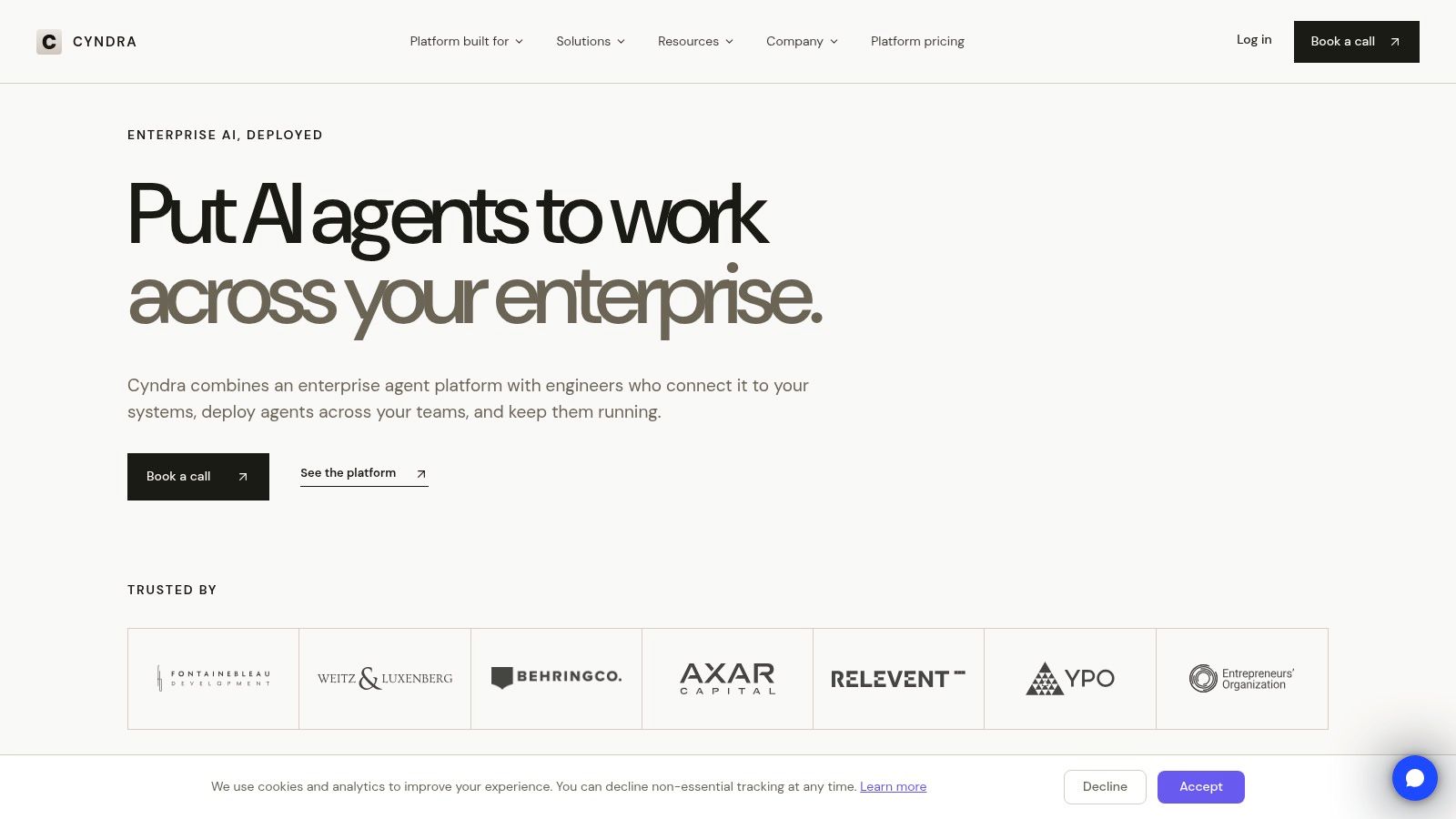
Cyndra is the strongest example here of an AI sales agent treated as an operational system rather than a standalone messaging bot. Its platform connects agents to business tools, while deployment engineers handle discovery, implementation, and ongoing operation. That distinction matters because the hardest part of sales automation usually isn't drafting an email. It's making sure the agent has the right account context, follows routing rules, updates the CRM correctly, and escalates sensitive decisions.
Cyndra's sales capability can enrich a lead, draft follow-up messages, book meetings, and brief a rep before a call across tools such as Salesforce, HubSpot, Gmail, and LinkedIn. It can also capture deal updates from Slack conversations, call transcripts, and email threads, then update the CRM. That gives it broader workflow coverage than tools focused only on website chat or outbound sequences.
Where Cyndra fits
Cyndra is designed for operators who need AI across sales and adjacent functions, including support, marketing, finance, recruiting, and operations. Its platform offers 1,000+ integrations, approval-gated access, scoped permissions, audit trails, and controls to pause or revoke actions. Those features address the implementation barriers identified by BCG's analysis of AI agents in B2B sales, where inaccuracy and poor data integration are repeatedly cited as obstacles.
The delivery model is the main differentiator. Cyndra offers both managed deployment and a self-serve platform, but the managed path pairs software with engineers who own discovery, build, and production operations. Agents can go live in days, and engagements typically show material results within 60 days, according to the supplied company information.
Practical rule: Choose Cyndra when the bottleneck crosses system boundaries, not just when a sales rep needs faster email drafts.
Trade-offs and implementation requirements
Cyndra's breadth brings a clear trade-off. Pricing isn't posted publicly, so buyers need a consultation for specific pricing and timelines. The managed model may also create reliance on Cyndra's delivery team, although the self-serve option gives internal teams more control.
The platform is best suited to growth-stage companies, agencies, enterprise teams, COOs, founders, and non-technical CTOs that want measurable automation without assembling an internal AI delivery function. It's less compelling for a very small team seeking a narrow, low-cost inbound chatbot.
Explore the Cyndra AI employee platform if you need one accountable implementation partner for prospecting, follow-up, CRM updates, and broader operational workflows.
2. Qualified "Piper" AI SDR Agent
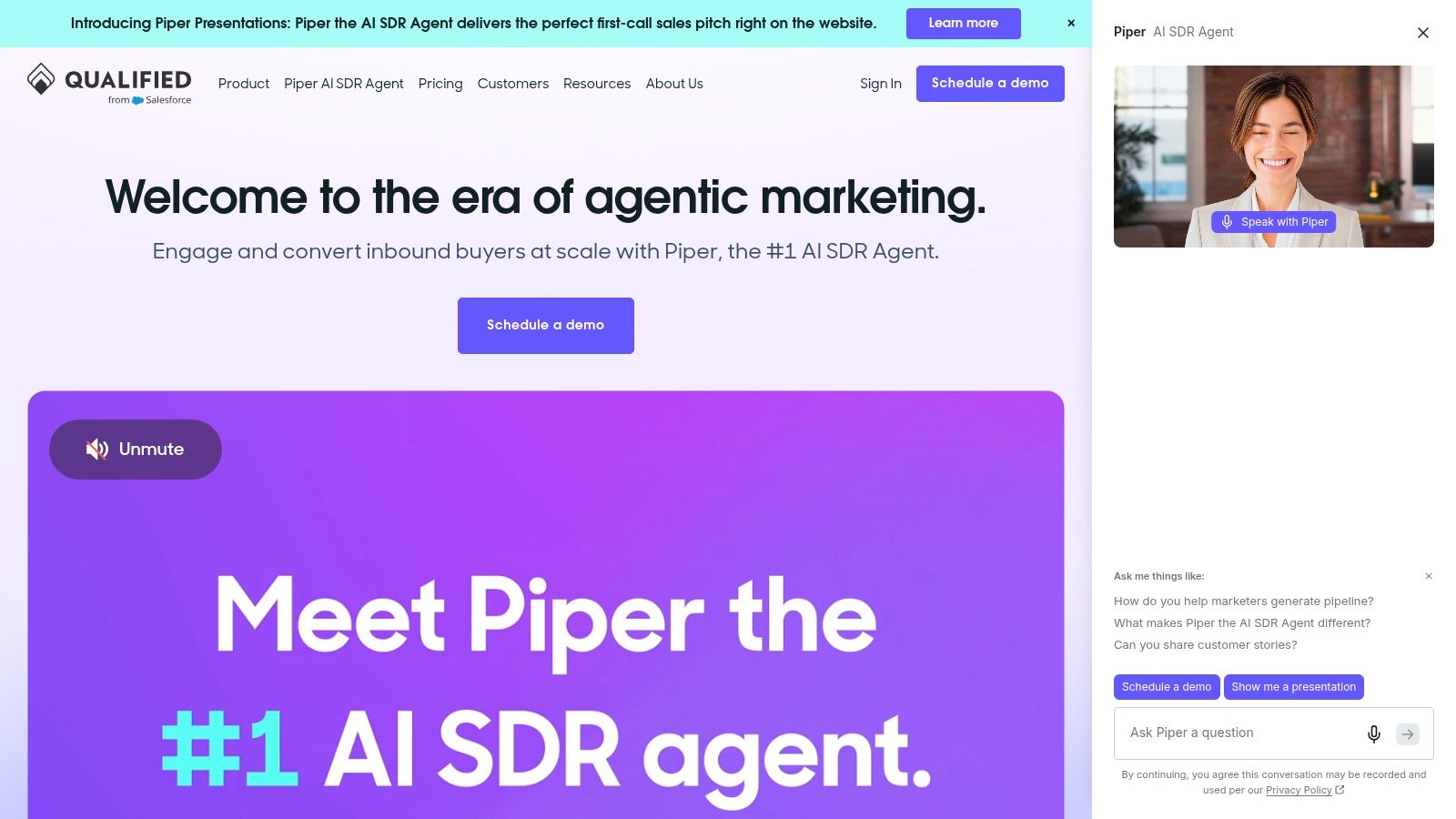
Qualified's Piper addresses a specific bottleneck: turning active website interest into sales conversations. It engages visitors through chat, voice, and video, asks qualification questions, follows up by email, and books meetings. The fit is strongest for companies with inbound demand that lose opportunities while visitors wait for a representative.
Its Salesforce-first architecture determines where Piper adds value. Routing, personalization, and reporting connect with Salesforce objects, helping enterprise teams align website conversations with account ownership, opportunity records, and ABM programs. That integration matters when territories, account rules, and qualification stages shape the sales process.
The bottleneck Piper removes
Piper performs best after buying intent appears. It can respond to a visitor, collect qualification context, route the conversation, and schedule a meeting without waiting for manual follow-up. Agentic nurture and product-led growth capabilities extend the workflow beyond one chat exchange.
Response speed alone is a weak evaluation criterion. Piper must ask useful questions, apply the correct routing logic, and give the sales representative enough context to continue the discussion. Evidence for inbound agents remains mixed. A 2026 benchmark covering 847 B2B organizations, 2.3 million sales interactions, and $18.7 billion in pipeline reported agentic inbound conversion rising from 11.3% to 19.8%, while 94% of inbound leads received responses in under 15 minutes (Jeeva's 2026 benchmark). The finding supports the workflow's importance, though it does not establish the same result for every implementation.
Strategic lesson: Piper is an inbound conversion agent, not a general outbound or revenue-operations platform.
Trade-offs and implementation requirements
Qualified is a weaker fit when the priority is outbound prospecting, detailed email reply handling, or automation across multiple business functions. Quote-based enterprise pricing also makes early comparison difficult for smaller teams without a sales consultation.
Before deployment, define qualification fields, Salesforce ownership rules, meeting availability, escalation triggers, and the information Piper may disclose. Teams evaluating the surrounding process can use this ai sales prospecting guide and review Cyndra's approach to AI sales prospecting. These resources help separate inbound qualification requirements from broader prospecting workflows.
3. Reply.io Jason AI SDR
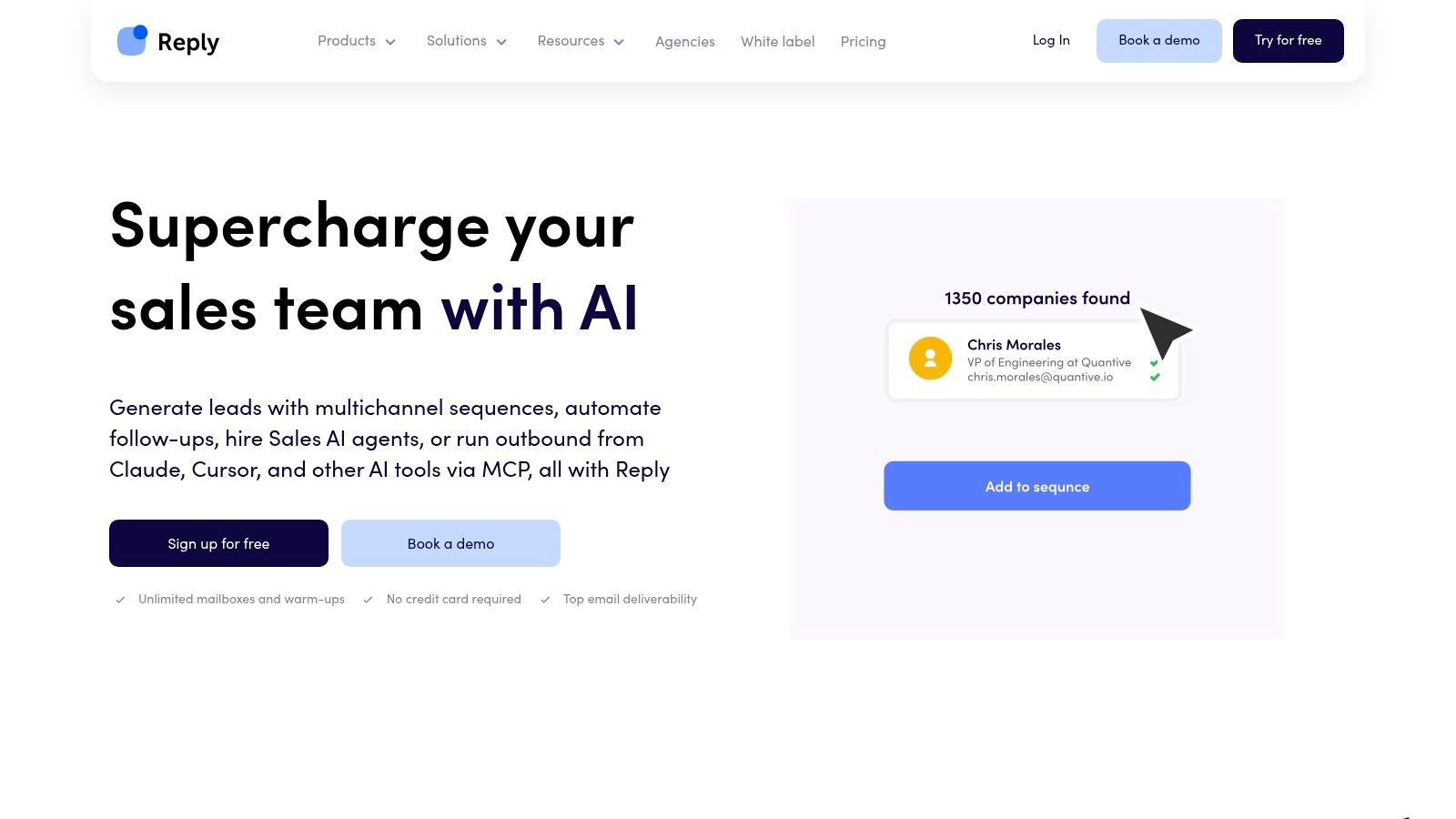
Reply.io's Jason is built around the part of outbound that often breaks after the first message: the reply. It runs prospecting sequences, handles two-way email conversations, responds to common objections, and books meetings. That makes it more operationally useful than an agent that only generates an initial email and leaves every response to a human.
The product includes reply handlers for questions about pricing and integrations, plus multichannel outbound sequences. Jason can also run headlessly through a Sales Engagement API, allowing a technical team to use it as a controllable component inside a broader agent workflow.
Why reply handling changes the evaluation
Outbound tools are often judged by research quality, personalization, and send volume. Those capabilities matter, but a prospect's answer creates a higher-risk moment. The agent must understand intent, avoid making an unsupported commitment, recognize when a question needs human input, and keep the thread moving without sounding repetitive.
Jason's guardrails and reply-handler library address that specific operational gap. The headless option is particularly relevant for SMB and mid-market teams with a clean data and enrichment layer that want to orchestrate outbound programmatically rather than adopt a completely closed workflow.
The useful question isn't “Can it write an email?” It's “What does it do when the buyer answers?”
Trade-offs and implementation requirements
Reply.io works best when the customer supplies reliable contact data, enrichment, segmentation, sending infrastructure, and clear response policies. If those inputs are weak, the agent can process replies efficiently while still targeting the wrong people or using incomplete account context.
Pricing varies by plan and add-ons, and some capabilities require higher tiers. Teams should test the exact reply categories they care about, including positive interest, objections, requests for pricing, unsubscribe language, competitor comparisons, and questions the agent must escalate.
For teams documenting the outbound process before automation, this guide to sales outreach automation provides a useful companion. Review Reply.io's platform for the API and sequence capabilities directly.
4. 6sense AI Email Agents
6sense's AI Email Agents target a specific bottleneck: persistent, intent-linked email follow-up. They qualify interest, continue conversations with contacts who have not replied, and pass engaged prospects to human representatives. The product evolved from Saleswhale and supports persona-specific agents connected to Salesforce or HubSpot, making it relevant to demand generation teams with established account and contact workflows.
The system is designed around email rather than broad conversational coverage. Teams can use Google or Outlook accounts, native 6sense email providers, or connected CRM processes. That operating model fits organizations already using 6sense intent signals to prioritize accounts and email as the primary engagement channel.
The operational strength
The clearest use case is governed follow-up around identified demand. Marketers can configure agents for different personas, define qualification logic, and continue outreach to non-responsive contacts without relying on representatives to track every next action.
A deployment still depends on operational controls. Data availability and quality remain significant barriers to agentic AI adoption, and many AI initiatives struggle to scale across business units, according to IBM's State of Salesforce report. For 6sense, that means assigning record ownership, managing consent and suppression rules, approving persona-specific messaging, and keeping CRM synchronization reliable.
An email agent improves follow-up only when the organization defines who can be contacted, what qualifies as intent, and when a person must take over.
Trade-offs and implementation requirements
6sense is a narrower choice for teams that need website chat, voice engagement, or a broad outbound execution layer. Its sales-led, quote-based pricing also limits direct cost comparison before a vendor discussion.
Before deployment, specify what counts as interest, which replies trigger handoff, how long follow-up continues, and which claims each persona may use. Map those rules to Salesforce or HubSpot fields instead of informal instructions. The resulting workflow should include documented escalation and review paths, rather than an autonomous sender aimed at an undifferentiated database.
Review 6sense AI Email Agents for current integration and packaging details.
5. Conversica AI Sales Assistants
Conversica targets high-volume, governed follow-up across multiple channels, rather than a single conversational use case. Its AI Revenue Digital Assistants engage leads through email, SMS, and chat, qualify interest, schedule meetings, and route conversations according to defined rules. CRM connectivity and industry-specific deployments make it better suited to organizations with established processes than to teams testing a lightweight tool.
Its primary bottleneck is follow-up consistency. The assistant can continue structured outreach while a sales representative focuses on leads that meet an agreed interest threshold. That division reduces manual chasing, but it also makes qualification logic and handoff design central implementation tasks.
Where mature governance helps
Conversica fits enterprises that need role-based controls, documented integrations, and repeatable playbooks across substantial lead volumes. Multichannel coverage extends follow-up beyond email, although SMS and chat add separate consent, tone, escalation, and recordkeeping requirements.
The business case should separate labor savings from revenue impact. Teams need baseline measures for qualified conversations, meetings, pipeline contribution, and handoff quality before they can judge whether the assistant improves performance. Industry research also indicates that AI programs often struggle to produce measurable value at scale. BCG reported that just 5% of firms were getting measurable AI value at scale and 60% were getting no value at all (BCG's B2B sales agent analysis).
Conversica's value depends less on message volume than on the controls that determine who receives each reply and when a human takes over.
Trade-offs and implementation requirements
Custom enterprise packaging means pricing is not publicly listed. Implementation requires teams to align CRM fields, channel permissions, handoff thresholds, industry language, and reporting definitions.
Conversica suits organizations that prioritize control and repeatability over rapid self-serve setup. A small team with one narrow sequence may get better operational fit from a simpler platform. Review the Conversica AI sales assistants offering against existing CRM, consent, and compliance requirements.
For a broader comparison of assistant-led sales workflows, see AI sales assistants from Cyndra.
6. Exceed.ai by Genesys
Exceed.ai, now part of Genesys, targets lead capture and qualification across email, SMS, and web chat. It can automate outreach, hold two-way conversations, schedule meetings, and follow up with leads that aren't ready for immediate human attention.
Its strategic advantage is platform context. Teams already standardizing on Genesys may prefer to keep conversational AI, customer experience governance, and enterprise administration within one broader environment. Website chat also gives Exceed.ai a direct inbound entry point, rather than restricting the workflow to an email inbox.
The fit for CX-centered organizations
Exceed.ai is most relevant when sales and customer experience teams share infrastructure or when the buying organization values vendor consolidation. Enterprise governance and usage-metered AI capabilities can support controlled deployment, but the commercial and technical details depend on the Genesys contract.
That creates a different evaluation from Reply.io or Selix. The question isn't only whether the agent can qualify a lead. It's whether Genesys can provide the required routing, permissions, reporting, and ownership model without adding unnecessary platform complexity.
Trade-offs and implementation requirements
Pricing details are opaque and may be bundled into enterprise agreements. Exceed.ai can also feel heavier than a point solution if you only need a simple website capture flow or a focused outbound sequence.
Before approving the purchase, map the journey from visitor or inbound contact to CRM record, qualification decision, meeting booking, and human escalation. Test how the system handles incomplete answers, duplicate contacts, opt-outs, scheduling conflicts, and leads that move between sales and support.
The Genesys platform is the relevant starting point for current product availability, packaging, and integration details.
7. Selix by SellScale
Selix targets a specific bottleneck: coordinating outbound execution across an entire campaign lifecycle. It can assemble lists, enrich contacts, draft and personalize outreach, sequence messages, and support initiatives such as events, new verticals, market launches, and early outbound programs.
This breadth reduces the need to connect separate tools for list building, enrichment, copywriting, sequencing, and campaign management. The operational benefit is fewer handoffs between systems. Teams spend less time checking campaign status, moving records, and deciding which workflow owns the next action.
Why consolidation matters
Selix suits growth teams seeking an agentic layer over outbound operations without building a complex internal workflow. Its templates provide a repeatable starting point for event campaigns, industry launches, and focused outbound sprints.
Broader workflow coverage also raises the cost of weak segmentation and inaccurate data. General-purpose AI assistance is common among sellers, but adoption alone does not show that end-to-end outbound is creating better pipeline. Evaluate Selix through qualified opportunities, reply quality, deliverability, and handoff performance, rather than campaign completion alone.
The relevant comparison is workflow coverage, not chatbot quality. Selix is most useful when list creation, personalization, sending, and campaign control need to operate together.
Trade-offs and implementation requirements
Selix has no public pricing, so buyers need a demo and quote. The product is also a newer brand evolving from SellScale. Roadmap clarity, vendor support, integrations, and ownership of campaign logic should therefore be part of the buying review.
Start with one tightly defined outbound motion. Set the target persona, permitted enrichment sources, approved claims, send limits, reply-escalation rules, and CRM write-back behavior. Compare its results with the existing process before expanding to additional markets. Review the current product scope at Selix.
7 AI Sales Agents, Feature Comparison
| Product | 🔄 Implementation complexity | ⚡ Resource requirements | ⭐ Expected outcomes | 💡 Ideal use cases | 📊 Key advantages |
|---|---|---|---|---|---|
| Cyndra | High, managed deployment + ongoing engineering ops | Low internal lift (Cyndra-led); enterprise pricing model | ⭐⭐⭐⭐, live in days; measurable ROI often within ~60 days; documented savings | Growth-stage companies, enterprises, COOs, non-technical CTOs scaling ops/sales/support | Platform + delivery team; 1,000+ integrations; built-in governance & audit trails |
| Qualified, "Piper" AI SDR | Medium, Salesforce-first setup and routing | Requires Salesforce CRM; enterprise pricing/quote | ⭐⭐⭐, improves inbound qualification and meeting booking (real time) ⚡ | Salesforce-centric ABM and inbound pipeline acceleration | Real-time chat/voice/video; CRM-aligned personalization & analytics |
| Reply.io, Jason AI SDR | Low–Medium, out-of-the-box or headless via API | Needs clean data/enrichment; API integration for orchestration | ⭐⭐⭐, effective outbound sequence + two-way reply handling ⚡ | SMB/mid-market outbound teams; programmatic agent orchestration | Headless API mode; robust reply-handler library; multichannel sequences |
| 6sense, AI Email Agents | Medium, enterprise configuration and governance | Integrates with Salesforce/HubSpot; pairs with intent signals | ⭐⭐⭐, reliable email qualification; targeted outreach 📊 | Demand-gen teams using intent data and persona segmentation | Persona-specific agents; enterprise governance; CRM integrations |
| Conversica, AI Sales Assistants | High, heavier implementation for enterprise scale | Enterprise-grade support and playbooks; custom pricing | ⭐⭐⭐, scales to large lead volumes with rigorous compliance | Large enterprises, regulated industries, high-volume lead ops | Mature playbooks; multi-channel (email/SMS/chat); industry solutions |
| Exceed.ai (Genesys) | Medium–High, integrated into broader Genesys CX stack | Typically bundled in Genesys contracts; enterprise governance | ⭐⭐⭐, multi-channel lead capture and scheduling | Teams standardizing on Genesys CX wanting conversational lead capture | Backed by Genesys; web chat + email + SMS; scalable CX controls |
| Selix (SellScale) | Low–Medium, turnkey outbound workflows and templates | Consolidates outbound tools; demo/quote; newer vendor | ⭐⭐⭐, end-to-end outbound automation; reduces tool sprawl ⚡ | Teams launching outbound programs, events, new markets, 0→1 outbound | Outbound templates, list assembly/enrichment, single workflow |
Turn an AI Sales Agent Into a Controlled Revenue Workflow
The strongest selection process starts with the bottleneck, not the vendor category. If inbound visitors aren't being handled quickly, Qualified or Exceed.ai may deserve attention. If outbound replies are the constraint, Reply.io is more relevant. If intent-linked email follow-up is the priority, 6sense has the closer fit. High-volume, governed engagement points toward Conversica, while consolidated outbound execution points toward Selix. Cyndra is the broadest option when sales automation must connect with support, operations, marketing, finance, recruiting, and other systems.
The evidence also argues against treating productivity as proof of revenue impact. In one reported enterprise rollout, administrative work fell from 22 hours per week to 8.4 hours per week, average sales cycle length declined from 127 days to 103 days, win rates increased from 18% to 22%, and revenue per sales rep rose 23% year over year (reported enterprise rollout). Those results are useful as an example of what to measure, not as a promise for every implementation.
Use a controlled rollout:
- Name one bottleneck: Choose inbound response, qualification, meeting booking, reply handling, CRM updates, or follow-up.
- Define the decision rule: State what qualifies a lead, what triggers a handoff, and what the agent must never do without approval.
- Verify the data path: Check CRM ownership, enrichment, email, calendar, website, and channel permissions before enabling actions.
- Set governance controls: Require scoped access, approval gates, audit logs, pause controls, and clear human escalation.
- Create a baseline: Record response, qualification, booking, follow-up, and pipeline measures before launch.
- Review early decisions: Inspect agent outputs closely during the initial rollout, then move only proven low-risk actions toward greater autonomy.
Strategic lesson: An AI sales agent isn't a revenue strategy by itself. It's an execution layer inside a revenue workflow.
Cyndra is the choice for broad managed transformation and cross-functional agents. Qualified is the Salesforce-first option for inbound engagement. Reply.io is the fit for API-controlled outbound reply handling. 6sense suits intent-linked email agents, Conversica suits governed high-volume multichannel follow-up, Exceed.ai suits Genesys-centered lead capture, and Selix suits consolidated outbound execution.
The best implementation starts narrow. Fix data quality, establish routing, define governance, and make human escalation reliable before adding another channel or automating another stage. Once the first workflow produces trustworthy results, expand from a measured process rather than from a feature list.
Cyndra installs, trains, and manages production-grade AI employees that can enrich leads, draft follow-ups, book meetings, brief reps, and keep CRM records aligned across your sales stack. Visit Cyndra to discuss a controlled deployment that connects sales automation with the wider operational workflows your team needs.