 CYNDRA

Your board call is Thursday. The contract dispute goes to arbitration in six weeks, both paralegals on the litigation team just handed in notice, and outside counsel's estimate for handling discovery would eat a quarter of the litigation budget in a month. You need reviewers who can start Monday, a paralegal who already knows Relativity, and possibly an interim contracts lawyer, and you need all three without adding permanent headcount the CFO hasn't approved.
Legal staffing firms aren't interchangeable in a week like that. Some place attorneys at law-firm rates and won't take a single paralegal requisition. Some staff document review by the thousand documents and have no interest in one interim counsel. A few do both, and their pitch emails read almost identically. The wrong partner costs you in delay, in a reviewer who mishandles privileged material, or in a fee dispute over a placement that didn't stick, and those costs dwarf the hourly rate you negotiated.
The firms below are organized by the problem each one solves: an urgent interim lawyer, a document review surge, a permanent senior hire, or ongoing legal operations support. Each entry names who it suits, where it falls short, and the questions worth asking before you sign the engagement letter.
Table of Contents
- 1. LatHire
- 2. Robert Half Legal
- 3. Beacon Hill Legal
- 4. Axiom
- 5. Major, Lindsey & Africa (MLA)
- 6. LHH Legal & Compliance
- 7. Lawyers On Demand (LOD), a Consilio Company
- 8. Scion Legal
- How the Seven Legal Staffing Agencies Compare on Engagement Models, Best Fit, and Pricing Transparency
- Match the Agency to the Gap Before You Sign Anything
1. LatHire
LatHire solves a narrow staffing gap: routine legal support that must start soon without carrying a US-market salary. It is an AI-powered hiring platform connecting US and Canadian companies with pre-vetted Latin American professionals. Its legal use case sits in the support layer. When you hire legal assistants through the platform, you are covering document organization, exhibit preparation, intake, calendar and docket support, billing review, and legal operations admin, not courtroom advocacy.
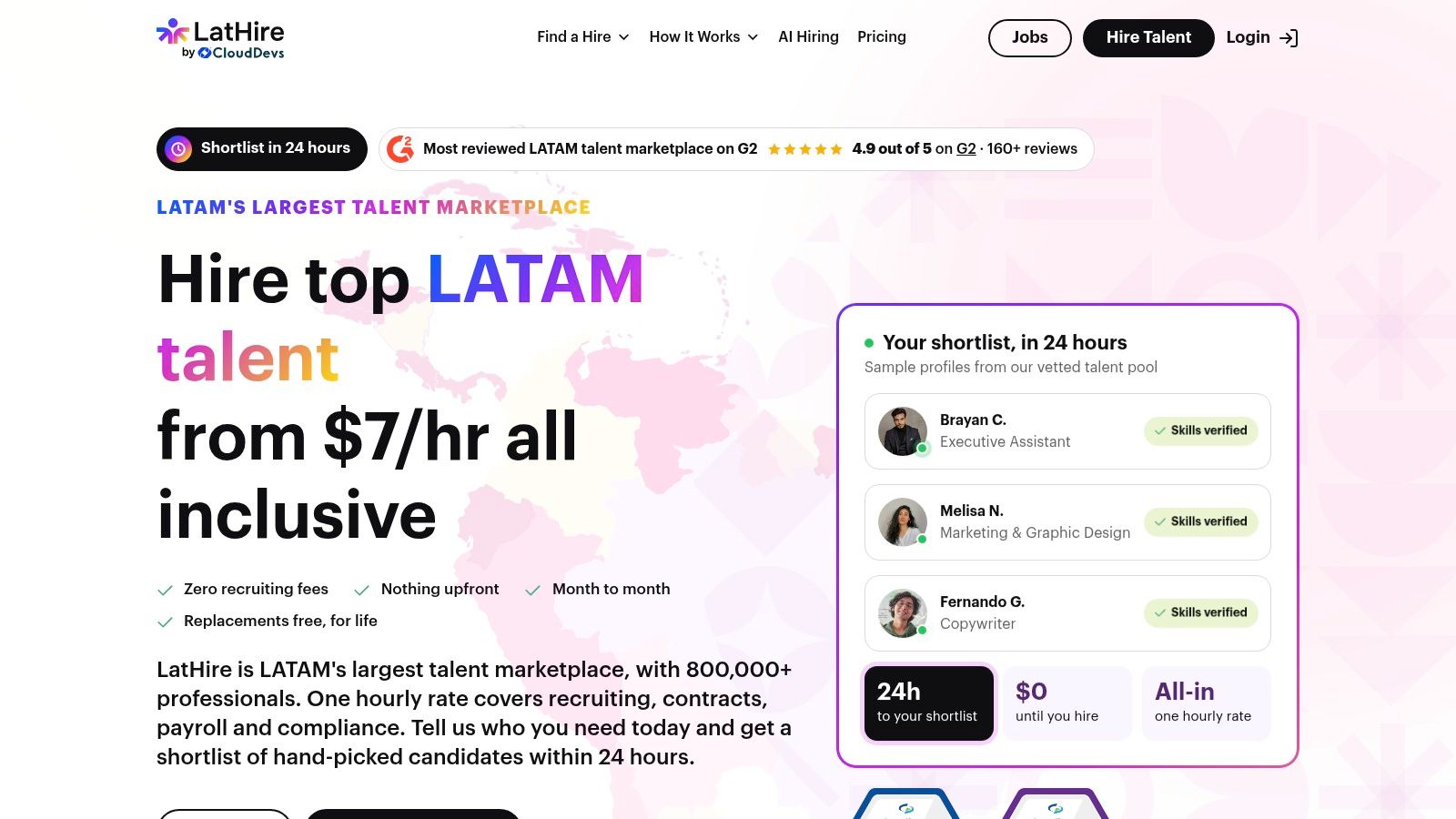
The screening process is the part that matters for a legal buyer. LatHire narrows candidates through AI assessments, skills evaluations, and human-led background checks, so the shortlist arrives already filtered. You can import an existing job description or generate one on the platform. That is useful when the need is clear but the manager has no time to write a precise requisition from scratch.
Where LatHire Fits Best
The platform carries the administrative burden that makes cross-border hiring feel risky. HR support, international payroll, benefits, and legal compliance run through LatHire rather than through your entity. Engagement models can cover a short matter or an open-ended support seat. Candidates are presented with validated skills and real-time availability in your time zone, which is the detail that decides whether a remote assistant is useful or just nominally employed.
A two-partner litigation shop with a document production starting in ten days is a good fit. The associates can run review strategy. Nobody available can build the exhibit index, manage privilege log intake, and keep the calendar clean. That is the shape of work LatHire handles well, at a cost structure a US search cannot match. I would use it for repeatable support seats first, then expand only after the workflow and access rules are stable.
The Limit You Need to Understand
Latin American legal professionals generally are not admitted to US state bars and do not appear in US courts. This is not an interim counsel substitute, and treating it as one creates an unauthorized practice problem rather than a staffing solution. Keep legal advice, signatures, court filings, and judgment calls with admitted counsel. The remote role works when the task list is operational and supervised.
The support layer travels across borders. Court appearances and legal advice don't.
What to Confirm Before You Start
- Time zone overlap: confirm the actual working hours in your time zone, not just the country of residence.
- Privilege and data handling: ask where documents are stored, who can view them, and what happens to access when the engagement ends.
- Replacement terms: get the trigger and the turnaround in writing before the first day.
- Ramp capacity: ask how fast they can add three more people if the matter expands.
Best for legal teams that need remote legal support capacity without adding US headcount. Price the role against the work you can clearly define, then compare it with a domestic requisition.
2. Robert Half Legal
A corporate legal department loses its senior litigation paralegal two weeks before a hearing, and the local market has no legal boutique with available staff. Robert Half Legal fits that problem. It is the safe, unglamorous choice, and in a staffing emergency that is a compliment. Its legal division places temporary and full-time attorneys, paralegals, legal administrators, and legal secretaries, with the reach of a wider staffing business behind it, as reflected in its SEC annual report.
That scale is why it wins requisitions smaller firms cannot cover. When your litigation paralegal quits in a market where no legal boutique keeps an office, Robert Half has coverage, a recruiter with a database behind her, and a payroll system that already exists. That matters when the gap is immediate and the work is defined: document review, contract attorney coverage, legal administration, or support staff who can start without a long search cycle.
The trade-off is depth versus breadth. It is not exclusively a legal firm, so the quality of your experience depends on the local recruiter's legal background. Ask how many paralegal and contract attorney placements that specific person made in your metro in the last twelve months. Rates are not published, which means you are comparing quotes rather than a price list. For a short assignment, that can be fine. For a long review project, small differences in bill rate and replacement terms matter more than the brand name.
Rate reality: Every contract bill rate bundles the worker's pay, payroll burden, and margin. Ask for the pay rate and the bill rate separately, in writing, before you compare two agencies on an hourly number.
What to Confirm Before You Sign
- Local bench: request two recent placements in your practice area and city, not a national case study.
- Replacement window: get the guarantee into the engagement letter, including what triggers it and who pays for the second search.
- Conversion terms: if you expect to hire the contractor permanently, fix the conversion fee now rather than after the person has started.
- Supervision model: confirm who handles timesheets, escalation, and performance issues once the contractor is inside the legal team.
Best for law firms and corporate legal departments that need paralegals, legal support, and contract attorneys across multiple US markets on short notice. Details sit on the Robert Half Legal site.
3. Beacon Hill Legal
Beacon Hill Legal is built for the mid-market requisition: one paralegal, one contracts analyst, or a review team of six that has to start Monday, with the option to convert at the end. That conversion option deserves more attention than it usually gets. Contract work has become standard practice, with the share of firms using contract staff at least once a year projected at 69%, remote placements expected at 34% of the mix, and temp-to-hire conversions at 39%, per Regents' legal staffing services data.
Convert at the right moment and you've effectively run an extended working interview. Convert late, after the assignment has rolled for two quarters, and you'll pay a placement fee on top of months of hourly billing.
What the Firm Covers
Its legal division runs contract staffing and direct-hire recruitment across seniority levels, and it also offers eDiscovery and managed-review consulting. That combination is unusual at this scale: the same firm supplying a litigation paralegal can stand up a managed review with a project manager attached. Local recruiting teams operate in multiple US markets, which matters when your matter spans two states.
The weaknesses are predictable. Coverage and candidate availability differ by city and practice area, pricing isn't published, and if you need a senior counsel secondment for a regulatory program, compare it against an interim-counsel specialist. A generalist legal desk will fill the seat; it may not fill it with the person who has run the program before.
Before you staff around a bottleneck, check what the bottleneck is. If the missed client calls are the problem, a law firm answering service solves it for less than a hire, and the requisition you were about to open may turn out to be unnecessary.
Ask three things before signing: whether the recruiter has placed your role type in the last year, what the replacement guarantee covers on a contract-to-hire conversion, and who carries payroll and classification risk during the assignment. Get all three in the engagement letter. Full service details are on the Beacon Hill Legal page.
4. Axiom
A privacy program that needs a lawyer who has built one before. A commercial contracts backlog that needs clearing in ninety days. A nine-month gap while the deputy general counsel search runs. These are lawyer problems, not staffing problems, and Axiom is the cleanest fit for them. It supplies experienced legal professionals into legal departments on flexible terms: full-time or part-time, remote, on-site, or a blend, for ongoing workloads or defined projects.
Axiom describes itself as an alternative legal services provider rather than a traditional staffing agency, and that distinction shows up in what you're buying. You're purchasing a lawyer who has done the work before, with a scope attached, not an hourly body in a chair.
The trade-offs are real. It isn't a source of paralegals, legal assistants, or document reviewers, so it won't solve a review surge. Availability and terms depend on the role and the location. Pricing isn't public, which means the comparison you should run is total engagement cost against the fully loaded cost of a permanent hire, not against another agency's hourly rate.
Scope test: A secondment without a written scope becomes an open-ended consulting relationship at a fixed monthly cost. Name the deliverables, the review cadence, and the exit date in the statement of work.
How to Run the Engagement
Treat a secondment like a vendor contract even though it feels like a hire. The law firms and legal departments that get value from flexible counsel write down what the lawyer owns before day one, including which business units can assign work and who approves changes in scope.
- Interim to permanent: confirm whether a conversion fee applies and when it steps down.
- Blended arrangements: ask how remote and on-site time is priced when the mix changes mid-engagement.
- Knowledge transfer: require a documented handover, because the secondment ends and the institutional knowledge shouldn't leave with it.
Best for legal departments that need an experienced lawyer embedded without adding permanent headcount. See the Axiom site for engagement models.
5. Major, Lindsey & Africa (MLA)
When the gap is a general counsel seat, a deputy GC, or a compliance officer who will sit across from a regulator, the quality of the search matters more than the speed of the fill. MLA runs a dedicated Interim Legal Talent practice alongside its permanent search work, covering in-house counsel, law-firm roles, contract attorneys, and legal operations. Its interim assignments can be scoped to a specific project, a temporary staffing gap, or a temp-to-perm trial.
The two models aren't rivals, and the market data says so. 58% of legal leaders planned to add permanent employees while 51% expected to increase contract hiring, according to Robert Half's legal hiring trends report, which also counted 159,600 legal job postings in 2025, including 45,300 lawyer postings and 9,800 compliance postings. Demand has broadened well past conventional attorney placements, which is why a firm that only runs one playbook leaves gaps.
Where MLA Earns Its Fee
Search-grade vetting applied to interim work is the differentiator. A candidate who has been through a partner-level search process presents differently from someone pulled off an agency bench at 9am on a Monday, and for a board-facing interim role that difference is the whole product.
The limits are equally clear. MLA isn't built for high-volume paralegal or administrative staffing, so don't send it a six-person review project. Interim availability depends on the candidate pool in your market and the seniority you need, and fees and engagement terms aren't standardized publicly, which means the scope conversation has to happen early.
Before signing, ask how the firm screens for the specific regulatory or industry exposure your role requires, whether the interim can convert to permanent and on what terms, and which partner owns the relationship if the assignment goes sideways. Get the answer from the person who will run the search. Visit the MLA site for its practice detail.
6. LHH Legal & Compliance
Compliance hiring is where legal staffing and general recruiting collide, and LHH works that overlap. It recruits for legal and compliance positions, including in-house roles, and sits inside a broader talent and workforce-services organization, which helps when a legal department needs a compliance analyst, a contract manager, and a privacy lead in the same quarter.
The overlap is harder to staff than it looks. Legal departments report an 84% skills shortage, with the most serious gaps in legal operations, legal-technology proficiency, and legal research and analysis, per BigHand's law firm talent and resourcing report. A candidate's law-firm pedigree doesn't prove competence in any of those three.
Test the Skills, Not the Résumé
Ask the recruiter how they assess technology fluency before you meet anyone. The specific question is whether the agency can test a candidate on matter management systems, document automation, and data-handling practice, or whether it only verifies years and employers. Reference verification matters as much, particularly for compliance roles where the last employer's regulatory environment shapes what the candidate can do.
The disclosure gaps are worth naming. Public detail about LHH's specific placement models and role coverage is limited, pricing isn't published, and coverage varies by office. Confirm on the first call whether your local team handles contract staffing, permanent placement, or both, because a team that only does direct hire will waste two weeks of your search.

And before you post the requisition, split the role into what needs judgment and what needs repetition. A large share of compliance monitoring, evidence collection, and first-pass review is exactly the kind of work compliance automation now handles, and staffing a person to do it manually locks the cost in for years. Ask what the hire will spend their first month on; if the honest answer is copying data between systems, the role design is the problem.
Best for in-house legal departments hiring where legal expertise overlaps with risk and compliance. Start at the LHH Legal & Compliance practice page.
7. Lawyers On Demand (LOD), a Consilio Company
LOD earns its place when the work is document-heavy and the deadline is a court date. It supplies flexible legal talent to in-house departments and projects, covering lawyers, paralegals, risk and compliance specialists, and legal operations professionals, and its contract-attorney staffing handles litigation and foreign-language document review. Embedded assignments and defined projects are both on the menu, which matters when a matter starts as a review and turns into a production dispute.
Legal staffing is a concentrated market, which is why the parent company's scale is relevant to your risk. The ten largest US providers generated approximately $1 billion collectively in 2023, representing 65% of total market revenue against total US legal staffing revenue of $1.53 billion, per Regents' legal staffing market data. Consilio appears in that leading group at approximately $110 million.
Concentration cuts both ways. A large provider can absorb a surge and manage conflicts across jurisdictions. It can also put you in a queue behind a client with a bigger production.
Where the Model Fits
Recruiting depth, credential and bar-status verification, conflict screening, and geo coverage are what separate the leaders in this market, not candidate volume. Those are the questions to press on when you're buying a review team, because a reviewer who hasn't been conflict-checked against the matter is a disqualification risk rather than an extra pair of hands.
The reverse trade-off is scope. The broader legal-services and technology offering can exceed what a straightforward single-person hire needs, and availability and engagement terms require direct scoping. There's no standard public rate card, so the comparison has to be run on a scoped quote that separates review hours, project management, and technology fees. Confirm who supervises the review, how foreign-language review is quality-checked, and what the exit looks like when the production closes. Start with the Consilio site.
8. Scion Legal
Scion Legal is the one to call when the hire isn't a lawyer. Its advertised roles span attorneys and legal support alongside compliance, contracts, eDiscovery, litigation support, legal operations, and executive positions, and it serves corporate legal departments, law firms, nonprofits, and public-sector organizations nationwide. For a team building out legal operations or standing up a contracts function, that breadth is more useful than another attorney bench.
The performance claims need interrogation, because the industry has no common measuring stick. No audited, industry-wide fill-rate benchmark exists, so any agency quoting a placement success rate is quoting its own definition, per Frontline Source Group's guide to comparing staffing agencies. The same analysis reports best-in-class legal staffing benchmarks of about 15 days to fill, 88% 90-day retention, and 24-hour conflict-check turnaround, against a sensible procurement gate of 87% retention, a 17-day median fill, and conflict clearance within one business day.
The Questions That Separate Real Data From Marketing
Request a trailing twelve-month dashboard with cohort definitions, role-level results, and exclusions disclosed. Then ask the question most buyers never think to ask: does the fill-rate denominator include withdrawn, competitor-filled, and abandoned requisitions? Denominator choices can inflate a performance claim without a single false statement.
- Role segmentation: ask for results split by paralegal, litigation support, legal operations, and attorney. Pooled averages hide weak specialty searches.
- Retention cohorts: ask what share of placements reached 90, 180, and 365 days, and how early attrition is counted.
- Conflict turnaround: confirm the documented hours, not the promise.
Scion's pricing isn't public and role availability varies by market, so confirm the staffing model and local recruiter coverage before you send a job description. The Scion Legal site lists its practice areas.
How the Seven Legal Staffing Agencies Compare on Engagement Models, Best Fit, and Pricing Transparency
| Item | Engagement Models | Best For | Public Pricing |
|---|---|---|---|
| LatHire | Flexible hiring with HR, payroll, benefits, and compliance support | Companies seeking Latin American talent, including legal assistants and operations staff | Not publicly listed |
| Robert Half Legal | Contract, project-based, temporary, and permanent placements | U.S. employers hiring across legal roles and practice areas | Custom quote |
| Beacon Hill Legal | Contract staffing, direct hire, eDiscovery, and managed review | Law firms and legal departments needing hires or document-intensive project support | Not publicly listed |
| Axiom | Full-time, part-time, remote, on-site, interim, and project-based support | Organizations needing experienced legal talent without immediate permanent headcount | Not publicly listed |
| Major, Lindsey & Africa (MLA) | Interim, project-based, temp-to-perm, and permanent search | Law firms and legal departments seeking counsel, contract attorneys, or legal operations talent | Not publicly listed |
| LHH Legal & Compliance | Legal and compliance recruiting; placement models vary | Employers hiring for roles that combine legal, compliance, and business needs | Not publicly listed |
| Lawyers On Demand (LOD), a Consilio company | Embedded assignments, project-based support, and contract staffing | In-house teams and projects needing legal, compliance, litigation, or document-review talent | Not publicly listed |
| Scion Legal | Legal recruiting and staffing; specific models vary | Employers hiring across legal, compliance, contracts, eDiscovery, and legal operations | Not publicly listed |
Match the Agency to the Gap Before You Sign Anything
Most bad staffing decisions are made before the first call, when a buyer treats legal staffing as one category and ranks firms on brand recognition. The routine that works is shorter and more boring.
Name the gap in one sentence. Urgent interim lawyer. Document review surge. Permanent senior hire. Ongoing operations support. Attach a duration and an end date to it. "We need help" produces a generic shortlist; "we need two Relativity-trained reviewers for eleven weeks starting the 14th" produces a scoped quote you can compare.
Shortlist two or three whose model matches the gap. A review surge needs managed review capability. An interim privacy counsel needs a secondment platform with experienced lawyers on the bench. A deputy GC search needs a search firm. Asking a boutique to run a 200,000-document production, or a document-review shop to find your next general counsel, wastes a week and tells you nothing about the market.
Request quotes that show total engagement cost. The hourly bill rate is one line. Ask for the pay rate underneath it, the conversion fee and when it steps down, the minimum assignment length, the replacement guarantee and its trigger, who carries payroll and classification risk, and what the quote excludes. Two agencies can quote the same hourly rate and land at very different totals once those terms are priced in. A lower rate with a stiff conversion fee and a four-week minimum can cost more than a higher rate with clean terms, so compare the full engagement, not the headline number.
Verify the recruiter, not the logo. Ask for two placements that person made in your practice area and city in the last year, then call those clients. A national brand with a generalist recruiter in your market is a local boutique with worse pricing.
Then ask whether the work needs a person at all. Intake triage, invoice checks, first-pass conflict screening, and monthly matter reporting are process-heavy and repetitive, and they're where a hire becomes a permanent cost for work that never needed judgment. Cyndra, which serves law firms, builds AI workflows that route high-stakes steps to human approval and keep a full audit trail, so a team can price automation alongside a staffing quote instead of assuming headcount is the only lever.
The agency that answers your questions most precisely, and admits what it doesn't do, is usually the one to sign with. It rarely turns out to be the biggest name on your shortlist.
If you'd rather test that assumption before signing a staffing engagement, start with a Free Live Build. It's a 30-minute session where Cyndra builds one real task your team still handles by hand, from intake routing to a monthly matter report, and you keep what gets built either way. Half an hour tells you whether your gap needs another person or a better workflow.