 CYNDRA
The CRM says the leads are assigned. The sequencing tool says the emails went out. The ad dashboard shows activity, and the analytics platform has another chart to review. Yet the funnel is slowing, follow-up is inconsistent, and the team is spending more time moving information between tools than talking to buyers.
That's the point where another dashboard or hire often fails to help. The gap isn't a lack of software. It's that no one system owns the work from signal to action, with clear rules about what it can decide and when a person must take over.
Table of Contents
- The Operator's Dilemma When Output Stops Scaling
- What a Sales Marketing Agent Actually Is
- Where Agents Earn Their Keep Across the Funnel
- The Autonomy Problem Most Guides Skip
- A 60-Day Path From Pilot to Production
- Choosing a Sales Marketing Agent and a Representative Case
- What to Do This Quarter
The Operator's Dilemma When Output Stops Scaling
A founder starts the morning checking pipeline, campaign performance, and replies. A growth lead spends the next hour reconciling records that disagree across the CRM and marketing platform. A sales rep gets a promising inbound lead, but the research, qualification, and follow-up still depend on several manual steps.
Each tool does its part. The CRM stores account history, the sequencer sends messages, and analytics reports what happened. But the team still has to connect the dots, decide what matters, and move the work forward. Adding another tool can create more activity without making the revenue process more coherent.
That operational gap is increasingly visible in AI adoption. McKinsey's 2025 global research found that 62% of organizations were experimenting with AI agents, but only 23% were scaling an agentic system in at least one business function, as reported in the SAS research on marketers and AI. The distance between experimentation and scale is a reminder that a compelling demo isn't enough. Leaders need a system they can govern, measure, and trust in live workflows.
A sales marketing agent should close the gap between the tools, not add another interface. It can carry work across prospect research, message drafting, follow-up, CRM updates, and reporting. But the important question isn't how many tasks it can automate. It's which decisions it's allowed to make, under what conditions, and with what oversight.
Operator's rule: Don't scale activity until you can explain who or what owns each decision in the revenue workflow.
That framing changes the evaluation. Instead of asking whether an agent can send emails or summarize accounts, ask whether it can complete a defined workflow without creating unreviewable risk. The answer depends on the agent's permissions, the quality of its data, and how easily a human can inspect or reverse its actions.
What a Sales Marketing Agent Actually Is
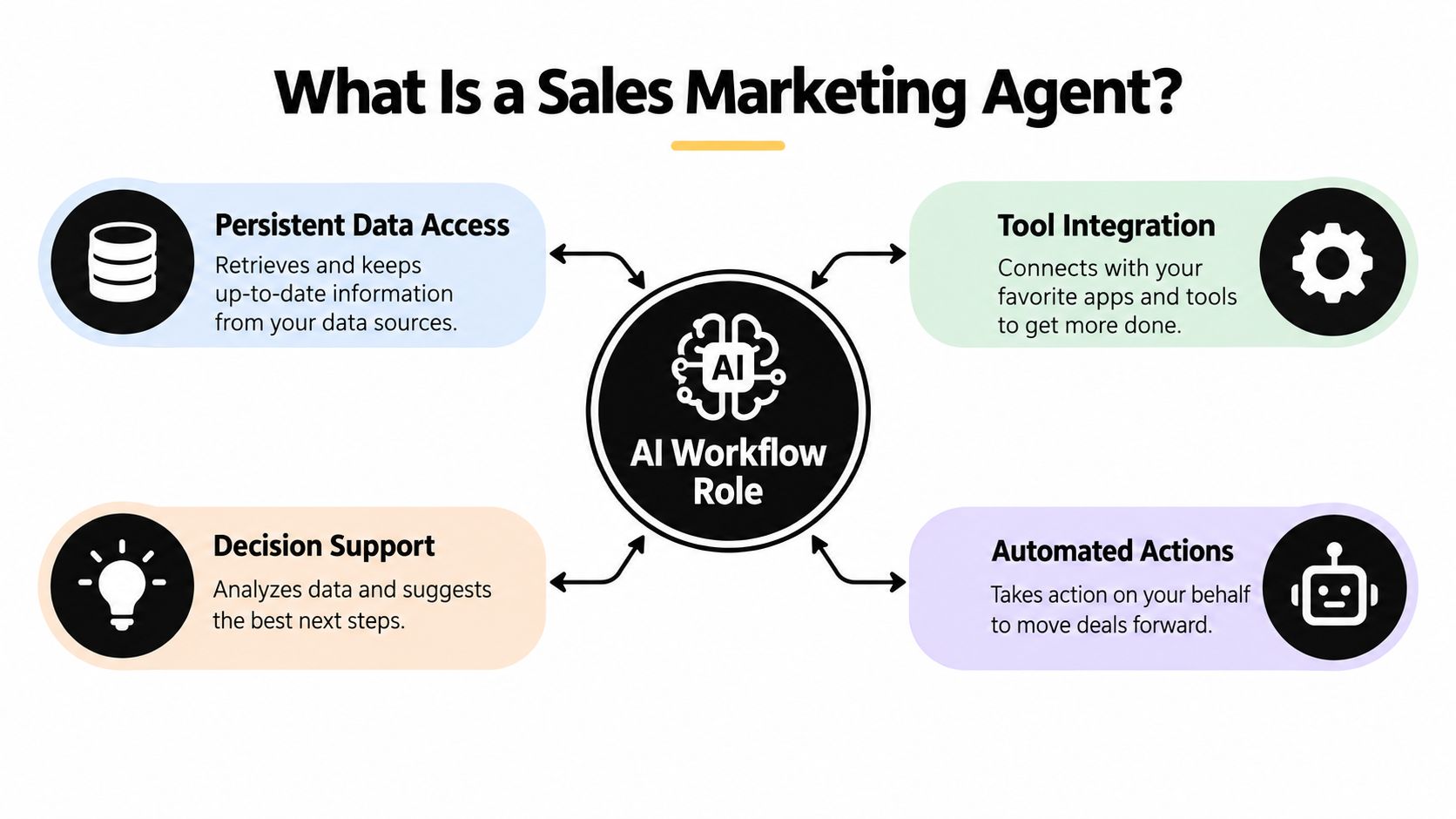
A sales marketing agent is best understood as a workflow role, not a product category. It's an AI system connected to company data, business tools, and decision rules that can coordinate steps across a revenue process, then report what it did and why.
For example, the agent might research a prospect, retrieve relevant product information, draft a message, assess engagement, update a CRM record, and recommend a next action. The value comes from handling connected steps inside one operating loop. A chatbot that answers questions but can't work with the CRM or follow an approved process isn't performing that role.
The distinctions matter when evaluating vendors:
- A traditional SDR is a human seller who researches accounts, contacts prospects, qualifies opportunities, and manages follow-up. An AI agent may assist with those tasks, but it doesn't own human judgment or relationships by default.
- A marketing automation tool follows configured rules, such as sending a message after a form submission. It's useful for repeatable triggers, but it usually doesn't interpret the broader context and choose among competing actions.
- A CRM assistant helps a person work inside the CRM, often by summarizing records or suggesting next steps. An agent may go further by executing approved actions across connected tools and recording the outcome.
The difference is authority. A sound implementation defines whether the agent can observe, recommend, draft, execute within limits, or act independently. Those permissions should vary with risk. Updating a low-risk record may need less oversight than sending a customer a pricing commitment.
Agent-led selling isn't a new commercial idea. The World Federation of Direct Selling Associations reported 128.2 million independent representatives in 2021, a reminder that person-to-person selling has long operated at substantial scale (WFDSA's 2021 fact sheet). AI changes how teams can coordinate work around that human activity, not the fundamental need to understand buyers and earn trust.
If you're mapping the underlying process before adding AI, this guide to automating sales workflows with buying signals offers useful context. Use it to identify the workflow and signals first, then decide where an agent should participate.
Where Agents Earn Their Keep Across the Funnel
The best starting point is a bottleneck, not a department-wide mandate. An agent can support prospecting, qualification, sales follow-up, and expansion, but each workflow needs a clear input, an acceptable action, and a human checkpoint.
| Funnel Stage | Agent Task | Productivity Lever | Human Checkpoint |
|---|---|---|---|
| Prospecting | Research accounts and enrich records with relevant context | Less manual research before outreach | Review data sources and account relevance |
| Qualification | Summarize inbound intent and recommend routing | Faster triage of new inquiries | Confirm fit when information is incomplete |
| Outreach | Draft tailored follow-up using approved product claims | Less time spent preparing routine messages | Approve sensitive claims or unusual offers |
| Opportunity support | Prepare proposal inputs and summarize objections | Less administrative work between conversations | Validate pricing, commitments, and final terms |
| Expansion | Flag engagement or account changes that merit attention | Earlier review of possible renewal or expansion needs | Decide whether and how to approach the customer |
Consider a team whose reps spend too much time assembling account context before a first call. An agent can pull together relevant CRM history, public company information, and prior engagement, then prepare a concise brief. A rep still checks whether the details are relevant and decides how to use them in conversation.
For inbound qualification, the agent can summarize a prospect's stated needs, identify missing information, and suggest a route. If the prospect asks about a complex implementation or an unusual commercial arrangement, the system should escalate rather than improvise. A team can also connect lead qualification to CRM enrichment through a focused lead qualification and CRM enrichment workflow.
Set expectations using ranges, not promises. McKinsey estimates that generative AI could raise marketing-function productivity by 5–15% of total marketing spending and sales productivity by roughly 3–5% of current global sales expenditures. Its analysis also reports revenue uplift of 3–15% and sales-ROI uplift of 10–20% among organizations investing in AI. These are research-based ranges, not guaranteed outcomes; the McKinsey analysis of generative AI in marketing and sales makes a useful reference point for planning, not a forecast for your team.
The practical mechanism is workflow compression. An agent gathers context, prepares work, routes decisions, and records outcomes, reducing the handoffs that slow a process. Pick the bottleneck with the cleanest baseline first. If you can't describe the existing delay or effort clearly, you won't know whether the agent improved it.
The Autonomy Problem Most Guides Skip
Marketing and sales leaders usually ask whether an agent can complete a task. Operators should ask how much authority the task deserves. A system can be technically capable of acting and still be the wrong system to trust with a particular decision. That mismatch is the quiet reason so many AI sales pilots stay stuck in experimentation while a minority reach production: teams measure output before they have defined control.
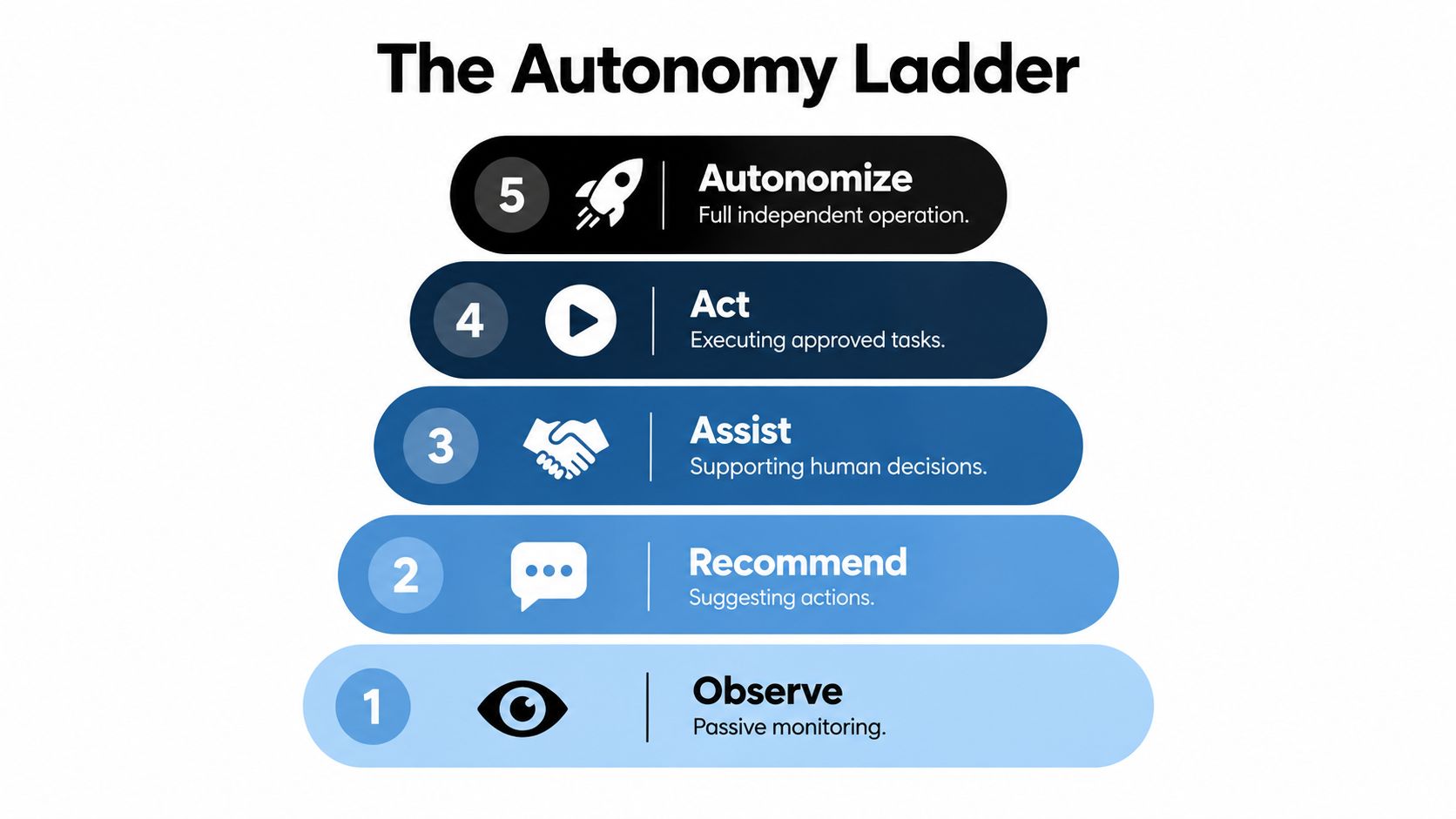
Make the autonomy ladder explicit. Five rungs cover nearly every sales workflow:
- Observe: The agent reads activity and summarizes what it finds. It doesn't recommend or change anything.
- Recommend: It identifies a possible next action, such as routing a lead, but a person decides whether to proceed.
- Draft: It prepares an email or CRM update for review. A person approves and sends.
- Execute within limits: It performs approved, bounded actions, such as updating specified fields or sending a preapproved follow-up when defined conditions are met.
- Execute independently: It manages a workflow without routine approval, subject to monitoring, auditability, and clear stop conditions.
Most production deployments belong at rung three or four.
Set confidence thresholds per action, based on its risk, not on a vendor's general claims about model accuracy. An agent might enrich an account record when the evidence is clear, but conflicting data should route to a person. Some actions stay off the ladder entirely: inventing a product claim, changing pricing, or promising a commercial outcome because a generated response sounds plausible.
The trust data supports this caution. SAS reports that 90% of marketers trust agentic AI to some extent, but only 5% express full trust, citing data exposure, governance, and ethical safeguards as leading concerns (the SAS study referenced in the opening section). The right response is controls: let teams see what the agent can access, what it can change, and when it must stop.
Field evidence points the same direction. In a randomized experiment involving roughly 44,000 consumers, GenAI pre-sale replies raised sales by 16.3% and conversion by 21.7% versus no pre-sale service. A human-in-the-loop design performed better still, lifting sales by 25%, and customers in that group spent 11.5% more than those served exclusively by human agents (field experiment on GenAI and pre-sale support). The strongest results came from pairing automation with deliberate human intervention.
Control principle: Every autonomous action needs an owner, an audit trail, and a way to stop or reverse it.
For teams building those guardrails, a practical workflow automation guide can clarify how tasks, conditions, and handoffs fit together. For designing human review into automated workflows, see Cyndra's guide to human-in-the-loop automation.

A 60-Day Path From Pilot to Production
A pilot should earn more authority as it proves itself. Start with one workflow, one accountable owner, and a baseline that shows what happens before the agent is introduced.
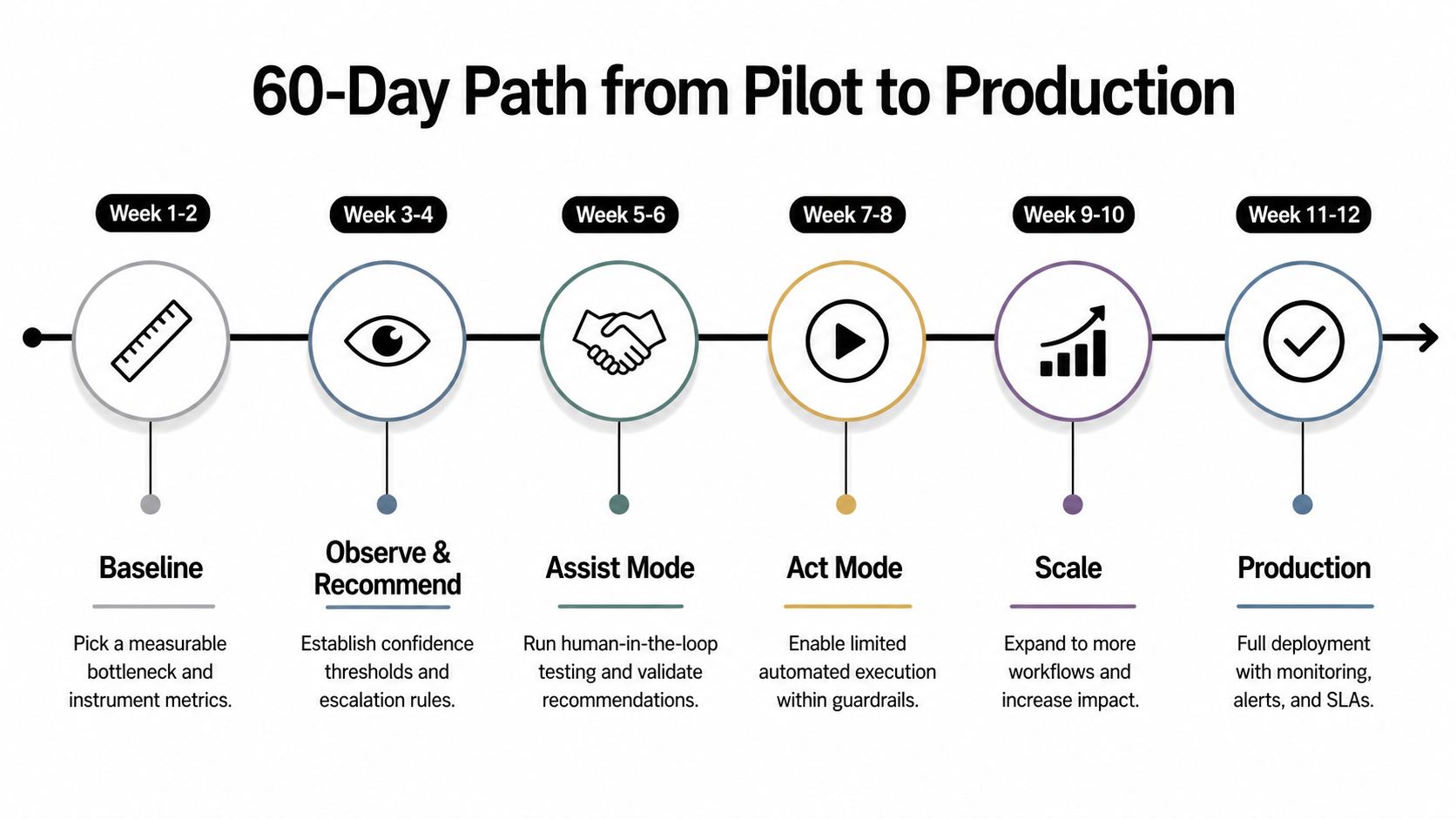
Weeks one and two, establish the baseline. Choose a bottleneck such as slow inbound response or repetitive prospect research. Record the existing process, define which data the agent can use, and decide which actions require approval. Write down escalation rules before configuring the workflow.
Weeks three and four, observe and recommend. Run the agent in shadow mode. Let it analyze real work and propose actions, but don't let it change customer records or contact prospects. Compare its recommendations with human decisions and review errors, missing context, and unnecessary escalations.
Weeks five and six, assist. Let the agent draft messages, summaries, or CRM updates for a human to review. Keep an audit log, define who can approve actions, and document how to disable the workflow or reverse changes.
Weeks seven and eight, execute within limits. Give the agent permission to complete a narrow set of low-risk actions under clear conditions. Keep unusual cases, sensitive claims, and customer commitments with a human. At the end of the pilot, compare results with the baseline and decide whether the system has earned a wider role.
Use prompts that make evidence, uncertainty, and boundaries explicit:
Prospect research prompt: “Summarize this account using the approved CRM and research sources. Separate confirmed facts from inferences. Identify relevant engagement history, note missing information, and draft a short briefing for the sales representative. Do not contact the prospect or update CRM fields.”
Inbound qualification prompt: “Review the inbound inquiry and summarize the stated need, product fit, and information still missing. Recommend a routing action with reasons. If the request involves pricing, a custom commitment, or an unclear product claim, escalate to a human and do not draft a definitive answer.”
Track response latency, qualified-lead rate, conversion, revenue per opportunity, escalation rate, and post-sale satisfaction separately. A combined score can hide a system that responds faster but sends poor-fit leads to sales. WFDSA reported approximately $167.694 billion in global direct-sales revenue and 102.9 million representatives in 2023, with the representative count down roughly 20% from its 2021 peak (WFDSA historical direct-selling data). That history reinforces an operational point: plan for effective processes, not more people. Cyndra's AI agent integration guidance can help teams think through how agents connect to existing systems and workflows.
Choosing a Sales Marketing Agent and a Representative Case
Choose a vendor by testing what happens when the workflow encounters uncertainty, not by watching a polished demonstration. A good evaluation should include your CRM fields, your approval rules, and examples where the correct action is to stop and ask a human.
| Criterion | Ask the vendor |
|---|---|
| Security and data residency | What data can the agent access, where is it handled, and how are permissions limited? |
| Integration depth | Can it read and update the CRM and other required systems, with a clear record of each change? |
| Governance and audit | Can we inspect actions, approvals, failed attempts, and the evidence behind recommendations? |
| Workflow customization | Can we define our own escalation rules, prohibited actions, and approved language? |
Then run a realistic test. Give the system an incomplete lead record, conflicting account details, and a customer question involving a commitment it isn't authorized to make. A trustworthy agent should distinguish facts from assumptions, record uncertainty, and escalate the sensitive decision rather than filling the gap with confident prose.
Tool comparisons can help establish a shortlist, especially when they focus on sales intelligence capabilities; this overview of tools compared by Fetchin is one place to begin. Still, a category comparison can't answer whether a tool fits your data model or operating rules. Test those directly.
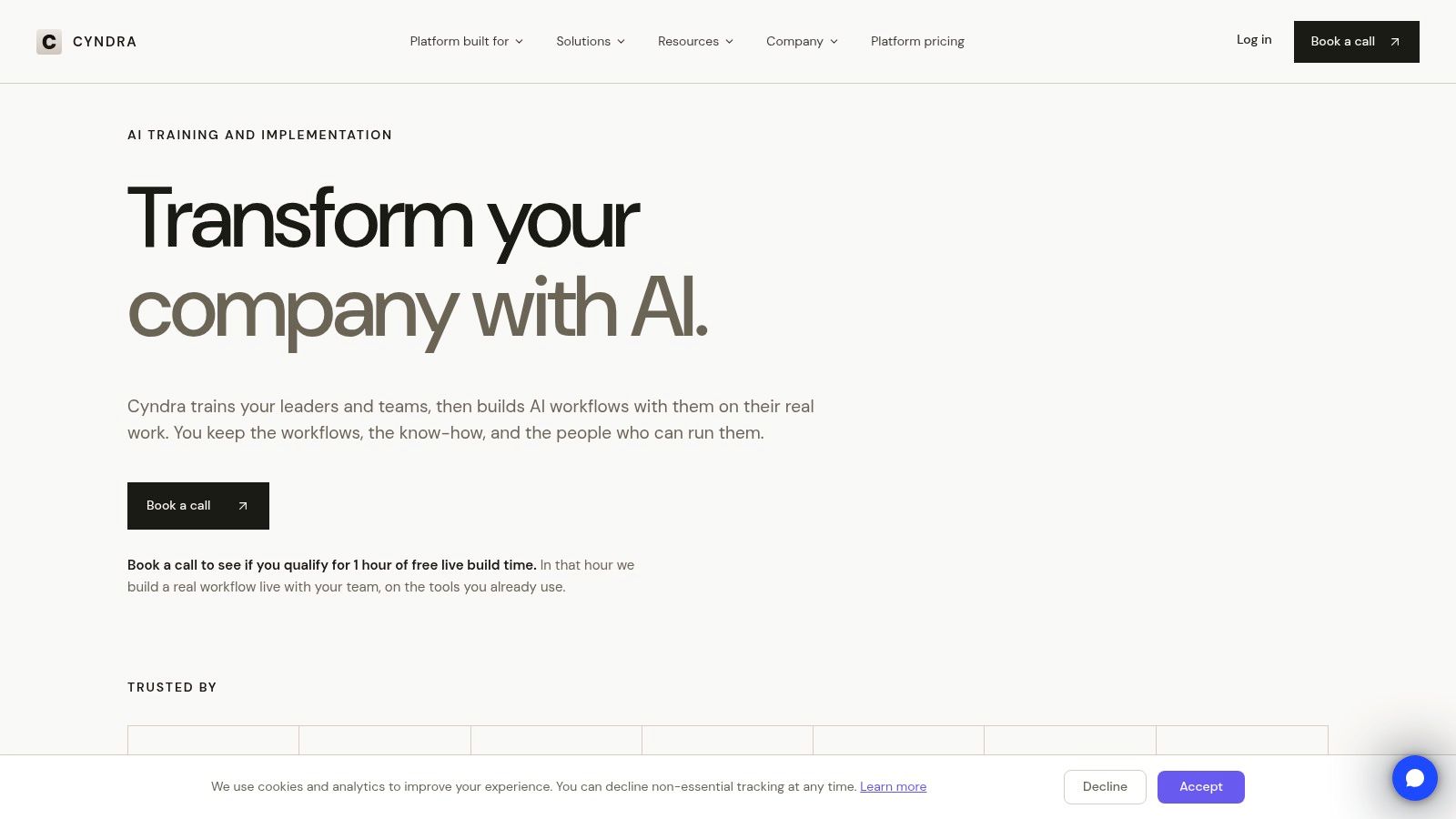
A representative implementation pattern is to automate a sales cycle internally, then apply the same operating discipline to customer-facing workflows. Cyndra describes work that includes an internally battle-tested automated sales cycle, portfolio-wide website optimization, and customer analysis associated with six-figure savings. Those examples show different uses of automation, but they don't remove the need to validate fit, controls, and results in your own environment.
What to Do This Quarter
Pick one revenue bottleneck and give it a named owner. Set the agent's autonomy level before deployment, define its escalation rules, and record the baseline for the metrics that matter. Run the pilot, compare results, and expand only the actions the evidence supports.
Watch the relationship between escalations and commercial outcomes. If the escalation rate rises without a matching revenue lift, don't scale the workflow yet. Investigate whether the agent lacks usable context, whether the rules are too broad, or whether the task belongs with a person.
The decision for Monday morning is straightforward: choose one bottleneck, set the agent's authority, measure the baseline, and let a controlled pilot determine whether it earns more autonomy.
Cyndra helps operators turn real sales and marketing workflows into managed AI agents that can research prospects, qualify leads, draft follow-up, and update CRM records under defined controls. If you're ready to assess a workflow and plan an implementation, visit Cyndra.