 CYNDRA
Most advice about an AI agent for content creation starts with the wrong question. It asks how quickly a model can write a blog post, social caption, or product description. That treats content production as a typing problem, when the operational burden usually sits in research, approvals, revisions, formatting, distribution, and measurement.
A production-grade agent is better understood as workflow infrastructure. It retrieves approved information, creates drafts across formats, checks claims, applies brand rules, requests approval when risk is high, publishes through connected tools, and records what happened. The writing matters, but reliable coordination matters more.
Table of Contents
- Redefining the AI Agent for Content Creation
- The Evolution from Generative Models to Autonomous Agents
- Architecting a Tool-Using Verification Workflow
- Real-World Applications Across Marketing and Operations
- Designing the Operating Model for Trust and Governance
- How Cyndra Deploys and Operationalizes AI Employees
- Measuring Durable Business Impact Beyond Content Volume
Redefining the AI Agent for Content Creation
The simplest version of AI content creation is a person opening a chatbot, entering a prompt, copying the result, and deciding what to do next. That can be useful for isolated tasks, but it isn't an agent in the operational sense. The human still supplies the context, manages every handoff, checks the output, adapts it for each channel, and initiates distribution.
An AI content agent coordinates those steps within defined permissions. It might turn a campaign brief into a research record, an article outline, a long-form draft, a video script, social adaptations, an email sequence, and a publishing queue. Each output should inherit relevant context from the previous step instead of forcing a marketer to copy and paste information between disconnected tools.
A 2025 Wondercraft survey reported by MediaPost's coverage of creator AI adoption found that more than 80% of creators use AI in at least one part of production, while 40% use it across the workflow from beginning to end. The same survey reported video as the leading format, prioritized by 52.5% of creators, with audio gaining importance in learning, accessibility, and internal communications.
Those figures point to an important distinction. Using an image generator for a campaign asset isn't the same as running an agent that coordinates ideation, writing, video adaptation, audio production, review, and distribution.
The unit of value is the workflow
A useful agent reduces unnecessary handoffs without hiding decisions. It should know which information is authoritative, which channels require different formats, which claims need evidence, and which actions require a person.
For an ecommerce operator, the workflow might connect product data, customer questions, merchandising priorities, creative templates, and publishing tools. A practical overview of this broader automation category is available in DTC agents for ecommerce, especially for teams thinking beyond standalone copy generation.
The agent's value comes from repeatability:
- One source of context: Product facts, positioning, audiences, and brand rules stay available throughout the run.
- Multiple outputs: A core idea can become an article, product explanation, email, video script, and social post without separate briefings.
- Controlled distribution: The system can prepare or publish content through approved channels, depending on its permission level.
- Recorded decisions: The team can inspect sources, revisions, approvals, and publishing events later.
Practical rule: Don't measure an agent by how impressive its first draft looks. Measure whether it completes the right workflow with fewer uncontrolled handoffs.
The right evaluation question is therefore not, “Can this model write?” It is, “Can this system reliably move a governed content job from brief to business outcome?”
The Evolution from Generative Models to Autonomous Agents
Earlier content automation relied on fixed rules, templates, and predictable inputs. Those systems could merge a product name into a template or send a scheduled message, but they struggled when a task required interpretation. They couldn't reliably decide which research mattered, change an argument for a different audience, or revise an output when evidence contradicted the initial brief.
Modern agents became practical after deep generative models improved across language, images, audio, and video. A historical review in the National Science Review describes how deep generative models displaced traditional approaches for many generation tasks during the late 2010s and became commercially usable in the early 2020s. The review also notes that generated material became realistic enough to sometimes be indistinguishable from authentic material.
That progression changed the role of automation. A template system follows a predefined path. A generative system can interpret an instruction, produce a novel draft, revise it, and transform it into another format. An orchestration layer can then connect that capability to a content calendar, knowledge base, customer data, approval queue, CMS, and performance dashboard.
Generation is only one layer
An agent isn't defined by the model alone. The model supplies language or media generation, while the surrounding system supplies memory, tools, rules, state, and escalation.
A content workflow may contain these layers:
- Intent: A brief identifies the audience, objective, format, topic, and commercial context.
- Retrieval: The agent fetches approved documents, product records, previous campaign material, or current sources.
- Planning: It selects an angle and maps the required outputs.
- Generation: It drafts text, image prompts, scripts, metadata, or channel variations.
- Verification: A separate process checks evidence, policy, tone, and completeness.
- Action: The system saves, routes, schedules, or publishes the approved package.
- Feedback: Performance and reviewer decisions become structured input for later runs.
This pattern also applies outside publishing. For example, a voice system that handles automated booking via voice still needs intent recognition, tool calls, permissions, fallback handling, and confirmation logic. Content agents face the same architectural question: what may the system decide independently, and what must it confirm?
The shift from generation to orchestration explains why a single impressive demo proves little. A demo can produce a plausible paragraph. A production system must preserve context, expose uncertainty, recover from tool failures, and leave an audit trail.
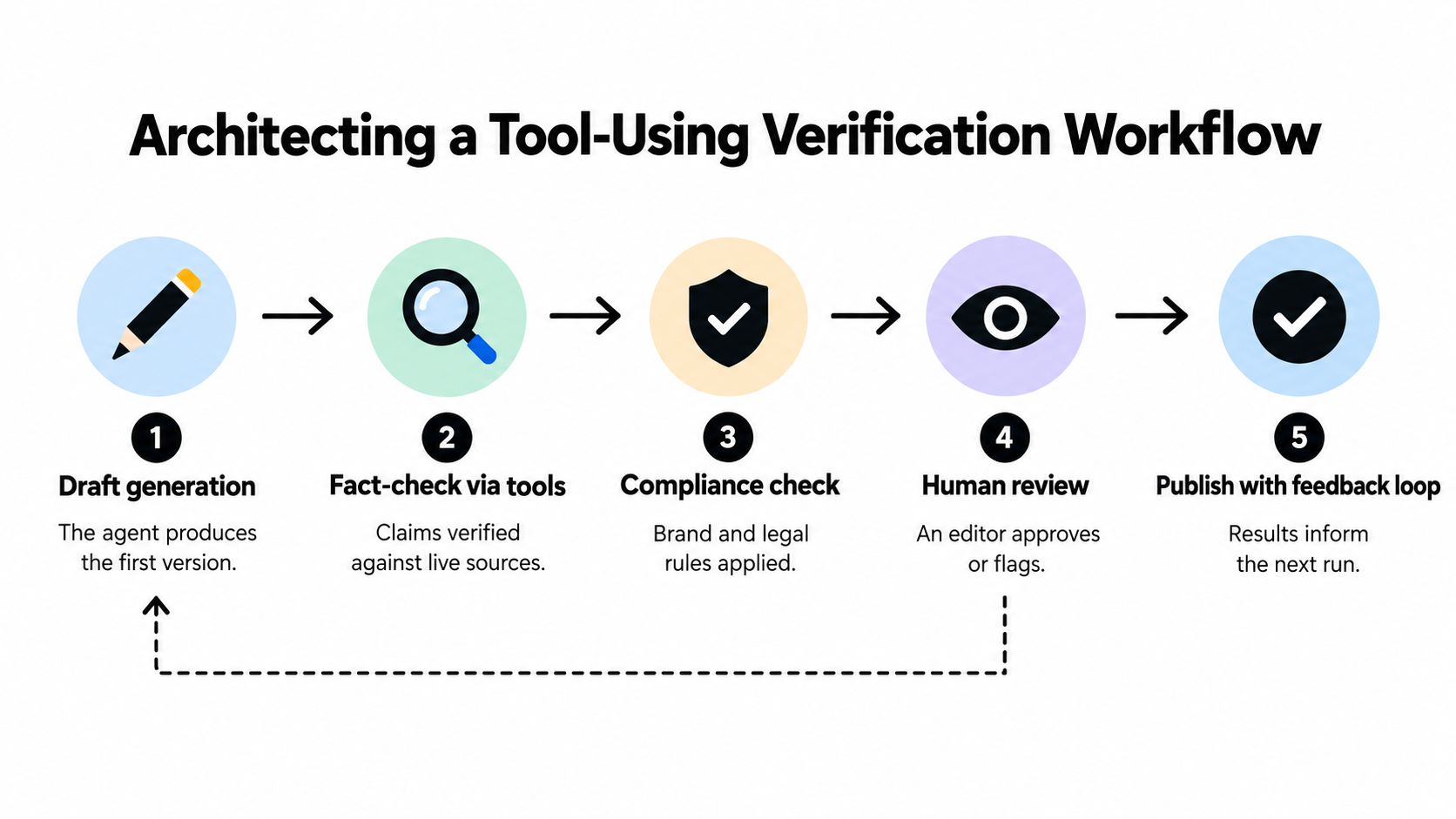
Architecting a Tool-Using Verification Workflow
A single-pass generator is a liability when content contains externally verifiable claims. Fluency doesn't prove accuracy, and a confident sentence can conceal a weak source or an unsupported inference.
The FACTSCORE methodology and related benchmarking support evaluating factuality at the atomic-claim level. Instead of judging whether an article sounds credible, the system breaks it into individual claims and checks whether reliable evidence supports each one. The benchmark evidence also indicates that retrieval augmentation can improve factuality, while natural-sounding output and factual reliability don't always rank models in the same order.
A practical pipeline separates writing from verification.
Build the pipeline in stages
1. Extract the brief. Convert the request into structured fields such as audience, purpose, required claims, prohibited claims, format, target channel, and approval owner. Reject incomplete briefs before the agent starts drafting.
2. Retrieve evidence. Search approved knowledge bases and external sources according to the content's risk level. Store the source, retrieval time, relevant passage, and permitted use rather than passing a loose summary to the writer.
3. Create the outline. The planner should map each major point to evidence or mark it as interpretation. This prevents the writer from filling unsupported gaps because the outline contains an empty heading.
4. Draft at claim level. Generate paragraphs, but attach claim identifiers internally. Each factual statement should point back to a source or be marked as opinion, recommendation, example, or unresolved.
5. Verify independently. Use a separate verifier with access to retrieved evidence. It should return structured outcomes such as supported, unsupported, contradicted, or undecidable.
6. Route the result. Publish low-risk material only when it passes defined gates. Send ambiguous, regulated, commercially sensitive, or high-impact content to a human reviewer.
The FELM benchmark evaluates fine-grained factuality by segmenting responses into spans and labeling errors, reasons, and supporting references. Its findings reinforce why a verifier shouldn't only ask whether a draft “looks accurate.” The verifier needs external evidence and a defined output schema. Teams can then monitor claim-support rate, unsupported-claim rate, citation coverage, and reviewer overrides.
Verification should be a system boundary, not a sentence in the prompt.
The implementation details resemble secure software design. An agent that can retrieve sources, update a CMS, and publish content has permissions and failure modes that deserve the same seriousness as other internal automation. Guidance on AI coding security offers a useful adjacent perspective on access control, tool boundaries, and operational risk.
For a more detailed view of how state, tools, and approval nodes fit together, compare this AI agent workflow architecture. The important design choice is separation. The writer shouldn't be the only judge of its own output, and the verifier shouldn't rely on the draft without consulting the evidence.

Before publication, require a support record for every material claim. At minimum, that record should contain the source, retrieval timestamp, confidence or support label, and reviewer status. This makes quality measurable and gives engineers concrete failure data for improving retrieval, prompts, routing, and model selection.
Real-World Applications Across Marketing and Operations
The strongest use cases don't begin with “write something.” They begin with a repetitive business process that already has inputs, decisions, outputs, and a clear owner.
Consider a sales research workflow. The agent receives an account list, retrieves approved company and product information, identifies relevant business context, drafts a customized message, and stores the evidence behind each personalization point. It can prepare the outreach sequence, but a sales manager might still approve the first message for strategic accounts. The gain comes from removing research and formatting work while keeping judgment over the relationship.

Product content needs structured inputs
Ecommerce teams can connect an agent to a product information system, merchandising rules, customer questions, and channel templates. The agent can draft descriptions, comparison copy, buying guides, email snippets, and social adaptations from the same approved product record.
That setup works better than asking a general model to “make this product sound premium.” The system can distinguish a verified material specification from a positioning statement, avoid prohibited promises, and flag missing data instead of inventing an answer. Operators who want to connect content with broader marketing workflows can review AI agents for marketers as a reference point for the kinds of cross-functional tasks an agent can coordinate.
Support content can become a feedback loop
A support agent can classify incoming questions, retrieve approved answers, draft a response, and identify recurring information gaps. Those gaps can feed a content queue for help-center articles, onboarding emails, product education, or troubleshooting videos.
The boundary matters. Tier-one questions with clear answers may be suitable for automated responses after validation. A complaint involving a refund, legal exposure, safety issue, or unusual account history should route to a person. The agent can still prepare the case summary and recommended response without taking the final action.
A similar pattern works for content repurposing. Start with a source interview, webinar transcript, product announcement, or customer insight. The agent extracts themes, proposes channel-specific adaptations, creates a review package, and sends each version to the correct destination. The team isn't asking one model to perform every task blindly. It is assigning narrow jobs inside a connected process.
What fails in practice is usually not the draft itself. Common failure points include stale product data, unclear ownership, missing approval states, inconsistent channel rules, and publishing integrations that don't return a reliable status. An agent needs fallbacks for each one, including a manual queue when evidence is incomplete or a tool call fails.
The best first workflow is usually boring, repetitive, and easy to audit.
Start there. Once the system demonstrates stable performance, expand its permissions gradually. Don't begin with autonomous publishing across every channel just because the API makes it possible.
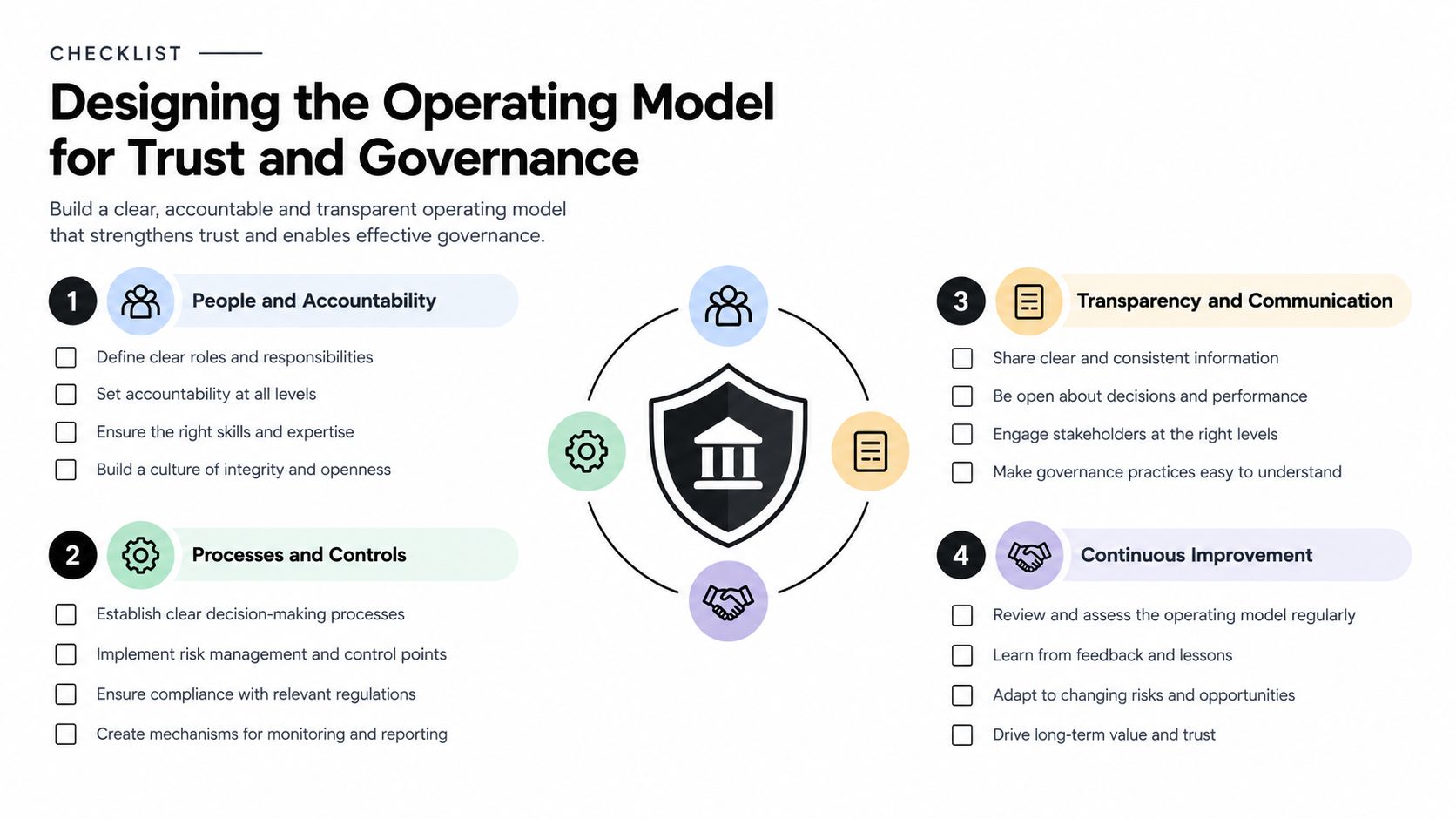
Designing the Operating Model for Trust and Governance
Generation speed is rarely the lasting bottleneck. Governance is. A team can produce drafts quickly and still move slowly if nobody knows who approves them, which sources are allowed, or what happens when the agent is uncertain.
Enterprise research reported by Markup's AI survey report found that 92% of organizations increased AI use for content creation over the past year, but only 33% considered their content guardrails strong and consistently applied. The report also found that 80% still relied on manual reviews or spot checks. Leaders identified regulatory violations at 51%, copyright and intellectual-property issues at 47%, inaccurate information at 46%, and brand misalignment at 41% among their concerns.
The conclusion isn't that human review has failed. It's that informal review doesn't scale well. A reviewer who checks everything manually becomes a bottleneck, while a reviewer who checks randomly creates inconsistent protection.
Define permissions before prompts
Give the agent a written action policy. It should specify what the system may read, create, change, send, and publish.
A useful permission model separates actions into three classes:
- Autonomous actions: Formatting, summarization, internal tagging, draft creation, and routing can often run without approval when the input is trusted.
- Conditional actions: Updating a content calendar, generating customer-facing variants, or preparing a campaign can require evidence checks and an owner's approval.
- Human-only actions: Regulated claims, legal statements, financial promises, sensitive customer responses, and irreversible publishing decisions should remain behind an explicit gate.
Escalation thresholds should be concrete. Route content when the verifier finds a contradiction, when a material claim lacks a source, when the confidence label falls below the permitted level, or when the draft contains restricted language. The agent should stop rather than improvise.
Make accountability inspectable
Maintain an audit trail for the brief, source documents, prompts or instructions, model outputs, tool calls, revisions, reviewer decisions, and final publication event. Store the version of the knowledge base used for the run. Without that history, a team can't explain where a claim came from or determine whether a later correction affects published assets.
The approved knowledge base also needs an owner. Someone must remove outdated information, mark superseded documents, and decide whether external research may be used. Brand guidance should include positive examples, prohibited language, audience-specific rules, and criteria for human escalation.
The AI governance and compliance guide is a useful reference for turning broad governance principles into operating controls. The practical objective is not to eliminate people. It is to move human attention toward ambiguity, risk, and judgment while allowing the system to handle predictable execution.
A human-in-the-loop model works only when the human receives the evidence, the uncertainty, and a clear decision to make.
That is more effective than sending an editor a polished draft with no source trail and asking for a general “quick check.”
How Cyndra Deploys and Operationalizes AI Employees
A production deployment starts with the workflow, not the model. The implementation team first maps how work moves through the organization, where people copy information between systems, which decisions repeat, and where exceptions require experience.
Cyndra's approach follows a practical path from consultation to implementation and transformation. The consultation phase identifies a valuable workflow and defines the business outcome. Implementation turns that workflow into a connected agent with access to the relevant tools, data, rules, and approval states. Transformation focuses on operating the system, reviewing results, and expanding into adjacent processes when the evidence supports it.
Connect the agent to existing operations
A content agent shouldn't live in an isolated chat window. It may need product information from Shopify, customer context from a CRM, campaign data from advertising platforms, creative assets from Canva, publishing access to a CMS, and performance signals from analytics systems.
The integration pattern determines the quality of the result. If the agent can't access current product data, it may produce accurate-sounding but outdated copy. If it can't receive conversion or retention signals, it can optimize for output volume rather than commercial value. If it has broad write access without approval states, a small mistake can propagate across multiple channels.
Cyndra describes its AI employees as systems that work with existing tools across sales, support, operations, marketing, and recruiting. For content teams, that means the agent can research, draft, adapt, schedule, publish, and measure within a governed workflow rather than forcing staff to assemble each asset manually.
Train for the exceptions
Training an agent isn't only a matter of providing brand examples. The team needs to show it how to handle missing information, conflicting instructions, unusual customer requests, and approval rejection. Those exception paths often determine whether the system is safe enough for daily use.
A sensible rollout begins with drafts and recommendations. Reviewers log why they edited, rejected, or escalated an output. Engineers then convert recurring decisions into source rules, validation checks, or routing conditions. Publishing permissions can expand after the workflow demonstrates dependable behavior, but the audit trail should remain in place.
The result is a division of labor. The agent handles research, transformation, formatting, and routine coordination. People retain responsibility for strategy, factual accountability, legal judgment, originality, and reputation. That arrangement can increase capacity without treating headcount reduction as the only measure of success.
Measuring Durable Business Impact Beyond Content Volume
Content volume is easy to count and easy to misunderstand. An agent can create more drafts, publish more pages, and generate more impressions without improving qualified demand or customer outcomes.
A reported experiment involving 2,000 AI-generated articles across 20 new domains found that the pages initially indexed and ranked but reportedly disappeared from Google results after three months. The pages generated 122,102 impressions and 244 clicks, according to the supplied research. Those results don't prove that all AI-generated content fails. They do show why publishing activity isn't a substitute for durable performance.
The Adobe report on content management and digital trends identifies data integration and data-quality issues as major obstacles to agentic AI implementation for 75% of organizations. Without connections to analytics, CRM, commerce, and finance data, a content agent can't reliably distinguish attention from commercial progress.
Compare operational output with business value
Track production metrics, but don't stop there.
| Output measure | Durable measure |
|---|---|
| Drafts created | Qualified pipeline influenced |
| Pages published | Conversion quality and assisted revenue |
| Social posts scheduled | Engagement from target accounts |
| Impressions | Search visibility that persists and supports intent |
| Review time | Reviewer override rate and risk exposure |
| Repurposed assets | Customer-service resolution or retention impact |
Each workflow needs a primary outcome before automation begins. For an SEO program, that might involve qualified organic visits, assisted conversions, content decay, and claim-support coverage. For support content, it may involve resolution quality and escalation patterns. For sales enablement, it could involve the usefulness of research and the quality of accepted opportunities.
If the agent isn't connected to the outcome system, it can only prove that it produced activity.
Use a baseline period, define the events that count, and tag agent-assisted work so downstream results remain attributable. Review both gains and costs, including editor time, corrections, escalations, source maintenance, and compliance incidents.
The right question isn't whether every workflow deserves full autonomy. It's which workflows produce measurable value with acceptable risk, and which should remain controlled experiments until the data becomes clearer.
Cyndra installs, trains, and manages AI employees that connect content workflows with the tools, approvals, and business data your team already uses. If you want to replace disconnected content tasks with a governed agent that researches, creates, distributes, and measures output, visit Cyndra to discuss the workflow you want to operationalize.