 CYNDRA
The most popular advice about competitive intelligence software is to monitor more competitors, connect more feeds, and let AI summarize everything. That's a good way to build a crowded inbox. Buy a system that helps your team defend a decision, not one that produces the longest activity feed.
For founders and COOs, the core requirement is source lineage, confidence labels, change history, and human approval before a high-impact recommendation becomes company policy. Collection can be automated. Accountability can't.
Table of Contents
- What Competitive Intelligence Software Is Built to Do
- Core Features and Data Sources to Require
- Score Platforms on Evidence Not Alert Volume
- From Intelligence Question to the Right Desk
- Keep Battlecards Current Enough for Live Deals
- Packaged SaaS Versus a Custom Internal Agent
- Lawful Collection Rules for Always-On Agents
- Buyer's Checklist Before Signing
What Competitive Intelligence Software Is Built to Do
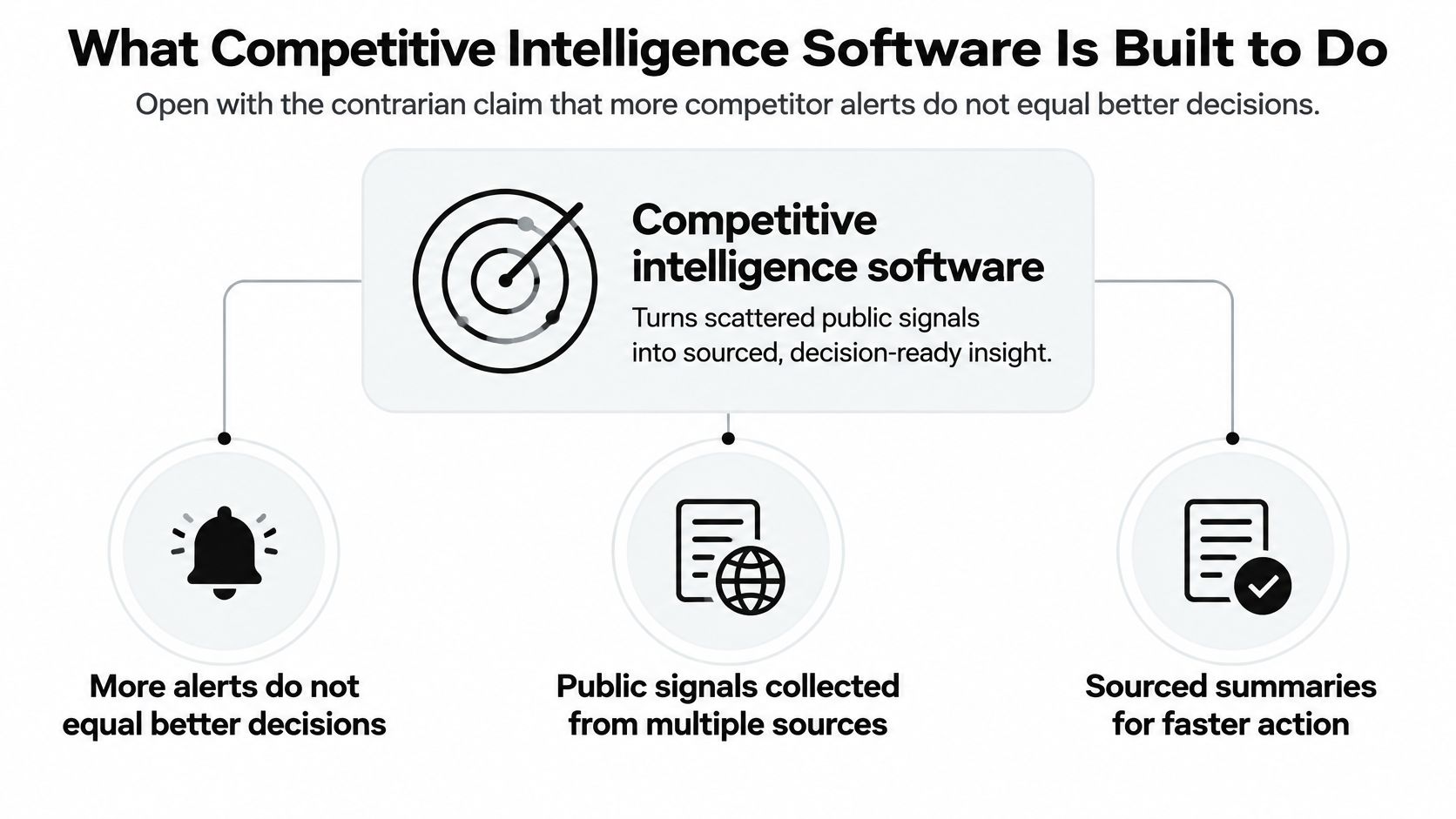
More competitor alerts don't equal better decisions. Say a rival changes its packaging page before your sales team enters a renewal negotiation. A notification that says “website updated” adds work. A sourced comparison showing which capability moved into a premium tier gives the account owner something useful.
Competitive intelligence software turns scattered public signals into sourced findings that sales, product, marketing, and leadership can use on a repeatable cadence. Its job isn't merely to archive pages. It should connect a change to the business question someone needs answered.
Think of a weather station. A stack of old forecasts isn't the same as a station that timestamps each reading, identifies a meaningful change, and routes a warning to the person responsible for acting. Your intelligence system needs that same distinction between stored information and operational awareness.
The workflow should look like this.
Cloud delivery changes the buying decision
Entering 2026, buyers should distinguish market projections from actual operating requirements. Mordor Intelligence's competitive intelligence tools market analysis estimated global spending at USD 590 million in 2025 and projected USD 1.46 billion by 2030, representing a 19.96% compound annual growth rate. The same analysis put cloud deployment at 78.04% of market share in 2024.
The practical implication isn't that every company needs an enterprise intelligence suite. Cloud delivery makes continuous monitoring possible without assigning your team to maintain collection infrastructure. But accessible infrastructure doesn't remove the need to decide what deserves attention.
For an ecommerce operator, the relevant question might concern a rival's offer, merchandising, or positioning rather than an enterprise product roadmap. AdLibrarySpy's a research guide for ecommerce teams provides useful context for defining that narrower scope before choosing software.
Buy an operating capability
Require a prospective platform to demonstrate an entire decision cycle. Give it a competitor page, ask what changed, inspect the evidence, and follow the finding into the destination where someone will use it. Don't accept a polished summary as proof that the workflow works.
The category label matters less than that demonstration. A market intelligence platform, sales enablement product, or custom agent can all contribute, but none deserves credit for information that remains unread.
Buying test: A finding is useful only if it reaches the responsible decision-maker, with a source and a date, before the decision.
Core Features and Data Sources to Require
Require approved-source collection, meaningful change detection, evidence storage, decision-specific analysis, and role-based delivery. Treat these as connected capabilities. Excellent collection won't compensate for findings that arrive without context or disappear into an analyst-only dashboard.
Storage should preserve the source, timestamp, extraction method, and confidence of each item. Analysis should support the actual task, such as positioning comparisons, industry structure, or deal analysis. Delivery should connect to your CRM, enablement library, and existing chat tool through workable integrations.
Data sources and their freshness checks
| Source | Signal it carries | Freshness check |
|---|---|---|
| Competitor websites | Packaging, product claims, messaging | Crawl date and change history |
| Pricing pages | Price and discount structure | Recrawl on every detected change |
| Review platforms | Customer language and objections | Review date and duplicate removal |
| Job postings | Hiring intent and team focus | Posting date and closure tracking |
| Regulatory filings | Financial facts and disclosures | Filing date and document version |
| Analyst coverage | Market framing and category shifts | Publication date and reuse terms |
| Win-loss interviews | Reasons deals were won or lost | Interviewer disclosure and interview date |
Test the connection, not the integration logo
Have the implementation team demonstrate authentication, field mapping, permissions, and write-back in a test environment. An integration that can export a PDF isn't equivalent to updating the competitive record attached to an opportunity. Record which destination systems have usable APIs and which require another supported connection method.
Before expanding coverage, decide how you'll measure competitive intelligence performance, using WebscrapingHQ's guide as a starting point for the measurement conversation. Assign a business owner to each output and confirm where they'll consume it. Otherwise, you're buying collection capacity without establishing demand for its results.
Score Platforms on Evidence Not Alert Volume
Judge competitive intelligence software by whether a reviewer can reconstruct its conclusions.
| Test | Pass looks like | Fail signal | Act only when |
|---|---|---|---|
| Recency | Timestamp plus a maximum age, and stale battlecard text auto-invalidates | Undated PDFs or a crawl with no change history | The source is inside the age threshold |
| Independence | Duplicate syndication collapsed to one underlying source | The same press release counted as separate confirmations | At least one independent source remains |
| Corroboration | Price from pricing pages, hiring from jobs, financials from filings, deal reasons from win-loss | A single blog inference treated as fact | Distinct source classes agree, or a human marks the gap |
| Confidence | Each line tagged observed, estimated, or model-inferred, with conflicts visible | A summary with no label and no supporting link | Observed, or an estimate a named owner accepts |
| Business impact | Alerts limited to price, message, roadmap, or hiring changes | Every page edit notifies sales | The change would alter a live decision |
Research and Markets' competitive intelligence software market coverage identifies data noise and source reliability concerns among the category's challenges. Treat those as procurement risks, not inconveniences your analysts will somehow absorb.
Examine the evidence behind a claim
Recency means more than showing when the agent generated its answer. A summary written this morning can still rely on an obsolete product page. Inspect the underlying observation time and the maximum acceptable age for that claim.
Independence requires tracing the original publisher. A press release copied into news aggregators remains the same underlying announcement. The platform shouldn't turn distribution into apparent corroboration.
For corroboration, select the preferred source class before reviewing the answer. Use live pricing pages for published prices, filings for financial disclosures, reviews for customer language, and interviews for reported deal reasons. A review can reveal a buyer's objection without proving that the competitor lacks a feature.
Confidence labels must apply to individual claims. A job posting is an observed fact; a conclusion that the rival intends to launch a new business unit is an inference. If another source conflicts, retain both records until a named reviewer resolves the discrepancy.
Business impact determines interruption. A navigation edit belongs in the log. A packaging change affecting an active proposal deserves escalation. Use a defined competitor monitoring workflow to connect those triggers to owners rather than notifying everyone.
Demand pilot metrics that reveal mistakes
Build a reviewer-checked reference set during the pilot. Without it, you can count delivered alerts but can't judge what the platform missed.
- False-positive rate: Track flagged changes that reviewers determine weren't relevant or weren't real.
- False-negative rate: Compare material changes found through manual checks with those the system detected.
- Update latency: Measure median hours from a source change to the updated enablement record, while recording detection delay separately.
- Claim rejection: Record the share of generated claims reviewers reject, with reasons such as unsupported inference or incorrect scope.
Don't let a vendor substitute email opens for these measures. Opens describe delivery, not correctness.
A demo that can't show lineage on a live claim fails the scorecard, regardless of how polished its dashboard looks.
From Intelligence Question to the Right Desk
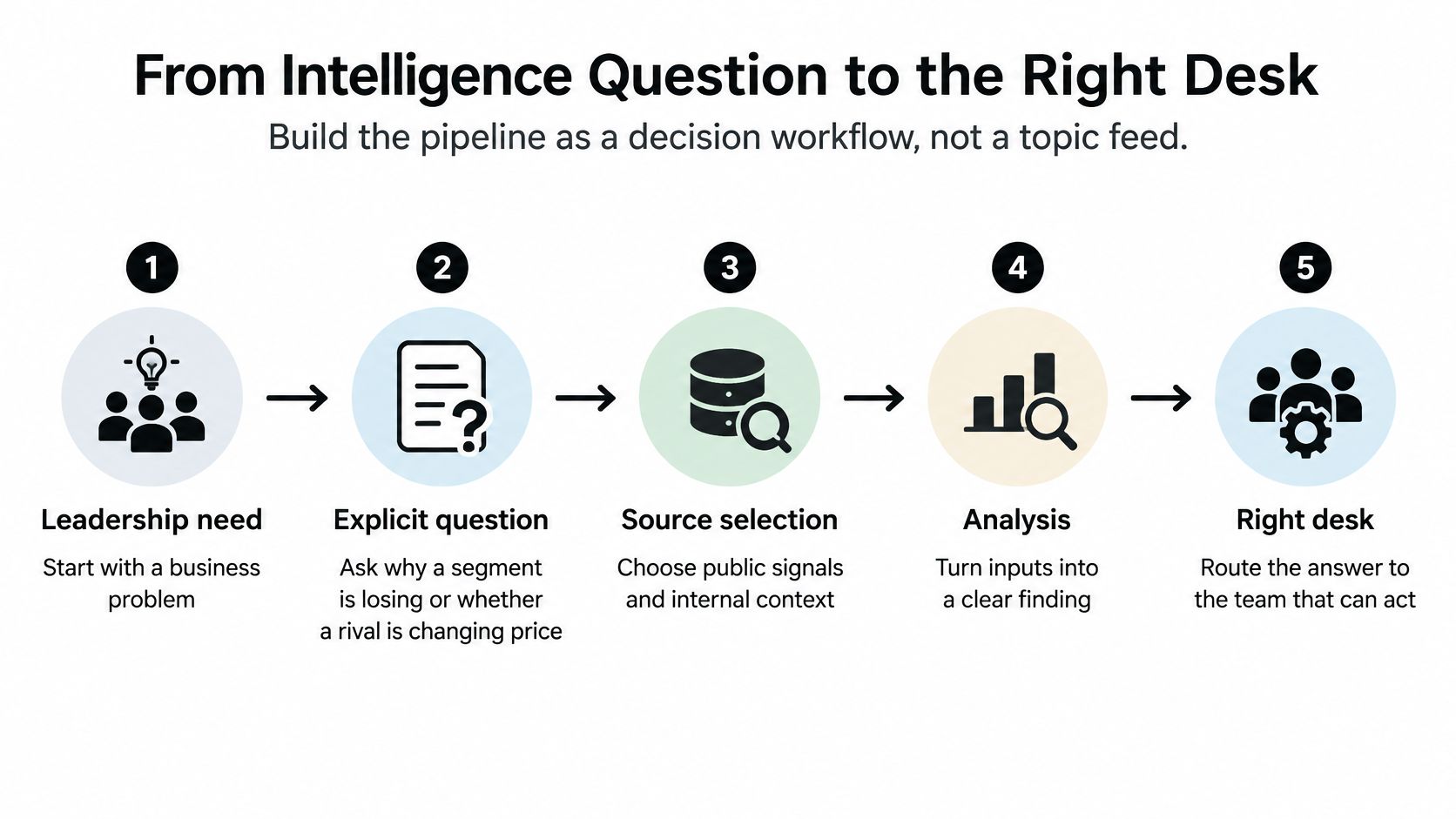
Start with a decision someone owns, not a competitor someone happens to recognize. SurveyMonkey's guide to competitive intelligence provides the foundation for connecting collection and analysis to business use. The operational discipline is to make that connection explicit before you configure monitoring.
This is the decision workflow to implement.
Build the pipeline around a question
Translate the leadership need. Replace “track our competitors” with “why are we losing renewals in this segment?” or “has the rival changed what its base package includes?” Record the decision deadline and the person authorized to act. That boundary prevents an open-ended research assignment.
Select named sources. Choose competitor sites, pricing pages, reviews, job postings, filings, and analyst coverage according to the question. Add authorized internal context, such as CRM records and disclosed win-loss interviews, without treating it as public information. A question about discount objections needs different evidence from a question about industry consolidation.
Preserve provenance during collection. Keep the original observation alongside its source, timestamp, extraction method, and confidence classification. Store an observed package entitlement separately from an inferred commercial motive. Once those are blended into a single summary, reviewers have to reconstruct the distinction manually.
Apply the right analytical method. Use a positioning matrix for messaging, Five Forces for industry structure, and win-loss patterns for deal questions. Don't force every question into a SWOT template. For a search-specific problem, a competitive intelligence workflow for SEO should examine search intent and content gaps rather than reuse a sales objection framework.
Deliver an audience-specific artifact. Sales receives a concise battlecard attached to the relevant opportunity. Product receives a feature-change brief that distinguishes announced capability from verified availability. Executives receive a decision memo with implications, alternatives, and unresolved questions, not a raw scrape.
Put a person in charge of interpretation
The COO should name an operating owner who maintains the questions, routing rules, and review queue. That person needn't approve every routine record update. They do need authority to resolve ownership gaps and stop unsupported conclusions from circulating.
An agent can collect, compare, summarize, and prepare a recommendation. The commercial owner approves a pricing response; the marketing owner approves positioning; the product owner decides roadmap implications. A human approval gate belongs at the business action, not merely at initial setup.
Success means sourced findings reach the responsible person before the decision, on a cadence the team can sustain. Write your three live intelligence questions before reviewing a feature list, because the questions determine the sources, analysis, and destination.
Keep Battlecards Current Enough for Live Deals
An industry analysis from NextLevel AI cites a 2024 survey in which 58% of CI teams struggled to keep battlecards and related content current and another 58% struggled to gather intelligence quickly enough; the analysis also reports that approximately 65% of software sales opportunities were competitive. Those figures describe a sales execution problem, not just a content backlog.
When pricing, capabilities, or positioning change faster than enablement material, representatives can repeat stale claims in precisely the conversations where buyers are comparing alternatives. Assign freshness to an operating owner and monitor it as a service-level objective.
Turn freshness into operating rules
- Trigger verification: Use change notifications or permitted event signals to initiate a recrawl. Keep scheduled checks as a fallback where event signals aren't available.
- Compare meaningful fields: Detect sentence-level or structured-field changes rather than treating every HTML difference as a commercial event.
- Timestamp evidence: Preserve when the source was observed, not just when a summary was generated.
- Invalidate dependent content: Mark affected battlecard sections unavailable for reuse until the replacement claim passes the required checks.
- Escalate aging evidence: Notify the content owner when a claim exceeds its agreed freshness threshold, even if no change was detected.
Retrieval needs the same discipline. Return the newest corroborated evidence, not merely the historical document with the strongest keyword match. Every generated sales claim should expose supporting material so a reviewer can inspect its scope.
Follow a pricing change through the workflow
Say a competitor replaces a sentence stating that an integration is included with wording that places it in a premium package. The agent records the before-and-after text, verifies the live page, and identifies the battlecard row that depends on it.
Within the agreed service level, the system marks the old row invalid and prepares a replacement description of the competitor's published packaging. It can update that factual record automatically if your approval policy permits. It shouldn't automatically recommend raising your price.
If a nearby discount note creates uncertainty about eligibility, route the ambiguity to the commercial owner. The representative should see the confirmed packaging change and a visible qualification, not an invented explanation of the discount policy.
Freshness rule: Never leave a confident old claim visible while a reviewer investigates whether it's still true.
Put hours from detected change to updated CRM or enablement record on the operating dashboard. Split automatic updates from human-reviewed updates so the COO can distinguish collection failures, integration failures, and approval bottlenecks. Also check whether representatives use the revised record in competitive opportunities.
Packaged SaaS Versus a Custom Internal Agent
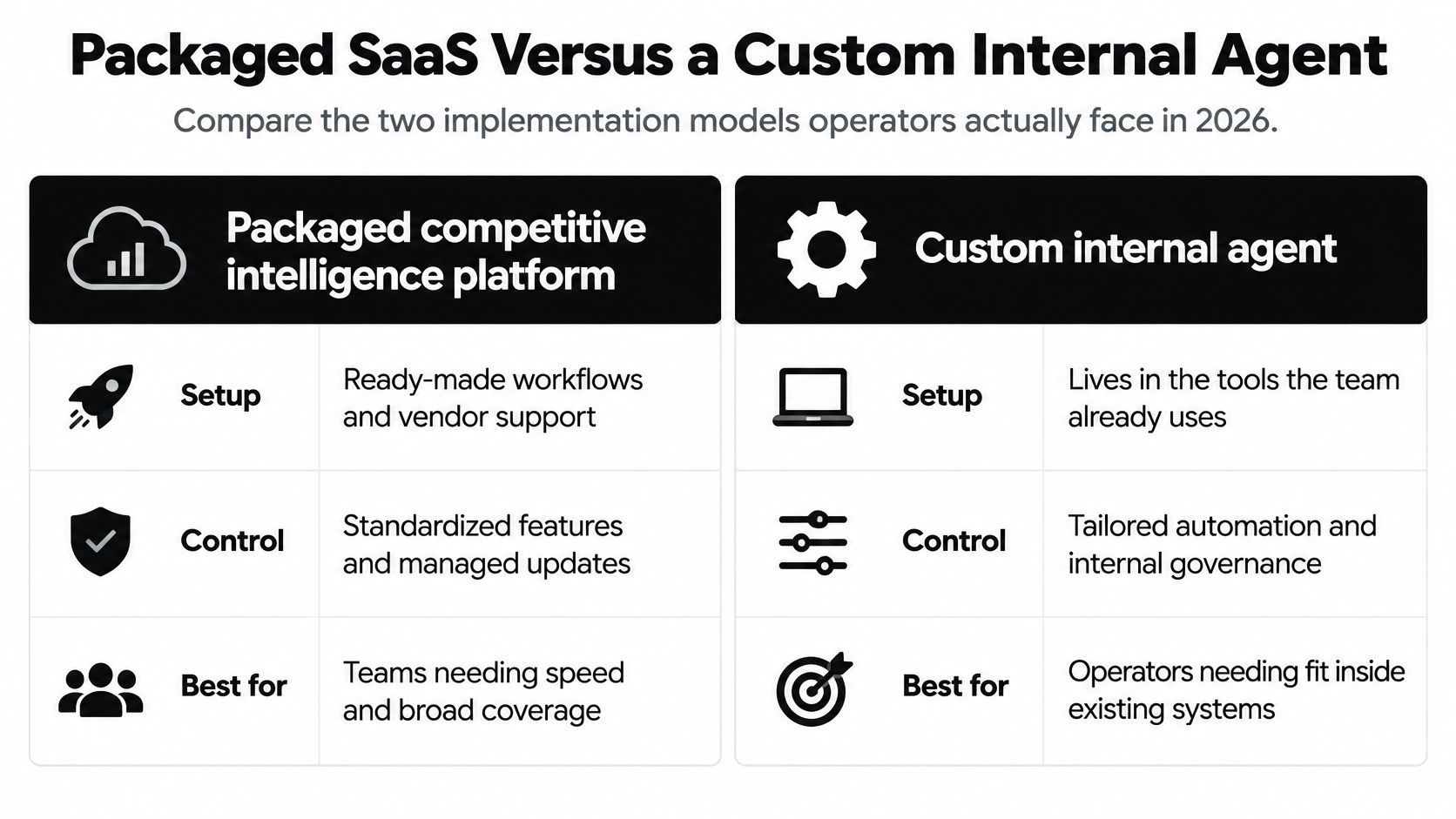
| Dimension | Packaged SaaS platform | Custom internal agent |
|---|---|---|
| Time to first useful output | Faster when sources and workflows match the vendor's standard setup | Requires workflow scoping and connection testing, especially where APIs are weak |
| Best-fit questions | Public page, price, review, and news monitoring shared by many buyers | Questions joining CRM, finance, ads, and internal notes |
| Freshness control | Vendor crawl schedule and available change settings | Buyer-defined age thresholds, field invalidation, and routing rules |
| Where people work | A CI application, integrations, and exports | Teams or existing tools, when designed for those channels |
| Governance | Vendor policy and available administrative controls | Explicit source rules, audit requirements, and named approvers |
| Cost shape | Subscription and seats, sometimes professional services | Implementation, ongoing maintenance, and expansion work |
| Who should choose it | Teams with a standard battlecard process and dedicated CI staff | Operators whose decisions cross systems and who can assign a workflow owner |
The implementation choice is about workflow fit, not whether custom technology is better by nature. Use this comparison to identify which responsibilities you're buying and which you'll retain.
Buy SaaS for a standard public-source workflow
Say your sales enablement lead needs competitor page monitoring and a maintained battlecard library. If the platform covers your sources, passes the evidence tests, and writes into the tools sales uses, buy the packaged product. Rebuilding ordinary monitoring infrastructure would add ownership without necessarily improving decisions.
Inspect the contract and administration model carefully. Confirm source coverage, usage limits, export rights, connector access, and what happens when a monitored page changes structure. Include implementation and ongoing administration in the comparison, not just the subscription.
Stimulead's AI build-or-buy decision framework is useful for separating reusable product capabilities from requirements specific to your operation. Keep that distinction explicit when stakeholders request customization.
Commission an agent for a cross-system decision
A different problem arises when the question is why competitor discounts are affecting margin in a particular segment. Answering it may require public offers, CRM opportunity history, finance records, and authorized meeting notes. A standalone competitor dashboard won't solve that problem merely by collecting more pages.
A custom agent can be designed around those connections and the team's existing channels. Weak APIs don't make custom work automatically easy. They make access testing, permission boundaries, failure handling, and maintenance responsibilities more important.
Cyndra is a services firm, not self-serve software, and customers don't need new software to work with us. We audit the customer's workflows, design and build the AI employee, train it on the business, and deploy it into existing systems and channels. After launch, coverage can expand across departments on a monthly retainer.
Use our custom AI agent development guide to frame the implementation discussion around tasks, connections, and ownership rather than a generic chatbot specification.
This video provides additional context for evaluating the implementation approach.

Custom work still needs acceptance criteria, a maintenance owner, and an exit plan for stored evidence and workflow logic. Don't commission it because a demo feels more flexible.
Buy SaaS when the workflow is generic and the evidence is public. Commission an agent when the decision depends on systems your team won't abandon.
Lawful Collection Rules for Always-On Agents
Lawful competitive intelligence starts with honest methods. Aqute's guidance on competitive intelligence ethics and legal risk identifies deception, confidential information, stolen documents, and misuse of personal data as risk areas, and describes the professional requirement to disclose identity and organizational affiliation before interviews.
Treat compliance as a daily operating model. Public availability isn't blanket permission to collect, retain, or redistribute material. Have counsel assess applicable jurisdictional requirements, site terms, licensing, and privacy obligations before enabling sensitive collection.
Separate approved sources from prohibited methods
Candidates for the approved-source list, subject to those checks, include:
- Company publications: Public websites, pricing pages, and product documentation accessed without bypassing controls.
- Official records: Public regulatory filings and disclosures.
- Market-facing material: Public job postings and review pages, with unnecessary personal details excluded.
Prohibited methods in your operating policy should include:
- Deceptive outreach: Pretexting or interviews that conceal the interviewer's identity and affiliation.
- Unauthorized access: Collection behind logins without explicit authorization or attempts to bypass access controls.
- Compromised material: Buying leaked documents or importing confidential competitor information.
- Personal-data harvesting: Copying unnecessary employee or customer details into battlecards.
Human review remains part of the operating model.

Make refusal and escalation auditable
An agent can collect, classify, summarize, and distribute the same mistake repeatedly. A problematic source can therefore contaminate multiple outputs before anyone notices.
Require an approved-source list, prohibited-method list, data minimization rules, documented retention and deletion periods, and an audit log. Assign a reviewer for high-risk findings and an escalation path for leaked or apparently confidential material. Pause distribution while that material is assessed.
For product and marketing teams, establish a clean-room rule: use the approved written finding and its public citation, not a document dump that may contain trade secrets. Keep the review record showing how the usable finding was derived.
Ask for refusal logs as well as collection logs. A tool that can't show what it refused to collect isn't ready for production.
Buyer's Checklist Before Signing
Run a short, decision-focused evaluation rather than an open-ended feature tour. Give the COO responsibility for the buying decision and name the operator who will maintain the workflow after launch.
Bring real work into the evaluation
- Recover missed decisions. Write down the three decisions that were late or wrong last quarter because competitor facts were missing or stale. Turn them into explicit pilot questions.
- Inspect live evidence. Run those questions through the evidence scorecard. Mark every test the platform can't demonstrate on an actual claim.
- Map the destination systems. List the CRM, enablement library, finance tool, and communication channel the answer must touch. Flag systems without workable APIs and test the proposed alternative.
- Choose the implementation model. Shortlist SaaS for public-web questions that pass the evidence tests. Scope an agent when the answer requires internal joins or governance controls the products can't support.
- Assign authority before collection. Approve the source list, name high-impact approvers, and inspect the prohibited-method policy and audit trail.
Make acceptance observable
Agree on how you'll assess freshness latency, reviewer rejection, and battlecard adoption. Include a missed-change check so a quiet system doesn't appear successful because it sends fewer alerts.
Sign only after a live claim shows its source, its age, and the person authorized to act on it. If the vendor can't demonstrate that chain, don't purchase a broader monitoring package to compensate.
Cyndra designs, builds, and manages AI workflows that work across your existing tools, including workflows for competitor monitoring and executive briefings. Visit Cyndra to book a free strategy call and map the intelligence questions, system connections, and approval responsibilities your operation needs.