 CYNDRA
Many teams treat an online ad agent as a faster version of a media buyer. They hand over the budget and hope the software spends more wisely than last week's meeting. That skips the actual gap. Speed without a named owner, a spend ceiling, and proof of extra sales is just a faster way to waste money.
If the agent can move budget in minutes, who still owns the mistake when a bid, a placement, or a creative goes wrong?
An online ad agent is software, a person, or the two working as a pair. It plans, launches, adjusts, and reports paid campaigns across search, social, display, and retail platforms, and it stays inside a budget and approval limits you set.

Say a marketer runs Google Ads, Meta, a retail network, and a display partner, while seasonal budgets shift every few days. The work isn't one big call. It's repeated small ones: which ad set gets the next dollar, which keyword is wasting spend, which creative gets paused, and which cost spike needs a person before noon.
A thermostat holds a room inside a range all day. Checking the temperature once a week doesn't. The agent is closer to the thermostat. A dashboard only shows the reading. A media buyer negotiates deals. The agent changes the live campaign, but only inside the range you wrote down.
Where the role stops
If you still need a plain map of the buying environments, SimpleLab Digital's guide to compare online advertising platforms for 2026 lays out the major networks before you automate any of them.
The market is large enough that those small decisions add up. The IAB and PwC internet advertising revenue report measured U.S. internet advertising revenue at $107.5 billion in 2018, $225.0 billion in 2023, and $258.6 billion in 2024, with that latest growth supported by search, social, digital video, and retail media. Choices now cross formats, audiences, budgets, and reporting systems. Automation earns a place when it coordinates that work and still leaves performance visible.
Fit comes down to three questions: which agent type matches your spend and risk, which tasks it may run alone, and how you'll prove the lift is real.
Table of Contents
- Where the role stops
- Human, AI and Hybrid Ad Agents Compared
- Campaign Tasks an Online Ad Agent Can Handle
- Benefits and Risks of Letting an Agent Run Ads
- Integration and Security Checks Before Launch
- How to Roll Out an Online Ad Agent in Four Phases
- KPIs and Quick Wins That Prove Real Lift
- Choose Your First Online Ad Agent Pilot
Human, AI and Hybrid Ad Agents Compared
| Agent type | Best for | Reaction speed | Cost pattern | Main risk |
|---|---|---|---|---|
| Human agent | Brand judgement, negotiation, unusual cases | Hours to days | Salary, scales with headcount | Slow and inconsistent at high volume |
| AI agent | Many parallel campaigns with stable rules | Minutes | Software and compute, low marginal cost | Opaque decisions and drift when markets shift |
| Hybrid agent | Growing teams that need speed with sign-off | Minutes for routine changes, same day for approvals | Software plus reviewer time | Unclear approval rules slow or bypass the system |
A human agent is an experienced media planner or account manager. Brand tone, a tense client, and a one-off sponsorship still need that judgement. The limit shows up when volume rises. The same person can't watch four platforms every hour, and two planners will pause different ads for the same symptom.
An AI agent runs bids, budget moves, creative tests, and reports without waiting for a meeting. Minutes, not days, is the right speed for auction-level work when the rules are stable and many campaigns run in parallel. Teams weighing that software layer can use Next Point Digital's notes on AI-driven digital marketing strategies to see where automation usually sits in a wider plan. The failure mode is opacity. When the market shifts, the model can keep optimizing a pattern that no longer holds, and nobody can say why the budget moved.
A hybrid agent keeps the software on high-frequency work and a named person on anything past a threshold. A budget increase above 20%, or a brand-new audience segment, waits for that person. Routine bid changes do not.
Practical rule: Pick the type from the constraint you can't relax. Sensitive brand and small spend point to a human. Stable rules and many campaigns point to software. Most growing teams land on hybrid, because speed and a signature both matter.
Before you choose, answer four questions in writing.
- Monthly spend: Small accounts rarely justify a full software loop.
- Platform count: One channel is easier to supervise than four.
- Market churn: Promos, stock-outs, and competitor sales make yesterday's rules stale.
- Sign-off: Name the person who can approve spend, not a shared inbox.
Campaign Tasks an Online Ad Agent Can Handle
Think of a retailer opening a two-week seasonal sale. The brief names the products, the margin floor, and the daily budget. Everything the agent does after that should be a task you can describe, log, and reverse.
Draft the campaign, then wait
Campaign creation starts from that brief. The agent drafts ad groups, keyword or audience sets, headlines, and a few variants, then queues them. It doesn't publish on its own. A buyer still checks claims, prices, and whether the landing page matches the offer. For product-led creative, AdCrafty's notes on AI product ads for DTC brands show how those drafts get shaped before they ever reach an auction.
Bid as a sequence, not a guess
Optimization is the part people confuse with "set it and forget it." Each auction is a sequential decision. The agent sees context and campaign settings, then sets a bid. It also shifts budget between ad sets and paces spend so the account doesn't burn the week's money by Tuesday.
On two large real-world datasets, a model-based reinforcement-learning bidder improved performance by 16.7% and 7.4% over established methods, and a live commercial A/B test reported a 44.7% improvement in click performance against a commonly used industry method, according to this bidding study. Those gains are experimental, not a promise for your account. A useful reward weighs conversions, spend, pacing, and budget depletion together. Click-through rate alone will cheer a cheap click that never orders.
Treat every reported lift as a hypothesis until a holdout on your own traffic agrees with it.
Tell the truth in the report
Reporting should be a weekly summary plus exceptions, not a dump of every metric. For the sale, the agent flags a sudden cost-per-click jump on one product set and leaves the steady ad sets alone. Someone still decides whether the spike is competition, a broken page, or a tracking gap. How that handoff sits inside daily marketing work is covered in our guide to AI for marketing operations.
Attribution is the last task, and the one most often skipped. The agent lines up platform-reported conversions with first-party orders or leads and highlights the gap. It doesn't declare a winner. A person investigates whether the platform counted a sale the store would have made anyway.
Benefits and Risks of Letting an Agent Run Ads
The benefit teams expect is speed. A person who checks campaigns on Monday will miss a Thursday cost spike. An agent can react the same afternoon, watch several platforms through the night, apply the same rule every time, and give managers hours back for offer and margin decisions.
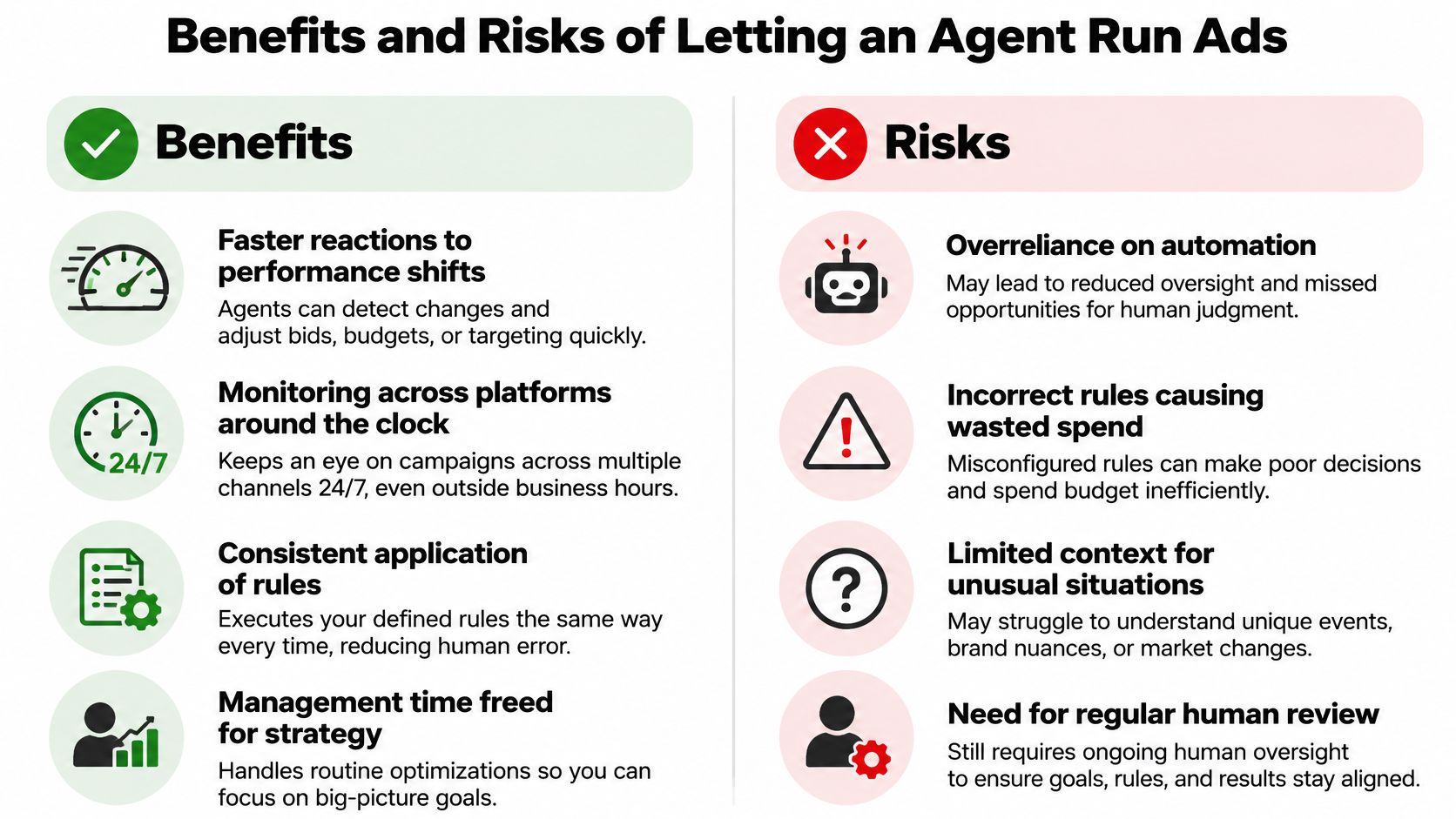
More freedom isn't automatically better. Once the agent can act, four failures show up fast.
- Hard-to-explain moves: Budget shifts with no reason a client can read.
- Mis-set rules: A ceiling typed wrong, then spent before lunch.
- Unsafe placements: Ads beside content the brand would never buy by hand.
- Stale patterns: Optimization toward history that stopped matching this week.
Platform automation is already widespread, and visibility hasn't kept up. Among surveyed advertisers, Google Performance Max adoption reportedly rose from 60% in 2024 to 71% in 2025, while critics have pointed to limited visibility into targeting, placements, and optimization decisions, as covered by exchange4media. Meta's advertising terms still place responsibility for ad content, targeting, and placements on the advertiser, even when generative tools help produce the ads.
A short discussion of that ownership gap is worth watching before you write the approval rules.

"If the agent makes the decision, who owns the mistake?" The workable answer is narrow. One accountable owner per account. A written list of decisions the agent may take alone. A human signature above a spend threshold. Logs that show what changed, why, and who allowed it. Controlled autonomy beats maximum autonomy because the owner can still reconstruct the week.
Integration and Security Checks Before Launch
An agent that can't see orders will optimize clicks. An agent with every permission in the company will eventually touch something it shouldn't. Connect only what the job needs, and test it before live money moves.
Three connections, minimum rights
Ad platforms need bid and budget rights on the accounts in the pilot, not on every account in the business. The CRM or order system supplies conversion facts the ad platform doesn't own. Read access is enough for most reporting. Analytics and the reporting destination should receive summaries and flags, not a second copy of every raw event.
For each login, grant the smallest scope that still lets the task run. Reporting can be read-only. Bid changes belong to one account. Creative publishing can wait until the pilot is trusted. Run the same flow in a sandbox, with no live spend, and confirm the agent stops at the approval gate.
Keep an immutable activity log. Each row should store the change, the reason, the data used, and the approver. If you can't replay Tuesday from that log, you don't have an audit trail. Our AI agent governance framework spells out how those limits sit next to the rest of an agent's authority.
What data may cross the boundary
Send only the first-party fields the bid or the budget rule needs. Hash or omit personal identifiers. Cap how personal a message can get. Moderate relevance tends to hold trust better than a message that feels like it knows too much.
We build inside the Claude, ChatGPT, or Copilot tools a client already pays for, connected to the systems that client already runs. Campaign data stays in that existing environment instead of a new one stood up only for the agent.
Confirm this list before the first live dollar.
- Permissions reviewed: Each token matches one task.
- Sandbox passed: The agent queued, didn't publish, and stopped at the gate.
- Logs on: Changes, reasons, inputs, and approvers are stored.
- Rollback tested: You can restore yesterday's bids and budgets.
- Owner named: One person, not a group alias.
- Ceilings set: Monthly and daily spend caps are in the platform, not only in a slide.
How to Roll Out an Online Ad Agent in Four Phases
A reliable rollout is a narrowing of authority, not a big-bang launch. Start with work you can already describe, then widen only after the numbers and the logs agree.
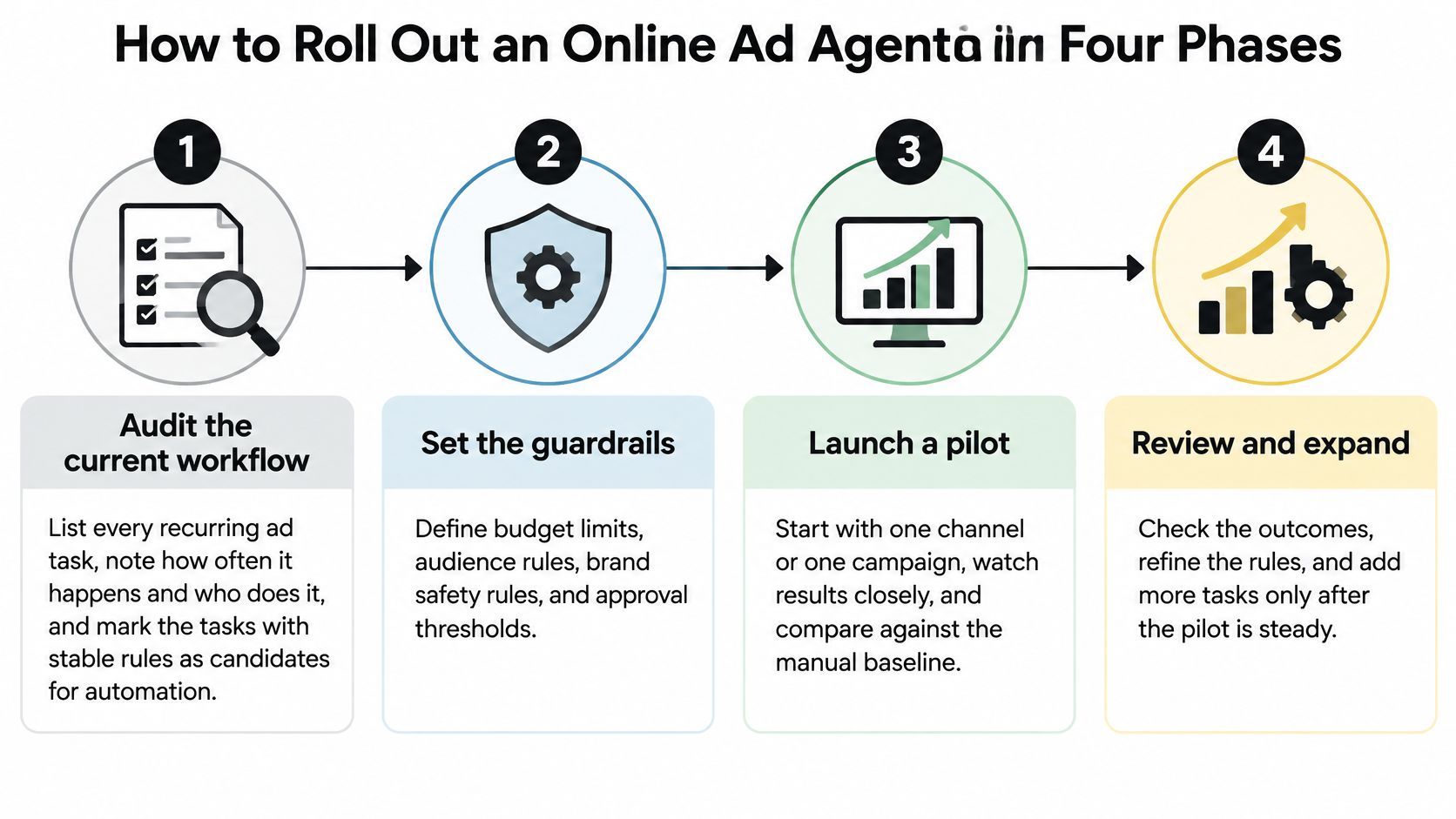
- Audit the current workflow. List every recurring ad task, how often it happens, and who does it. Mark tasks with stable rules as automation candidates. Leave negotiations and brand calls with people.
- Set the guardrails. Write the monthly ceiling, the daily spend cap, the approval threshold, and the placements to exclude before the agent acts. A missing exclusion is how a test campaign reaches a site you'd never buy.
- Pilot one campaign. Give the agent 10 to 20% of one channel's budget. Keep a comparison group the agent doesn't touch. Review after two weeks so a bad rule can't run for a month.
- Expand and govern. Add a second channel only after the pilot hits its targets. Each month, read the logs and rehearse rollback. Expansion without that review just multiplies the first mistake.
Why a two-speed controller holds up
Auction markets are large and they don't sit still. AuctionNet, a benchmark from a real advertising platform, contains 10 million ad opportunities, 48 auto-bidding agents, and more than 500 million auction records. Offline replay can overestimate results once an agent changes prices, win rates, pacing, or the inventory it wins. The pattern that survives that test is a two-layer controller. A fast bid policy acts at auction time. A slower supervisory policy reallocates budget and updates goals as performance shifts.
A replay of last month's auctions is not a forecast. The moment your bids change, the other bidders change too.
Our AI Consulting service sits with your team, audits the workflows, designs the agent architecture, builds it, trains it on the business, and deploys it into the systems and channels you already use. The sequence of that build is laid out in our AI implementation roadmap.
KPIs and Quick Wins That Prove Real Lift
Platform-reported conversions often include sales that would have happened with no ad at all. An agent can "win" on those numbers and still add no revenue. Judge it on incrementality, cost, and whether spend landed on the plan you approved.
| KPI | What it measures | Good direction | Review frequency |
|---|---|---|---|
| Incremental conversions | Conversions above a holdout group | Higher | Weekly |
| Cost per acquisition | Spend divided by conversions | Lower | Daily |
| Marginal ROAS | Revenue from the last unit of spend | Above 1 | Weekly |
| Frequency | Average exposures per user | Within the cap | Daily |
| Spend pacing | Budget used against schedule | On plan | Daily |
Incremental conversions answer the only commercial question that matters: did the agent cause orders the holdout didn't get? Cost per acquisition tells you the price of what you did buy, including sales you might have gotten free. Marginal ROAS checks the last dollar, not the average of the easy dollars. Frequency catches a bid policy that hammers the same people. Spend pacing catches a rule that fronts the budget.
Why the platform number misleads
Measurement is harder under privacy limits, model-based attribution, and bias in platform-reported results. One review in the Journal of Marketing Analytics reports that differential privacy reduced precision by 2 to 33%, while federated approaches retained about 90 to 95% of centralized performance in documented deployments. You can protect data and still measure, but you should expect a wider error bar and say so in the readout.
Three moves you can make this month:
- Hold out 5 to 10% of the audience so incremental conversions have a baseline that never saw the agent.
- Cap bid changes per day so one bad afternoon can't rewrite the whole account.
- Reconcile platform conversions with first-party orders every week, and investigate any gap past the threshold you agreed in advance.
Choose Your First Online Ad Agent Pilot
Start with a hybrid agent unless spend is small and brand risk is high.
Keep the first pilot to one channel and one campaign, with a daily spend ceiling and one named owner. Watch incremental conversions, cost per acquisition, and spend pacing before you add any other score.
Do these three things this week.
- Write the approval threshold, including the dollar amount that always needs a person.
- Pick the pilot campaign, ideally one with stable rules and enough volume to read in two weeks.
- Schedule the two-week review now, with the owner and the log in the same meeting.
Our consulting path audits the workflow, designs the architecture, and deploys the agent into tools you already run. Teams that want to operate agents themselves can use our self-serve platform. You can subscribe in under a minute, connect your channels, and have agents on real workflows before the day ends. The Setup Checklist, Day-of-Call Prep, First Week, and Extending Your Agent guides cover those first days.
Cyndra installs online ad agents that work inside the ad platforms, CRMs, and AI tools your team already uses, with approval limits and logs so a person still owns the spend. If you want that first hybrid pilot designed around your accounts rather than a generic automation tour, start with a conversation on Cyndra. Bring one campaign, your daily ceiling, and the name of the owner who will sign off.